




We may earn a commission when you buy through links on this page. It never changes what we recommend. How we pick
On this page8 parts
- What Gooseneck Kettle Temperature Control Does, and What It Only Reports
- The Window the Water Has to Hit, and the Ceiling Your Kitchen Sets
- Why the Display Is Not the Water at the Grounds
- Presets and Hold Are for the Rinse and the Second Cup
- What Month Two Does to the Sensor, the Element and the Reading
- Which Part of the Control Is Worth Paying For
- Preheat the Dripper, Probe Once, Then Taste
- Frequently Asked Questions
You set the dial to the number a guide recommended, the display agrees, and the cup still comes out thin and a little sharp, which is the taste of water that was cooler than you thought. Gooseneck kettle temperature control is a thermostat: it cuts the heat at the number you pick and, on some models, keeps cycling the element to hold it there. What decides the cup is the temperature of the water when it reaches the grounds, and the sensor in the base is not standing there. This guide covers what the control does and what it only reports, the window the water has to hit, the ceiling altitude sets, why the display is not the coffee bed, what presets and hold are for, what months of use do to the sensor, and which part of the control is worth paying for.
Quick Answer
Gooseneck temperature control is a thermostat that stops the heat at a number you set and, on some models, holds it. The number that decides the cup is the water at the grounds, 195–205 °F (90–96 °C), and the base does not read there. One probe reading proves the offset; a preheated dripper closes the rest.
What Gooseneck Kettle Temperature Control Does, and What It Only Reports
A kettle can control the heat, report the heat, or do neither, and the listings use one phrase for all three. A thermostat that stops the water at your number is one thing, a display that shows a number is another, and a spout that pours well is a third. The five kettles in this guide sit at different points on that line, and placing them there shows what each phrase on a listing is really promising.
A set point and a hold: the thermostat in plain words
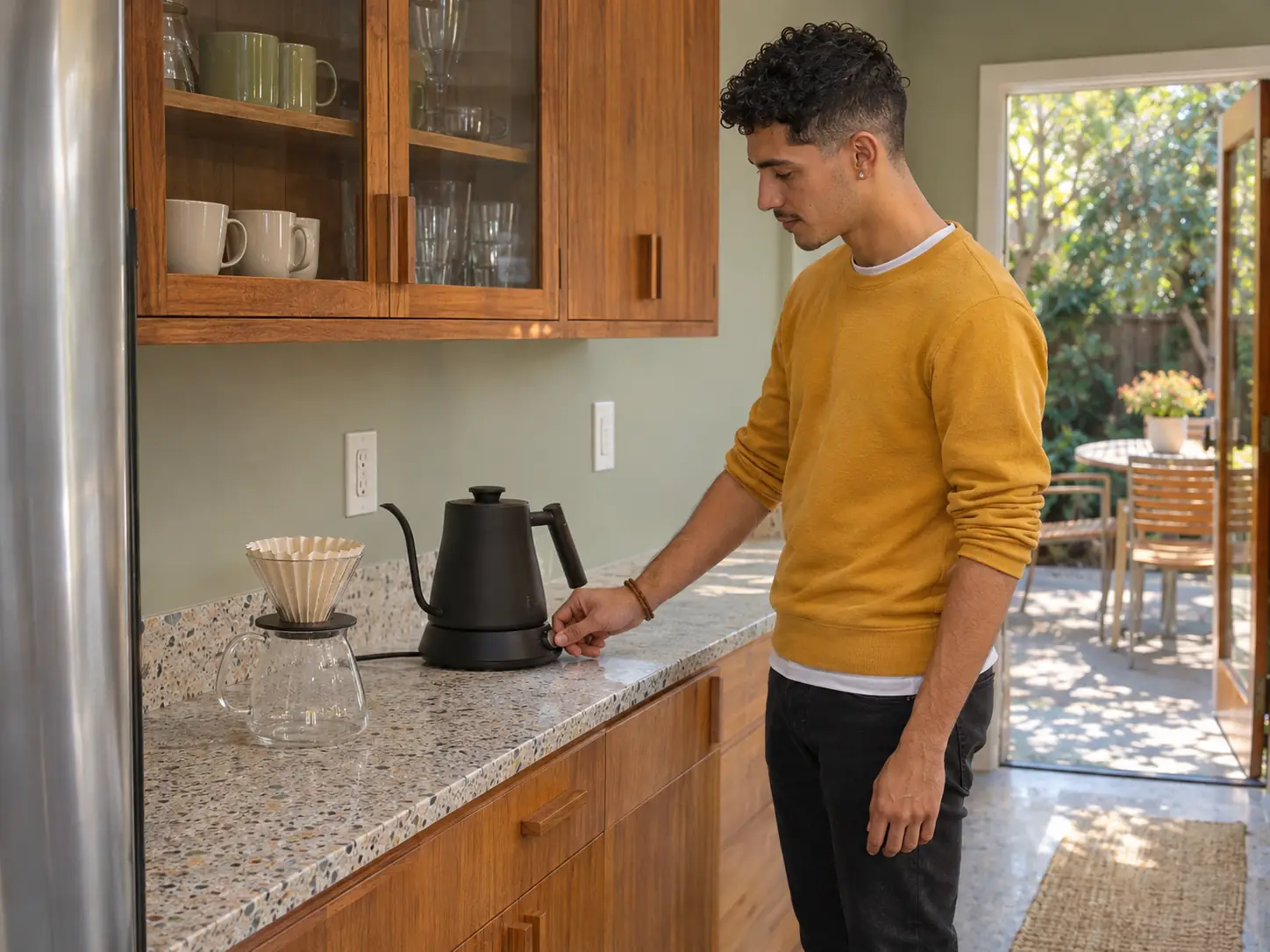
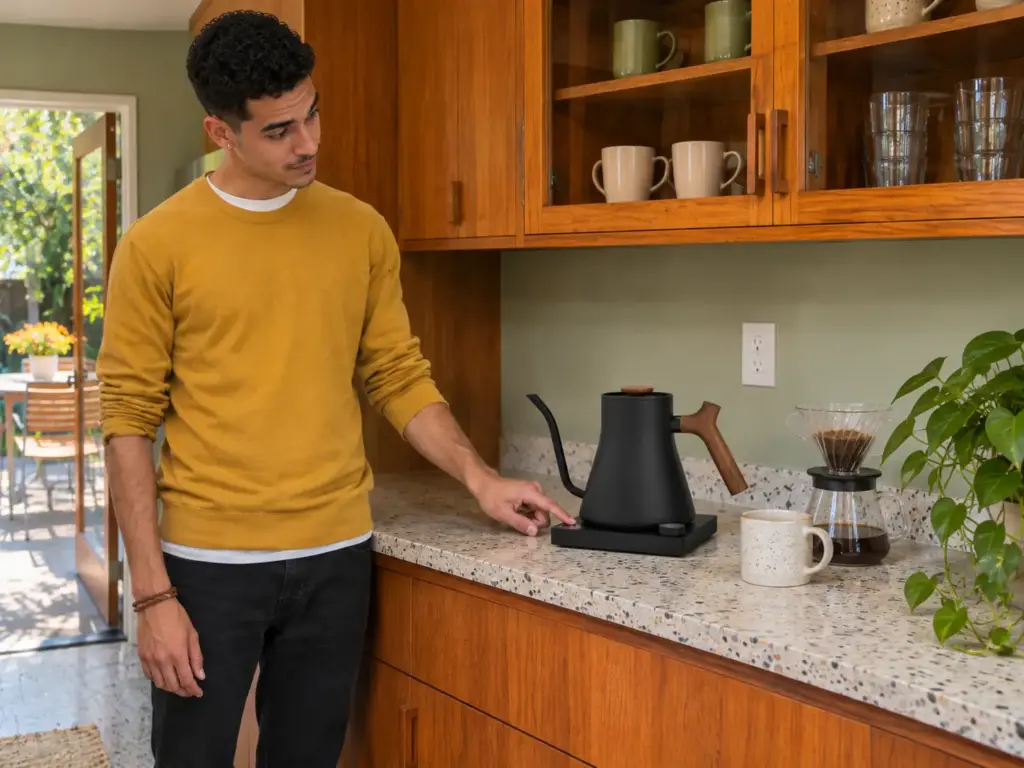
A set point is the number you choose, the target temperature. The kettle reads a sensor, and when the water reaches that number the thermostat cuts the element; a hold (some listings say keep warm) keeps the element cycling on and off to stay near it. That is the whole mechanism, and the word smart on a listing adds neither.
Fellow states to-the-degree control with a temperature hold, Bonavita states 1-degree steps, and OXO states 1 °F increments: each is the maker’s statement for that model. Whether a gooseneck suits your brewer at all is a question one step earlier, covered in whether a pour-over reader needs a gooseneck in the first place.
The one menu entry that tells the truth about all of it is the altitude setting on the Fellow. Water cannot be hotter than its boiling point, so at height a set point above that boiling point is a request, not a delivery. Hold that thought until the next section, because it caps every number on every dial.
And one detail you meet at the counter: the base clicks, the digital display shows the number, and the water at the spout lip has not caught up with it yet. The next two sections pick that up.
A kettle that only boils, named beside the ones that control
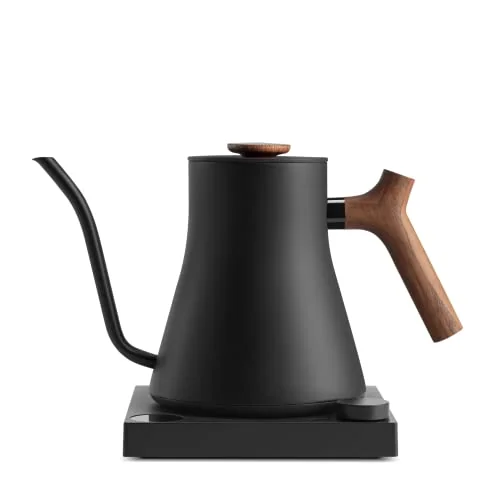
The BALMUDA The Kettle is easy to file with the controlled kettles by looks alone, and it has no temperature setting at all. It holds 0.6 L (about three cups), has a precision spout (pour control and flow rate, nothing to do with temperature) and a neon power light, and boils, then stops. Its flaws are plain: no control, small, and a wobble on its base. What it proves is that the spout and the thermostat are two separate purchases, and a kettle can pour like a gooseneck while knowing nothing about 200 °F.
The stovetop way: a gauge, a probe and your own timing
The other way to manage the heat has no electronics. The Hario V60 Buono stovetop is the pour most electric goosenecks copy: a 1.2 L stainless kettle that is best filled to about 800 mL, with a plastic handle, no thermometer, and a base that works on gas, electric or induction.
The temperature belongs to your eye, your timing and a probe. Its flaw is how the steel ages, because rust can start inside the kettle, a failure no electric one can suffer. How a stovetop gooseneck behaves on gas, glass-top and induction is laid out in a stovetop gooseneck on gas, glass-top or induction.
The three ways, a variable temperature kettle, a boil-only electric gooseneck kettle and a stovetop gooseneck kettle, in the terms that matter for the cup:
| Way of managing the heat | What it does | What it cannot tell you | Who it suits |
|---|---|---|---|
| Set-point thermostat (electric, temperature control) | Stops the element at the number you choose; a hold cycles it to stay there | The temperature at the grounds, because it reads the kettle | The pour-over reader who wants the number repeatable every morning |
| Boil-only electric | Heats to the boiling point and shuts off | Anything below the boil, since there is no number to set | The reader who rests the boil and adds a probe |
| Stovetop with a probe | Heats on gas, electric or induction while you read a gauge or a probe | Nothing it controls: you supply the temperature and the timing | Someone who wants no electronics and will watch the water |
The Window the Water Has to Hit, and the Ceiling Your Kitchen Sets
A thermostat is only as useful as the number it is told to reach, and the standard says both what that number is and where it is measured. The window is set at the coffee, never at the base, and a kitchen’s elevation can lower its top edge before the kettle does anything. Three short stretches cover the window, what a few degrees do inside it, and the ceiling.
195–205 °F at the grounds, and who sets it
The Specialty Coffee Association writes its brewing requirement for machines: the brewer has to reach 92 °C within the first minute, stay at or above that for the rest of the cycle, and never go past 96 °C. That is 198 to 205 °F, measured at the coffee from the first minute, so it describes the water in the bed and says nothing about a dial.
The wider framework is on the SCA’s published brewing standards. Pour-over readers borrow that window and stretch it a little, to 195–205 °F (90–96 °C), and the SCA does not certify kettles, so treat the range as a working band built around a brewer’s standard. The same band carries over to a Kalita Wave, and to a French press or an AeroPress. How it plays out for each method sits one step back, in what water temperature coffee should brew at.
What three degrees change, and what they leave alone
Three degrees sounds like a lot until a panel tastes it. A peer-reviewed trial from the UC Davis group brewed the same coffee at 87, 90 and 93 °C (189, 194 and 199 °F), held strength and extraction constant, and analyzed 31 attributes. In the authors’ words, “surprisingly the brew temperature had no appreciable impact.” The full trial is in the brew-temperature trials from the UC Davis coffee group, and strength and extraction drove every difference the panel did find.
Temperature still matters through extraction. Cooler water pulls less from the grounds (under-extraction), so the cup leans thin, weak and sour; hotter water pulls more (over-extraction), so it leans bitter, dry and astringent. A cup that is just flat is usually the grind or the dose talking.
But the grind and the dose move extraction further than a degree does, and cooler water simply needs a finer grind to reach the same place, as the pour-over grind that moves the cup further than a degree does explains. So the order for a cup that is off runs grind first, temperature second, and a kettle set three degrees away from the target is rarely the reason. The direction of each five-degree step is mapped in how each five-degree step shows up in the taste.
Why a kettle in Denver cannot hold 205 °F
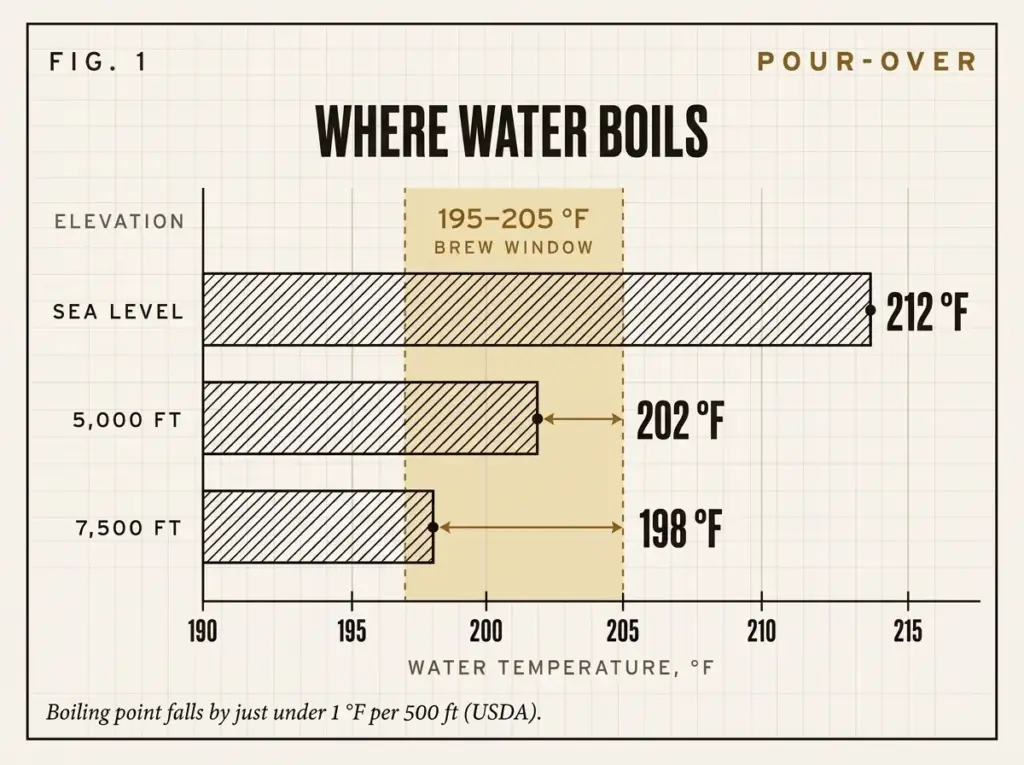
The ceiling is physics, and the USDA puts a number on it: “With each 500-feet increase in elevation, the boiling point of water is lowered by just under 1 °F.” That figure comes from the USDA’s high-altitude cooking guide. Sea level boils at 212 °F, 5,000 feet at about 202 °F, and 7,500 feet at about 198 °F. At Denver’s elevation of roughly 5,280 feet, a kettle set to 205 °F stops at the boil, near 201 °F, and no menu setting changes that.
A kitchen where water boils at 203 °F has a dial whose last few degrees are numbers the kettle cannot physically reach, and a kettle that announces 100 °C there is announcing its setting rather than the water. Boiling at 201 °F still sits inside the window, so altitude costs you the top of the dial and not the cup. An altitude entry in the menu, like the Fellow’s, is the kettle saying so.
Why the Display Is Not the Water at the Grounds
The sensor reads the kettle, the coffee sits one spout-length away, and between them the water loses heat the base never sees. That is the hand-off from the first section, and it is where most of a cup’s temperature goes missing. Free fixes come before any purchase here, and a probe settles the rest.
Where the heat goes between the base and the bed
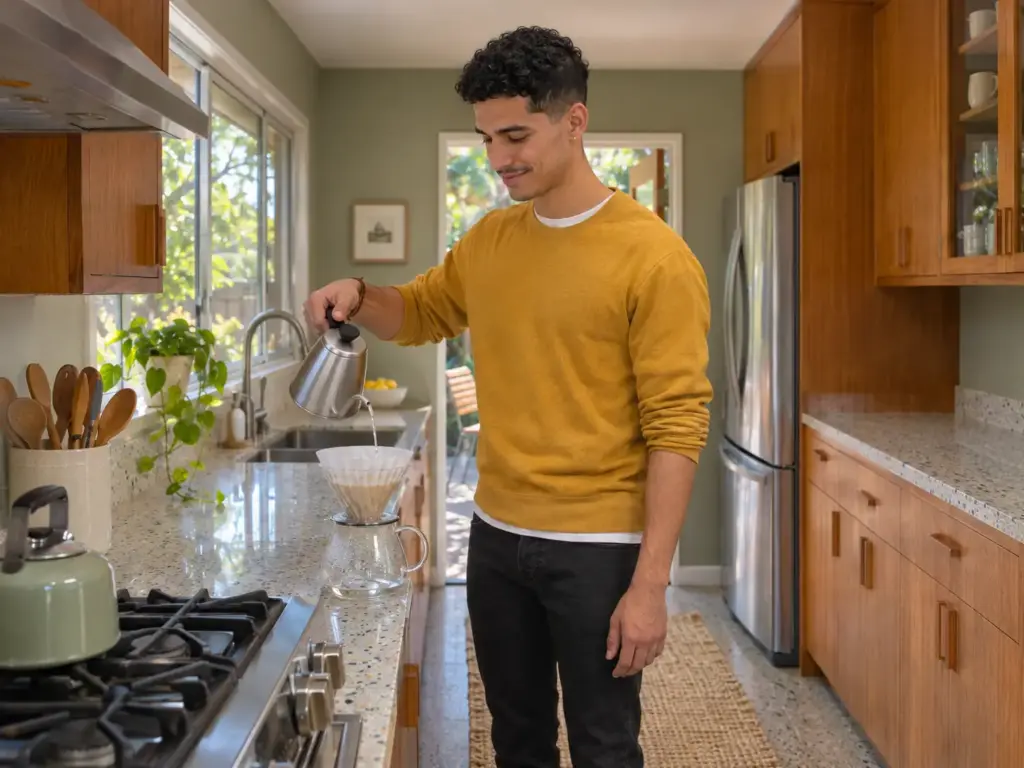
The sensor sits against the base and the wall of the kettle, not in the stream. The water leaves the spout cooler than the base reads, loses more as it wets the grounds, and a cold dripper and server take another share. The number that decides the cup is the water temperature at the grounds, the one at the bed, and it is measured, not read. Once the water has wet the coffee, the slurry temperature is lower again.
Two kettles from different brands can sit about six degrees away from a probe in the same water, and the difference widens on a low fill, where the element’s heating ramp overshoots the set point before the thermostat catches it. Picture the minute the probe reads 199 °F while the base shows 205 °F: the brew is already running on whatever the water actually was.
The free fix: a preheated dripper and a rested boil
Start with the dripper. Rinse the filter paper, then preheat the brewer: fill the dripper and the server with hot water and tip it out, so the coffee does not hand its heat to cold ceramic or glass. Brew the usual recipe and taste: if the last cup leaned thin and sour, this one should come out a notch fuller and sweeter, and if nothing moved, go on to the next fix.
The second is for a kettle with no thermostat: rest the boil for 30 to 45 seconds before the pour (what that does is covered in what a rested boil does for a kettle with no thermostat), then taste again. A rest stretched far too long drifts back toward thin and sour. Third, keep the kettle reasonably full, since a small volume takes the element’s heat harder and overshoots more. Only after those three is a purchase on the table.
Preheat the server before the dripper, not after. The server holds the finished coffee for longest, so a cold one pulls the temperature of the whole cup down while you are still pouring.
Prove the offset once with a probe, then set the kettle by it
Stir the water and let it settle before reading, because a probe left in an unstirred kettle finds the hottest layer near the element. Then take one reading with a probe thermometer in the pour itself and compare it with the base (the steps are in how to read the water with a probe). When the kettle is always off by the same amount, treat that as an offset: if the probe reads six degrees under the base, set the base six degrees higher, and if it reads six over, set it six lower. I would trust the probe over the dial every time, and the one limit is the boiling point from the last section.
Write the offset on a strip of tape under the base once the probe has proved it. A number you have to remember is a number you will skip on a busy morning.
The OXO Brew Pour Over Gooseneck suits this routine because it carries a brew timer on the base beside the temperature, the pair of numbers a pour-over needs. It steps 1 °F from 104 to 212 °F, holds for 30 minutes and takes a 1 L fill. Its flaw is durability: units can break within a year, so a probe check in month one is worth doing early. The timer sits next to the scale that sits under the pour as the other instrument of the routine.
The cheapest version of all needs no thermostat: a boil-only kettle plus an inexpensive instant-read probe makes the probe the instrument and the kettle only the pour, a route laid out in the boil-only kettle plus a probe route.
Presets and Hold Are for the Rinse and the Second Cup
Presets and hold are real features, and neither one comes with instructions for when it earns its place. A preset is a shortcut and a hold is a patience tool, and neither reads the water at the coffee. Used for the right job, though, both save a trip back to the dial.
A preset is a shortcut to a number you still have to prove
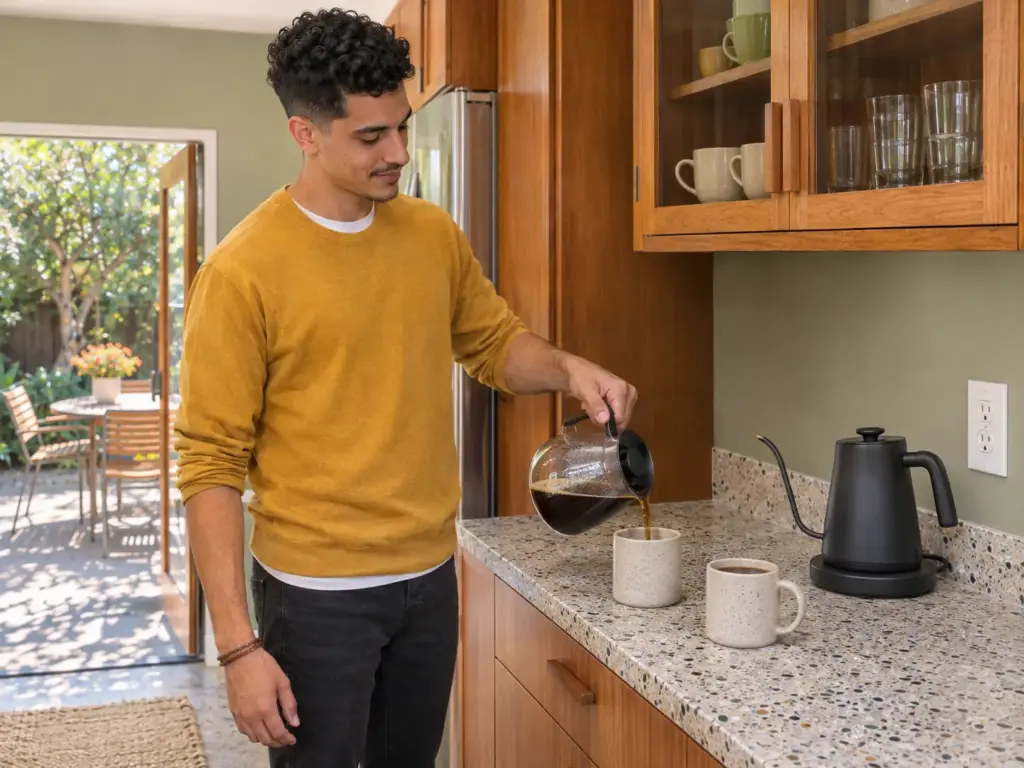
A preset is a stored number and nothing more. The one worth using is the coffee preset a maker offers, but it inherits every error from the last section: it is the display’s 205 °F, not the bed’s. Once the offset is proved, six preset buttons and a free dial reach the same water, so choose a preset only when it lands on your corrected number, and otherwise dial the number you need.
What a hold is for: the filter rinse, the bloom and the second cup
A hold keeps the water near the set point after it arrives by cycling the element. By the makers’ own figures, Bonavita holds for up to 60 minutes and OXO for 30, and Fellow lists a temperature hold with no stated duration. It exists for the filter rinse, the wait through the bloom and a second cup; the first pour is the one that needs the number, and a hold that runs an hour is the same element cycling to stay there. The second cup forty minutes after the rinse comes from water the kettle has been holding since, and it deserves a probe glance before the dose goes in.
The Bonavita 1 L Digital Variable Temperature is the kettle that makes this worth explaining, with 1 °F steps from 140 to 208 °F, six presets, a hold of up to 60 minutes and about five minutes to a boil. That is the widest preset set and the longest hold of the five, and the range tops out at 208 °F, which still covers the whole coffee window. Its flaw is longevity and arrival: some units never reach the set temperature, and elements can stop somewhere between five and ten months.
Set the hold to cover the rinse and the bloom, then stop leaning on it. After half an hour of holding, pour out a splash and probe the water before the second dose goes in.
The ceiling no app removes
A kettle that preheats from a phone still cannot read the temperature at the bed. The app moves the moment the water starts heating, and it leaves untouched the heat lost between the spout and the grounds. The altitude menu is the honest version of the same limit: both say the number on the screen is the kettle’s, and the coffee’s is a separate measurement.
What Month Two Does to the Sensor, the Element and the Reading
The pour is the same on day sixty, and the reading is the part that stops being trustworthy. Scale builds where the water is heated, a sensor that was fine in week one starts to drift, and the failures that end these kettles are almost all electrical. This section names the mechanism, gives the free proof and says where these kettles fail.
Scale on the element and the sensor turns a reading into a guess
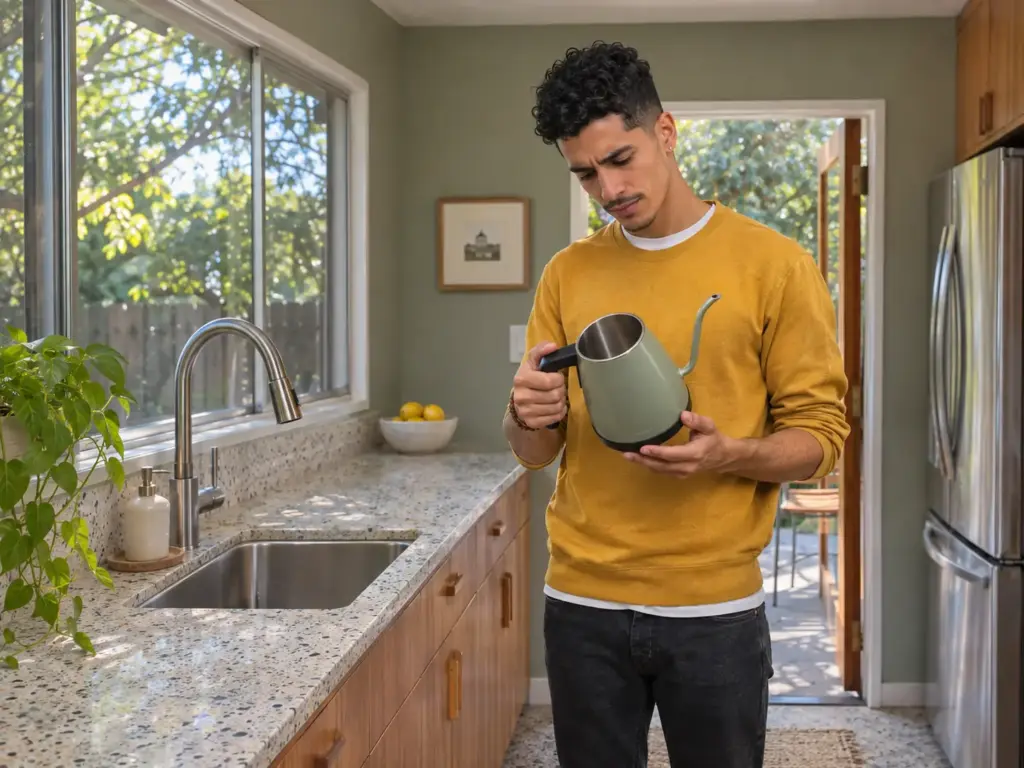
Scale (limescale) forms on the element and around the sensor wherever the water is hard, and it insulates both. The reading that agreed with the probe in week one drifts, and that temperature drift turns the number on the base becomes an estimate again. Say the base matched the probe in January and stopped matching it some time before a crust ring showed at the bottom in February: the drift started before the ring was visible. How much a given tap leaves behind is laid out in what tap water leaves behind.
The check that costs nothing: boil hard and read the probe
First check the probe itself with the ice water check: a glass of crushed ice with a little water should read 32 °F (0 °C), and that is the calibration. Then boil the kettle hard, read the probe in the water, and compare it with the boiling point for your elevation from the last section. Then compare both with what the base claims. It takes a minute and costs nothing, and it separates a kettle that still tells the truth from one that has started guessing.
Where these kettles fail, and the repair that is cheap
Failures cluster between five and twelve months and they are electrical: the element, the base, the switch. They are rarely cosmetic. A kettle dead at five months, another at ten, a third that breaks inside a year, and a premium one whose readings are never quite confirmed by a probe are the shapes this takes, and rust inside is the one failure a stovetop can suffer that an electric cannot.
The repair is cheap. Read the maker’s manual first, because its instructions come before anything here. Then a descale with citric acid at about a tablespoon per liter, one boil and a rinse clears the scale, and a 50/50 soak of vinegar and water does the same. Ten minutes once a month keeps the number honest in hard water.
After any descale, boil one fill of plain water and tip it out before the first brew. A rinse that skips that step can carry the cleaner into the cup.
Which Part of the Control Is Worth Paying For
After the window, the offset, the hold and the months, the question is which part of a control is worth the money, and which reader needs none of it. A spec sheet is where that gets decided, and most of its lines do less work than they appear to.
The claims worth checking on a spec sheet
Accuracy to the degree is a maker’s claim per model, and the only check that counts is one probe reading.
The top of the preset range matters, because Bonavita states 140–208 °F and not 212 °F, and a coffee window ending at 205 °F does not need the ceiling. Hold length runs from 30 and 60 minutes to none stated.
Capacity is the quiet one: 0.9 to 1.0 L is the usual precision size and suits one to three cups, and the BALMUDA’s 0.6 L is the outlier. On materials, the makers state stainless steel or borosilicate for the interior, and that describes the kettle’s interior and nothing else. The spout and the stream belong to the pour pages, so one clause is enough here.
Three ways to run the same pour
A set-and-hold kettle lets the control do the number. A boil-only kettle plus a probe makes the probe the instrument and the kettle only the pour. A stovetop gooseneck plus a probe and a rested boil does the same job with no electronics at all.
No official standard says a variable-temperature model beats a stovetop and a thermometer; what holds up is that a set point is repeatable, a gauge is read by eye, and an inexpensive probe closes the gap either way. Which of these kettles to buy, and what fails first on each, is the job of the kettles worth buying and what fails first on each.
When the kettle is not the answer
If the coffee comes from a drip coffee maker, a kettle control fixes nothing, because the machine already heats and holds the water. What the machine does to the temperature is covered in what temperature a drip machine really brews at, and the machine worth choosing for its heat before its features is in a drip machine picked by its heat before its features.
Preheat the Dripper, Probe Once, Then Taste
A control is a thermostat and a hold, and the cup is decided at the grounds. The window is 195–205 °F, and no kettle clears the boiling point of the kitchen it stands in. The free fixes (a preheated dripper, a rested boil, one probe reading) come before any purchase, presets and hold are for the rinse and the second cup, and the reading is the part that fails first, so it gets checked.
After a season of hard-water boils, or the first time the kettle takes noticeably longer to reach its number, boil it hard once and read the probe against your elevation’s boiling point. If the base no longer agrees, descale and set the offset again.
For tomorrow’s cup, preheat the dripper and the server, take one probe reading at the pour, and taste before touching anything else; if the cup is still off, move the grind before you move a degree. When you are ready to pick a kettle, the kettles worth buying and what fails first on each is the page to open next.
Frequently Asked Questions
01Does gooseneck kettle temperature control keep the water hot until I pour?
A hold function does, up to the maker’s limit: Bonavita states up to 60 minutes and OXO 30 minutes. It is built for the filter rinse and a second cup, and it does not read the temperature at the grounds.
02Why does my kettle’s display say one number and my thermometer another?
The sensor reads the kettle itself, not the stream, and a low fill or the element’s heating ramp can overshoot the set point. Stir the water, fill the kettle properly and read it with a probe; two kettles from different brands sat about six degrees off one.
03What temperature should I set a gooseneck kettle to for pour-over?
Aim for 195–205 °F (90–96 °C) at the grounds, a window built around the SCA’s 92–96 °C brewer requirement. Prove your kettle’s offset once with a probe, and at altitude the local boiling point is the ceiling, not the dial.
04How often should I descale a kettle with a temperature sensor?
Follow the maker’s manual first, since the steps differ by model, and in hard water about once a month keeps the reading honest. Softer water stretches it. A citric acid boil and a rinse clears scale around the element and the sensor.
05Is a temperature-control kettle better than a stovetop gooseneck and a thermometer?
No official standard says so. A set point is repeatable and a gauge is read by eye, and an inexpensive probe closes the gap either way; the thermostat saves you the watching, not the measuring.



How did your cup turn out?
No comments yet. Tell us what you changed — and whether the needle moved.