




We may earn a commission when you buy through links on this page. It never changes what we recommend. How we pick
On this page10 parts
- Which Brewers Care Where the Water Lands
- What a Wide Spout Does to the Coffee Bed
- The Free Fix to Try Before You Buy Anything
- What a Gooseneck Kettle Will Not Fix
- The Display Reads the Kettle, Not the Grounds
- Stovetop or Electric, and What Each Costs You in Time
- Month Twelve, and Which Gooseneck to Buy If You Do
- The Flaws of a Gooseneck, Spelled Out
- Pour Slower Tomorrow, Then Test the Hold Later
- Frequently Asked Questions
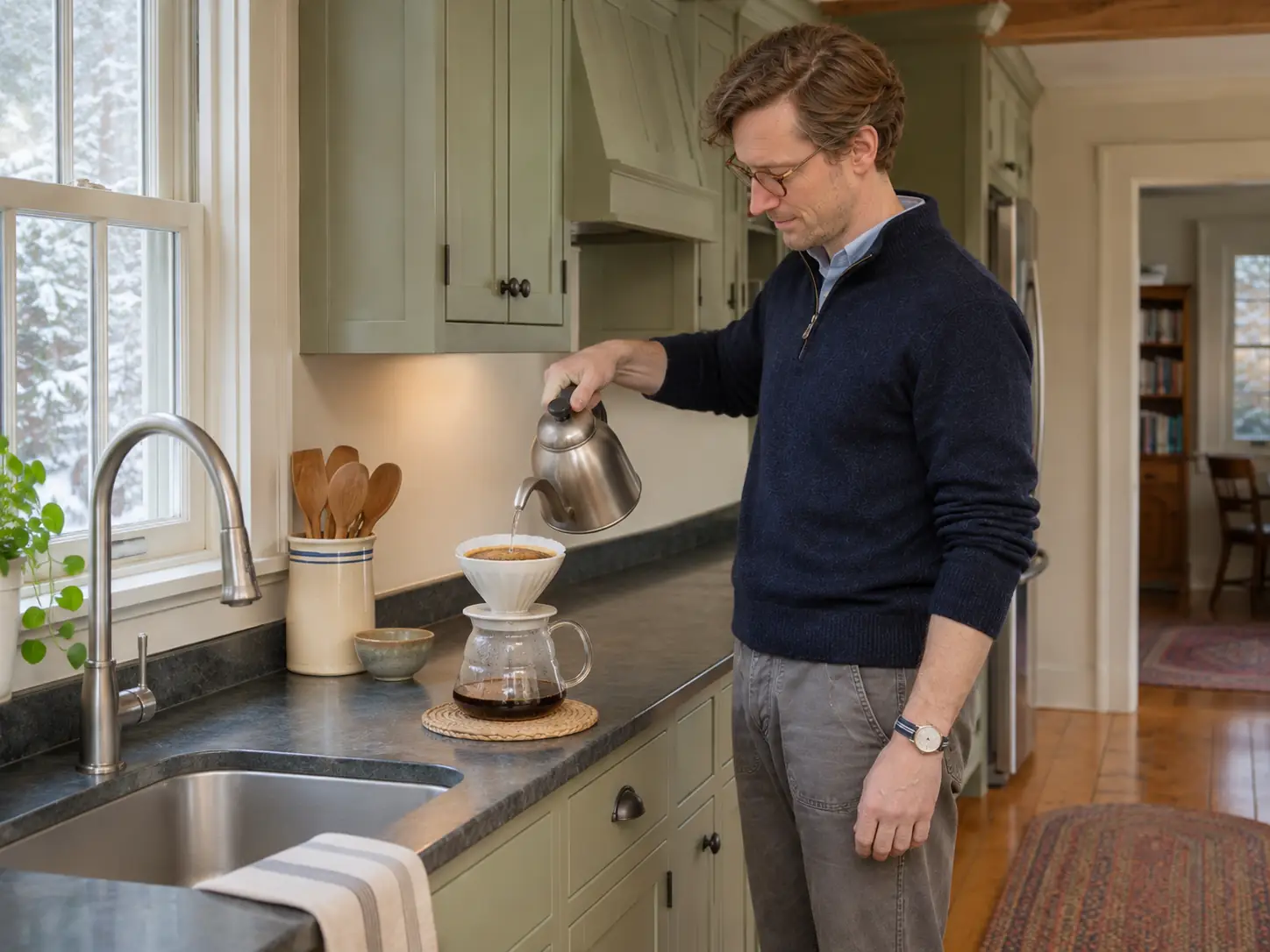
Your pour-over splits down the middle: one sip dry and bitter, the next one thin and sour, and the kettle with the wide spout standing next to the dripper is taking the blame. So, do you need a gooseneck kettle? For a cone dripper the spout is the tool that makes a good pour repeatable, and for every other brewer on your counter the answer is no.
Water that lands in one spot digs a channel through the bed, and the coffee that channel touches is not the coffee the rest of the bed gives up. Below: which brewers care, what to try for free first, what the display on an electric kettle does and does not know, and what is likely to fail by month twelve.
Quick Answer
Yes if you brew with a V60, a Chemex or a Kalita Wave, where a thin, steady stream keeps the coffee bed evenly wet. No for a French press, an AeroPress, a moka pot or a drip machine, which put the water in before a pour could matter. The spout buys pour control, and flavor only follows from that.
Which Brewers Care Where the Water Lands
Brewers split into two camps. Percolation brewers, the cone drippers with a paper filter, take their water in a slow pour onto a bed of grounds and depend on where every ounce lands. Immersion and pressure brewers get all their water in before a pour could matter, so the spout never enters the question.
Pour-over: V60, Chemex and Kalita Wave
In a V60, a Chemex or a Kalita Wave, the water passes through the bed once, on its way down, and the grounds give up only what that single pass reaches. A pour that lands evenly wets every gram of coffee for about the same time. That even saturation is what a pour over kettle is for.
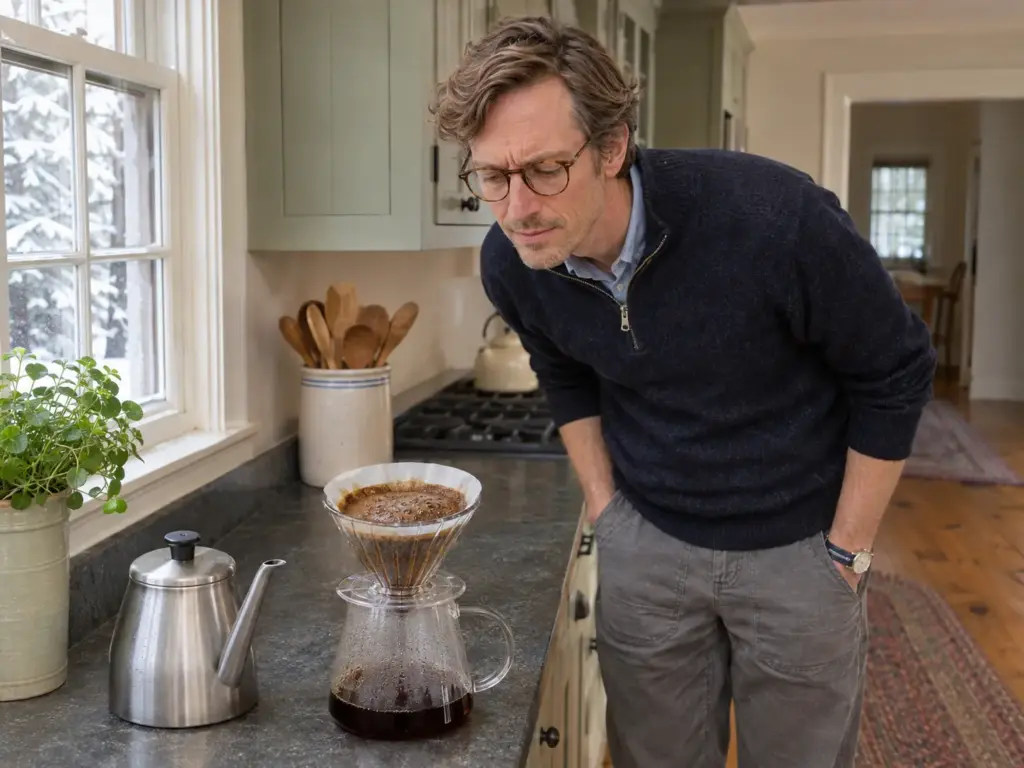
A pour that lands hard in one place does not give it, and the dripper shows it: a crater in the middle and dry grounds climbing the wall. It shows most on a metal cone filter, where nothing slows the water at the walls, and less on paper, which is more forgiving. The same goes for an origami dripper or any other cone. For the V60, the Chemex and the Kalita Wave the answer is yes, with a limit the next sections spend their time on: a gooseneck makes a good pour repeatable, and it cannot invent one.
| Brewer | What the water does | Does the spout matter? |
|---|---|---|
| V60 | Poured in stages onto the bed; flow through the cone depends on where it lands | Yes |
| Chemex | Same pour onto thick paper; the drawdown is slower, so a disturbed bed shows later | Yes |
| Kalita Wave | Poured onto a flat bed; an even pour keeps the bed level | Yes |
| French press | All the water goes in at once and steeps | No |
| AeroPress | Water steeps as one volume, then is pushed through | No |
| Moka pot | Steam pressure drives the water up through the grounds from the base; nothing is poured | No |
| Drip machine | A shower head spreads the water over the bed for you | No |
French press, AeroPress and moka pot
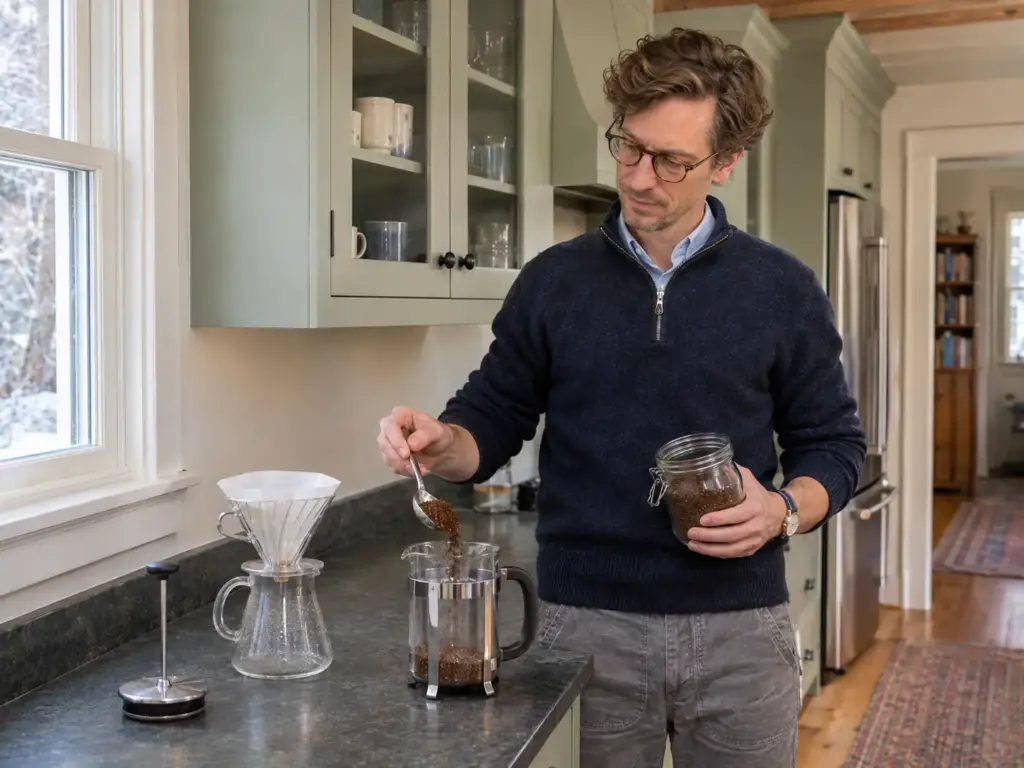
These three put the water in before the pour could matter. A French press steeps every ground in the same pot for the same stretch of time, and an AeroPress does the same for a shorter one and then pushes the liquid through. A moka pot is never poured on at all: it fills from the base. In none of them does it matter where a stream lands, so a gooseneck buys a slower fill and a narrower spout to clean (the French press takes longer to fill and tastes exactly the same).
A drip machine already does the pouring
The shower head on a drip coffee maker spreads the water over the bed for you, so the reader with a drip machine needs no kettle at all. The lever on that counter is the water temperature the machine actually reaches, and how hot a drip machine’s water really gets is worth a look before anything gets bought. If money is going to move, it goes into the machine: a drip machine picked by its water temperature does more for that cup than any spout will.
What a Wide Spout Does to the Coffee Bed
Yes for pour-over still needs its reason, and the reason is water landing in one place too fast. A cup that tastes different from the first sip to the last is the symptom, and it is easy to mistake for the beans. The mechanism is short.
Two settings: a trickle and a flood
A kettle with a wide spout has two speeds, a trickle and a flood, and nothing in between that holds still. The flood digs a hole in the bed, the water finds that hole and runs down a single channel, and the grounds around the channel get wet late or hardly at all.
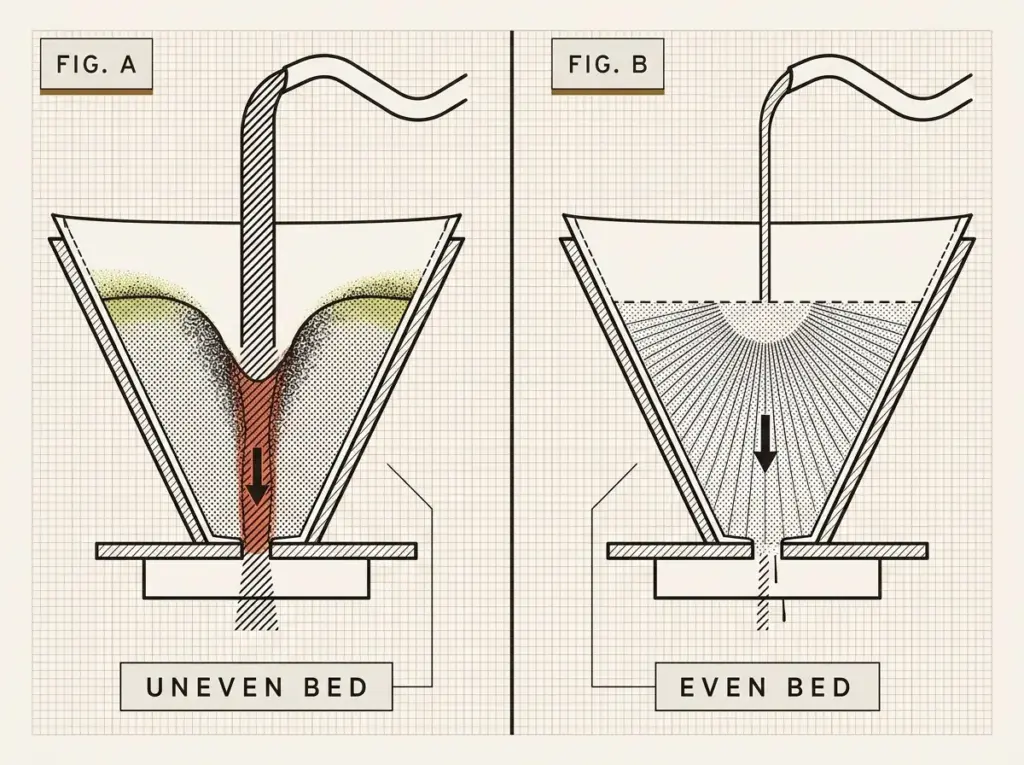
You can hear the difference before you see it. A thin steady stream lands as a quiet line on the bed, and a flood lands as a splash that moves the grounds around.
Which way the cup is off when the bed channels
One cup shows both directions, because uneven extraction happens inside the bed. The grounds along the channel suffer over-extraction, pushed past the 22 % end of the SCA’s 18–22 % extraction zone, and they taste bitter and dry. The grounds the water skipped sit in under-extraction, below 18 %, and taste sour and thin.
That split inside one cup is the tell that the pour is responsible: a wrong grind or a stale bag pulls the whole cup one way. A muddy, blurred cup with little clarity points the same direction, and sweetness only shows up once the bed is wet evenly.
What a narrow spout actually changes
A narrow gooseneck spout makes the slow, thin, centered stream the easy thing to do instead of the hard one, and it lowers the flow rate to something a hand can steer. The water’s temperature stays what it was, and so does its flavor. What changes is the pour rate and its repeatability: the same pour on a Tuesday as on a Saturday, with a tired hand or a hurried one. And that is the whole product.
The Free Fix to Try Before You Buy Anything
Most cups blamed on the spout are a pour nobody slowed down, and a jug with a lip can prove it by tomorrow morning. Four free fixes follow, ordered by how likely they are to work, with a taste between each so you know which one did the job. Skip the order and you will never learn whether it was the speed, the height or the vessel.
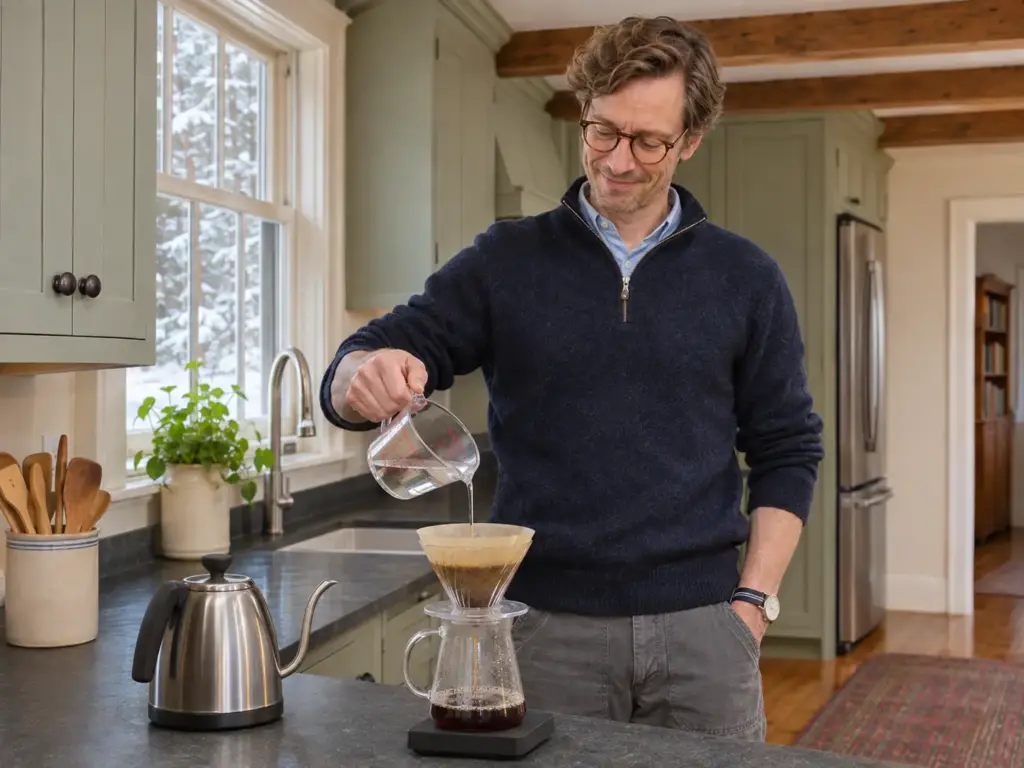
Pour slower, lower and from the middle out
Start with speed. Slow the stream until it is as thin as your spout will make it, brew the same dose the same way, and taste. If the bitter-dry sips and the thin-sour sips have merged into one even cup, you are done and the spout stays on the wish list.
On a metal cone filter, where the bed is easiest to disturb, this fix alone often does it. If the cup is still split, bring the spout closer to the bed so the water lands instead of falling, and taste again. The same gentle hand matters in the bloom pour, the first small pour that wets the bed before the main one.
The last two moves are the path and the stopping point: a spiral pour in concentric circles that starts in the middle and works outward, staying off the filter wall, where water slips past the grounds and down the paper. If it worked, the thin sips fill in and the dry edge fades. If you overshot, the bed stalls and the total contact runs past 4 minutes, and the cup finishes dry. Keep the whole brew time inside 2.5 to 4 minutes.
A vessel with a real lip does the spout’s job
The fourth fix is a vessel with a lip: a Pyrex measuring cup, a milk pitcher, a small beaker, a funnel with a narrow spout, even a small watering can. The lip narrows the stream to a line the way a gooseneck does, and a pitcher or a beaker does it in a kitchen that already has one. Fill it halfway, because a full cup pours in a sheet, and pour from the lip, not the rim; a glass cup’s handle warms long before the water inside has cooled.
Boil in whatever you own, pour into the cup with the lip, wait a few seconds, then pour into the dripper in a thin line. If that cup tastes more even than yesterday’s, the spout was never the problem.
Where the workaround stops holding
A steady hand is a skill, and a skill varies from morning to morning until it has been practiced. The workaround gets most of the way on a Saturday, when you have time and attention. A gooseneck is the tool that makes the same thin pour appear on a rushed weekday with a half-awake hand.
The spout also makes it easy to pour to a target weight, and pouring against a scale instead of by eye is the next skill it serves. If the pour-over happens twice a month, a measuring cup is plenty; if it happens daily, that is where the spout starts paying for itself.
What a Gooseneck Kettle Will Not Fix
Before the kettle, the grinder, the beans, the water and the ratio get their turn, and they are likelier culprits for a flat cup with no acidity or a harsh one. A gooseneck sharpens a pour. It cannot rescue coffee that was set up to fail before the water arrived.
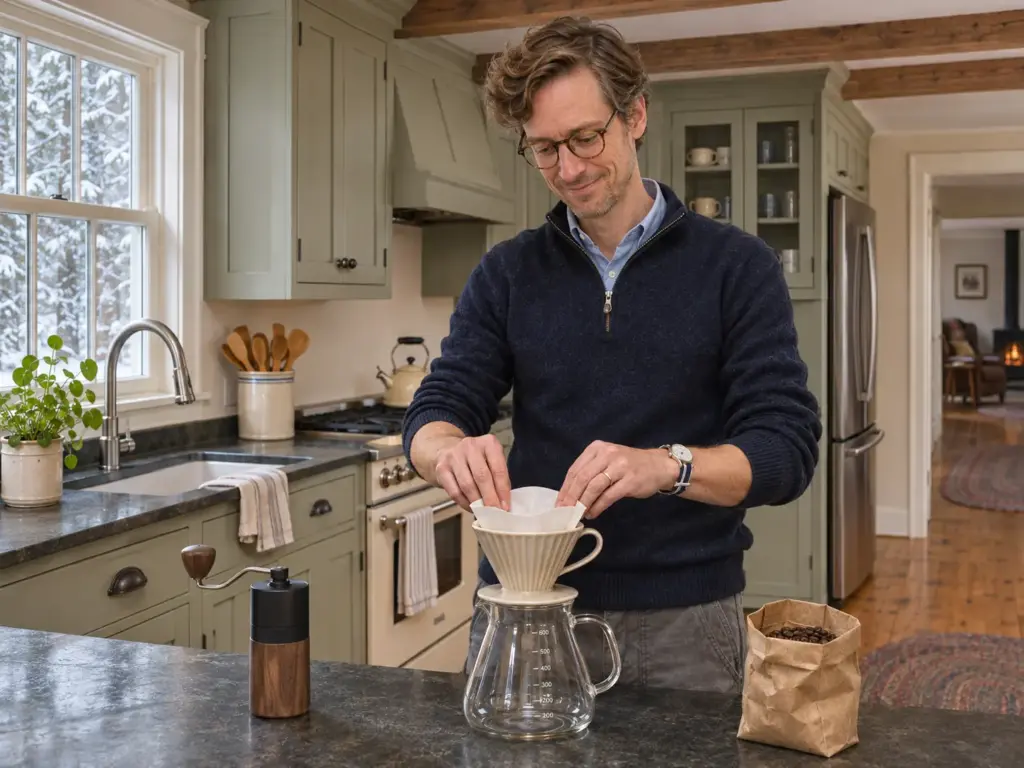
A grind that is too coarse fails a gooseneck too
Hold these numbers before blaming any spout, taken from the Golden Cup Standard: about 15 g of coffee to 250 ml of water (a ratio near 1:16 to 1:17, or roughly 3 tablespoons of grounds to 8½ fluid ounces of water), a bloom with about twice the dose’s weight in water, a wait of 30 to 45 seconds, a total contact of 2.5 to 4 minutes and a medium grind. Extraction should land between 18 and 22 %: under it the cup is sour and thin, over it bitter and dry.
A coarse grind lands under that line however thin the stream is, and a fast pour does the same. The kettle only nudges extraction through temperature. If the cup in front of you is sour or bitter, the one grind-size change that follows a sour or a bitter cup comes before a purchase, and grind sizes for a V60, a Chemex and a Kalita Wave give you the starting point for each dripper.
Stale beans, the ratio and the paper filter
A flat, papery or dull cup points at the roast date and the age of the beans long before it points at a kettle. The brew ratio sits in the same list, and the coffee to water ratio worked out in grams settles it faster than any pour does. The paper filter belongs here too: unrinsed paper flavors the cup, and the rinse water warms the dripper while it washes the paper.
Then there is the grinder. A grinder that makes boulders and dust together gives the bed no even path for water, whatever pours onto it, and which grinder gives a pour-over an even bed is where the first spending goes.
Water that is too hard for any kettle
The SCA’s specification for brewing water asks for water free of odor and chlorine, with hardness between 50 and 175 ppm and a pH near 7. Hard water leaves limescale, and the scale buildup in a narrow spout comes faster than in a wide one because it has less throat to pass through. A kettle that starts to sputter or dribble after some months is often telling you about the water, and what the brewing water should have in it is worth settling while the old kettle is still fine.
The Display Reads the Kettle, Not the Grounds
The best argument for a variable temperature kettle is the dial: set a number, get that number. The temperature that matters is the one at the grounds, though, and no dial reaches there. What follows is the standard, the study behind it, and a check that takes a minute.
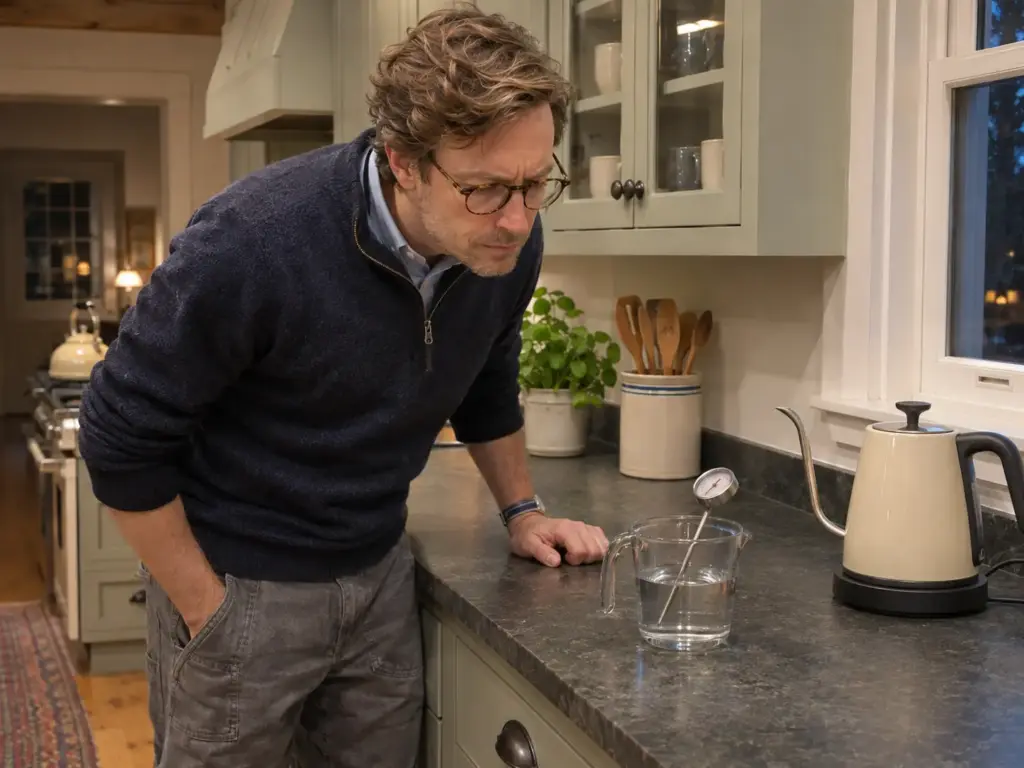
The 195 to 205 °F window, and where it is measured
The Golden Cup Standard puts brewing water at 200 °F ±5 °F (93 °C ±3 °C) at the point of contact with the grounds. For certified drip machines, the SCA’s certified home brewer program says it in one line: “Maintains 198–205 °F throughout brewing for balanced, full flavor.” Both agree, and both measure the water where it meets the coffee. The roast moves where inside that window you aim, darker roasts toward the cool end and lighter ones toward the hot end, and how the roast moves the water temperature you want sits close to what temperature the water should be for coffee as a pair of decisions.
How much do a few degrees matter once the extraction is the same? In the SCA’s brew temperature study, 433 batches and 4,158 cups, the flavor differences from 189 to 199 °F (87 to 93 °C) were mostly insignificant with TDS and extraction held equal, and the line the study draws about the drinkers is plain: “Brew temperature also did not seem to matter to the consumer panel either.” What a few degrees do to the taste is small next to what grind and pour do. Buy the pour control; treat the degree as a bonus.
“To the degree” is the maker’s word. Fellow, Bonavita and Brewista all advertise one-degree steps (the Bonavita’s run from 140 to 208 °F, 60 to 98 °C), and none of them publishes how far the water wanders around the set point during the hold. Read it as a description of the dial.
Why the second pour and the cold dripper read cooler
The display shows the water in the kettle. On the Fellow Stagg, the screen shows the set temperature and the real-time temperature together, and both belong to the water in the kettle.
The slurry temperature, the water as it sits with the grounds, runs cooler, and the gap depends on what the water lands in: a cold stainless vessel or a cold plastic cup takes more out of it than a warm glass one. Then there is the second pour, a minute later from the same kettle. The number on the screen has not moved, and the water under it has.
Preheating gets most of that back. Rinse the dripper and the receiving vessel with the first hot water; a glass dripper held upside down in hot water for five to ten seconds warms the glass itself, which a paper rinse does not do. Whether a kettle needs a dial at all depends on how far the boiling water sits above your window, and letting boiled water rest for half a minute already moves it most of the way.
Check it once with a probe
Do the measurement once, not every morning. Pour a normal pour into a preheated dripper with grounds in it, and read the slurry a few seconds in; measuring the water at the grounds instead of in the kettle walks through the method.
Subtract that reading from the screen’s number and you have the offset of your own kitchen, your own dripper and your own cup, and you now know it instead of guessing. If the reading lands inside the window, the dial was telling you something useful. If it lands below, move the set point up a few degrees and taste.
A probe thermometer through the lid hole does for a stovetop kettle what an electric’s screen only suggests. Pull the kettle off the heat a couple of degrees short of your number, because the water keeps climbing for a moment after the burner stops.
Stovetop or Electric, and What Each Costs You in Time
The real trade is money up front for an electric and attention for a stovetop. A reader with a stove, a drip machine and no room for another appliance has a genuine choice here, and the question is which of the two your mornings can afford.
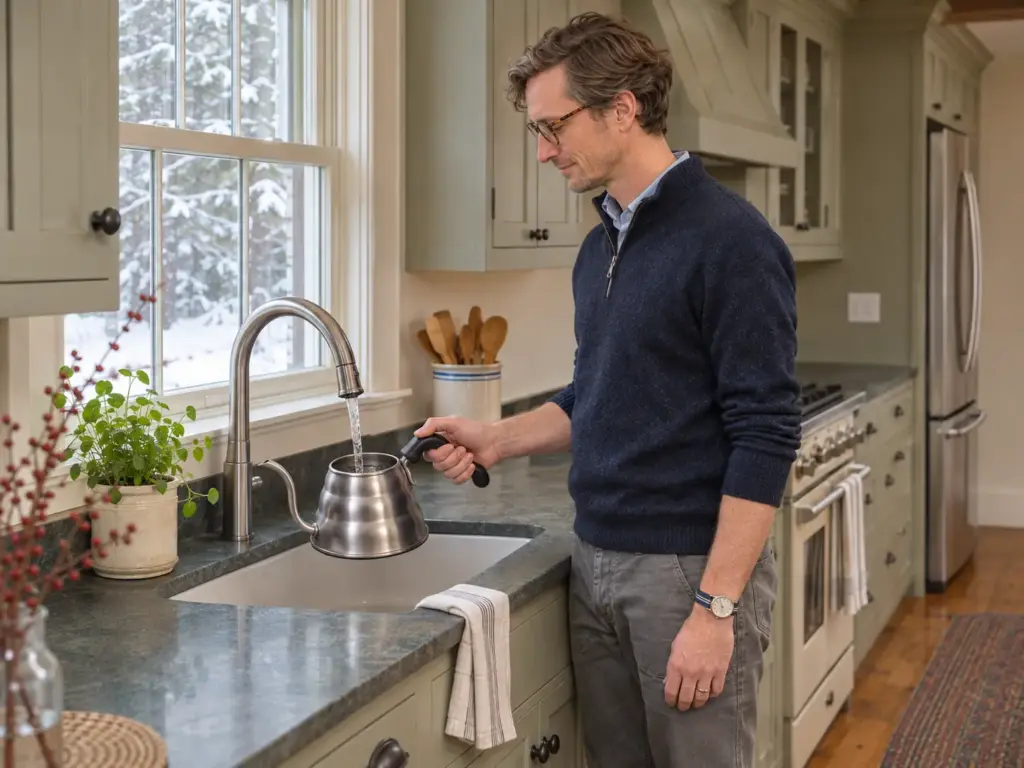
What a stovetop gooseneck gives you and takes away
The Hario V60 Buono Stovetop Gooseneck Kettle is a 1 liter kettle in stainless steel (the Hario Buono) with a long thin spout and nothing else: no screen, no hold, no timer, nothing to burn out. It sits on a burner and doubles as the tea kettle it replaced, at a fraction of what the electrics cost. The temperature job goes to a probe thermometer and your ear, and the steel shell eats heat until it has been preheated. It does not hold temperature, so a long Chemex pour can need a reheat halfway, it is awkward to clean, and rust starting on the inside is the wear to watch for.
That last point corrects a popular claim. Stovetop kettles are cheaper than the electrics, and that part is true, but more durable is only half right: there is no electronics to fail, and there is rust. The free version of this whole purchase is the jug you already own plus a probe thermometer.
What an electric adds, and the minutes it holds the heat
An electric adds a set point and a hold function. The hold runs 30 to 60 minutes depending on the model, which covers a second cup and not a pot (a single 250 ml pour-over uses a quarter of a 1 L kettle). The Cosori Gooseneck Electric Kettle with Temperature Control is the smallest in this field at 0.8 L, with five presets, a 60-minute keep-warm and a 304 stainless interior so the water never touches plastic, which suits a single mug. Reliability varies from unit to unit: some stop within four months, while others run three years.
Rinse the kettle’s own steel with hot water before the real fill. Cold metal takes more heat out of the first pour than anything else on the counter, and that first pour sets the bed.
The tap on the coffee machine as a third option
Some coffee machines carry their own hot-water tap. It gives hot water on demand without another appliance, but it hands you a flow you cannot steer, so it fits tea and a rinse more than a bloom. A coffee maker with its own hot-water tap is worth weighing against a kettle if the counter is already full.
Month Twelve, and Which Gooseneck to Buy If You Do
A kettle is bought in week one and judged in year two. What fails on an electric gooseneck is rarely the shell; it is the heating element or the base, and it fails months in, long after the unboxing. Judge the element first and the screen second.
The hold drifts, the base wears and the spout scales
On electric gooseneck kettles the part that goes is the heating element or the base. On the budget ones it tends to go four to ten months in; on some units of the premium kettle, within weeks; on the middle one, within about two years. The usual picture is a stainless shell standing on a dead base. A stovetop wears the opposite way: nothing electrical to die, and rust inside the steel.
The hold drifts too. No maker publishes a tolerance for it, so a hold that wanders a few degrees after the first months is a pattern of the part and never a spec, and it deserves one more look with a probe.
The narrow spout scales up as well. Hard water leaves a crust in a throat with little room to give, and once the lid gasket hardens the spout can start dribbling down the outside instead of pouring. A kettle that dribbles after a year is more often scale and a tired gasket than a defect.
Three electrics, each with what goes wrong
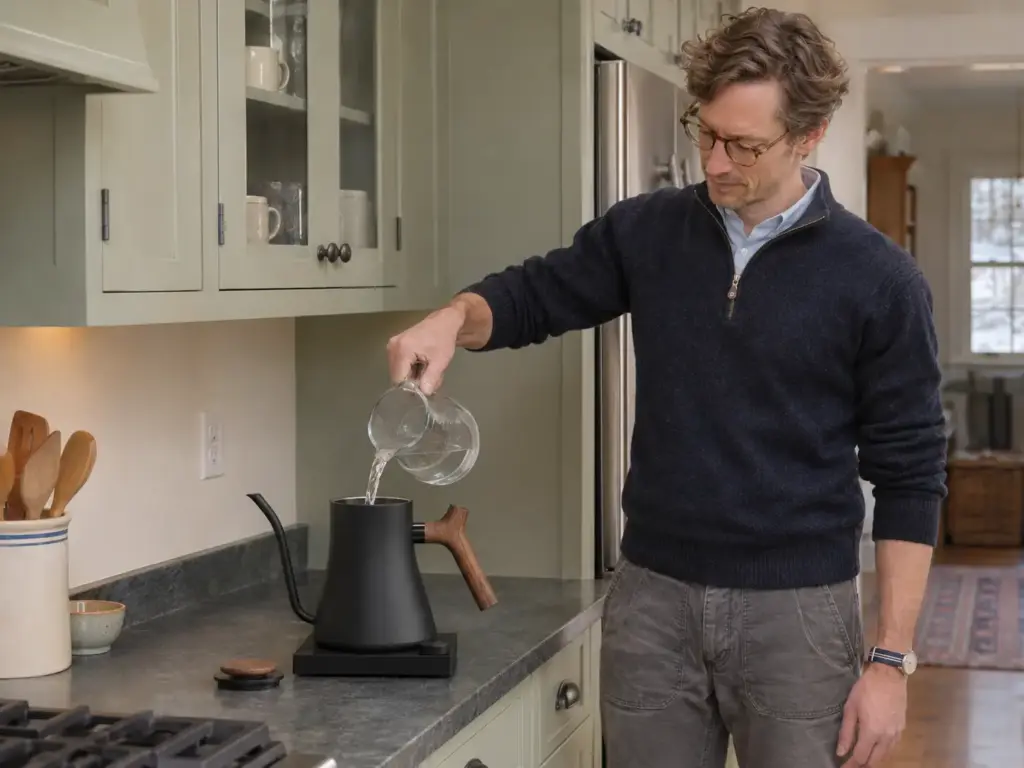
The Fellow Stagg EKG Pro Gooseneck Electric Kettle is the reference for pour control: 0.9 L, 1200 W, a set point Fellow describes as to-the-degree, a hold with scheduling, a brew stopwatch and a screen showing the set and real-time temperature together, with a walnut handle. Its pour runs on the slow side by design. The temperature control is uneven from unit to unit, and some units stop working within weeks, the element being the part that fails.
The Bonavita 1L Digital Variable Temperature Gooseneck Electric Kettle is the budget electric that holds a set point best for the money: 1 L, 1200 W, six presets plus one-degree steps from 140 to 208 °F (60 to 98 °C), a 60-minute hold and an LED panel, at about half the premium’s price and 0.2 L larger than the Cosori. The element tends to fail around month five, and some units never reach the set temperature.
The Brewista Artisan Electric Gooseneck Kettle sits in the middle: 1 L, one-degree steps, an LCD console, a built-in timer, flash boil and keep-warm, with slow, clean pours. Durability is the weak spot, with the element tending to break within two years, and the temperature control is uneven.
Empty the kettle after each session and leave the lid open. A narrow spout that stays damp is a spout that scales.
When the cheaper one does the same job
Apart from the walnut handle and the screen that shows set and real-time temperature together, the budget electric does the same job as the premium one: it holds a set point and pours from a thin spout.
The Cosori gives up the most polish at a fraction of the Stagg’s money, and the Bonavita is the next step up for the extra 0.2 L and the finer steps. The Brewista earns its place only if its timer and flash boil matter to you, because the Bonavita does the same job with fewer features. And if the pour-over happens on weekends, the Hario plus a probe covers it with nothing to fail in month five. The expensive kettle is the obvious pick and rarely the right one.
The Flaws of a Gooseneck, Spelled Out
After the argument for it, here is what it costs, and buying advice rarely spells it out. The flaws are built in: slow, narrow, and fussy about water.
It pours slowly, and a full liter takes the better part of a minute
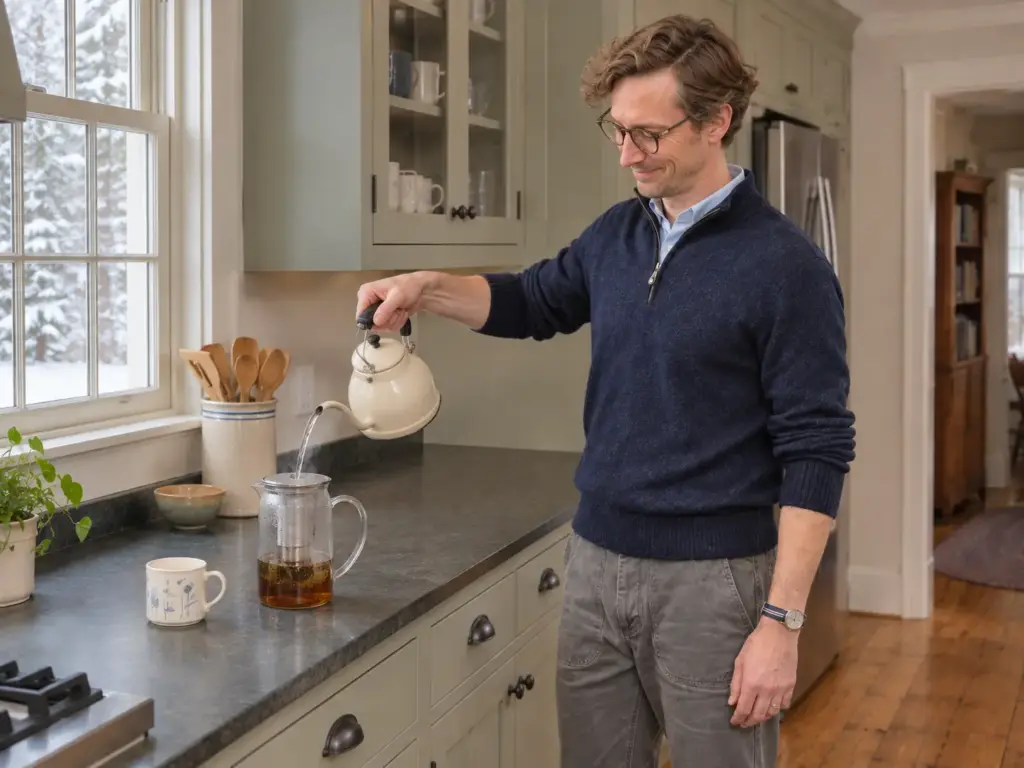
The slow pour is the point and the price. Emptying a full liter through a gooseneck takes the better part of a minute, and the Stagg’s flow is slower than most. For a single pour-over that is a feature. For filling a pot of tea for four, a pasta pan or a French press, a thin spout is a chore, and you will reach for the other kettle in the cupboard.
It is clumsy for the jobs a kettle also does
A thin spout fills a teapot slowly, and a long arm balances badly when the kettle is full. The handle sits close to the spout and its steam on some models, something to judge from the product photos before buying; no technique solves it. If tea is the kettle’s other job, hot water from a machine suits some teas and spoils others, and which teas a coffee machine’s hot water suits and which it spoils sorts the two.
A badly formed spout pours no better than the jug
A cheap gooseneck with a badly formed spout dribbles down the outside and pours no better than the jug already in the cupboard. Shop by the spout and the lid: a long, thin, tapered spout, a lid that seats, a handle that balances an empty kettle. The verdict by brewer holds: pour-over with a pour that still drifts is the case for a gooseneck, and a drip machine, a French press, an AeroPress or a moka pot is the case for keeping your money.
Pour Slower Tomorrow, Then Test the Hold Later
The answer by brewer is yes for a V60, a Chemex and a Kalita Wave, and no for a French press, an AeroPress, a moka pot and a drip machine. The free fix goes first: a slower, lower pour from the middle outward, or a transfer into a cup with a lip. The display describes the water in the kettle while the grounds sit somewhere else, and the element is what dies in an electric gooseneck.
After the first six months of daily use, and again near the end of the first year, put a probe in the dripper once more and look inside the spout for scale. If the hold has wandered or the throat is crusting, that is the drift, and a descale or a new base answers it.
Tomorrow morning, slow the stream or pour through a cup with a lip, then taste for a cup that stays even from the first sip to the last. If it is still split, the grind is next. Once the stream is steady, a scale to pour against is where the budget goes.
Frequently Asked Questions
01Can you put a gooseneck kettle on the stove?
Only a stovetop gooseneck goes on a burner; an electric one never does, because its heating element sits in the base that plugs into the wall. The Hario V60 Buono is the stovetop example here, and it has no electronics to worry about.
02Do you need an electric kettle for pour-over?
No: a stovetop gooseneck plus a probe thermometer does the same job more slowly, and an electric adds a set point and a hold. The hold runs 30 to 60 minutes, about a second cup. The screen reads the water in the kettle, so check the grounds once with a probe.
03Can you do pour-over without a gooseneck kettle?
Yes: a slower, lower pour from the middle outward, or a transfer into a measuring cup with a lip, gets close to what a gooseneck does. The gooseneck makes that same pour repeatable on rushed mornings.
04What is the best brand of gooseneck kettle?
No single brand wins: the Fellow Stagg EKG Pro, Bonavita and Brewista pour much alike and differ in what goes wrong. The element and the temperature control are the weak points on all three, and the cheaper one does the job without the walnut handle.
05Do you need a gooseneck kettle for a French press or an AeroPress?
No, those brewers put the water in before the pour matters, so the spout buys nothing for either. A French press steeps every ground at once, and an AeroPress steeps and then pushes the liquid through.



How did your cup turn out?
No comments yet. Tell us what you changed — and whether the needle moved.