
We may earn a commission when you buy through links on this page. It never changes what we recommend. How we pick
On this page7 parts
- Which teas a drip cycle can carry
- Run the coffee out before the first tea bag
- Two dials you can turn: how much tea and how much water
- What the pot does on the warming plate
- When green or white is the goal, heat the water elsewhere
- Clean the machine, count the bags, then taste before you change anything else
- Frequently Asked Questions
You have a drip coffee maker, tap water, a box of tea bags in the cupboard and no kettle within reach, so the question is whether you can use a coffee maker to make tea. For black tea and most bagged blends the answer is yes, once the machine has been run clean of coffee; for green and white it is no, because the machine fixes the water at one temperature and that number was chosen for coffee.
A brewer that meets the Specialty Coffee Association’s home standard sends water at 194 to 205°F (90 to 96°C) over whatever sits in the basket, and it also sets how fast that water passes through the leaves, so the two numbers a cup of tea depends on are decided before you press the button. The sections ahead cover which teas the cycle carries, the cleaning that has to come first, the two things you can still change, what the warming plate does to a full pot, and the kettle for the teas the machine cannot do. The dose and plate rules for coffee live in the basic routine for a drip machine, and this article only changes them for tea.
Quick Answer
Yes for black tea and bagged blends, as long as the machine has been run clean of coffee first. No for green and white tea: a drip machine’s water arrives around 194 to 205°F (90 to 96°C), above the range they want. Herbal tea never gets the full boil it asks for, so it steeps weakly.
Which teas a drip cycle can carry
The question was yes or no, but the answer depends on the tea, because the machine’s brew temperature is one fixed number and each tea asks for its own. What follows sets what the machine sends beside what black, green, white and herbal teas want. The only standard on the table is a coffee one, and the tea ranges below come from a tea seller’s guide and from common tea advice.
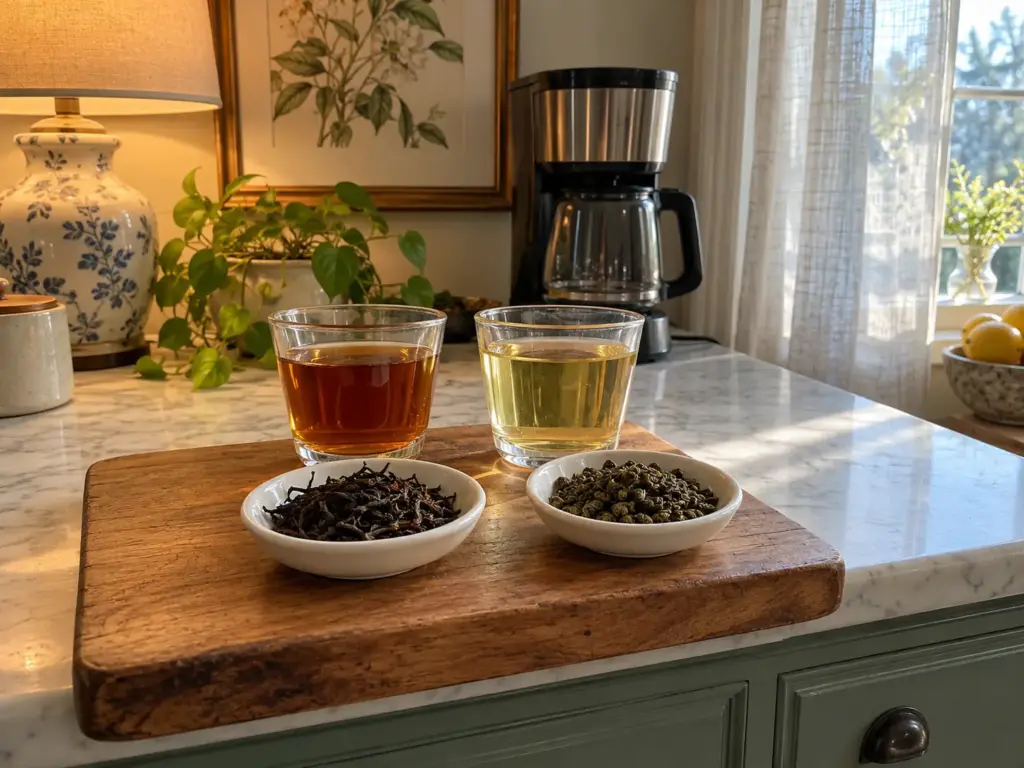
Black tea and bagged blends sit inside the window
The machine’s number comes from the home-brewer standard, SCA 310-2021, section 6.2: the water has to reach 90 to 96°C (194 to 205°F) by the time a third of it has been sprayed, and it stays in that range for the rest of the cycle. A tea bag in the basket gets that number whether it likes it or not. Plum Deluxe, a tea seller, describes the same window from the other side: coffee machines “aim for a temperature between 195 and 205 degrees Fahrenheit,” which is the same 195 to 205°F window.
Black tea lives in that range, mostly. The same seller lists some black teas among those that want more heat than a coffee machine sends. So black is a yes with a small asterisk: the cup may come out a touch lighter than a kettle’s would, and the dose, two sections down, is what makes up the difference. Not every machine on a shelf meets the standard, and one that runs cooler hands the tea less than the window above.
One more thing before the first bag goes in. The water that touches the tea touched the grounds first, so the first tea from a machine that has made coffee is judged by the nose before the first sip.
Green and white tea arrive too hot
Green tea wants 160 to 180°F (71 to 82°C) for 2 to 4 minutes, and one seller’s green blend steeps at 175°F (79°C). Set that against the machine and the gap is plain subtraction: the coolest water a compliant brewer sends, 194°F, is 14°F above the top of that range and 19°F above the seller’s 175; at 205°F the gap is 25°F above the top. The seller says it in its own words, that the water is “too hot for steeping green teas, white teas, and mate teas.”
Green tea is easy to ruin with too long a steep, and the same tea can turn bitter at home. That cup is a report, not a measurement, and it fits what the machine does: a short pass gives hot water little time with the leaf, so it can come out drinkable. But a drinkable cup you cannot repeat is luck rather than a setting, and green and white are the two teas where hot water does the damage fastest. Nor does a different machine fix it; even a drip machine picked by its water temperature still sends tea the coffee number.
Herbal tea never reaches the boil it wants
Herbal teas want something close to a full boil, 212°F (100°C) at sea level, and the machine tops out at 205°F. The seller’s phrase is that the machine’s water is “not hot enough for herbal teas.” Seven degrees short on a short pass is why a pot of herbal comes out thin, and thin is a different complaint from the green tea’s bitterness: the cure for it is time in a mug, covered in the last section.
If you are standing at the cupboard with three boxes (a black breakfast blend, a green, a mint), take the breakfast blend. It is the one the machine can carry.
Run the coffee out before the first tea bag
A yes for black tea is a yes for a clean machine, so the next question is how clean. The cup tells you when the answer is not clean enough, and it tells you before you have finished the first mouthful. Everything in this section is free: vinegar and water are already on your counter.
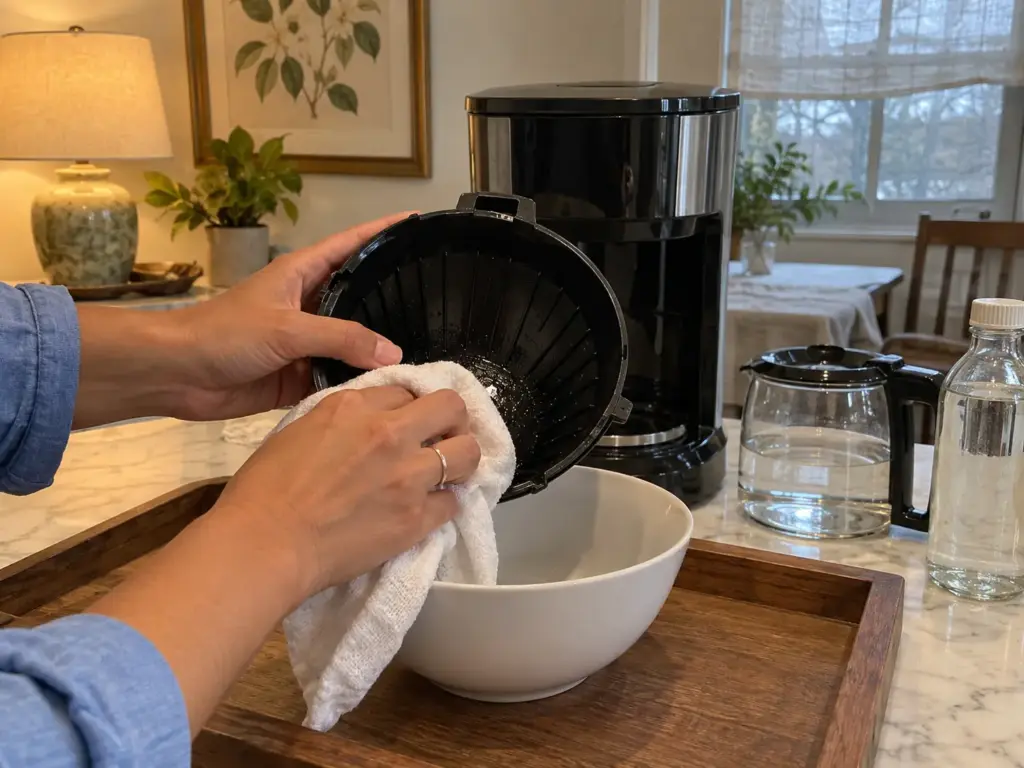
The faint coffee flavor in the cup
With many coffee machines, a faint coffee flavor can remain in the brewed tea, and it is easy to taste. Plum Deluxe calls the same leftover coffee-flavored water. The oils are not only in the water path; the filter basket and the carafe lid hold them too, which is why a quick rinse of the carafe does so little.
The direction comes first. A coffee taste in the tea points to residue, not to the tea, the dose or the temperature. The change that follows is another clear-water run, not more tea. Adding bags to cover the coffee only gives you stronger coffee-flavored tea.
A vinegar run, then clear water
Do these in order, and taste between the last two:
- Wash the basket, the carafe and its lid by hand.
- Run a vinegar cycle through the reservoir, at the ratio your manual gives for descaling.
- Run clear water through as a rinse cycle, as many times as it takes for the vinegar smell to leave the carafe.
- Pour a plain cup of the hot water and taste it before any tea goes in.
Teabloom, another tea seller, opens its steps the same way: “The first thing you need to do is clean the coffee maker completely of all coffee residue.” Treat the vinegar run as a test of the machine rather than a cure, because Plum Deluxe warns you can spend hours wiping and running vinegar and clean water through a used machine “and not remove the pervasive residual coffee taste.” Nobody has measured how long a clean holds, so none is promised here. What you can do is the fourth step, every time: the plain cup of hot water tells you the state of the machine today, which is the only state that matters for the pot you are about to brew.
Before the tea goes in, run a plain pot of water and pour a little into a clear glass. If it smells of coffee, it will taste of it, and a nose catches it sooner than a mouth does.
Two dials you can turn: how much tea and how much water
A clean machine is not yet a good cup. The machine has fixed the temperature and the speed, and it has left you exactly two dials: how much tea goes in and how much water goes through. Most bad cups from a drip machine are one of those two set wrong, and the cup says which.
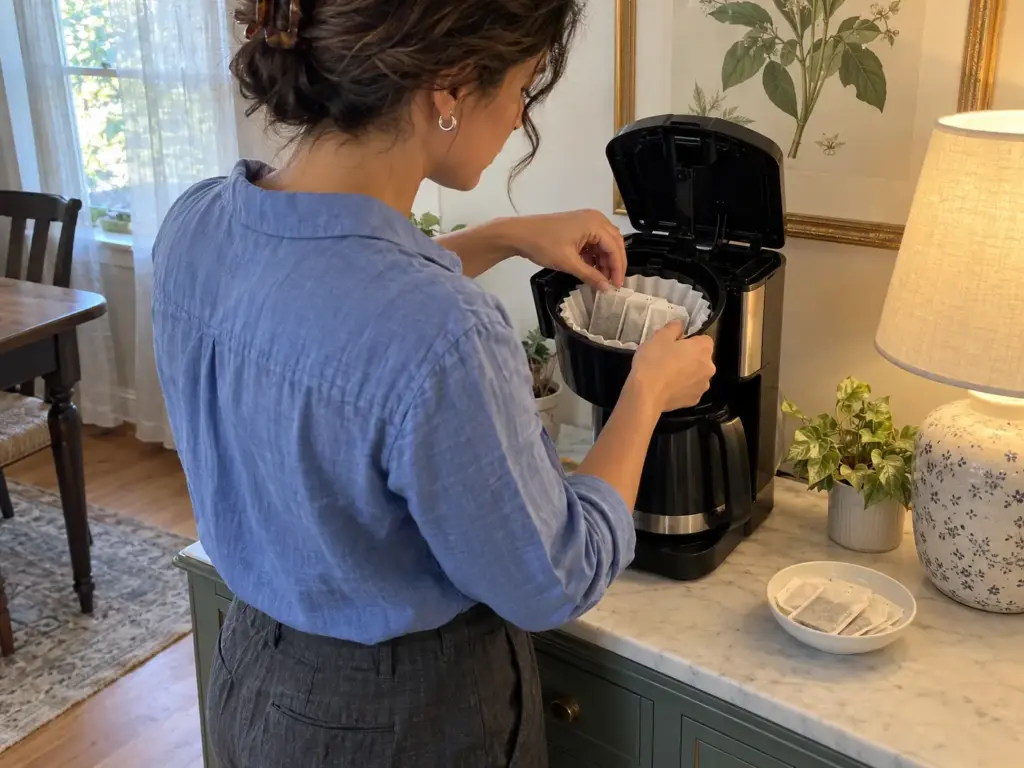
What the machine already decided
You have met the temperature. The second problem is the pass: Plum Deluxe puts it plainly, since the water spends little time mingling with the grounds. Tea is less dense than ground coffee, so the water runs through the leaves too fast to get a good brew. In fewer words, forcing water through tea leaves quickly is not brewing them.
The contact time is set by how fast the water moves through the grounds in a drip cycle, and that belongs to the machine, not to you. You cannot lengthen the steep time. What you can change is how much tea is in its way.
The dose for a full pot, and why we pick one count
Do the arithmetic for your own pot, because the cup rating on a machine is generous. A drip cup counts as 5 oz, so a 12-cup pot holds 60 oz (about 1.8 L); that is a rating, not a measurement, so fill your carafe to its top line from a measuring cup and read the number off.
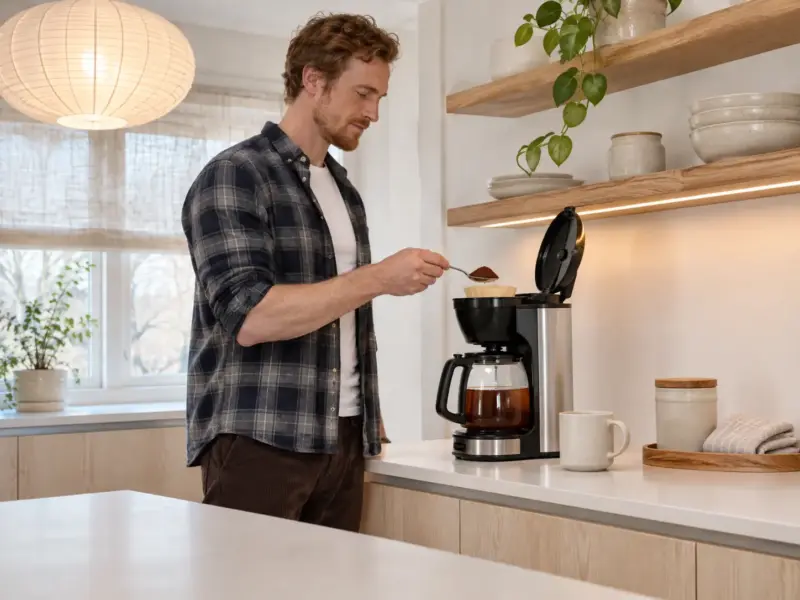
Teabloom says the usual recommendation is one bag per 6 or 8 oz, and then adds, “you’ll get the best taste if you double the amount of tea to water.” On a 60 oz pot that is 7 or 8 bags at one per 8 oz, 10 bags at one per 6 oz, and 15 to 20 if you double. For loose leaf tea, Plum Deluxe’s rule is one teaspoon per cup you want to brew.
This guide picks one bag per 6 oz, so 10 bags for a full pot. That is the stronger end of the seller’s range, chosen because the pass is shorter than any steep and the machine cannot lengthen it. Doubling is a second change, and it goes second: if the first pot is clean but thin, add bags; if you double on the first try and the pot turns bitter, you will not know which of the two moves did it.
A shorter pot keeps the same ratio with fewer bags and wastes less tea while you find your count. A pot filled to 6 cups is 30 oz, so 5 bags.
The first time a pot comes out right, write the bag count on the lid of the tea tin (10 for a full pot, 5 for a pot filled to 6 cups). The next pot then starts from the same number instead of from memory.
Reading the cup: which way it is off
Three cups go wrong in three directions, and each calls for one change. A thin or flat cup, the weak tea of a pass too fast for the leaves, points to too little tea, and the change is more tea: add bags, or brew a shorter pot with the same bags. A bitter or astringent cup points to water too hot for that tea, or to leaves left sitting in the liquid, and the change is fewer bags next time and the leaves out of the pot the moment the cycle ends.
A cup that tastes of coffee points to residue, and the change is another clear-water run. (This is a reading of the causes above, not a lab result.)
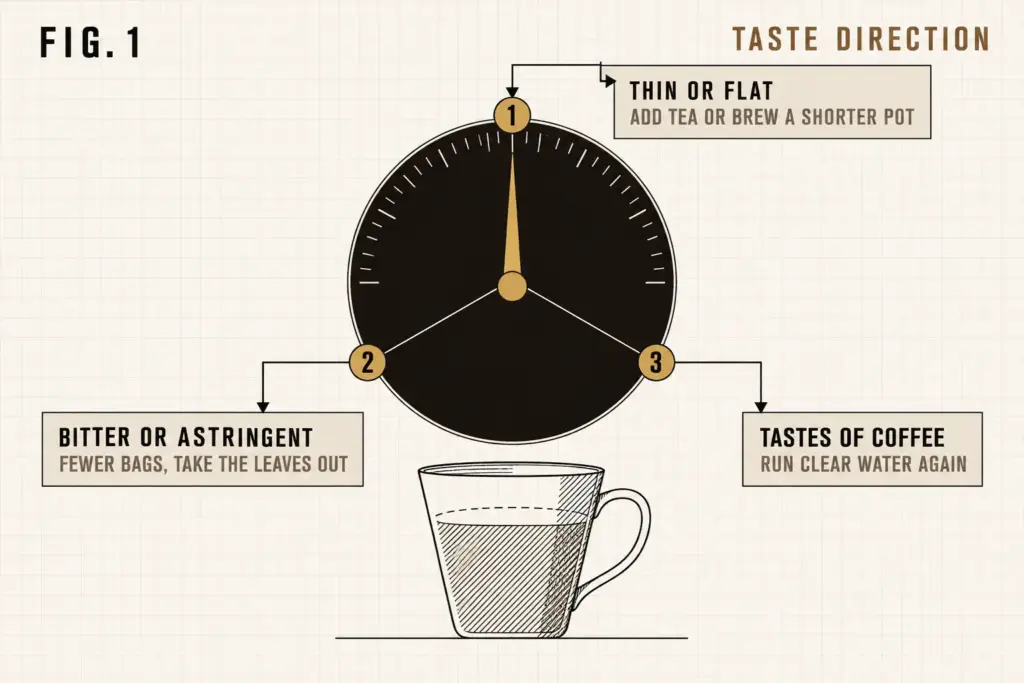
Change that one thing, then taste again. The overshoot is easy to recognize: add bags to cure a thin pot and it tips into bitter, which is the second direction, so come back by a bag or two rather than starting over. Fifteen minutes is far too long for most teas and will make them bitter, and a pot left on the plate with the bags in it gets there without anyone noticing. Judge the pot by the color in the carafe when the cycle ends, not by the first water that drips in.
Loose leaf tea in a permanent filter is its own case, because the fine bits the mesh lets through end up in the cup and a paper filter keeps them out; the trade is the subject of what a permanent mesh lets through.
What the pot does on the warming plate
The leaves are in, the cycle is done, and the pot is still full. The warming plate is the last thing the machine does to the tea, and it keeps doing it for as long as you leave it on. What the plate holds the liquid at and what the leaves do while they sit in it are two separate questions.
Half an hour at the green tea range
According to the Specialty Coffee Association’s home-brewer standard, SCA 310-2021, section 6.6, a heated holding receptacle “shall maintain the temperature of the coffee in the range of 80 to 85” degrees Celsius, which is 176 to 185°F, “during the first thirty (30) minutes of the holding time.” The standard speaks about coffee; applying it to tea is an inference, and it is written as one here.
That band overlaps the top of the green range quoted earlier, 160 to 180°F, between 176 and 180°F. A pot on the plate of a machine that meets the standard sits close to the top of green tea’s range for half an hour, and the standard says nothing about the time after. The overlap is arithmetic, not a way to brew green: the leaves already met 194°F or more in the basket before the plate held anything. What a pot does after that half hour depends on the carafe, and how a glass carafe and a thermal one hold a pot is its own question.
Leaves out, pot off the plate
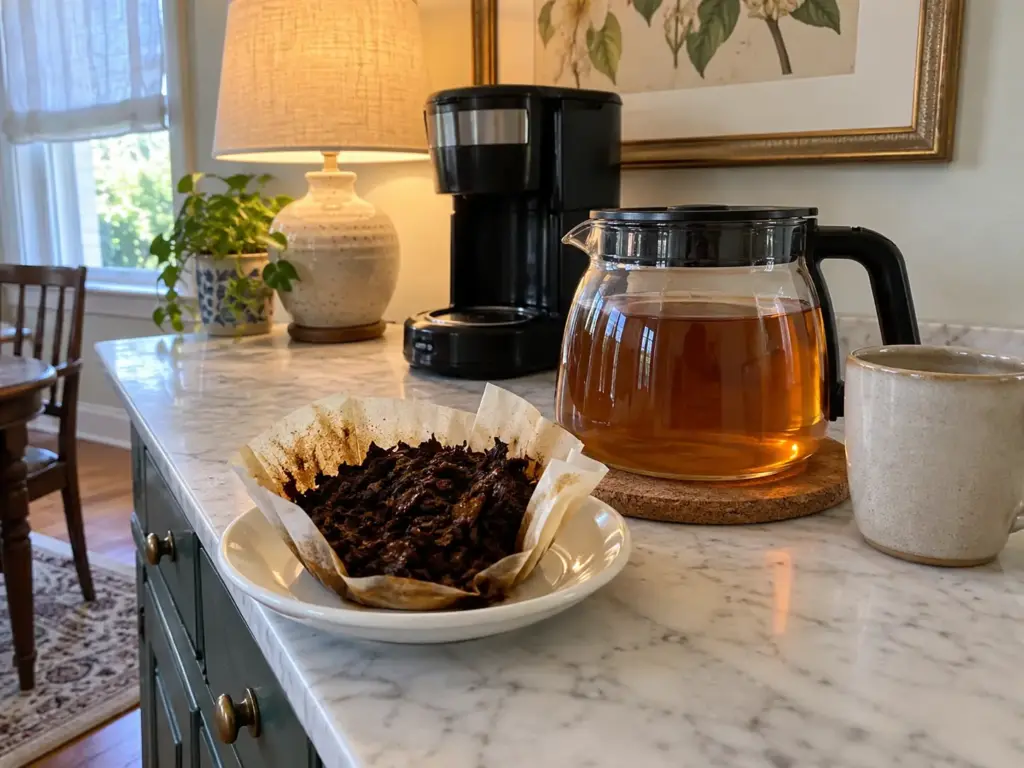
A pot made in the morning and left on the hot plate is where the answers split. One says sitting on the plate “will keep the tea hot and you can drink it that way”; another says “NO it will taste horrible later on as it will be stewed and bitter.” Neither came with a measurement, and neither is contradicted by the other once you separate the two jobs: the warmth keeps the tea hot, and the stewed tea comes from the leaves still in the liquid.
So the change is to lift the filter, or the bags, out as soon as the cycle ends, and then set the pot aside or pour it into a carafe that holds heat. A bag left in the carafe keeps steeping in the heat of the pot after the cycle ends, and the last cup of the pot is the one that shows it. The plate routine for coffee lives in the guide linked at the top; this section only gives the tea reason. If you make tea often, a drip machine that brews into a thermal carafe takes the pot off the plate without a second step.
The moment the cycle ends, lift the filter out by its edges, leaves and all, and set it on a saucer. After that the plate only keeps the liquid warm, and nothing is left in the pot to stew.
When green or white is the goal, heat the water elsewhere
For green and white the machine cannot be tuned, because the steep temperature is not a dial you have. The way out is to heat the water somewhere else, and each way out has a cost. They come in order here: the free one first, then the products, each with what is wrong with it.
The free way: the machine heats, a mug steeps
Use the machine as a water heater only.
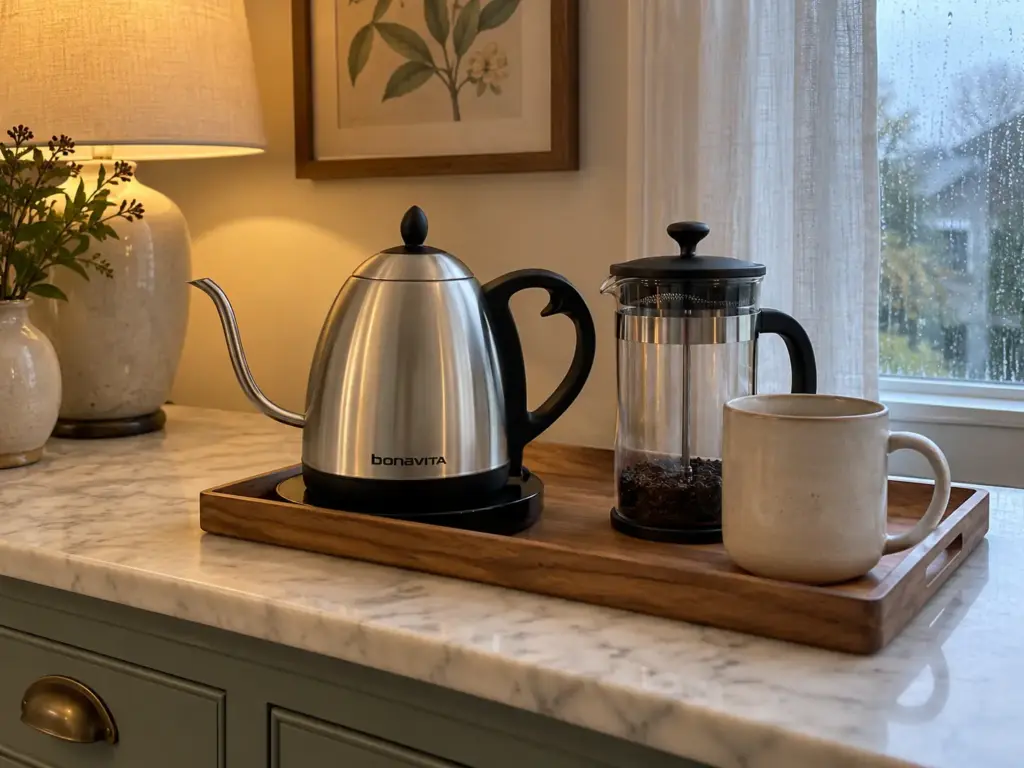
The simplest route is to use the coffee maker only to heat water: run plain water through, pour it into a mug or a teapot (with an infuser if the tea is loose), and steep it there for as long as the box says.
For black tea that is all you need, and for herbal tea a longer steep in the mug makes up some of what the last seven degrees would have given. For green and white the water is still too hot when it lands in the mug. There is no measured wait time to give for how long that water should cool, so none is invented here.
If your machine has its own hot water tap, a coffee maker with a hot water tap does not set the temperature either, and that guide covers the tap side of tea in full.
A kettle with a set temperature
On a budget, an electric kettle with a temperature setting does the job, and you pour the hot water into a mug or a teapot. The Bonavita Cosmopolitan is that kettle, a 1.0 L gooseneck kettle set in 1-degree steps from 140 to 208°F (60 to 98°C), with six presets, and a reviewer names 176 and 185°F among them. That covers green tea’s whole range on purpose, which no coffee machine does. The complaints about it are small: the beeping can be a bit annoying, the power light stays on when it is plugged in, and some buyers find it too small.
A press for loose leaf, and the budget kettle
For loose leaf, a French press is a vessel where you set the time. The Bodum Chambord holds 34 oz (1 L) in borosilicate glass, and the plunger keeps the leaves at the bottom. The catch is the method’s rather than the Chambord’s: leave the tea in the press and, in Plum Deluxe’s words, it will “continue to steep the pressed grounds or leaves, which can lead to a bitter bevvy.” Pour it all out into a mug or a pot when the steep ends.
On the lower end, a stovetop kettle will boil water for black and herbal teas. The Hario V60 Buono is a 1 L stainless gooseneck with no thermometer, so it cannot set green’s range, and a gooseneck spout is a coffee habit you will not miss for tea. A reader who would rather hold the water in hand than hand it to a machine will find that route in a kettle and a cone instead of a machine.
Set a timer for the steep before the water is poured, and lift the leaves out when it rings.
Clean the machine, count the bags, then taste before you change anything else
The machine fixes two numbers, the temperature and the speed of the pass, so black tea and bagged blends are a yes and green and white are a job for a kettle. The coffee goes out before the tea goes in, and the cup tells you which way it is off: thin means more tea, bitter means fewer bags and the leaves out, a coffee taste means another clear-water run. The leaves come out of the pot, and the pot comes off the plate.
A few weeks on, on the day you next wash the basket or descale, pour a plain cup of the machine’s hot water and smell it before the machine makes tea again; any coffee that came back since is the thing to clean first. Tomorrow morning, run the vinegar and the clear water and taste a plain cup of the hot water. Then brew 10 bags in a full pot, or 5 in a pot filled to 6 cups, lift them when the cycle ends, and taste before changing anything else. And if the box in the cupboard says green or white, the next decision is a kettle with a set temperature.
Frequently Asked Questions
01Is it okay to make tea in a coffee maker?
Yes, for black tea and bagged blends, once the machine has had a vinegar run and clear-water runs; green and white tea want cooler water than the machine sends. Use a kettle for those two.
02Can you boil water for tea in a coffee maker?
No, a coffee maker does not boil the water: a machine that meets the SCA standard sends it at 194 to 205°F (90 to 96°C), under the 212°F (100°C) boil. That suits black tea and leaves herbal tea thin.
03How many tea bags do you use in a coffee maker?
About one bag per 6 oz of water: 10 bags for a full 12-cup pot at 5 oz a cup, or fewer bags with a shorter pot. Check the count against your own pot’s ounces.
04Why does tea from a coffee maker taste like coffee?
Coffee oils stay in the basket, the lid and the carafe, so a vinegar run and clear-water runs have to come first. Taste a plain cup of the machine’s hot water before any tea goes in.

How did your cup turn out?
No comments yet. Tell us what you changed — and whether the needle moved.