
We may earn a commission when you buy through links on this page. It never changes what we recommend. How we pick
On this page9 parts
- Before You Blame the Water, Clear the Usual Suspects
- What Water Does to the Grounds, and Four Numbers on the SCA's Sheet
- Which Way the Cup Is Off Points to Which Number
- Tap, Filtered, Distilled, Bottled and Alkaline, One Verdict Each
- The Free Checks, Then the First Rung, a Filter Pitcher
- One Bottle, Then Minerals, Then Reverse Osmosis
- Month Two, When the Cartridge, the Tank and the Scale Show Up
- Two Pots Tomorrow, and What to Taste Again as the Filter Ages
- Frequently Asked Questions
The grinder is on the same setting, the scale reads the same dose, and the bag is the one that tasted right last month. The cup comes out flat and a little chalky, with the brightness gone. Water is about 98.5 percent of a brewed cup and about 90 percent of an espresso shot, and it is the solvent that pulls everything else out of the grounds, so it can dull a cup while every dial you control stays right. That leaves the question you are typing now, what is the best water for brewing coffee, and the answer below follows the order a plain kitchen can use: the other suspects first, then the four numbers on the SCA’s sheet, which way the cup points, a verdict on each source of water, the free checks and the first purchase, and what the cartridge, the tank and the scale do by month two.
Quick Answer
For most kitchens the best water for coffee is fresh cold tap water that tastes clean, filtered only if it smells of chlorine. Distilled and very hard water break a cup. Read TDS first on a cheap meter, then alkalinity if the cup is flat; 75 to 100 ppm sits inside both common target ranges.
Before You Blame the Water, Clear the Usual Suspects
Water is the one ingredient nobody can taste apart from the coffee, so it gets checked last and blamed first. Five other suspects sit ahead of it in likelihood and in cost, and each takes a single cup to clear. A reader who goes on to the numbers after that is doing it for the right reason.
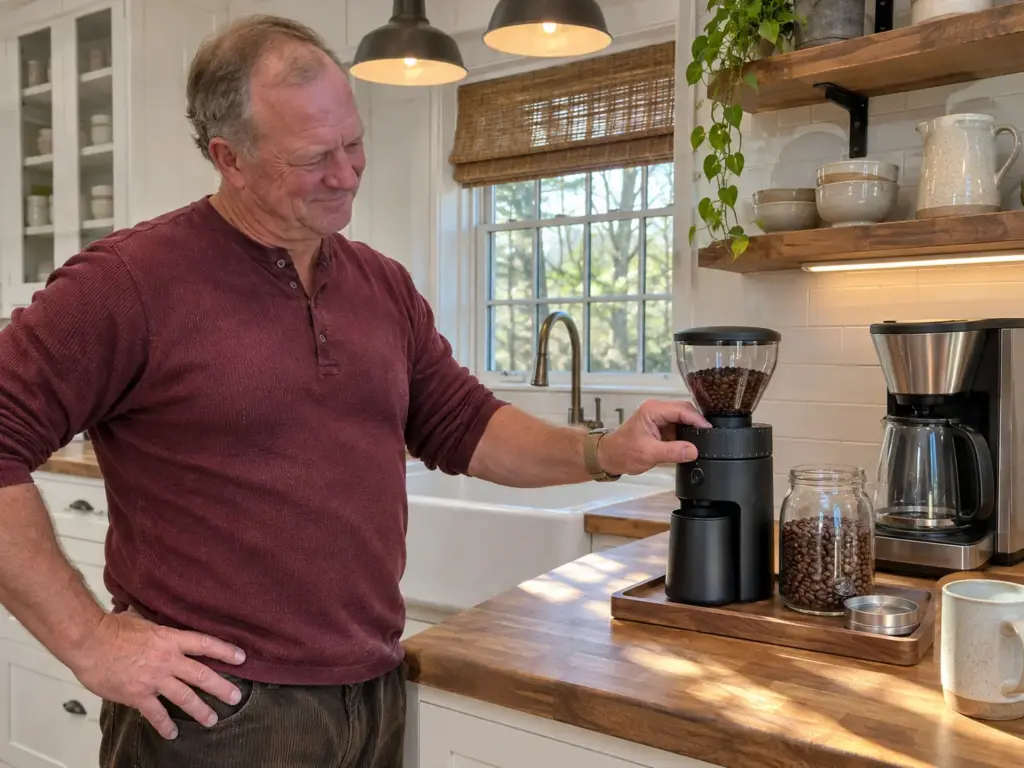
Why water gets checked last and blamed first
Because water is the bulk of every cup, a change in the kettle reaches every brew before any grind change does. Yet it is the only ingredient that cannot be pulled out and tasted apart from the coffee, and that keeps it at the bottom of the checklist while it can be the loudest variable of the lot. A cup that tastes of nothing after a grinder upgrade and a bag of expensive light roast is the typical case: the water never changed, and a standard pitcher was assumed to be enough.
The five suspects that cost nothing to clear
Clear them in this order, cheapest and likeliest first, and taste after each one.
- Stale beans. Check the roast date. A bag well past it barely blooms when the first water hits the grounds, and the cup from it is flat whatever the water does, light roast or dark roast.
- The grind, one step off. Finer rescues a sour cup and coarser tames a bitter one, so name the direction of the cup before touching the collar.
- The brew ratio. Start from the 16-to-1 starting ratio: about 30 grams of coffee to 480 grams (16 fluid ounces) of water, roughly six level tablespoons of grounds. A pot brewed looser than that tastes watery in a way that mimics a water problem.
- A carafe that sat on the hot plate. A carafe left on the heat for an hour tastes of the plate, and no water filter fixes that. Pour the pot into a thermal carafe or a mug within minutes, and read how hot the water is where it meets the grounds before moving to minerals.
- A machine due a descale. A machine that has run for months on hard water slows down and runs cooler, so descale it on the maker’s schedule before judging anything else.
Keep the collar, the dose and the pour exactly where they are through the whole round of checks. A cup that improves after one move names the suspect, and a cup that improves after three names nothing, which leaves the water a suspect you can never clear.
When the same beans taste of nothing in a new city
A recipe that worked for years can fall flat after a move, with the same grinder, the same beans and the same weights, because the tap changed and the recipe did not. Hard water pushes the buffer up and mutes the acids; very soft water leaves the cup hollow. The mirror image is a bag of light roast blamed for a year, until a gallon of distilled water with a measured amount of minerals makes the same beans taste like the notes printed on the label. How that mineral step works comes later, in the ladder of routes.
What Water Does to the Grounds, and Four Numbers on the SCA’s Sheet
With the other suspects cleared, the brewing water has to be read, and the numbers that describe it are four different things that get merged into one. The Specialty Coffee Association (SCA) keeps them apart on its sheet, and so does this section. Where common targets and the SCA window disagree, both are written out, with the range where they overlap.
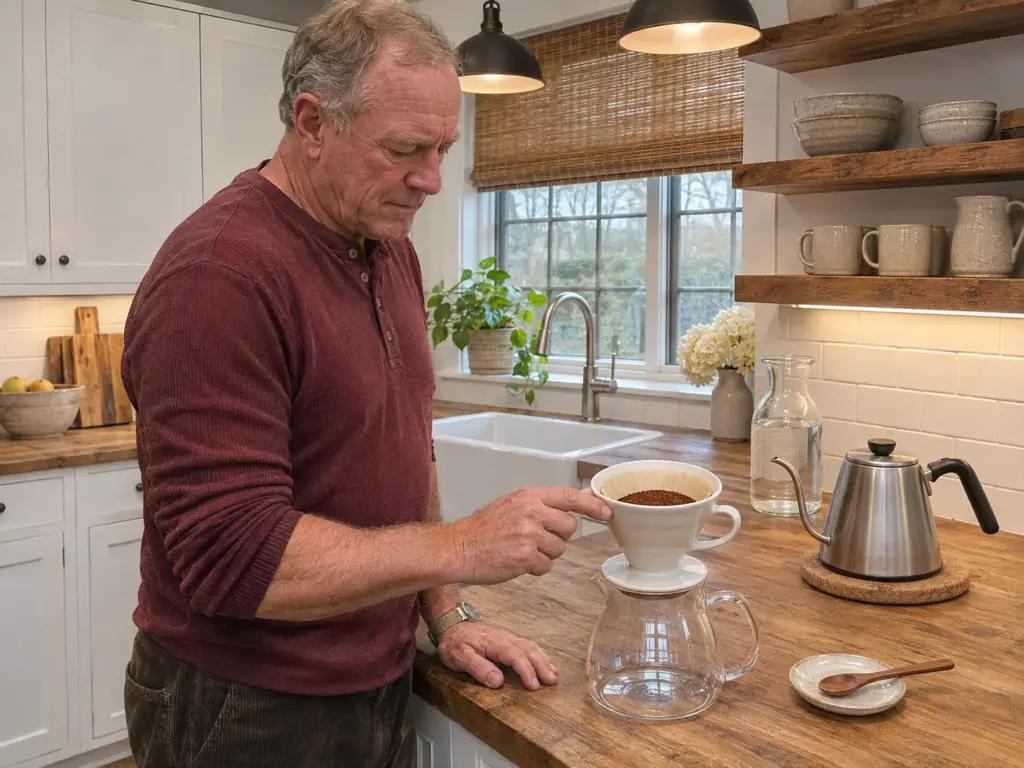
Water as a solvent, and the minerals that carry flavor
Hot water pulls compounds out of the grounds, and what is already dissolved in that water changes which compounds come out and how the cup tastes. Magnesium and calcium add flavor and body, meaning the weight and mouthfeel of the cup on the tongue; bicarbonate buffers acidity and mutes the brightness and clarity of the cup.
Whether minerals change the extraction itself or only how the tongue reads the cup is still argued: in one blind tasting, water mineralized before brewing and water mineralized after were hard to tell apart. The working conclusion holds either way. What is in the water ends up in the cup.
The four numbers, and the target for each
The SCA’s water standard gives each number a window and a target. TDS (total dissolved solids), the total of everything dissolved, runs 75 to 250 mg/L with a target of 150.
Total hardness, also called general hardness or GH, is the calcium and magnesium side and runs 50 to 175 mg/L as CaCO3 (calcium carbonate) with a target near 68. Alkalinity, the buffer that cancels the coffee’s acids and is also written KH or carbonate hardness, sits at about 40 mg/L.
The pH runs 6.5 to 7.5 with a target of 7.0, and chlorine is 0. For water, 1 mg/L and 1 ppm are the same amount, so a meter that reads in ppm compares straight against the sheet.
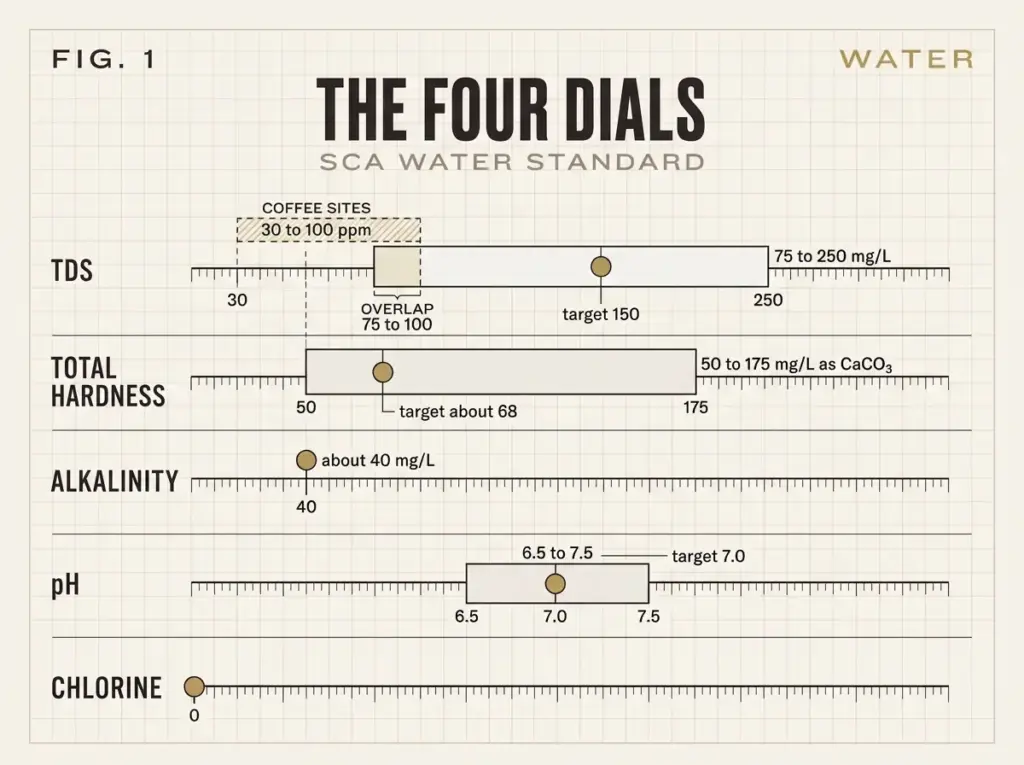
The standard is a window, and drinkable tap can sit inside it or far outside it with the same pleasant taste. Hardness works as a taste dial more than an extraction engine: above about 250 ppm the cup tends toward over-extracted flavors and below about 40 ppm toward under-extracted ones, while measured differences in extraction yield between 20 and 250 ppm are insignificant. Two waters with the same hardness and alkalinity can still taste different, because each mineral arrives with a partner ion (sulfate, chloride), and that is where a recipe copied from a number can disappoint.
Why alkalinity matters more than pH
The acidity you taste in a cup is roughly the acids extracted from the coffee minus the water’s alkalinity. The SCA’s own note on alkalinity and extraction ranks alkalinity far above pH as the dial for choosing coffee water, and puts its effect on the final acidity of the drink at several hundred times that of pH. A tap that reads 7.0 on a pH strip therefore says very little about the cup, and the buffer is the number to find.
Where the 30 to 100 ppm camp and the 75 to 250 ppm camp meet
Two ranges get quoted for filter coffee. One is 30 to 100 ppm TDS, a taste preference; the other is the SCA’s window of 75 to 250 ppm with a target of 150. They overlap between 75 and 100 ppm, so a reading in that band satisfies both, and neither side is wrong: one is a preference and the other a certified window. The risk at the low end is real, though.
A water filter pitcher that cuts hardness hard, from about 45 KH and 90 GH down to about 25 KH and 50 GH, leaves the cup flat until the water is made slightly harder again, so both ends of the dial fail. One number can look healthy while the pair behind it is out of balance, and that makes a TDS reading a first look and never a verdict.
Which Way the Cup Is Off Points to Which Number
A number only helps if it explains a cup, and the cup says more than the meter does. Flat and chalky, thin and sharp, and pool-like or medicinal each point at a different part of the water, and each calls for a different change. Read the cup first, then the number.
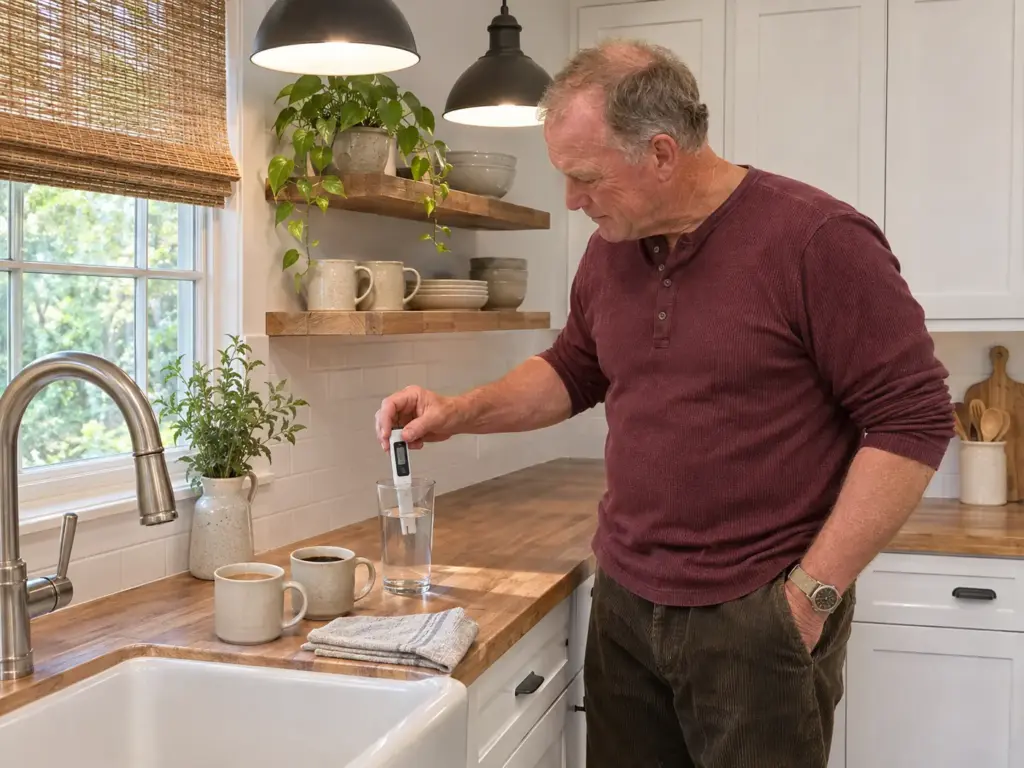
Flat and chalky points at too much buffer
Flat and chalky, with the brightness gone, is the signature of too much buffer. In cupping data published by Daily Coffee News, high-alkalinity water gave very flat, chalky coffee with muted acidity and muddled flavors, and water with a 2:1 ratio of hardness to alkalinity, up to 3:1, scored better.
The average American tap runs about 150 ppm alkalinity and about 170 ppm total hardness, already at the top of the useful range for filter coffee, which makes a flat cup from an ordinary tap more often too much buffer than too little. The useful range sits near 40 ppm, with room up to about 75 ppm when the water is harder. The change is to lower the buffer by blending the tap with softer water or running it through a filter that strips it, and the next cup should come back brighter. If it turns hollow and sharp, the water went too soft, and the next arm of the compass applies.
Thin and sharp points at too little mineral
Thin and sharp points the other way, and since what a few degrees do to the same sour and bitter can mimic it, the water temperature is checked first. Water stripped of its minerals, by an over-softening jug or a very soft city supply, leaves the cup hollow and sharp. One cause is a Brita-type pitcher in a soft-water city, which can make the cup worse than straight tap because there was little hardness left to remove.
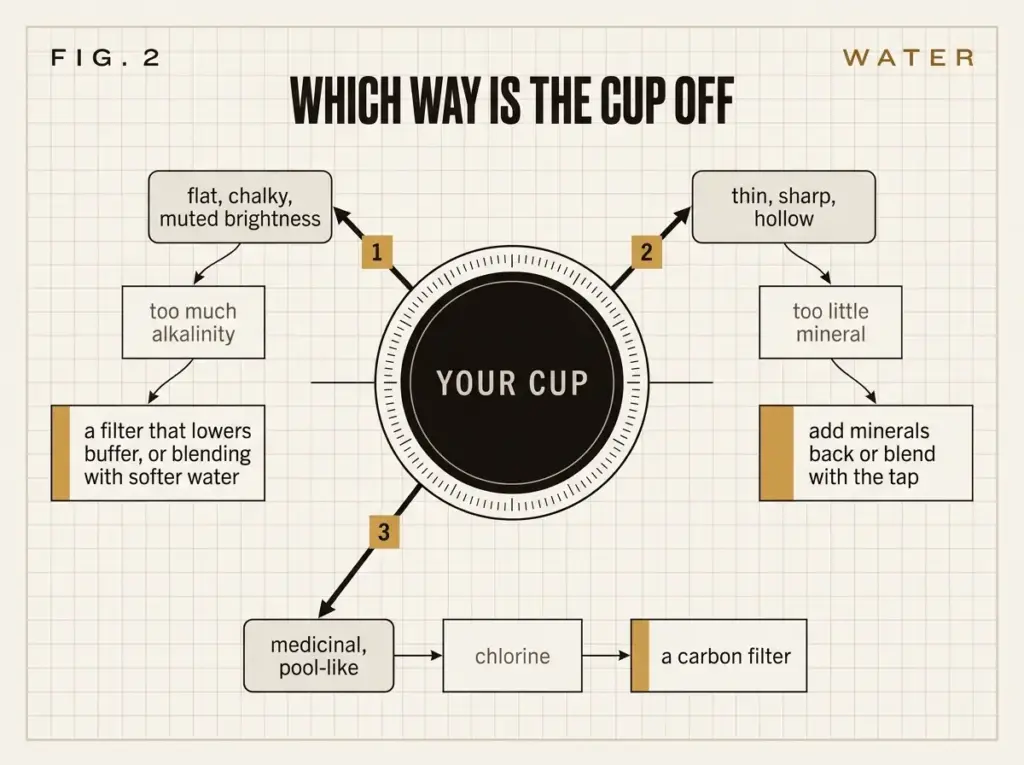
The change here is to put minerals back, or to blend some tap back into the stripped water as bypass water, and the next cup should taste rounder. Add too much and it slides back to flat and chalky, the first arm.
Pool-like, papery or medicinal points at chlorine
A pool, paper or medicine note in the cup is chlorine or chloramine, and no change of grind or ratio touches it. Chloramine is widely used because it lasts. According to the EPA’s page on how chloramines are used to treat drinking water, “Chloramines provide longer-lasting disinfection as the water moves through pipes to consumers.”
That staying power is exactly why the note lingers in the kettle. Only an activated-carbon filter of the right kind removes it, and the cup that follows should lose the note while the mineral side stays where it was.
The one number to read first, and the free way to read the rest
A TDS meter reads only the total, so it is a first look, not a verdict: a reading near zero says the water has been stripped, a reading far above the SCA window says trouble, and in between it cannot tell hardness from alkalinity. The HM Digital COM-80 is the meter to start with: it reads 0 to 5,000 ppm in 1 ppm steps within about 2 percent, compensates for temperature automatically, shows the temperature alongside, and lets you recalibrate. That matters because a TDS reading moves with the water’s temperature, so a reading taken at the tap and one taken at the counter disagree.
Calibration is where units differ and where this model is weakest, so dip it in distilled water first; a reading close to zero says the low end is honest. A cheaper meter of the same kind does the same job.
Rinse the probe in the water you are about to read, wait until the display stops moving, and write the temperature down beside the number. A tap reading and a kettle-water reading only compare when they were taken at the same temperature.
Where the cup is flat and the meter looks fine, the number to find is alkalinity, and two routes get there at no cost or next to none. The city’s annual water quality report prints hardness and alkalinity, and an aquarium GH and KH titration kit reads both at the counter, where a TDS meter reads only the total. Both come before any appliance. What the same water does inside the machine comes at the end of this guide.
Tap, Filtered, Distilled, Bottled and Alkaline, One Verdict Each
Every source of water has a character, and each is a deep question in itself. This section gives one verdict per source, the number or flaw that decides it, and the move that follows.
Tap, and tap through a pitcher
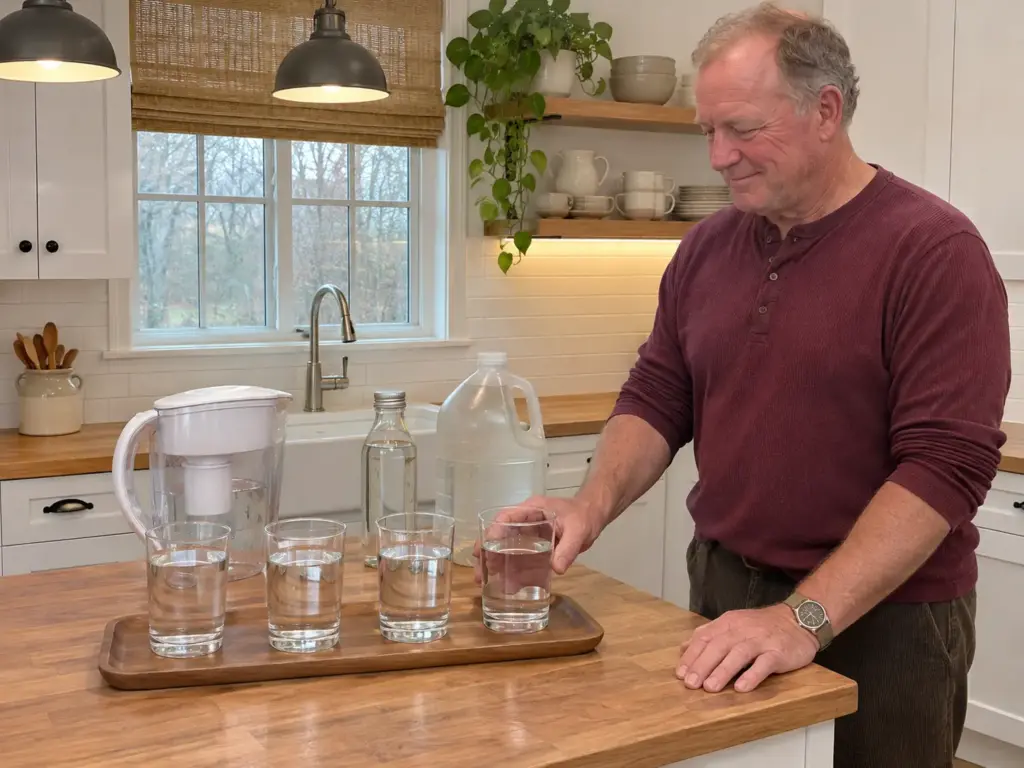
Tap is usually the right water when it tastes clean straight from the glass. The open questions are chlorine, which a filter answers, and hardness or alkalinity, which are numbers, and since an average tap already sits at the upper end of the useful alkalinity range for filter coffee, the verdict is fine until the cup says otherwise. Run through a carbon pitcher, tap loses the pool note and keeps nearly everything else: one measured tap went from about 110 ppm to about 96 ppm after filtering. That answers a smell and leaves a chalky cup untouched.
A very hard source is the exception: well water near 700 ppm TDS is beyond rescue by grind or dose, and plain store-bought reverse osmosis water is the change that worked.
Distilled, deionized and reverse osmosis
Distilled water, deionized water and reverse osmosis water sit at 0 to 5 ppm TDS. Brewed alone they give flat, under-extracted coffee and can leach minerals from the machine, so the verdict is a starting point to which minerals go back, never the finished water. A kettle that never grows a white crust has usually been fed water like this, from a water distiller, a deionizing cartridge or a reverse osmosis tap.
Bottled, spring and “alkaline”
Bottled water, spring water included, varies by brand and by batch and picks up a plastic note when it sits warm, and a purified label says less than a mineral analysis does. The verdict is one bottle as a test, never a habit. Alkaline water, sold on its pH, pushes the buffer up, the opposite of what a flat cup needs, so it mutes brightness. Whether any water suits you beyond the cup is a question for a doctor; the brewing answer is only about buffer.
The Free Checks, Then the First Rung, a Filter Pitcher
Before a single appliance there are checks that cost nothing and can change the cup the same morning. A pitcher is the first thing worth buying, and only when the problem is chlorine.
Draw it fresh and cold, and run the tap a few seconds
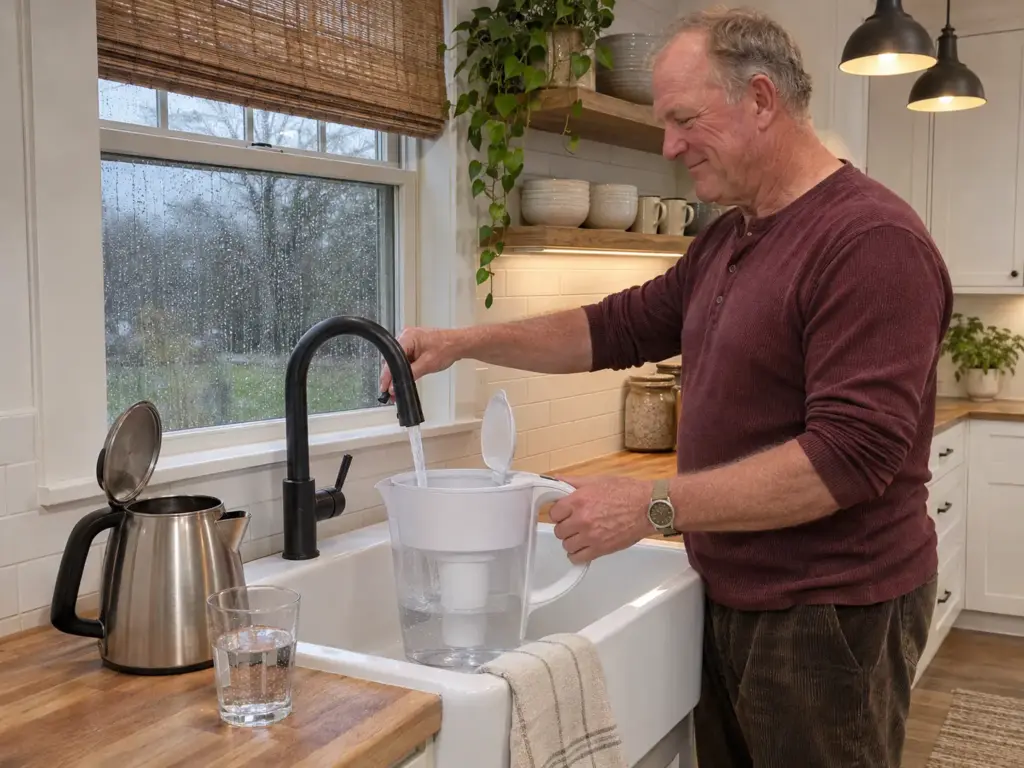
Fill from the cold tap and run it for a few seconds first, so the water that sat in the pipe goes down the drain. Empty the kettle after use and never re-boil the water that has been standing in it all night: each boil leaves the minerals behind in a little less water, and what the kettle gave the water stays in the cup.
The two tests that need no tool
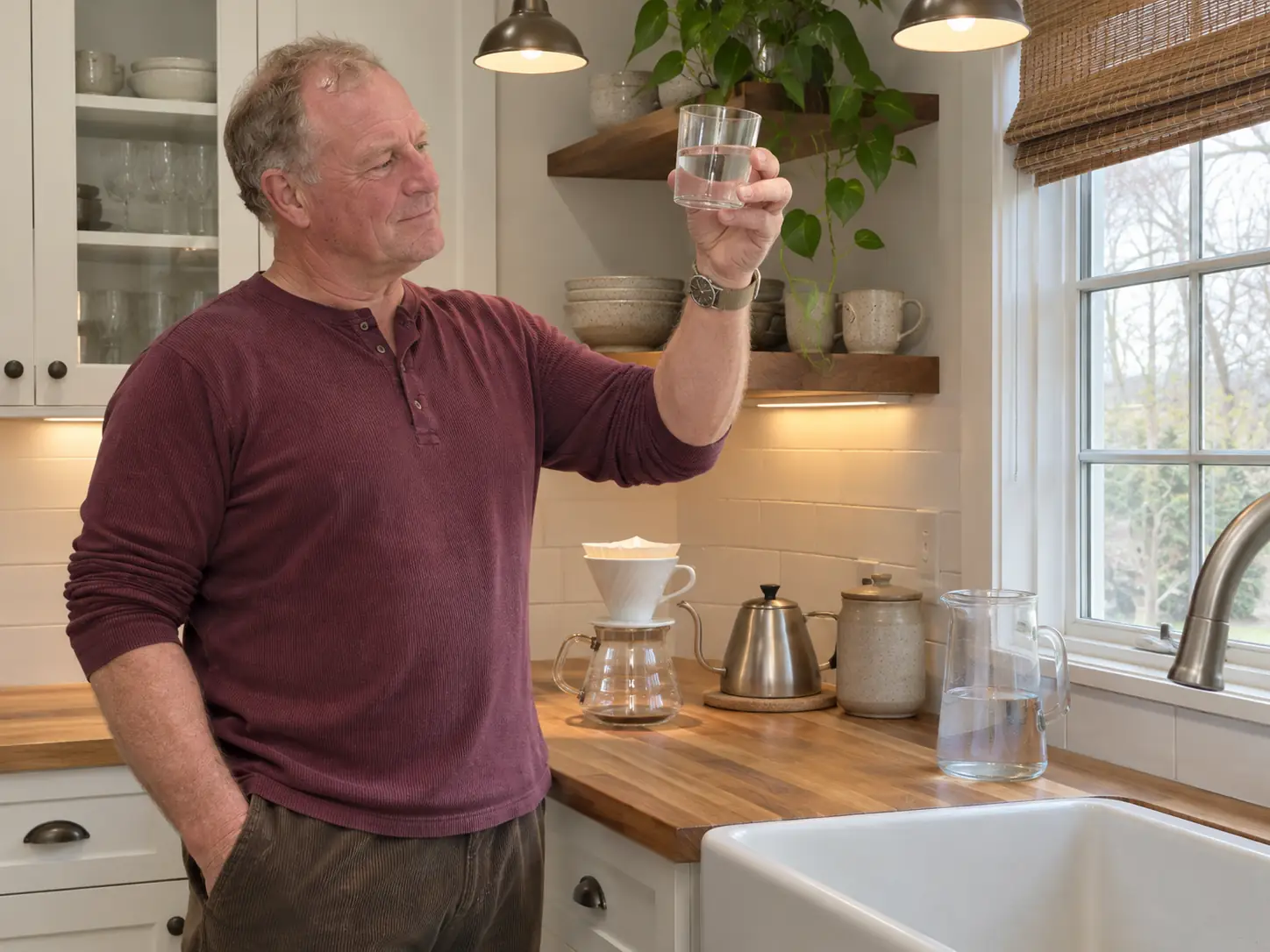
Smell a glass of the tap water: a pool note is chlorine, and the cure is a carbon filter. Then look inside the kettle after it dries: a white crust of limescale, or kettle scale, is hardness, and a hard supply with a flat, chalky cup points at the buffer. A glass that smells of nothing and a kettle with no crust at all is a result too, and it moves the search toward stripped water or toward the other suspects. The city’s annual water report prints the rest at no cost, as the earlier numbers show.
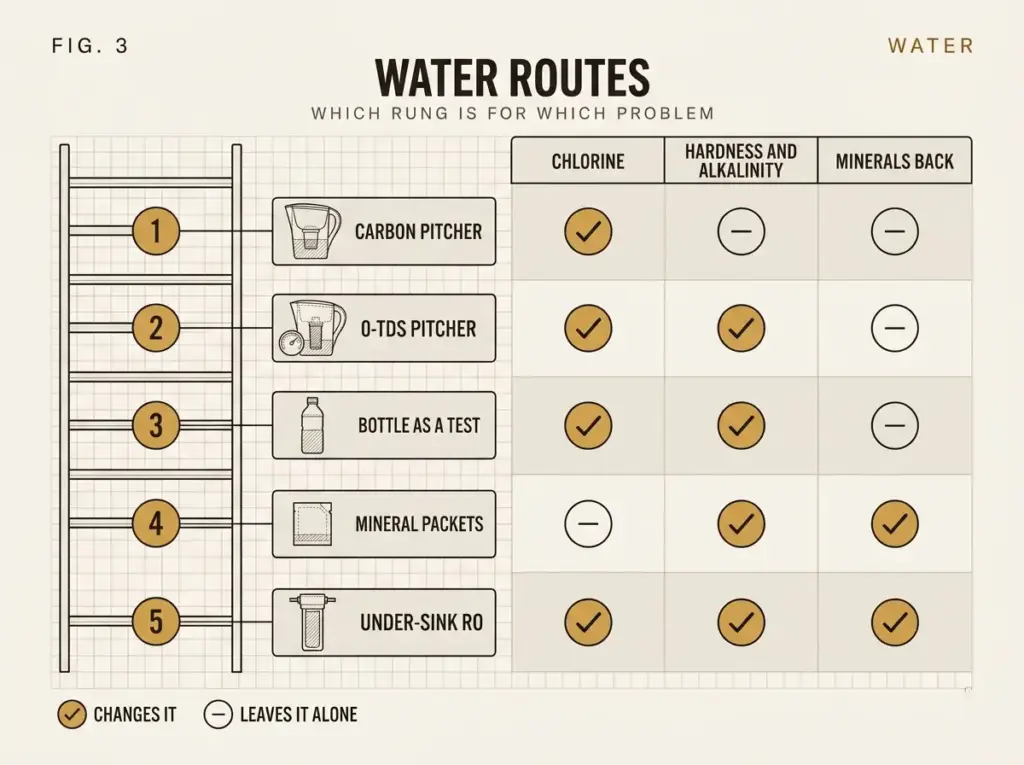
What a pitcher fixes, and what it leaves alone
A carbon pitcher takes the chlorine taste out and leaves the minerals almost untouched, so it suits a kitchen with a pool smell and a soft or middling tap, and it is wrong for a chalky cup, which a pitcher will not move. The Brita Small 6 Cup with its Elite filter is the cheap first rung: a 48-ounce pitcher with one carbon filter rated for 120 gallons or about six months, and a SmartLight reminder for the change. The plastic shell cracks on a light knock, water can escape when the lid is closed, and 48 ounces does not fill the tank of a 12-cup drip coffee maker. A fridge filter or an under-sink carbon filter does the same chlorine job.
The line on the box matters more than the brand. According to NSF’s page on what an NSF/ANSI 42 claim actually covers, “This standard establishes minimum requirements for systems designed to reduce non-health-related contaminants.” The claim covers chlorine, taste and odor, chloramine, particulate, iron, manganese, zinc and TDS, so the box says which of these the pitcher reduces, and a taste claim says nothing about hardness.
The hard-water rung is a different pitcher altogether. The ZeroWater 10-Cup runs the water through a five-stage ion-exchange filter, sends out 0 ppm TDS and ships with a meter that tells when the cartridge is spent. It strips everything, which makes it the base that minerals go back into later. The real cost is cartridge life, which falls quickly in hard water, and the pitcher can leak when it is full.
The word filter hides two parts, the water cartridge in the pitcher and the paper in the basket, and what the word filter means on the machine side separates them. A pitcher is also no substitute for a water report: it is only as good as its last cartridge change, and the month-two bill at the end of this guide puts that into months. The meter that ships with a 0-TDS pitcher reads the filtered water, so its number is the cartridge’s report card, the one reading that says when the filter is spent.
Write the date and the first meter reading under the lid the day a new cartridge goes in. A number that creeps up week by week is the cartridge reporting in, and it is a better guide than the calendar.
One Bottle, Then Minerals, Then Reverse Osmosis
When the free checks and a pitcher leave the cup flat, the next steps get more expensive and more precise. They come in order, and each one is a test before it is a purchase.
One bottle as the test
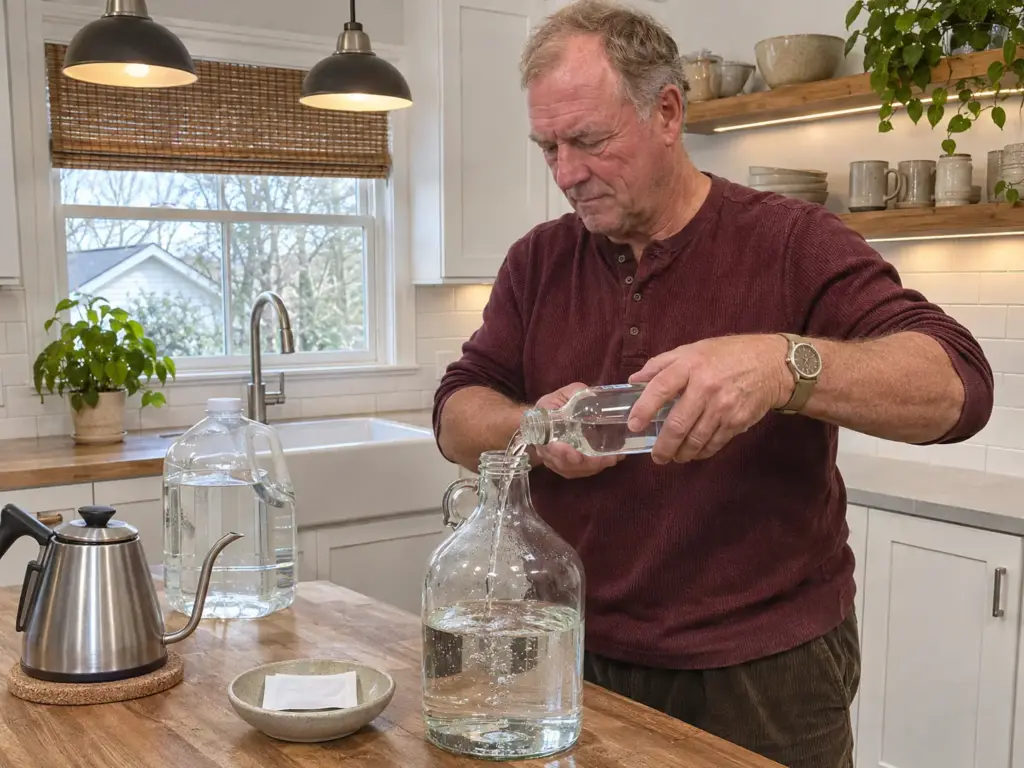
Brew two pots with the same beans, the same grind and the same ratio, one with a low-mineral still water and one with the tap. If the bottle’s cup is better, the tap is the variable and nothing has been bought yet. Volvic Natural Mineral Water is a common choice for the test: a still water with a low-mineral volcanic profile, in a pack of six 500 ml bottles (16.9 fluid ounces each, 3 liters in all).
Six small bottles cost more per liter than almost any other route, the water changes from batch to batch, and it picks up a plastic note when it sits warm. A store’s own purified water does the same test for less and usually runs softer.
Minerals back into stripped water
Distilled and reverse osmosis water carry nothing, and a packet of magnesium and calcium with low alkalinity puts the minerals back. Third Wave Water Classic is a box of 12 sticks, one per gallon (3.8 liters) of distilled or reverse osmosis water, and half a stick per gallon is the usual starting strength for filter coffee. The effect is mixed: the magnesium arrives with sulfate, the maker’s own profile and the reason half a stick is common, and the difference can be faint enough to make you wonder what the box added.
The do-it-yourself route is Epsom salt and baking soda on a gallon of distilled water, with salts bought once and lasting hundreds of gallons. It fails on the balance of the ions and not on the minerals, and the buffer is where it bites: 0.1 g of baking soda per liter lands near 50 ppm alkalinity and 0.2 g lands near 100. A pinch measures nothing, and the second pinch doubles the buffer and flattens the cup.
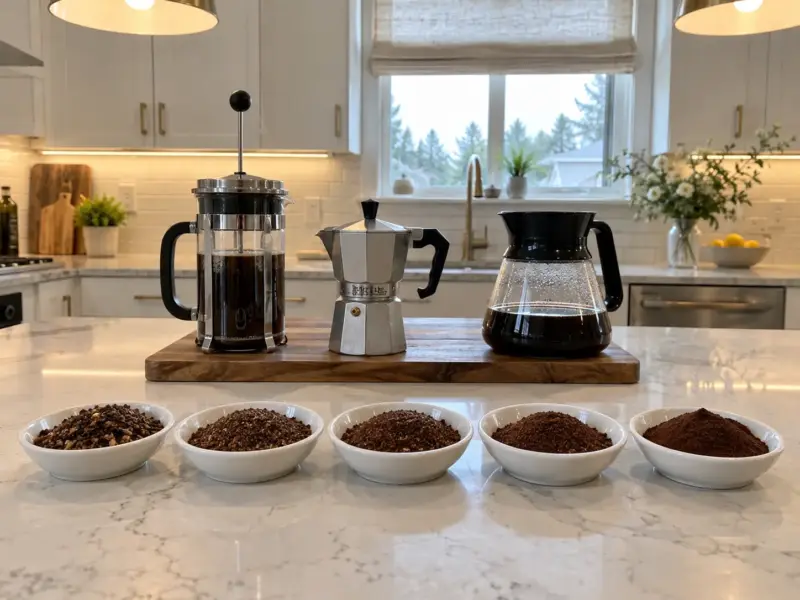
The ratio moves the target as well. Espresso puts only about 10 percent of the water against the same amount of coffee that filter does, so the same tap can be fine in an espresso machine and flat in a drip pot. A pour over and a batch of cold brew sit on the filter side of that line, with water as most of the cup.
Keep unopened sticks in a lidded jar away from the sink and the stove. A stick that has caked in a humid kitchen dissolves unevenly, and then the strength of the gallon is a guess.
The last rung, and what zero-mineral water does to a machine
The last rung is an under-sink reverse osmosis system with a remineralizing stage, for a kitchen that wants stripped water plus a mineral stage at the tap. The Express Water ROALK5D is a 10-stage system rated at 50 gallons a day, with an alkaline remineralization stage, NSF 372 certification and leak detection. The install is the risk: water can leak under the sink and, in the worst cases, damage the cabinet. A ZeroWater pitcher plus a packet reaches similar water at a fraction of the money and with no plumbing.
Stripped water is wrong for the machine too. Carbonate hardness is the lower of total hardness and alkalinity, and neither should fall below about 40 mg/L as CaCO3 if a protective layer is to form in a boiler. Zero-mineral water can leach minerals from the machine, an espresso machine’s boiler included.
Month Two, When the Cartridge, the Tank and the Scale Show Up
Every recommendation above gets judged in week one, and week one lies. The cartridge, the tank and the scale decide whether a water routine still works in month two.
The cartridge that keeps going after it stopped working
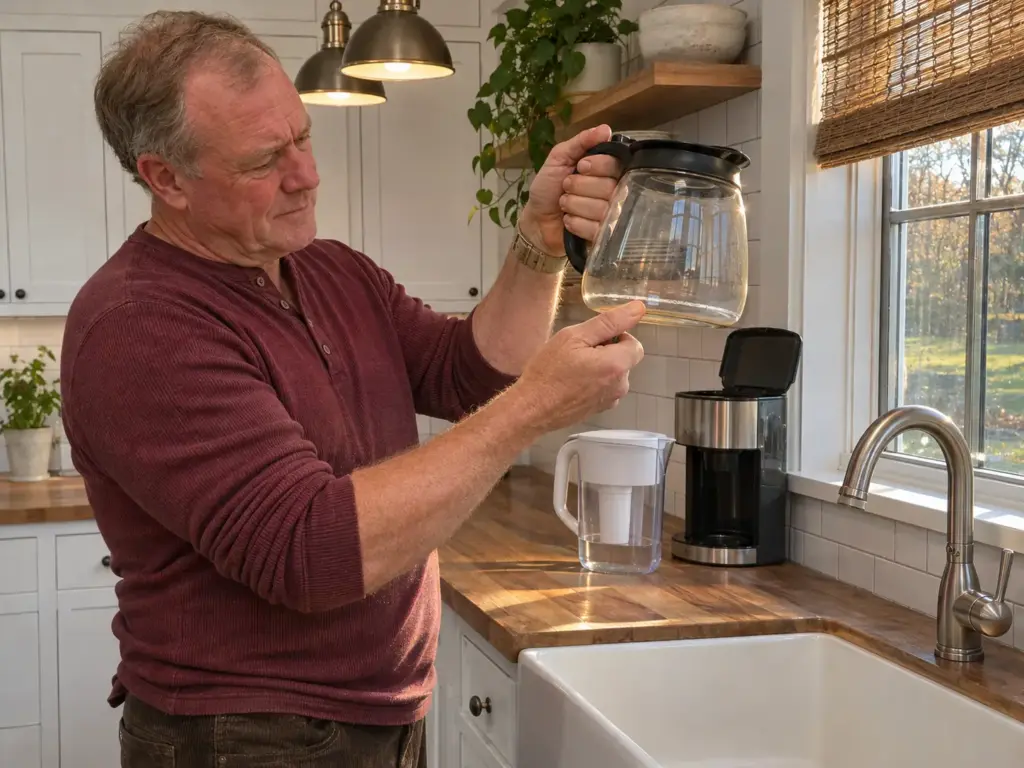
A carbon cartridge can keep passing water at a normal flow long after it has stopped catching chlorine, so flow is no sign that the filter still works, and a pitcher is only as good as its last change. The Brita Elite is rated for 120 gallons or about six months.
A 0-TDS cartridge fails more quietly: it still reads low, but a faint sour or lemon note appears at a reading of 1 while the maker’s replace mark sits at 5 to 6, and in hard water a cartridge can be spent in weeks. Cartridge replacement goes by the date and the meter reading, never by flow. A routine that works gets dropped when the cups start to look alike, then picked up again when they go flat, because the change is real and the maintenance is what fades.
The tank, and what scale does to the brew
Water that sits warm in a drip machine’s tank overnight tastes of the tank by morning, and a Bunn machine with an always-hot 70 oz tank that holds the water overnight is the extreme case. Scale builds silently on the shower head over the brew basket, slowing the brew and cooling it, and how scale at month two changes what a drip machine brews covers the temperature side. Descale on the machine’s own schedule.
What to read again, and the machine that comes next
The first sign of scale is not the white crust but a brew that takes a little longer and comes out a little cooler, so a cup that goes flat in month two is checked for scale before it is checked for beans. A machine that sets its descale prompt from the hardness number and carries a built-in filter cartridge points back at the same number read earlier, since the cartridge changes the water the machine sees, so read it again whenever the cartridge or the tap changes. The descale light on a pod machine is the same hardness at work, and the drip machine, the pod machine and the always-hot tank each handle that light and the filter cartridge differently.
Two Pots Tomorrow, and What to Taste Again as the Filter Ages
Water sits last in the order of suspects and first in how much it can change. Clear the beans, the grind, the ratio, the hot plate and the scale before touching it; read one number first on a TDS meter, then hardness and alkalinity from the city report; draw fresh cold water and run the tap. A pitcher fixes a pool smell and leaves a chalky cup alone, minerals go back only into stripped water, and reverse osmosis is the last rung, with its install as the risk.
Taste again as the cartridge nears the maker’s mark and the tank gathers weeks of use. A faint sour or lemon note, or a brew that takes longer, shows up well before the filter light or the descale prompt does.
Tomorrow, brew one pot with a bottle of low-mineral still water and one with the tap, side by side, with the same beans, grind and ratio, and taste. If the bottle wins, the tap is the variable and the meter comes next, then alkalinity. If the two taste alike, the water is cleared and the suspects go back on the list.
Frequently Asked Questions
01Should I use distilled or purified water in my coffee maker?
Neither works well alone, because distilled and reverse osmosis water at 0 to 5 ppm TDS brews flat coffee and can leach minerals from the machine. A purified label has to be read against a mineral analysis. Add minerals back to stripped water, or blend it with some tap, so the cup and the machine both get hardness and buffer.
02Which brand of bottled water is best for coffee brewing?
No single brand wins, and the usual first bottle is a still, low-mineral natural mineral water such as Volvic. Batches change from one case to the next, so judge it by the cup against your own tap, not by the label.
03Is bottled water good for brewing coffee?
Often yes as a one-off test, because it is the quickest way to find out whether the tap is the variable. As a habit it costs more per liter and can pick up a plastic note when it sits warm.
04What TDS should water for coffee have?
The SCA’s window is 75 to 250 ppm TDS with a target of 150, while 30 to 100 ppm is also quoted for filter coffee, so the two overlap at 75 to 100. Far below that is stripped water and far above is trouble. TDS cannot see alkalinity, so a flat cup at a fine reading needs that number next.
05Does a Brita filter make coffee taste better?
Only when chlorine is the problem. A Brita-type pitcher leaves hardness and alkalinity largely where they were, and in a soft-water city it can make the cup worse than straight tap, because there is little hardness left to remove.

How did your cup turn out?
No comments yet. Tell us what you changed — and whether the needle moved.