

We may earn a commission when you buy through links on this page. It never changes what we recommend. How we pick
On this page10 parts
- What the SCA Wants in Brewing Water, and the Number the Cup Feels First
- Why the Recipe Starts From Distilled Water, Not From the Tap
- The Scale Is the First Thing to Buy, Not the Minerals
- The Starter Recipe You Can Mix Tonight
- Where the One-Liner Lands, and the Two Jars That Fix It
- Which Way the Cup Is Off, and the One Change That Follows
- What Month Two Does to a Jar, a Jug and a Kettle
- The Sachet Shortcut, Machine Care and What Each Route Costs in Effort
- Mix One Liter Tonight, Taste Once, and Check the Jar in Two Weeks
- Frequently Asked Questions
You pour the same beans that tasted sweet at a café across town into a drip pot at home, and the cup comes out hollow, with a ring of limescale inside the kettle to match. The beans are the same; the water is not, and water is most of what is in the cup. That is why a coffee brewing water recipe starts from zero: minerals are what carry flavor out of the grounds, distilled water has none, and tap water is an unknown that shifts with the season, so you add back only what you weigh. Below you get the numbers the standard asks for, the scale that comes before any mineral, a starter to mix tonight, where that starter really lands, which way the cup is off and what a few weeks of the habit does, after a quick look at which water to brew with in the first place if you have not settled that yet.
Quick Answer
The starter that works tomorrow morning is two pantry minerals in distilled water. It is a starting line, because alkalinity and hardness are two separate numbers that get adjusted apart from here.
- Pour 1 liter (about a quart) of distilled water into a clean glass jar.
- Weigh 0.1 g of baking soda on a 0.01 g scale and stir it in.
- Weigh 0.12 g of plain USP Epsom salt and stir that in too.
- Stir until clear, then brew with it the same day.
- Taste once; if the cup is muted, cut the baking soda to 0.07 g.
What the SCA Wants in Brewing Water, and the Number the Cup Feels First
A recipe is only as good as the target it aims at, and the target here, the SCA water standard, is a short list of four figures. Only one of them is the number the cup complains about first, and the rest of the page keeps coming back to it. They go on the table before a single gram is weighed, so that everything after reads as arithmetic.
The four numbers on the standard’s list
The Specialty Coffee Association (SCA) describes brewing water with a handful of figures, and four of them do the work. Total alkalinity sits at or near 40 ppm as CaCO3, calcium hardness at 68 ppm inside a range of 17 to 85, total dissolved solids (TDS) at 150 mg/L inside a range of 75 to 250, and pH between 6.5 and 7.5. Around them sits a floor that never moves: sodium near 10 mg/L, no chlorine, no smell, and water that looks clear.
The unit looks like jargon, and it is only a shared yardstick. Alkalinity and hardness are both written as milligrams per liter, expressed as if the whole amount were chalk, which lets two very different minerals be compared on one scale. The window is narrow. The label on a bag of Epsom salt is written for a bath, so the amounts a coffee recipe asks for look absurd beside it, and 0.1 g of the wrong thing is enough to push a liter out of range.
Alkalinity is the buffer, and it is not the same as pH
Alkalinity is the water’s resistance to a change in pH. The pH is only where the water stands right now; the alkalinity is how much buffer stands behind that number. The buffer is mostly bicarbonate, and it neutralizes the acids that coffee releases into the cup. Two waters can share a pH of 7 and still taste like different drinks, because one holds ten times the buffer of the other: the first leaves the acids standing, and the second flattens them.
In its explanation of why alkalinity outranks pH in brew water, the SCA puts it flatly: “It is far more important to keep alkalinity within a certain range than pH” when choosing a water for coffee extraction. The Water Quality Association’s definition of alkalinity backs the distinction from the chemistry side: it is measured by titration, and a titration is a different measurement from a pH reading.
Chasing pH with a test strip is chasing the wrong dial. What decides how acidic the cup tastes is the buffer, and the buffer is the first thing this recipe moves.
Hardness, TDS and which taste each number moves
Total hardness is dissolved calcium and magnesium, and the two do different work in the cup. Magnesium lifts fruit and clarity. Calcium adds weight to the cup and, left to heat in a kettle, adds scale. TDS is the total of everything dissolved, bicarbonate and sodium and chloride included, so it says how much mineral content is in the water and nothing about which minerals those are.
Each number moves a taste, given here as direction only (the full chart comes in the section on which way the cup is off).
Too much bicarbonate flattens and mutes the cup. Too little leaves a hollow cup, sharp and thin. More magnesium brightens it. A dark roast takes the softer mix, with less of everything, and brighter roasts take more magnesium.
Before touching any number, write down which of four words the cup is: flat, thin, sharp or chalky. The word names the dial, and a cup you cannot name sends you hunting through all of them.
What these minerals do once you drink them, and whether remineralized water suits you or anyone in your house, is a question for a doctor, and no recipe answers it. This page stays with the cup, the machine and the bag the salt comes in.
Why the Recipe Starts From Distilled Water, Not From the Tap
Before any mineral goes in, the water has to be a blank page, and a tap never is one: it carries minerals no one picked and it shifts with the season. This section covers why the build starts from distilled, what to try for free first, and the one cheap meter that confirms the starting point.
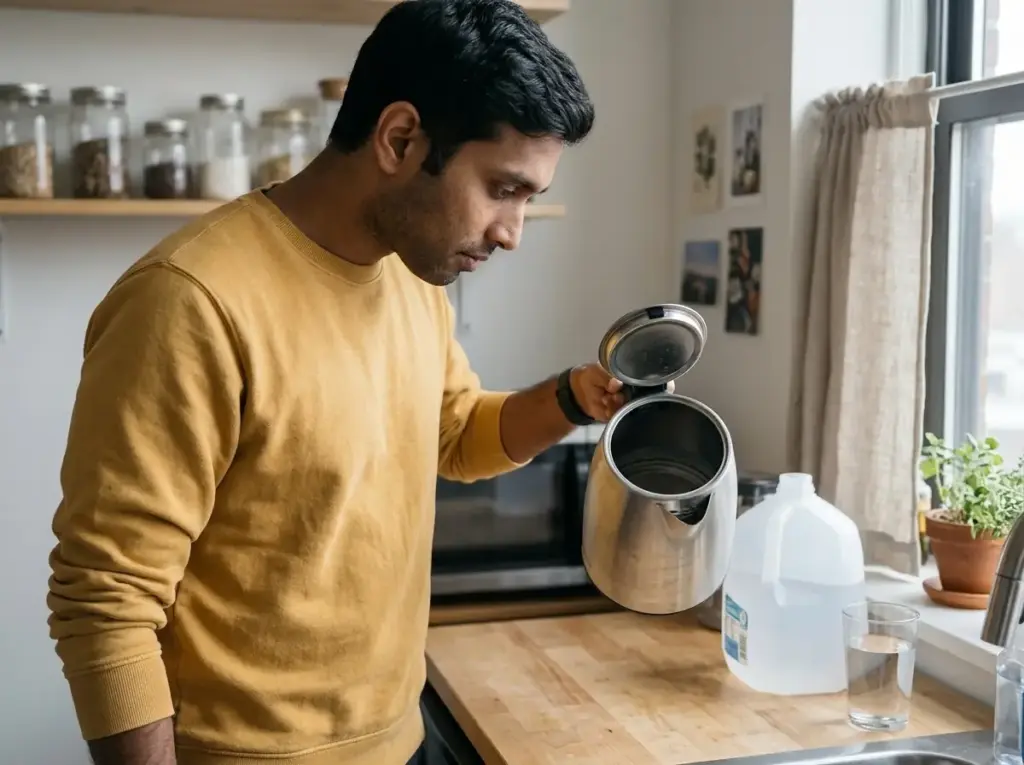
Distilled alone is a blank page, not a finished water
Distilled water, and deionised or reverse osmosis water too, has almost nothing dissolved in it, so there is almost nothing to carry flavor out of the grounds, and that is the reason why distilled water brews flat when it is used alone. The cup comes out hollow, thin and a little dull, even on a good bag. A blank page is still the right place to begin, because it is the only starting point you can repeat.
Tap water has the opposite problem. The hardness changes from season to season, from one reservoir to the next, and the utility’s mix may carry a chlorine note on top. A recipe that begins at zero and adds back only what a scale confirms is the one version of this that gives the same cup on a Tuesday in March and on a Tuesday in July.
Zero does not last forever, though. A sealed gallon of distilled keeps about a week out of the fridge and about a month in it, and the smell tells you the rest: if the water smells of anything, it gets poured out.
The free steps before any purchase
Start with a glass from the cold tap. Cover it with a hand, shake it once and smell it. A swimming-pool note is chlorine, and chlorine is a taste problem that a carbon pitcher fixes and a bag of minerals does not. If you are still deciding whether your own tap needs replacing at all, that page works through the smell test and what it means for the cup.
Next comes the hardness, and the utility publishes it for free in an annual water report. A tap that is only hard needs diluting, not rebuilding: about ten parts distilled to two parts of a hard bottled water makes a working water for the price of two jugs, close enough to the target to tell you whether the idea suits your machine before you weigh anything.
The smell test costs nothing: fill a glass from the cold tap, cover it with your hand, shake once and smell it before you decide the tap is the problem. A flat cup from a clean-smelling tap points at hardness, which is a different fix.
Reading the base with a meter, or taking the pitcher route
You cannot add minerals to an unknown base, so the first reading comes before the first gram. A TDS meter such as the HoneForest TDS Meter covers 0 to 9,990 ppm at a 1 ppm resolution and reads temperature too. Dip it in the gallon of distilled and it should show close to zero; a gallon that reads higher has been through something else, and that is worth knowing before anything goes in.
The meter’s weak point is consistency between units: some read the same for tap and for purified water, so confirm that yours shows near zero in distilled and clearly more in tap before trusting any other number. It reads conductivity and not mass, a limit that matters a good deal more once the jars exist and is covered in the month-two section.
The pitcher route suits a different reader: one whose tap is only hard and who wants the cup to improve without a jug of distilled on the counter. The BWT AQUAlizer Home 2.7 L is a 2.7 liter jug with a carbon filter and a magnesium cartridge, and it softens the water while putting some magnesium back.
In exchange you give up control. Nothing in the jug lets you steer the result, and no number appears to read, so the cup either improves or it does not. The cartridge also ages, and how a filter jug’s cartridge ages decides what the jug tastes like a few months in. The cheaper road to the same place is a gallon of distilled and the two minerals of this article.
The Scale Is the First Thing to Buy, Not the Minerals
A recipe in tenths of a gram is a recipe about a scale, and the scale in most kitchen drawers cannot do it. This section says what the scale has to read, where cheap ones go wrong, how a stronger jar gets around the problem, and the handling rules for everything that touches the water.
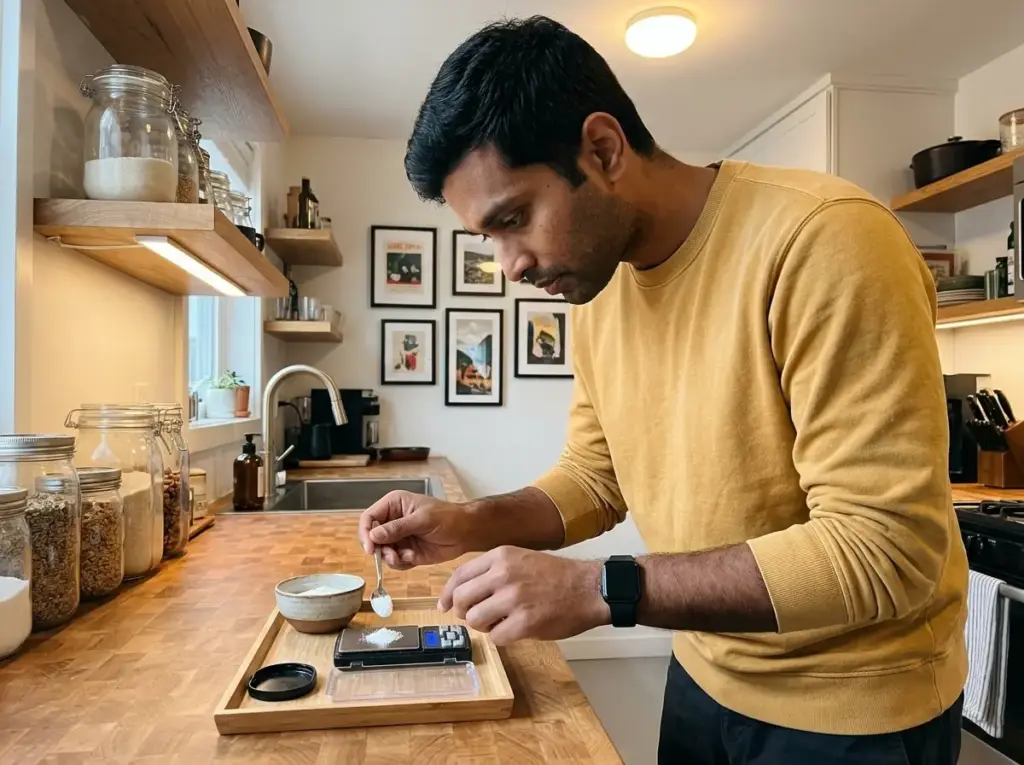
A kitchen scale cannot weigh a tenth of a gram
A kitchen scale that reads whole grams will not register 0.1 g of powder at all: the display stays at zero while the spoon is already empty. One that shows a tenth of a gram can display the digit, but the digit wobbles, and on a 0.1 g dose a wobble of a tenth is the entire dose. A scale readable to 0.01 g reads that dose with about a 10 percent error, which moves the alkalinity figure by about 6 ppm either way. That is the resolution the recipe needs, and it makes the pocket scale part of the recipe itself.
No spoon fills the gap, and a drip-machine reader’s instinct for a pinch or a quarter teaspoon goes wrong fast. A quarter teaspoon of baking soda is more than a gram, upward of ten times the dose a liter asks for. The entire reason for the scale is that nothing in the spoon drawer measures a tenth of a gram.
What a cheap pocket scale gets wrong at the low end
The scale to buy first is a pocket scale readable to 0.01 g. The MAXUS Digital Pocket Gram Scale states 0.01 g, reads up to 500 g, tares, switches between six units and comes with a lid tray for powder. Its trouble is the one every scale at this size shares: at the very low end it is not truly 0.01 g, accuracy varies from unit to unit, a drift can show on the second batch and not the first, and durability is mixed.
Check its calibration with something you know before trusting it. Weigh the same small pinch twice, and if the two numbers differ by more than a hundredth of a gram, trust the stronger jar described below over the dry dose.
The budget road is the 0.1 g scale already in the drawer, used with the stronger jar.
Weigh the tray first and tare it, then weigh the powder on it and never in the pan; a pinch you cannot read is a pinch you cannot repeat.
A stronger jar instead of a better scale
If the scale cannot be trusted at 0.1 g, move the weighing to a bigger number. Dissolve 10 g of a mineral in 1 liter of distilled water, and 1 mL of that jar carries 0.01 g. A 0.1 g dose of baking soda becomes 10 mL of its jar, a 0.12 g dose of Epsom salt becomes 12 mL of the other jar, and a scale that wobbles by a tenth of a gram is only about 1 percent off on 10 g.
A syringe does the dosing, and the arithmetic is done once, on the day the jar is made. That is the workaround for any scale that drifts at the bottom of its range, and it costs one extra jar and a few minutes.
What touches the water: jars, salts and the fridge
Everything that touches the water either keeps the recipe repeatable or quietly changes it, so the handling rules are short and worth following to the letter:
- Use salts marked food grade or USP, and nothing scented or blended.
- Mix and store in glass jars with lids.
- Dose a concentrate with a syringe or a pipette, never a spoon.
- Keep concentrates in the fridge.
- Use mixed brew water within a few days once the jug is open; a sealed jug keeps longer, as the month-two section shows.
- Pour out anything cloudy.
The Starter Recipe You Can Mix Tonight
Everything before this was the reason; this is the brew water recipe to do after work. The starter is two pantry minerals in a liter of distilled water, and the rest of the page is about moving it.

The two minerals and what each one does
Baking soda is sodium bicarbonate, and it is the buffer: it sets the alkalinity, so it decides whether the cup comes out muted or sharp. A 1.25 lb bag of It’s Just Baking Soda is labeled food grade, non-GMO and pure sodium bicarbonate with no additives, and it holds years of 0.1 g doses. Its one mixed point is the bag size, which arrives smaller than expected. Any supermarket box labeled 100 percent sodium bicarbonate does the same job, and baking powder does not, because baking powder is a blend with an acid in it.
Epsom salt is magnesium sulfate, and it is the hardness: the dial that lifts fruit and clarity. The Epsoak Epsom Salt 19 lb is USP grade and unscented, and that bag is more than a decade of liter batches.
It is sold as a bath soak, and the bag talks about baths and not about coffee. Only the plain USP unscented bag is the one for the jug, and a scented blend is the wrong product. If 19 lb is too much cupboard, a 2 lb bag of the same USP salt is the smaller version. Neither bag is a remedy for anything; both are ingredients for water.
The amounts, scaled to the jug
The starter is 0.1 g of baking soda and 0.12 g of Epsom salt per 1 liter (about a quart) of distilled water. It scales in a straight line, so a bigger jug is multiplication, and the table does the multiplying for the jugs a kitchen actually owns.
| Distilled water | Baking soda | Epsom salt | Where it lands |
|---|---|---|---|
| 1 liter (34 fl oz) | 0.1 g | 0.12 g | 60 ppm alkalinity, 49 ppm hardness |
| 2 liters (68 fl oz) | 0.2 g | 0.24 g | Same, at any size |
| 4 liters (135 fl oz) | 0.4 g | 0.48 g | Same, at any size |
| 1 US gallon (128 fl oz) | 0.38 g | 0.45 g | Same, at any size |
Marking a 2-liter bottle once and mixing into it lets the same jug refill every morning without arithmetic. The same jug serves a drip coffee maker, a pour-over or a French press; the brew ratio, the coffee to water ratio, is a separate question, picked up at the end.
Mix, stir, taste, and use it the same day
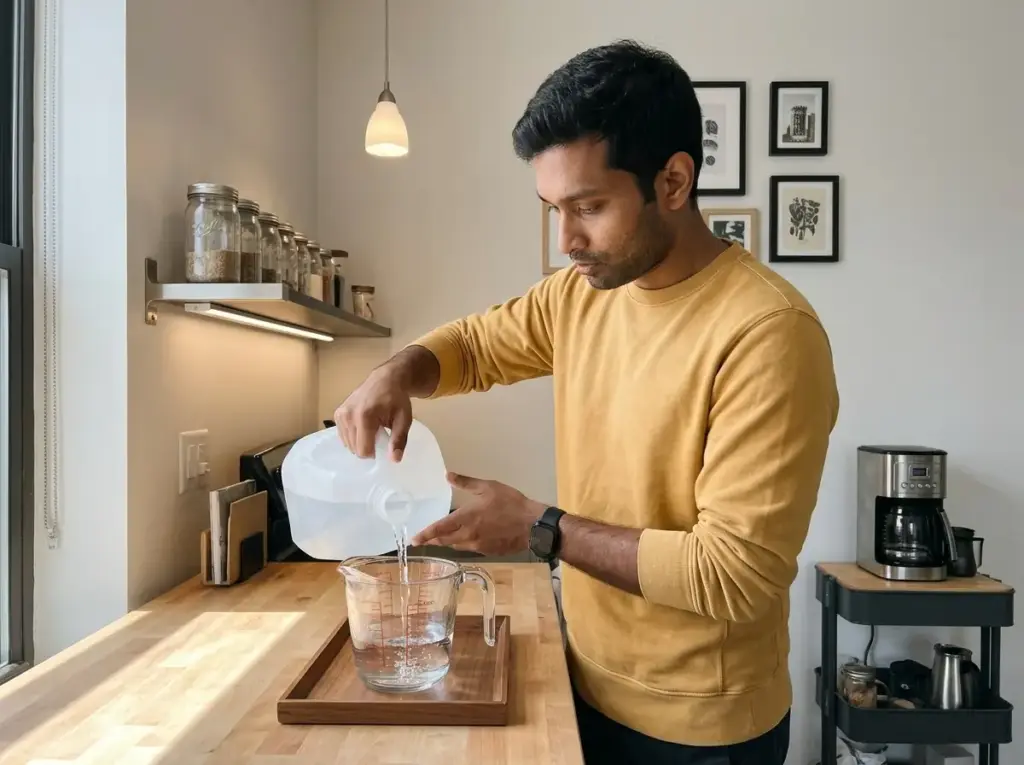
Pour the distilled water into a clean glass jar, add the baking soda, then the Epsom salt, and stir. The Epsom crystals dissolve in seconds and the baking soda a little slower, and the water goes from clear with specks to plain clear; that is the moment to stop stirring. Brew with it the same day the first time, and taste before changing anything.
Scaling the batch to a pot is the grams-of-coffee question. Water and coffee follow the ratio, and the page on scaling the grams of coffee to a full pot does that multiplication so the pot does not run short.
Stir with a clean spoon and brew the same day the first time. A jar that goes cloudy by tomorrow is reporting on the jar and the spoon, and says nothing about the recipe.
Where the One-Liner Lands, and the Two Jars That Fix It
The starter above is a common DIY water recipe in one line, and it does not land on the SCA’s figures; two short sums show where it does land. This section prints those sums, names the single number that has to move, and then gives the two-jar method for the day the cup needs one dial and the other left alone.

The arithmetic behind the one-liner
Alkalinity and hardness are both counted as CaCO3, so every mineral has to be converted into chalk-equivalents. The conversion uses each salt’s molar mass, 84.01 g/mol for baking soda and 246.5 g/mol for Epsom salt, and the two sums for one liter of the starter come out like this:
- 0.1 g of baking soda is 1.19 millimoles of bicarbonate, which counts as 59.6 ppm of alkalinity as CaCO3.
- 0.12 g of Epsom salt is 0.487 millimoles of magnesium, which counts as 48.7 ppm of hardness as CaCO3.
Two numbers fall out of that: about 60 for alkalinity and about 49 for hardness. Set them against the SCA’s 40 and 68 and the shape of the problem is visible without any chemistry beyond the sums.
The one number that moves, and what it does to the cup
The starter lands at about 60 ppm of alkalinity and 49 ppm of hardness against the SCA’s 40 and 68. Hardness already sits inside the 17 to 85 range, so it is no emergency. The alkalinity is 20 ppm over, which is half again as much buffer as the standard asks for, and the buffer is what mutes the acids: a light roast comes out soft, with the sweetness still there and the brightness gone. Only one number has to move.
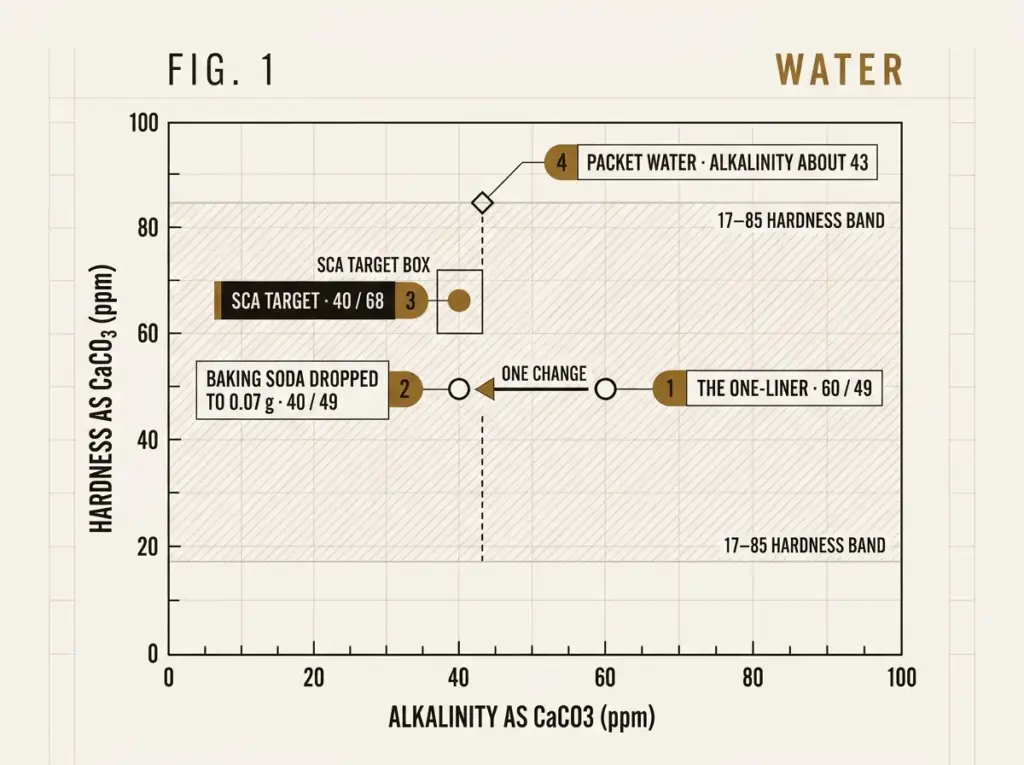
Nothing in the starter can lower alkalinity except using less baking soda. Drop it from 0.1 g to 0.07 g (0.067 g exactly) and keep the Epsom salt at 0.12 g, and the water lands at about 40 alkalinity and 49 hardness. The cup stops being muted without anything new entering the kitchen: the same two minerals, about 30 percent less of one of them. That is the first move for a muted cup, and it is what makes the starter a starting line.
The two jars, for moving one dial at a time
The one-line starter cannot move alkalinity and hardness apart, because the two minerals ride in a fixed ratio inside the same spoonful. Two jars can. The buffer jar holds 1.68 g of baking soda per 1 liter of distilled water, and the magnesium jar holds 2.45 g of Epsom salt per liter. After that, every recipe is arithmetic on a scale: 1 g of a jar adds 1 ppm to 1 liter of water.
A liter of SCA water is therefore 40 g of the buffer jar, 68 g of the magnesium jar and 892 g of distilled water, the last number found by subtracting the other two from 1,000 g. The constants check out: 1.68 g per liter dosed at 40 g per 1,000 g is 0.0672 g of baking soda, which is the 40 ppm the standard asks for.
Now each dial moves alone. A thin cup wants more magnesium, so 5 g more of the magnesium jar lifts the hardness by 5 ppm and leaves the alkalinity untouched. A muted cup wants less buffer, so 5 g less of the buffer jar takes 5 ppm off the alkalinity and leaves the hardness where it was. The jars are dilute, so the instrument is a syringe: 1 mL of the buffer jar carries about 1.7 mg of baking soda, and a spoon has no business near it.
Which Way the Cup Is Off, and the One Change That Follows
A cup points a direction, and the direction names the dial. This section lines up the taste words (flat, thin, sharp and chalky) with the single move each one calls for, in order and free first, and it says plainly when the problem sits in the bag and not in the water.

Check the free things before the water
Four things come before any move on the recipe. The first is the roast date on the bag: a bag several weeks past roast reads flat on any water, and the same water tastes bright on a fresh one. The second is the dose, weighed on a scale and not scooped.
The third is the grind, because a grind that is off makes the cup sour (under-extraction) or bitter (over-extraction) whatever the water carries. The fourth is the carafe, which should be clean, and a pot that has sat on a hot plate tastes different from the same pot straight off the brew.
A sachet bought to fix sour beans has fixed nothing, and the same goes for a jar of minerals. Fix the four, taste, and only then touch the water. Taste at the same point each time, too: the cup changes between the first pour and the last of the same pot as the carafe loses heat, and a comparison made at two different moments lies.
A muted or flat cup points one way, a sharp or thin cup the other
Muted or flat means too much buffer: the acids are being neutralized before they reach the tongue. The first move is the baking soda, down from 0.1 g to 0.07 g per liter, and then taste. The next cup should come out more open, with the acid back in it. If it turns sharp at the edges, the move overshot, and 0.085 g is the midpoint to try.
Sharp and hollow means too little buffer: add 5 g of the buffer jar at a time, each step worth about 5 ppm, and the cup rounds out; overshoot brings the muted taste back.
Thin means low hardness and usually low everything else: add magnesium, where 0.01 g more Epsom salt per liter is about 4 ppm, and the next cup should show more fruit and more clarity, while overshoot reads as a harsh mineral edge.
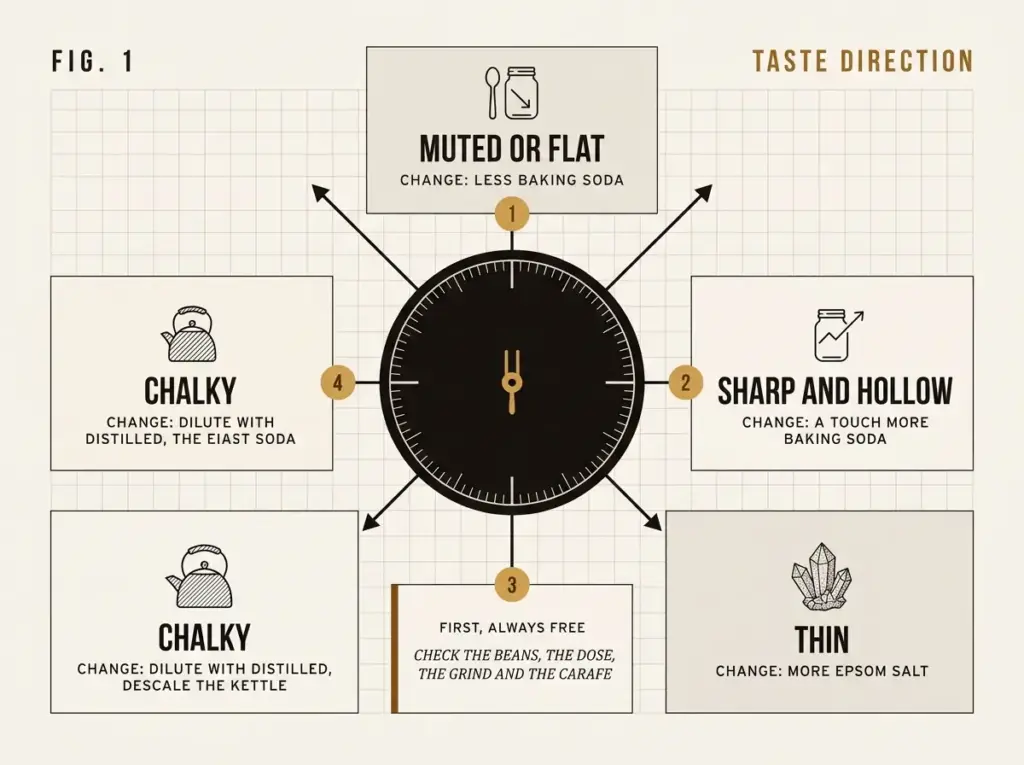
The order of moves never changes: the free checks first, then the dose of what is already in the jar, then anything new, and a purchase last, with a taste between each step. A reader who changes three things in one evening ends up with a better cup and no idea why, and that cup does not repeat.
A chalky cup is the tap or the kettle, not the jar
A chalky cup, dry and astringent, is a hardness problem, and hardness comes from the tap water in the blend or from scale in the kettle, almost never from the jar. If part of the water is tap, dilute it with more distilled. If the kettle has a white crust, descale it, because flakes of it travel into the cup. The jar is the last suspect: it holds distilled water and two measured minerals.
What Month Two Does to a Jar, a Jug and a Kettle
Week one tastes like a success, and week six tells the truth about the habit. This section is the month-two report on the three things the recipe leaves in the kitchen: the jar of concentrate, the jug of mixed water and the crust in the kettle.
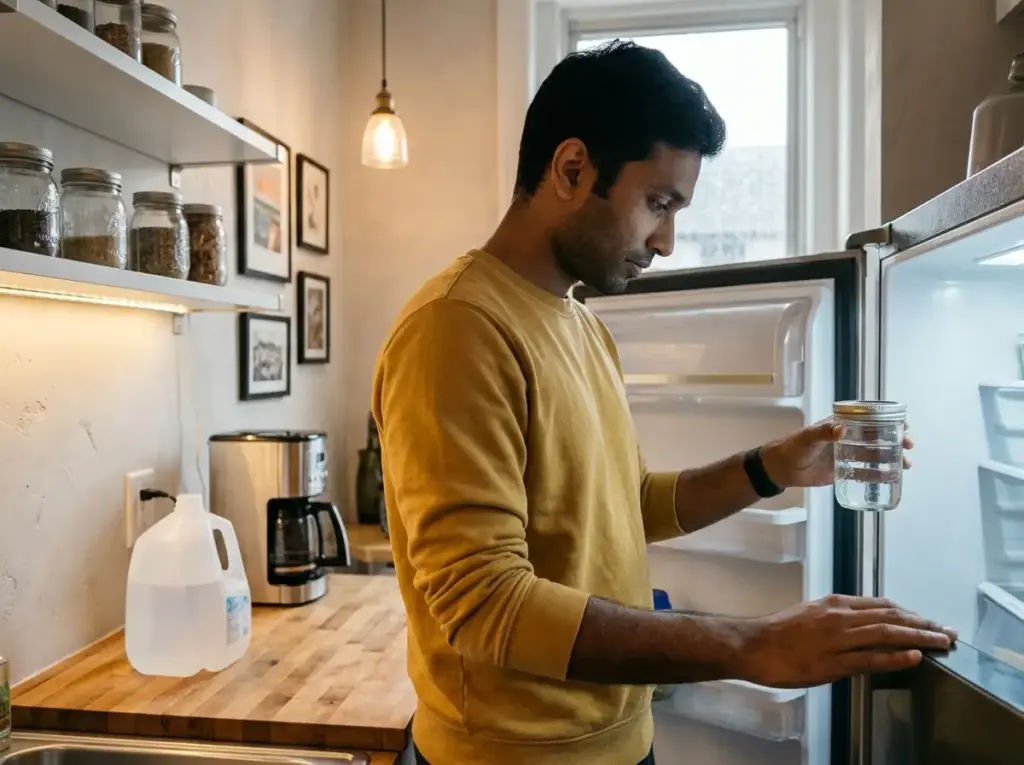
The jar goes cloudy and gets poured out
A concentrate does not stay what it was on the day it was made. Within days it can throw crystals at the bottom or turn faintly cloudy, and from then on the dose on the label is no longer the dose in the jar. The crystals are not dirt, but they are the sign to pour the jar out and mix a new one. Plan on remaking a concentrate about every two to three weeks, smell it before each use, and pour out anything cloudy without trying to rescue it.
Size the jar to the shelf life. A 10 g per liter jar doses 100 liters of the starter at 10 mL per liter, far more than a household drinks inside two or three weeks, so a 250 mL jar (2.5 g in 250 mL) is the better size, and it still doses 25 liters. A dropper bottle drifts in dose from bottle to bottle, and the same recipe quietly stops tasting the same, so a jar weighed in your own kitchen holds up longer than any bottle of drops.
A gallon on the counter is the first thing to go
A gallon of mixed water is the part of the habit that ages fastest. Distilled turns in about a week out of the fridge and about a month in it. A sealed jug of mixed water at room temperature lasts two to three weeks in a normal kitchen, and an open one a few days. The habit that survives is the one that refills the jug on a fixed day, with the smell test first every time, and it ends the argument about whether the water was fresh.
The kettle fares no better. Home-mixed water still scales over months, because scale forms when calcium carbonate leaves solution as water heats, so the white ring comes back whatever went into the kettle. That is a machine fact and the descale schedule stands, with the routine in the last section.
Why the pen reads wrong, and why the same number tastes different
A TDS pen estimates conductivity, not mass. Dip it in the 2.45 g per liter Epsom jar, which is 2,453 ppm of dissolved solid, and the pen reads about 750. It is a tool for tap water and the gallon, and judging a jar by its TDS number is reading the wrong instrument.
The same limit explains why two waters that both read 150 ppm can be two different drinks. The pen counts everything dissolved, and the cup only cares which ions those are: one 150 might be mostly bicarbonate and sodium, and the other mostly magnesium and sulfate. The first mutes the cup and the second lifts it. That is why the recipe adjusts by direction, taste first, and keeps the meter for what it does well, which is telling you that the base is near zero.
The Sachet Shortcut, Machine Care and What Each Route Costs in Effort
For the reader who will not weigh anything there is a shortcut, and it carries a trade-off. For everyone there is the machine, which scales whatever water goes in. This section lines the routes up in minutes, jars and flaws, with no dollar figure, and closes with the care the machine needs.

The sachet, in one step and with a fixed profile
Third Wave Water Classic Profile is a stick per gallon: tear it, pour it into a gallon of distilled water, shake. The pack holds twelve sticks, twelve gallons, with no scale and no jar. The profile is magnesium and calcium with low alkalinity, and an independent measurement put the alkalinity at 43 ± 5 ppm as CaCO3. That sits close to the SCA’s 40, and it is also a fixed alkalinity you did not choose, which suits a cup until the cup asks for 35.
Two flaws ride in the same bag. The profile is fixed, so one dial cannot move without the other, and it hides a hardness you did not choose. Value is mixed: where the cup does not change, the packet is a cost with nothing to show for it, and a blind tasting of it described the cup as high in acidity.
The two minerals of this article reach the same place at roughly a tenth of the cost per gallon. A sealed gallon of packet water holds two to three weeks in a normal kitchen.
What the recipe costs in effort against the packet
The recipe costs minutes and attention, and the packet costs a dial you can no longer turn:
- The recipe: two jars, a scale, about ten minutes a batch, and a concentrate remade every two to three weeks.
- The packet: one stick per gallon, nothing to weigh, and a profile that cannot be adjusted.
A third route skips both: bottled water, which asks nothing of you but a label. The two numbers to read on a bottle’s label are the same two this recipe adjusts, alkalinity and hardness, and a bottled water that lands near them is the cheaper alternative to mixing. For a reader with ten minutes before work, the honest ranking is by effort: a bottled water that reads right, then the packet, then the jars, and the jars are the only route where one dial moves without the other.
Scale, the descale schedule and a drip machine that runs cool
The USGS on what water hardness actually is fits in one line: “The simple definition of water hardness is the amount of dissolved calcium and magnesium in the water.” Heat is what turns that hardness into scale. Calcium carbonate comes out of solution as the water warms and coats the heater and the pipework, and the white crust in a kettle is the same thing a boiler collects.
So the machine is descaled on its maker’s schedule, whatever water goes in. The first sign that the schedule has slipped is the white film on the inside rim of the open water tank, which shows up long before the coffee tastes different. Some espresso machines also sense the water level through the conductivity of the water, and pure distilled water gives them nothing to read; the manual says which water the machine accepts.
A drip machine that runs cool is a separate fault, and no recipe fixes it. What a drip machine’s water reaches before it hits the grounds covers that side, and it matters as much as the minerals do for any home machine.
Mix One Liter Tonight, Taste Once, and Check the Jar in Two Weeks
Start from distilled water and weigh everything, because the cup you can repeat is the cup you can fix. The SCA’s four numbers set the target, and alkalinity is the one the cup feels first. The common one-line recipe is buffer-heavy, so the baking soda is the first number to move, and the two jars let the two dials move apart when one is enough.
Read the direction of the cup before touching anything, free checks first, and let the jar and the kettle decide whether the habit survives. The sachet is the shortcut, with a profile that stays where it was put.
Check the jar by smell and by eye before each dose, and watch the rim of the kettle and the water tank for the white film: the jar answers inside two or three weeks, the kettle over a season.
For tomorrow’s cup, mix the liter of the starter, brew with it, and taste once before touching any dial. If the cup is muted, take the baking soda down to 0.07 g and taste again; that is the whole first move. With the water settled, the question turns to how much coffee to put in once the water is right and to the other half of the water, the temperature it goes in at.
Frequently Asked Questions
01Can you give me a recipe for coffee brew water?
Stir 0.1 g of baking soda and 0.12 g of Epsom salt into 1 liter (about a quart) of distilled water and brew the same day. If the cup tastes muted, drop the baking soda to 0.07 g and taste again.
02How long does homemade coffee brewing water keep?
Mixed brew water keeps two to three weeks in a sealed jug, and a gallon of distilled turns in about a week out of the fridge. In the fridge distilled lasts about a month, and a concentrate about two to three weeks. Smell everything first and pour out anything cloudy.
03Do I really need a 0.01 g scale to mix coffee water?
Yes, for the dry recipe, because a kitchen scale cannot weigh 0.1 g of powder, and a pocket scale readable to 0.01 g can. With only a kitchen scale, dissolve 10 g of the mineral in 1 liter instead: 1 mL then carries 0.01 g, so a 0.1 g dose becomes 10 mL from a syringe.
04How much coffee for 8 oz of water?
Eight fluid ounces of water weighs about 237 g, so at a 1 to 16 ratio you need about 15 g of coffee. Grams are the unit that stays fixed; scoops vary with the grind and the roast.
05Will mixed brew water stop scale in my coffee maker?
No, home-mixed water still scales a machine over months, because calcium carbonate comes out of solution whenever water is heated. The machine’s descale schedule stands whatever water goes in.


How did your cup turn out?
No comments yet. Tell us what you changed — and whether the needle moved.