
We may earn a commission when you buy through links on this page. It never changes what we recommend. How we pick
On this page9 parts
- Three Off Cups Need Three Different Filters
- Read Your Own Water Before You Buy a Filter
- Which Pitcher Fixes Which Cup, and What Each One Gets Wrong
- Putting Minerals Back When the Cup Turns Thin and Sharp
- The Filter Your Machine Needs Is Not the One Your Cup Needs
- What the Cartridge Is Doing by Month Two
- The Arithmetic: Pitcher, Under-Sink, or No Filter at All
- Read the Report, Taste the Cup, Then Pick the Stage
- Frequently Asked Questions
The glass you just filled at the sink smells faintly of a swimming pool, the light roast in the hopper has started tasting of nothing, and there is a white ring inside the kettle. Three faults, one tap, and the search you type standing there, best water filter for brewing coffee, assumes the whole water filtration shelf shares a single answer. They don’t: activated carbon (a granular activated carbon fill or a pressed carbon block) pulls chlorine out of water and leaves calcium and magnesium exactly where they were, so a pitcher that cures the pool note does nothing for a chalky cup. What follows matches each off taste to the stage that removes its cause, reads your water before anything gets bought, names the pitchers with what each one gets wrong, and ends with the arithmetic, including the case where the right filter is none.
For a normal kitchen the default is a carbon plus ion-exchange pitcher, and the table says which cup calls for something else.
| The cup that is off | What it points to | The filter that fixes it | What that filter does not fix |
|---|---|---|---|
| A pool or chlorine smell | Chlorine or chloramine in the tap | Activated carbon, in any carbon pitcher | Hardness and alkalinity: minerals pass straight through |
| A chalky, flat cup on hard water | Too much alkalinity | Carbon plus ion exchange, the default pitcher; a near-zero pitcher or reverse osmosis when the tap is very hard | Near-zero water brews thin until minerals go back in |
| A thin, sharp cup on soft or stripped water | Too few minerals | No filter: minerals go back in, a little tap water first, then a packet | More filtering pushes the cup further the wrong way |
| White scale in the kettle or the machine | Hardness, heated out of the water | Reverse osmosis, or the machine’s own cartridge where it has one | A pitcher is a cup filter and barely slows a boiler’s scale |
Three Off Cups Need Three Different Filters
A cup that smells of the pool, a cup that tastes chalky and flat, and a cup that comes out thin and sharp all start at the same tap, and they ask for three different pieces of equipment. Reading the cup first makes the shelf make sense afterwards. The pool note is the one with a free test, so it goes first.
A swimming-pool smell is chlorine, and only carbon touches it
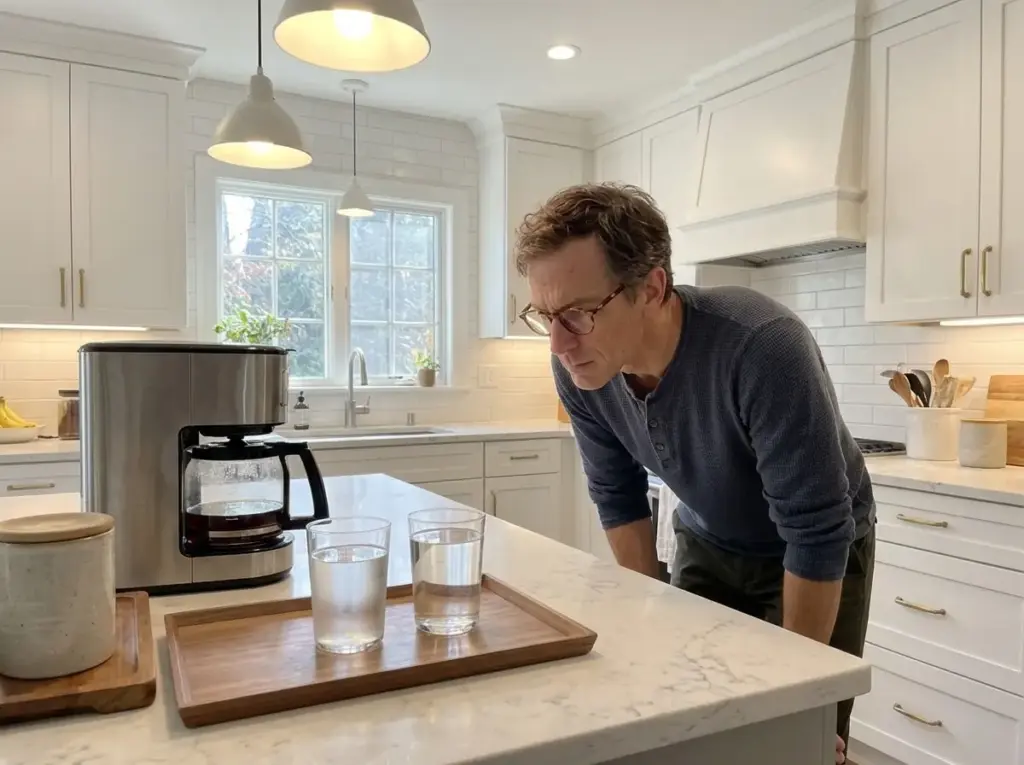
A cup that tastes faintly of the pool carries chlorine or chloramine, the disinfectants a utility leaves in the pipes, and both ride through the brew into the cup. According to the University of Nebraska’s guide to activated carbon filtration, “AC filtration can be effective in removing chlorine, chloramines, and some disinfection byproducts.” Calcium and magnesium are not on that list. A carbon pitcher is a chlorine filter and nothing beyond that, and a kitchen whose only fault is the pool note needs nothing else.
The pool note shows up in a glass of cold tap water before it shows up in coffee. Smell the glass once and trust that first breath, because the nose stops registering chlorine within seconds, then taste the first cup of the day. The two together say whether chlorine is in play at all.
Chalky and flat is too much alkalinity
Chalky and flat is a direction, and it points at alkalinity. Alkalinity is the water’s buffer, mostly dissolved bicarbonate: it neutralizes the acids the coffee gives up, so a tap with plenty of it leaves muted acidity, exactly what a light roast is for, and the cup comes out dull however fresh the beans.
The SCA wants alkalinity between 40 and 70 ppm as calcium carbonate (CaCO3), and an average American tap carries about 150; the water page that sets the target numbers lays out the wider list of waters. Only softening or reverse osmosis lowers it. A better bag of beans, a new grinder and a finer setting all fail on a cup whose acidity is neutralized before it reaches the tongue, and the cup stays flat until the water changes.
Thin and sharp on soft water is the opposite fault
The opposite fault shows up on soft water, and on water a pitcher has stripped too well: thin and sharp, with nothing in the water to carry the flavor out of the grounds. Sharp is a taste here, the acidity left standing without the sweetness that minerals help pull along behind it. More filtering takes this cup further the wrong way. The cure is minerals going back in, covered below with the free version first.
When the water was never the problem
Some cups don’t point at the water at all. A blind tasting of pitcher-style filters, run on tap water from three different regions, found a bigger difference from one region’s water to the next than from one filter to the next, and a dark roast barely moved with any of them.
A filter bought to rescue a dark roast on soft water buys very little. Before spending anything, run the free checks: what a glass of your own tap smells like before it ever meets coffee, then the grind, the roast date on the bag and a descaled machine. If those are clean and the cup is still off, the water is the next suspect.
Read Your Own Water Before You Buy a Filter
A filter bought without knowing the water is a guess, and the first reading costs nothing: the annual report your water utility publishes. The order of operations runs from that report to a cheap pen and only then to a filter, and only if the numbers call for one.
The free reading: the annual water report
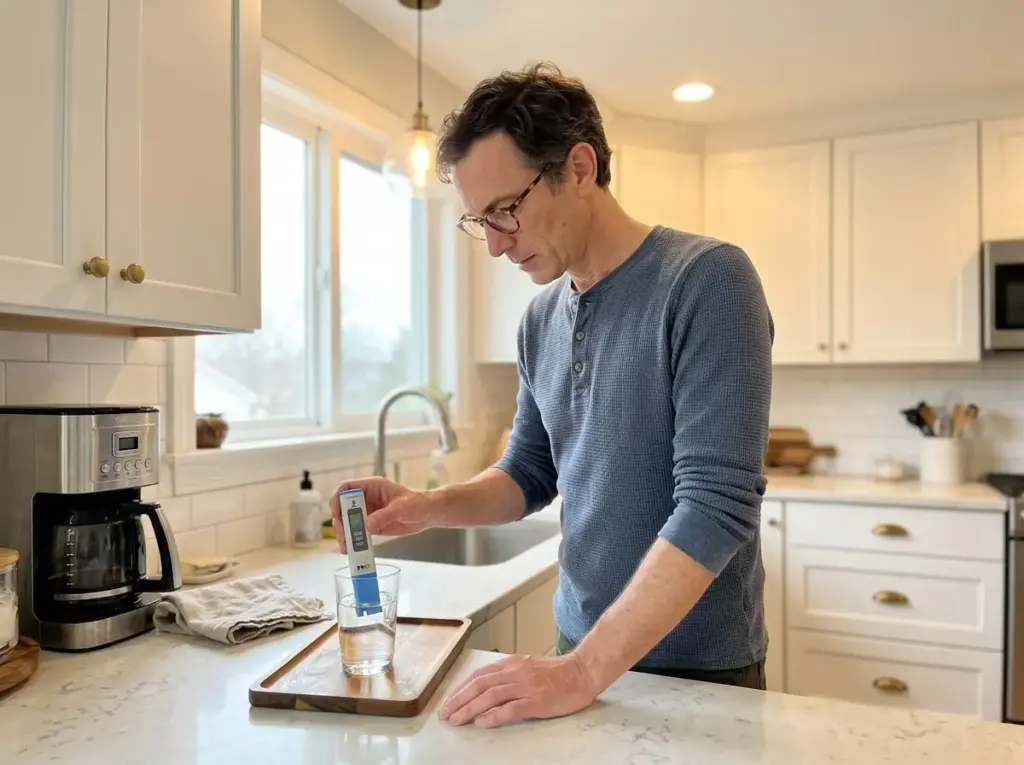
Every utility publishes a yearly water-quality report, usually as a PDF on its website. Look for the hardness and, where it is listed, the alkalinity. If hardness is given in grains per gallon, multiply by 17.1 to get ppm. A filter solves a number, and most kitchens have never looked at theirs; a report that already reads soft settles most of the question before a cart is opened.
The numbers to hold the water against
The SCA’s brewing-water standard is a band rather than a single figure: total dissolved solids around 150 ppm, with 75 to 250 acceptable; hardness between 50 and 175 ppm as calcium carbonate; alkalinity between 40 and 70 ppm. Below 75 ppm the cup goes hollow, and above 250 it goes muddy. An average American tap sits at about 170 ppm of hardness, which the SCA calls medium hard and which lands inside the band, and about 150 ppm of alkalinity, which lands far outside it.
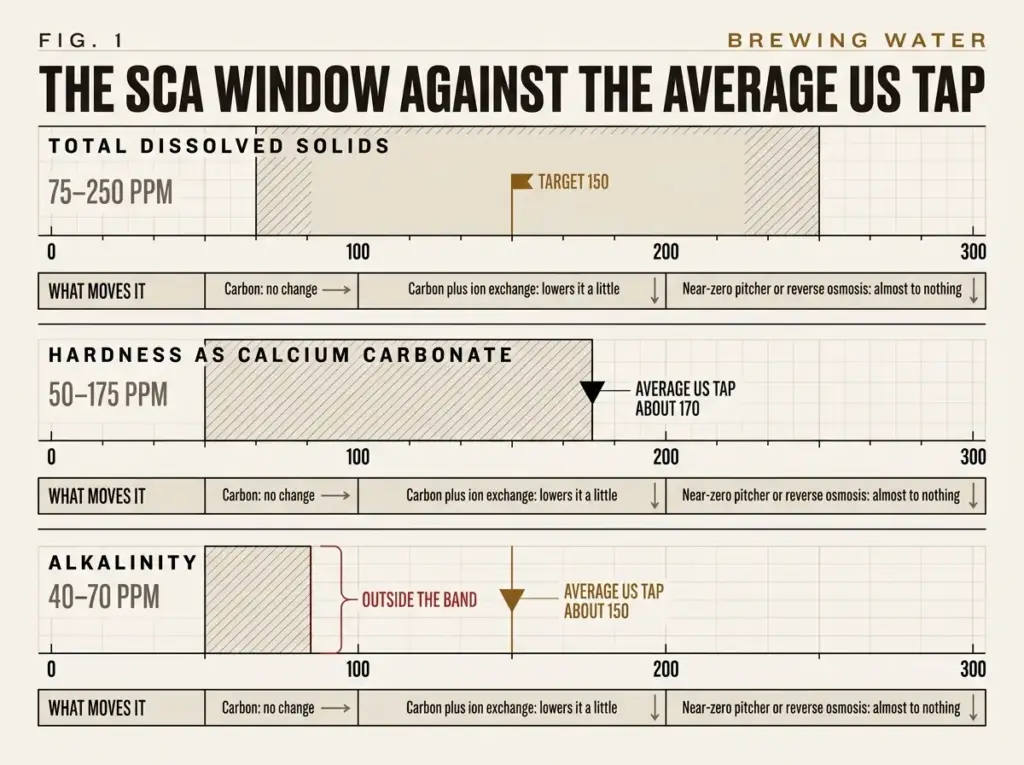
Hardness is the number the aisle talks about, and alkalinity is the number that decides the cup. The SCA’s own explanation of alkalinity and acidity says it plainly: keeping alkalinity in range matters far more than chasing pH. A pH strip tells you almost nothing about why a cup tastes dull.
A pen that tells you whether the filter is still working
A TDS pen reads total dissolved solids, and it turns a vague feeling that the filter seems done into a number. The HM Digital COM-80 EC/TDS HydroTester reads 0 to 5000 ppm within about 2 percent and compensates for temperature automatically, though a glass that has stood on the counter at room temperature (around 70°F, 21°C) is the honest sample, and the first pour from a just-run tap is the one that misleads. A pen can arrive slightly out of calibration, so check the first reading against the number on the water report; a cheaper pen does the same job.
A pen shows direction only. It cannot tell hardness from alkalinity, so a GH/KH drop kit, the same test kit aquarium shops sell, is the next step when the pen and the cup disagree: it counts general hardness and carbonate hardness separately. Its best work is in a household with an ion-exchange pitcher: read the tap, read the filtered water, and watch for the day the second number stops falling as far as it used to.
On the day a new cartridge goes in, write the pen’s reading for the filtered water on a strip of tape stuck to the pitcher. When the reading climbs back into the tens, the days between those two readings are that cartridge’s real life on your tap.
Which Pitcher Fixes Which Cup, and What Each One Gets Wrong
Once the numbers say what is off, the pitchers sort themselves by what they remove: carbon alone, carbon with a little ion exchange, and the ion-exchange pitcher that strips almost everything. Each pick below carries what it gets wrong, and the cheaper pitcher gets named wherever it does the same job.
Carbon only, for a chlorine note and nothing else
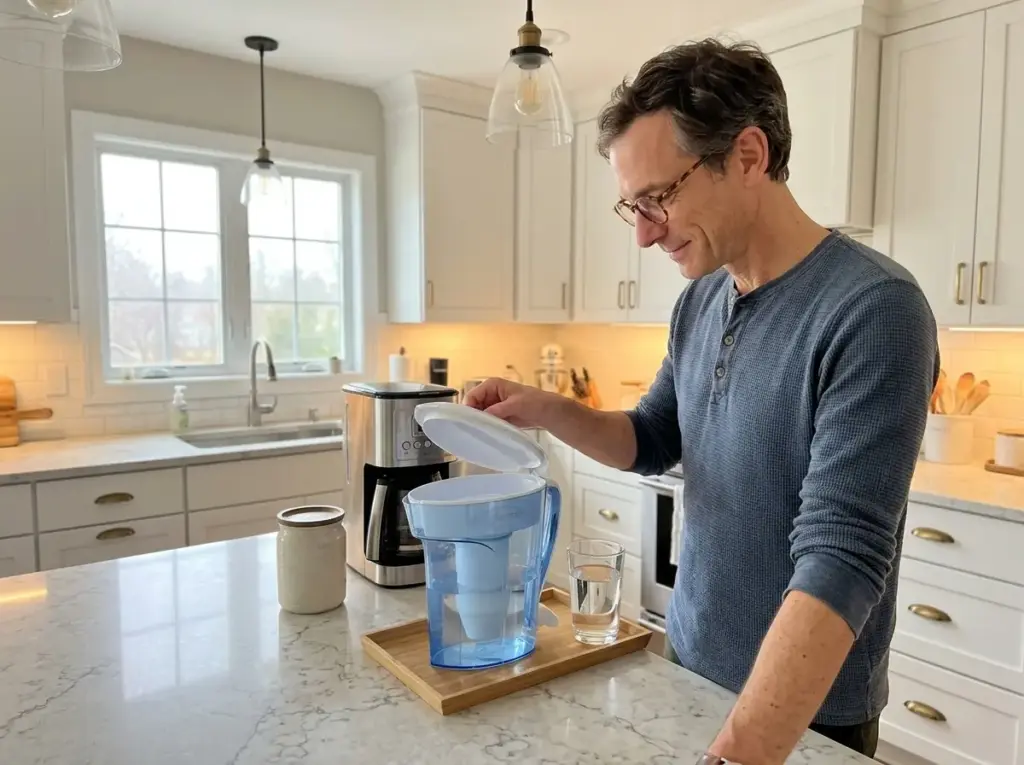
The chlorine-only answer is the Hydros 64 Ounce Water Filter Pitcher, a coconut-shell carbon block rated NSF 42 Class 1 for 90 percent chlorine reduction and 99 percent sediment reduction. It leaves the minerals alone on purpose, so a dark roast on water that is already soft keeps its body. Filtering is slow, the taste of the water is not to everyone’s liking, and a unit can leak past the filter chamber, while a plain Brita does the same chlorine job for less and softens a little. The shelf-bought alternative to any pitcher is bottled water, and which bottles are worth carrying home comes down to two numbers on the label (distilled water, purified water, spring water and mineral water land very differently).
A carbon-only pitcher barely moves a TDS pen, because carbon leaves dissolved minerals alone, so a flat reading proves nothing about it. Judge the carbon pitcher by the smell of its water and the ion-exchange pitchers by the pen.
Carbon plus ion exchange, the default for most kitchens
Carbon plus ion exchange is the default for good reason: carbon takes the chlorine, and a layer of resin swaps some of the calcium and magnesium for something gentler, so the pool note goes and the chalk eases. The pick is the Brita Small 6 Cup Water Filter Pitcher with Elite Filter. The Elite cartridge is rated for 120 gallons or about six months and certified to WQA and NSF/ANSI standards, and it is the one pitcher almost every kitchen already owns. It runs small at six cups, the plastic cracks on a small knock, and the lid can leak with it closed.
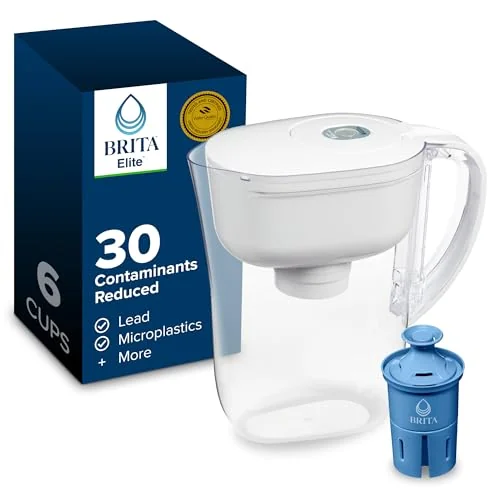
The PUR 7-Cup Pitcher Water Filter is the budget end of the same family: carbon plus ion exchange, with a filter rated for 40 gallons or two months. The pitcher is the small number and the cartridge is the running one: filter replacement is where the money goes, three PUR filters for every Elite across six months if the labels hold. The lid hinge breaks and the lid doesn’t stay put. On water that is only mildly hard, it does the work of the dearer pitcher, and a second pitcher kept for coffee alone makes sense when the family’s is always empty.
The near-zero pitcher, and why it brews flat on its own
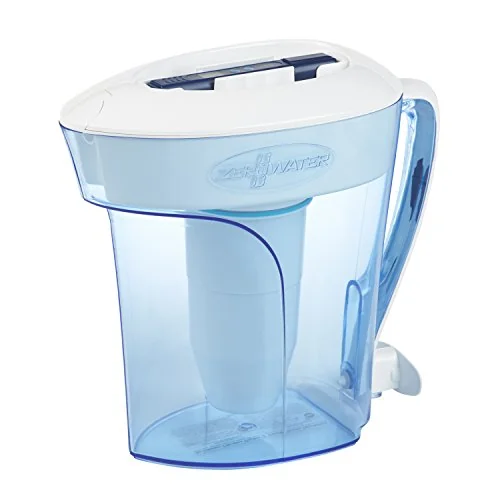
The ZeroWater 10-Cup Pitcher pushes ion exchange as far as a pitcher goes: five stages that take the water to nearly zero dissolved solids, with a TDS meter in the box. On a hard tap it is the pitcher that fixes a chalky, flat cup, and it makes the base water for putting minerals back. The first cup from it tastes noticeably thinner than the tap it came from, and that is the cup doing what the numbers said: water that clean needs remineralization.
It is also the obvious pick that stops being obvious on a very hard tap, where the cartridge lasts weeks (the figures are in the month-two section below). The cartridge life is short for the money on a hard tap, and a full pitcher can spill; when the water is only mildly hard, the PUR does the work for less.
Carbon fixes the smell, ion exchange fixes the chalk, and neither fixes a boiler; that job belongs to the machine and is covered below.
Putting Minerals Back When the Cup Turns Thin and Sharp
A pitcher that strips the water too well, or a tap that was soft to begin with, brings the opposite fault: a thin, sharp cup with nothing to carry the flavor out of the grounds, and why water with nothing in it brews a flat cup is the same story told from the other end. Another filter would only make it worse. The cup needs minerals, and the free way of putting them back comes first.
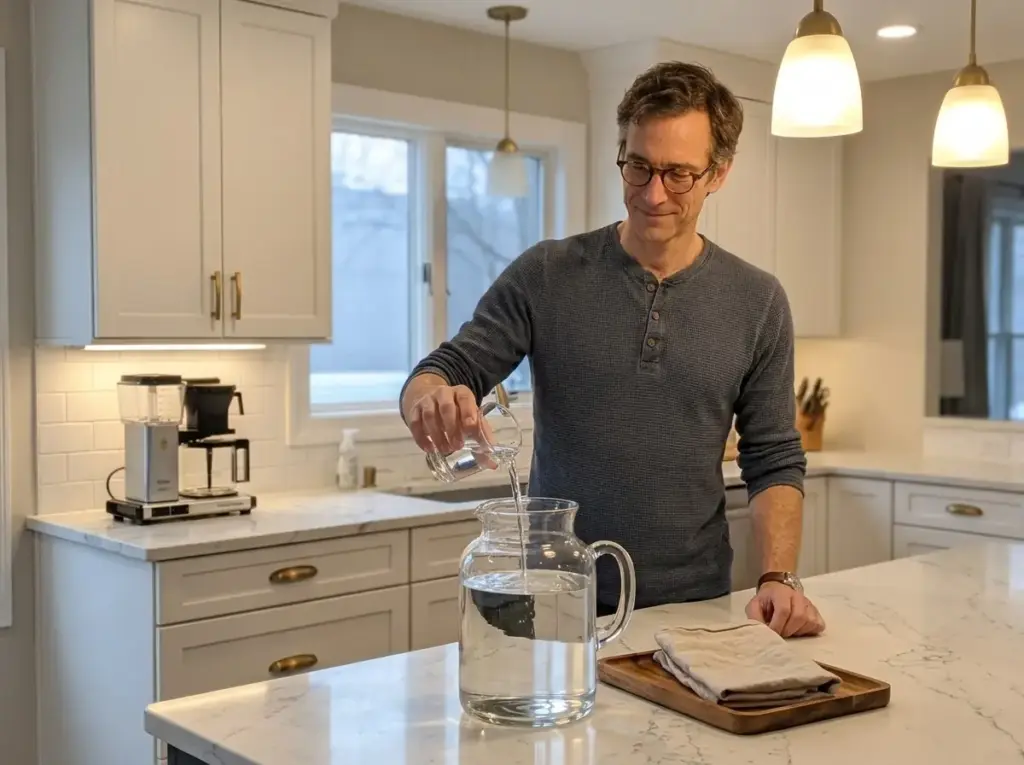
Mix a little tap water back into the stripped water. About a tenth is enough on a hard tap to restore hardness and alkalinity: roughly 13 fluid ounces of tap to a gallon of near-zero water. Brew the same pot the same way and taste. If the cup has filled out and the sharpness has settled, the water was the fault; if it has turned chalky again, the tap went in too heavy, and a splash less is the move.
When the tap-water mix doesn’t get there, the packet is next.
Third Wave Water Classic is dosed one stick per gallon of near-zero water, a magnesium and calcium mix with low alkalinity, and one box of twelve makes twelve gallons.
It works only if the base water really is near zero: dosed into a jug that was never stripped, it adds minerals to water that already had them, and nothing changes in the cup. The change in the cup is subtle, and whether a box is worth its price depends on how thin the base water brews, which is the argument for trying the free tap mix first. The pen’s reading will climb after the packet dissolves, but that number is not the test. The first pot brewed from the dosed jug, tasted against the old one, is.
Between two pots, move only the water: dose the jug, then brew with the same grind, the same ratio and the same machine, and taste before touching anything else. A cup that improves tells you the water was the fault, and a cup that doesn’t sends you back to the grind.
The Filter Your Machine Needs Is Not the One Your Cup Needs
A filter has two jobs that rarely call for the same equipment: making the cup taste right, and keeping the machine from scaling up. A carbon pitcher is a cup filter. Limescale in a boiler or a heating element is a hardness problem, and that one gets solved somewhere else.
Where scale comes from, and which filter stops it
Limescale is calcium and magnesium coming out of hard water when it is heated. The white ring in the kettle is the visible part, and the same crust forms on a heating element or inside a boiler where nobody looks. A pitcher that makes the cup taste better does nothing about the ring: carbon leaves hardness alone, and the ring keeps coming back until the hardness itself is addressed. An ion-exchange pitcher softens a little and slows the build-up. Only reverse osmosis takes hardness almost to zero at the tap, and a machine with a boiler to protect is the case where that matters. A descale light that comes on a little sooner each month is the same message arriving from the machine’s side. A whole-house water softener is a plumbing purchase aimed at scale, and it is a different decision from any pitcher on this page.
Under-sink reverse osmosis, and the water it throws away
Reverse osmosis forces water through an RO membrane that holds back dissolved solids, the calcium and magnesium that make up hardness included, and how much it holds back depends on the membrane and on the water going in. That makes it the stage that protects a machine, and it is also why its water brews flat until minerals go back in.
The bill is paid in water. According to EPA’s WaterSense page on point-of-use reverse osmosis, “a typical point-of-use RO system will generate five gallons or more of reject water for every gallon of treated water produced.” Inefficient units reach ten, and units carrying the WaterSense label must stay at 2.3 gallons of reject water or below, so the label is the only number that separates a good unit from a wasteful one.
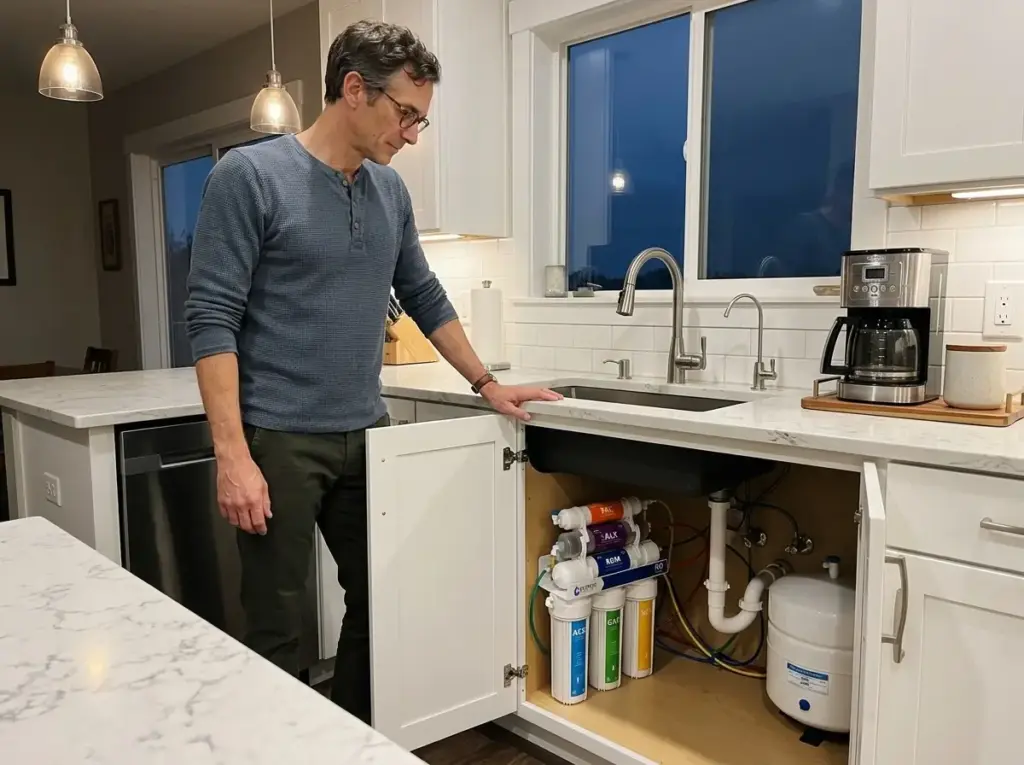
The Express Water ROALK5D is the honest answer for a very hard tap or a machine with a boiler to protect: ten stages, 50 gallons a day, and a final alkaline stage that adds calcium, potassium and magnesium back so the water doesn’t arrive stripped bare. Leaks are its flaw, up to and including water damage inside the cabinet, and the counter version of the same idea, a ZeroWater pitcher dosed with a mineral packet, costs a fraction of the install. For a kitchen with a drip machine and a moderately hard tap, that counter version is the better call.
The cartridge built into your machine, and the other filter that shares the word
Some machines carry a built-in water filter, an inline filter in the reservoir or in the water line, and the hardness number set in the machine decides when it asks to be descaled. The manual is the authority on both, and a pitcher is no substitute for that cartridge. Some carry a scale inhibitor, which changes how scale forms rather than removing the hardness, and a filter head with a bypass setting, a blending valve, sends bypass water around the cartridge, the same idea as the tap-water mix above; how a machine’s own cartridge and its hardness setting work on one model shows the arrangement in practice. How much hardness an espresso machine should be fed is argued both ways, soft water to spare the boiler against some hardness for the machine’s own sensors, and only the manual and a test settle it for a given model.
The other filter with the same name does a different job entirely. The paper or permanent basket in a drip machine cleans the coffee and never touches the water, and paper and permanent basket filters, which clean the coffee and not the water covers what each leaves in the cup.
What the Cartridge Is Doing by Month Two
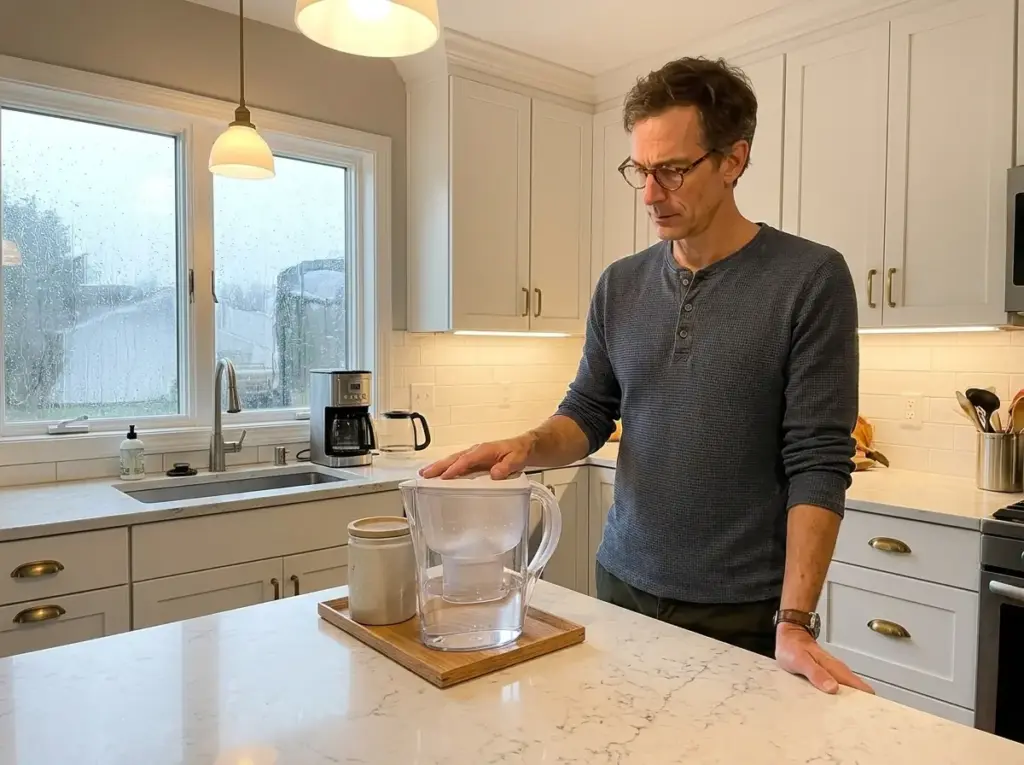
Filter replacement dates are the number a tap makes untrue. The label on the box describes a cartridge in a soft-water kitchen, and the one on your counter is working against your tap. This section is the weeks before the printed date: what happens to the cup, and to the pitcher’s speed, while the label still says everything is fine.
The label’s gallons and the hard-water gallons
The ZeroWater cartridge’s own rating runs up to 40 gallons on low-TDS tap water, 8 to 15 gallons once the tap passes 300 ppm, and 15 gallons as the certified service life on its performance data sheet. On a hard tap the 40-gallon box is fiction, and 15 is the number that decides whether the pitcher is cheap or expensive. A household that brews two full pots a day goes through roughly a gallon, so 8 to 15 gallons is one to two weeks, and 40 gallons is about six.
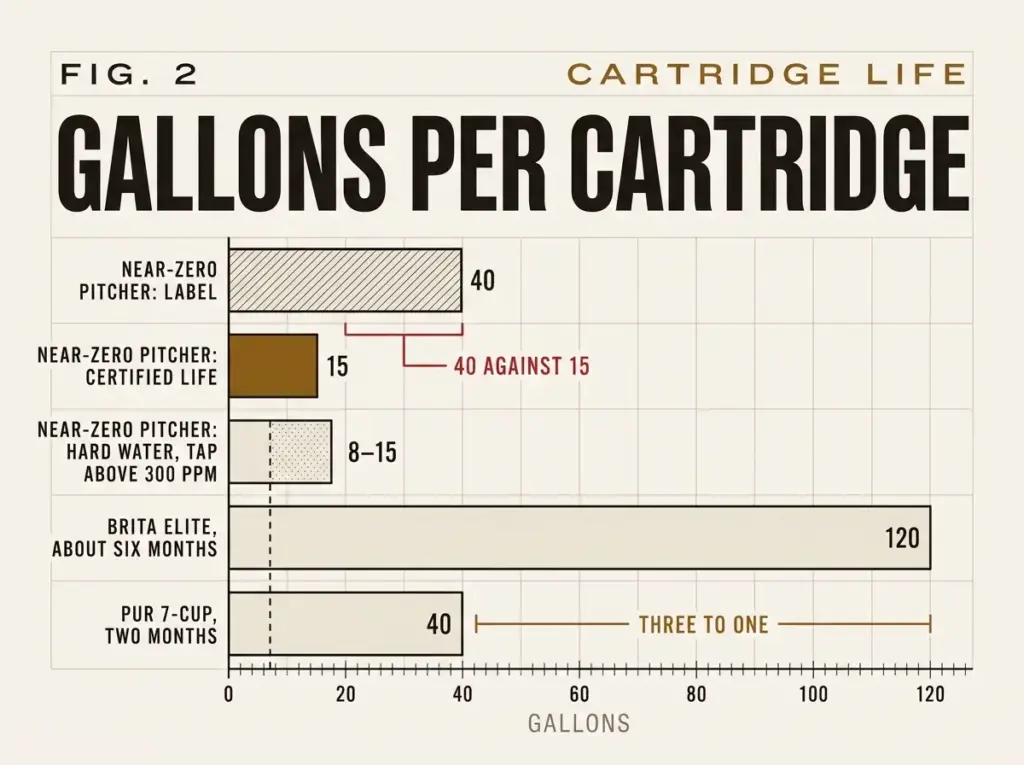
The same number swings the other way on a mild tap. Around 120 ppm of hardness can stretch a cartridge to about forty gallons, and spread over ten months of near-daily use that is only an eighth of a gallon a day, a couple of mugs and not a household’s pots. The label’s gallons depend on the tap, and so does the date on the calendar.
Two pitchers on the same shelf differ threefold: the Brita Elite filter is rated for 120 gallons or about six months, the PUR 7-cup filter for 40 gallons or two months. A commercial cartridge’s own capacity table makes the same point in liters, with capacity falling in proportion as hardness climbs. A one-cartridge-a-year plan holds only on soft water.
When a full cartridge starts doing harm
Carbon works until it is saturated, and then it reaches breakthrough. The University of Nebraska guide cited earlier explains that contaminants can move back into the water at that point, and that some units let treated water out worse than untreated; most household units don’t count the gallons, so nothing on the pitcher says when that starts. The cartridge’s last weeks are the ones that taste worst, because breakthrough returns what the carbon had been holding.
For an ion-exchange pitcher the date is readable: it is the morning the pen that used to read near zero starts reading in the tens. For a carbon pitcher, the signs are a slower upper chamber that takes a few extra minutes to drain and a cup that tastes a little more like the tap again. Scale is the cost of the hardness a tired cartridge stopped catching, and what a scaled-up machine does to the brew temperature is worth a read before the descale that the filter was meant to postpone comes due.
When the cup drifts back toward flat around week six or eight, read the pen before anything else. If the filtered water now reads well above where it started, the cartridge is spent, and a fresh one should bring back the fuller cup within a pot or two. If the pen still reads near zero and the cup is off anyway, the cartridge is innocent and the grind or the beans are the next suspects. Swapping the cartridge, the beans and the grind in the same week would leave no way of knowing which one worked.
The Arithmetic: Pitcher, Under-Sink, or No Filter at All
Everything above reduces to a few comparisons of what each choice costs in cartridges, in water and in counter space. This section runs them for a kitchen using a gallon a day, roughly two full pots from a drip coffee maker, a pour-over, or the water for a jug of cold brew, and ends with the answer nobody sells: the water is fine and a filter would change nothing. Scale the numbers down if the household makes one pot.
Pitcher against bottled, in cartridges and trips
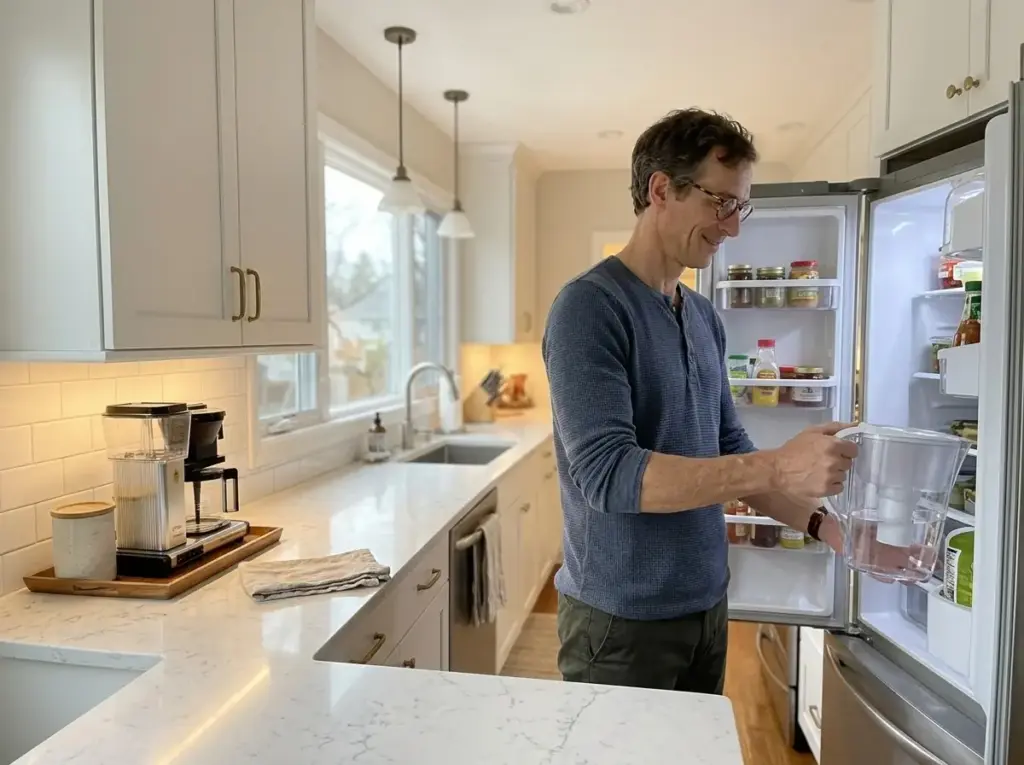
A gallon a day is 365 one-gallon jugs a year carried in from the car. The same year through a pitcher is cartridges: about three Brita Elite filters at 120 gallons each, about nine PUR filters at 40, and on a hard tap about two dozen ZeroWater cartridges at 15.
Divide today’s price for each cartridge by its gallons for the cost per gallon, and compare that with the jugs. (The Brita’s six-month label already assumes about two-thirds of a gallon a day, so at a full gallon the cartridge turns over in about four months.) A deionized water refill from a store is the budget version of bottled water: no membrane to replace, with minerals added at home.
The pitcher that gets refilled is the one that stays on the counter, and the one on the high shelf goes unused. Convenience decides more than the cartridge does.
Pitcher against under-sink, in membranes and drain water
The under-sink system trades a pitcher’s cartridge every month or two on a hard tap for a membrane that is a yearly part, and for a drain that throws away water to make water. At the typical five gallons of reject for every gallon made, a gallon a day sends more than 1,800 gallons a year to the drain; at the WaterSense ceiling of 2.3 it is about 840. Against that, the pitcher’s two dozen cartridges a year on a very hard tap looks like a lot of plastic waste, and the single membrane looks tidy. The expensive route is the honest answer only when the hardness is high enough to wear cartridges out fast or a boiler has to be protected; on a moderate tap the cheap pitcher does the same job.
When the answer is no filter at all
If the water report already reads inside the SCA’s band, a plain pitcher at most for a chlorine taste is all the water asks for, and an under-sink filter buys nothing the cup can taste. The problem may be the grind, the beans or a dirty machine, and those checks come first.
Soft water is the mirror case. A tap that already reads under 75 ppm of total dissolved solids has too little in it, and a near-zero pitcher or a membrane would take it lower still; the thin, sharp cup that results wants minerals, and a filter of any kind is the wrong purchase. A filter is worth its counter space when the cup points at the water, and not before.
Read the Report, Taste the Cup, Then Pick the Stage
Match the off taste to the stage that removes its cause: carbon for the pool note, ion exchange for the chalk, minerals for the thin and sharp cup, and reverse osmosis only when a boiler needs protecting or the tap is hard enough to eat cartridges in weeks. Read the water report and a pen before any purchase, treat every label’s gallons as a soft-water number, and remember that the cheap pitcher does the same job as the dear system more often than the shelf admits.
After a cartridge goes in, come back to two numbers: the pen’s reading for the filtered water, and how long the upper chamber takes to empty. A few weeks of daily use on a hard tap, a few months on a soft one, is when either starts to drift, and the white ring in the kettle says whether hardness is still getting through.
Tomorrow’s first move costs nothing: read the utility’s water report, taste the first cup, and let the numbers decide whether the pitcher, the minerals or nothing at all deserves attention next. Then move only the water and brew the same pot the same way. A cup that has turned sweeter and fuller means the water was the fault; a cup gone chalky again means the minerals overshot. The mineral packet and the near-zero base water above are where to go if it turns thin.
Frequently Asked Questions
01What is the best water filter for brewing coffee?
A carbon plus ion-exchange pitcher is the default for most kitchens: carbon removes chlorine and the resin softens a little. Choose carbon alone for a chlorine note on soft water, and reverse osmosis only for very hard water or a machine with a boiler. Match the filter to the off taste.
02Does a carbon filter soften water for coffee?
No. Activated carbon removes chlorine, chloramines and some disinfection byproducts, but not calcium or magnesium, so a chalky, flat cup stays chalky. That job belongs to ion exchange or reverse osmosis, and the pitcher label should say which one it carries.
03Is ZeroWater good for brewing coffee?
It strips water almost to nothing, which fixes a chalky cup on hard water but brews thin and flat by itself, so minerals have to go back in. Mix in about a tenth of tap water or dose a mineral packet, then taste the first pot against the old one.
04How do I know when to change a water filter cartridge?
By the water, not the date: a pen that used to read near zero now reads in the tens, or the pitcher tastes like the tap again. On hard water that arrives well before the label’s gallons, so the date printed on the box is only a ceiling.
05Do I need a water filter if my tap water tastes fine?
Not necessarily: if your water report falls inside the SCA’s band and the cup is neither flat nor off, a filter changes very little. Check the grind, the roast date on the bag and a clean machine first, then the water.

How did your cup turn out?
No comments yet. Tell us what you changed — and whether the needle moved.