



We may earn a commission when you buy through links on this page. It never changes what we recommend. How we pick
On this page8 parts
- Why Distilled Water Brews a Flat Cup
- Which Machine Can Take Distilled Water
- Cut It With Tap Before You Buy Anything
- Putting Minerals Back, by the Gram
- Where Distilled Sits Next to Tap, Filtered and Spring Water
- What a Jug of Distilled Does After Month Two
- Brew Half Jug, Half Tap Tomorrow, Then Taste Both
- Frequently Asked Questions
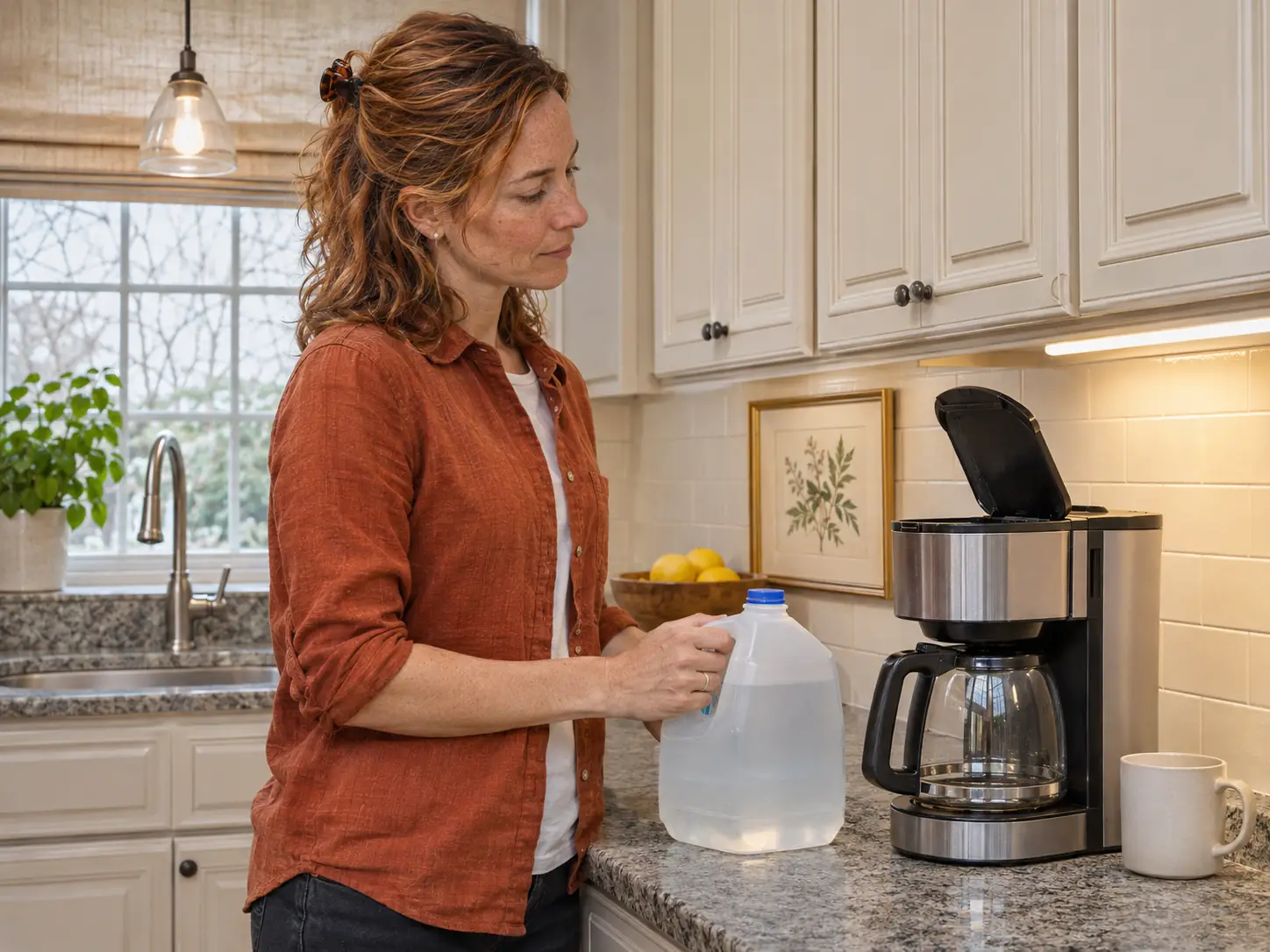
Can you use distilled water for coffee? You can, and the cup tells you what you did within one sip. Somebody fills the tank from the gallon bought for the steam iron, on the logic that the purest water must make the cleanest pot, and the coffee comes out flat, with nothing in the middle, while the beans take the blame. The minerals in water are what pull flavor out of the grounds, and distilled water carries almost none, so the same beans taste thinner and sharper at the edges before the grind or the ratio has done anything wrong.
What follows says which machines tolerate it, starts with the free fix (cutting it with tap), moves to a weighed pinch of minerals, and ends with what a jug of distilled does to a machine by month two.
Quick Answer
Yes, distilled water brews coffee, but on its own it makes a flat, hollow cup because it carries only 0–5 ppm of dissolved minerals and the SCA’s brewing range starts at 75. Cut it with tap, or weigh a small pinch of minerals back in. Keep it out of espresso and pod machines whose manual forbids it.
Why Distilled Water Brews a Flat Cup
Distilled water is the cleanest thing that comes out of a jug, and that is exactly what goes wrong in the brew: the cleanest water is not the best brew water, and the first sip says so. This section covers what the jug leaves out and which way the cup ends up off.
What Distilled Water Leaves Out
Distilled water is steam that was caught and cooled back into a liquid, and the trip leaves everything else behind: the calcium, the magnesium, the bicarbonate. What remains sits at 0-5 ppm of total dissolved solids. The SCA water standard for brewing runs 75-250 ppm, with about 150 ppm as the working target, so the jug starts at least 70 ppm under the floor of the range. Deionized water lands in the same near-zero place, and purified water or reverse osmosis water can too, depending on the label and the system.
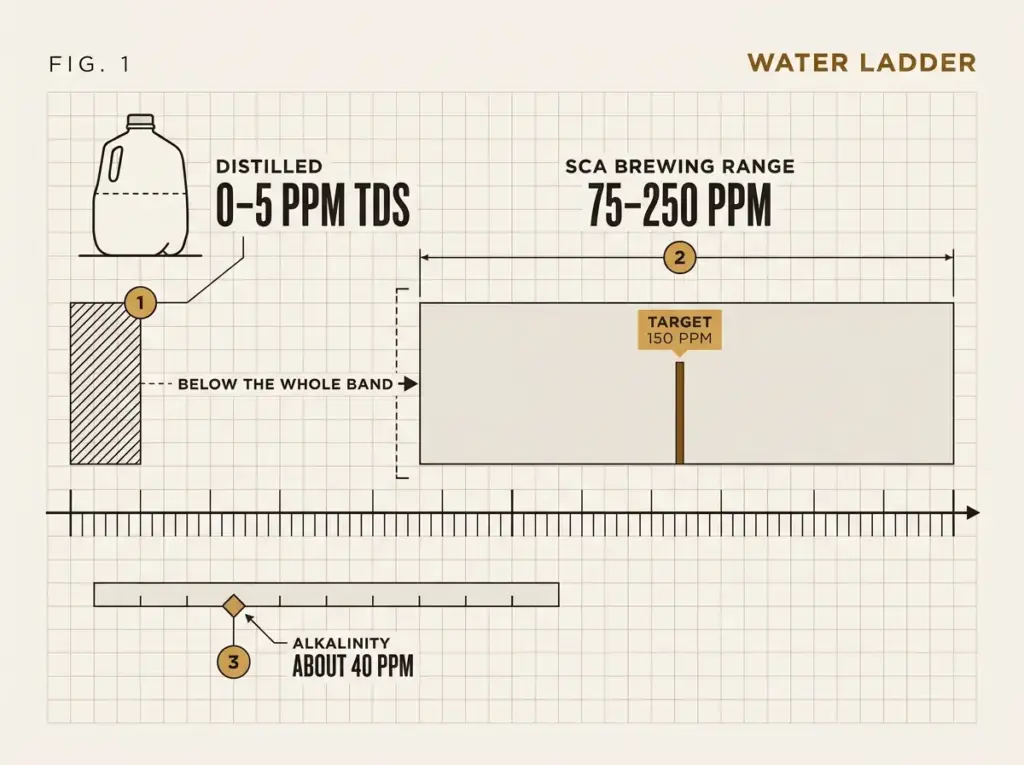
A TDS meter dropped in a glass of it reads almost nothing, and the reading is easy to misjudge: pure water has no ions for the probe to count, so a zero TDS reading is the absence of everything the water was supposed to carry, and nothing to chase. Whether distilled water is right for you to drink is a question for your doctor, and everything below stays with the cup and the machine. For the wider list of waters, start from what to brew with in the first place.
What the Minerals Do in the Brew
Minerals are not flavor. They are the hands that pull flavor out of the grounds. Calcium, magnesium and sodium ions latch on to flavor compounds, and a 2014 study of how dissolved minerals pull flavor compounds out of coffee puts numbers on how strongly each one binds.
Distilled water has no hands. Every flavor compound is still sitting in the grounds, and the water cannot grab it, so extraction runs short with the beans, the grind and the ratio all unchanged.
The SCA’s write-up reports a tendency toward underextracted flavor at total hardness under about 40 ppm as calcium carbonate, with the caution that measured extraction barely moves across ordinary hardness. The jug sits far under that line, and a cup from the pantry gallon can taste dull enough that the beans get replaced for nothing.
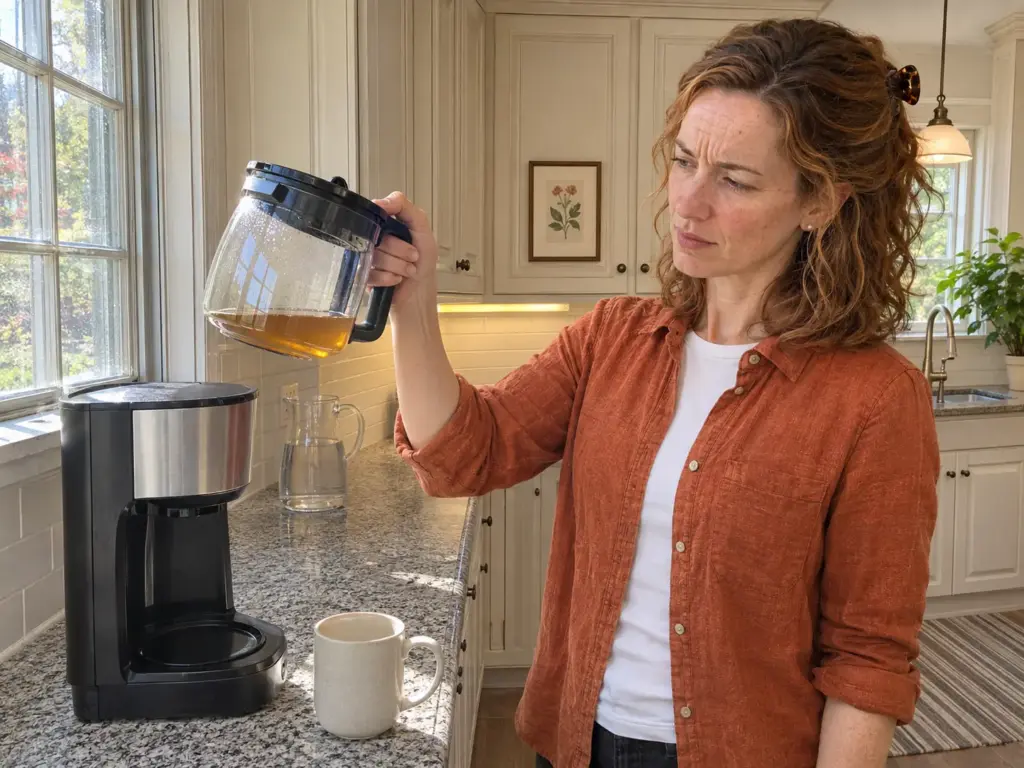
How a Flat, Hollow Cup Tastes, and Which Way It Is Off
The direction is under-extracted, but it does not taste like a coarse grind’s plain sourness. It tastes thin in the middle, with a sharp edge, and a little sour at the finish. It is flat coffee with a thin, watery feel, and not the drying, astringent finish of an over-extracted pot either.
The edge is sharp because nothing is left to buffer the acids: no bicarbonate means the sharp acidity that is there reads angular instead of round. The SCA’s own explanation of alkalinity and acidity says it matters far more to keep alkalinity inside its range than to chase a pH.
A hollow, sharp cup is also what a low brew temperature gives, and cool water gives it too, so a pot that comes out hollow after the water was switched is a water problem first. A finer grind would nudge the cup back toward the middle, but it chases the symptom and spends the setting that was right.
The cheapest test is a taste, not a purchase. Brew one pot from the jug and one from plain tap, same beans, same grind, same amounts, and taste them side by side before anything else moves. If the tap pot has a middle and the jug pot does not, the water is the whole story.
Which Machine Can Take Distilled Water
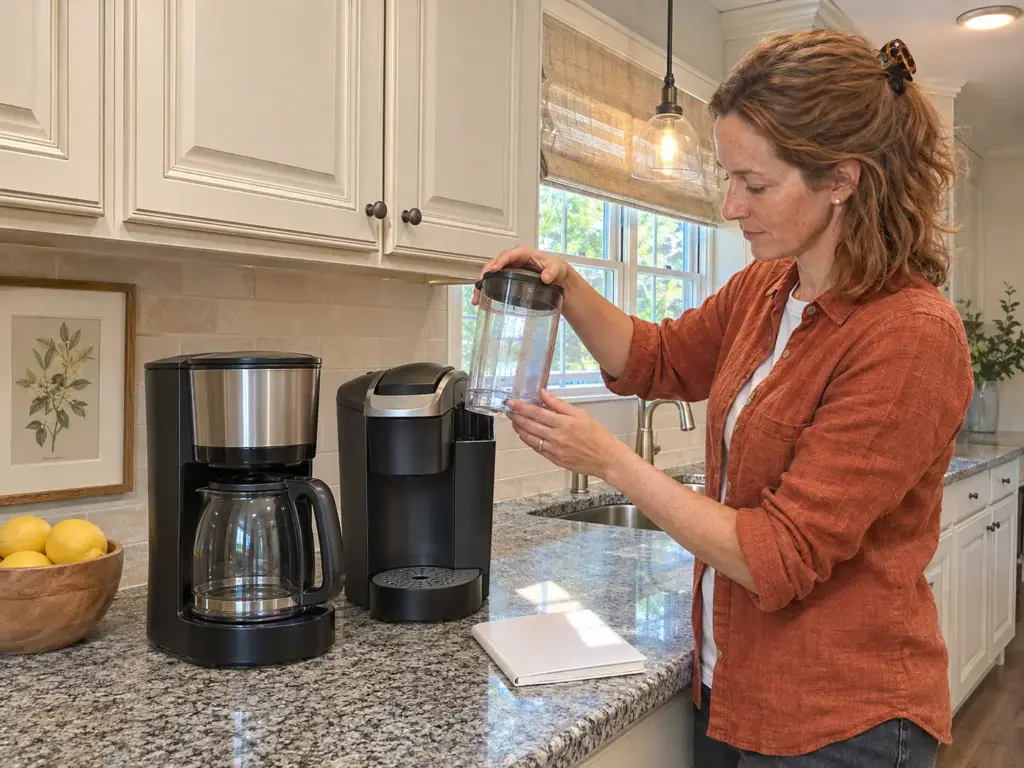
The shouting match online is “absolutely not” against “the best water there is”, and both are right about a different machine. A drip pot, a pod machine and an espresso machine hold three different answers, and the reader owns one of them.
The Plain Drip Machine
A plain drip machine has no pressure and no autofill probe, so it is the least strict case. Distilled water goes through it, and the only price is the flat cup of the last section, which the two fixes after this repair. If the pot also runs cool, the hollow taste doubles up: a drip machine judged by the water temperature it makes is the place to check, and why a drip machine’s first cup runs cool is the next dial after the water. A pour-over kettle has no sensor at all to confuse, so for pour-over the cup is the only thing at stake.
| Machine | What distilled does there | What to do |
|---|---|---|
| Plain drip machine | Brews fine, with a thin, hollow cup | Cut it with tap or add a weighed pinch of minerals |
| Pod machine with a water reservoir sensor | The level sensor can misread a mineral-free tank | Use filtered tap and follow the manual |
| Espresso machine with a boiler level or autofill probe | Goes after the metal parts and the probe | Use ordinary water and descale on the maker’s schedule |
Pod and Espresso Machines That Watch Their Own Water
These are the strict cases. A pod machine that reads the reservoir and an espresso machine with a boiler level or autofill probe depend on the water carrying a trace of ions, and mineral-free water is exactly what confuses that sensor. How a Keurig’s water lines and descale light behave shows how much of the machine hangs on the reservoir. A tank that never reads empty is a machine that pours short or runs dry.
The metal is the other half, and the name for it is corrosion. Water with no minerals in it goes after what it touches, and in an espresso machine that is the brass and steel of the boiler and the probe. The usual repair is ordinary water and a descale on the maker’s schedule, so a machine that has already been filled with distilled mostly needs its tank emptied, rinsed and refilled.
What the Manual Says, and Why Makers Say No
Machine makers answer “no” to distilled, and De’Longhi’s guide answers with an exclamation point: the process removes the magnesium and calcium the coffee needs.
The maker is no neutral referee. The same guide puts brewing between about 181 and 198 °F (83 to 92 °C), under the SCA’s 195-205 °F (90.5 to 96 °C) brew temperature at the grounds. But on the manual’s water line the maker wins over any blog, this one included: a machine filled against its manual is the owner’s risk, and the warranty wording, more than the chemistry, is what decides who pays. What breaks first on a De’Longhi is worth a read before the first fill.
Open the manual to the water line before the first fill and read what it says about distilled. If it says no, the question is closed, and filtered tap is the better route.
Cut It With Tap Before You Buy Anything
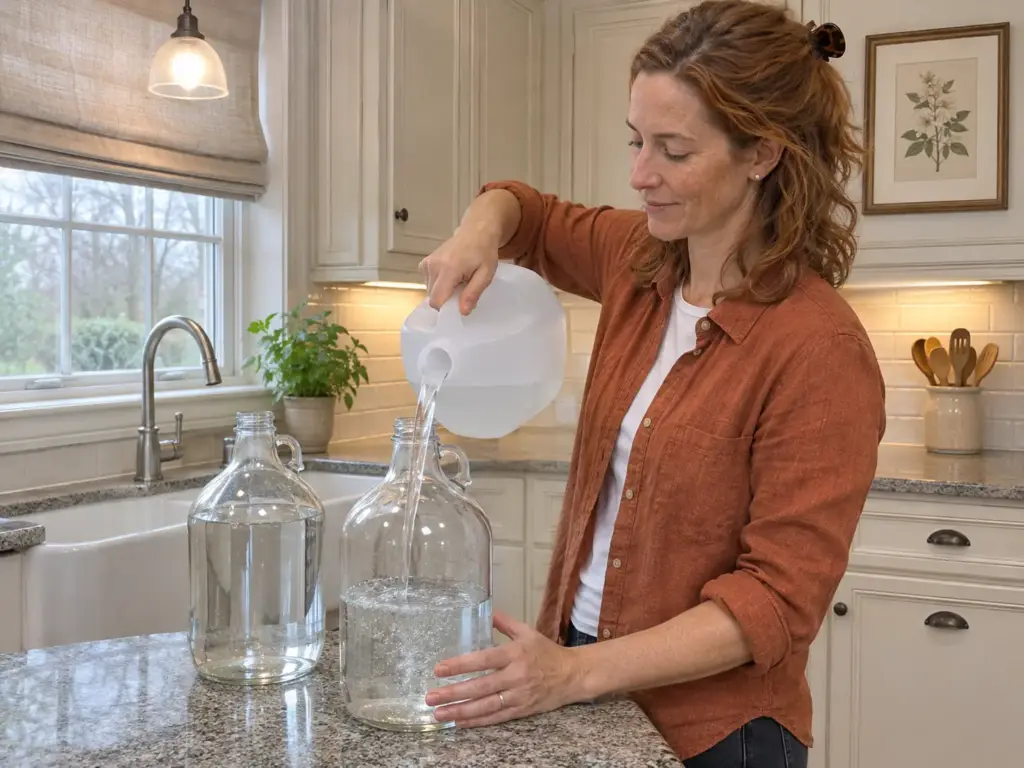
The free fix goes first. The jug in the pantry is already paid for, and so is the tap; mixing the two costs nothing and can be tasted the same morning.
Half and Half, in Numbers
Average US tap runs about 150 ppm alkalinity and 170 ppm total hardness, the SCA’s own figure. Half distilled and half of that tap lands near 75 ppm TDS and about 85 ppm hardness, the bottom of the SCA’s range, and one gallon of distilled becomes two gallons of brew water. The tap question is settled on another page, with the glass test for the tap.
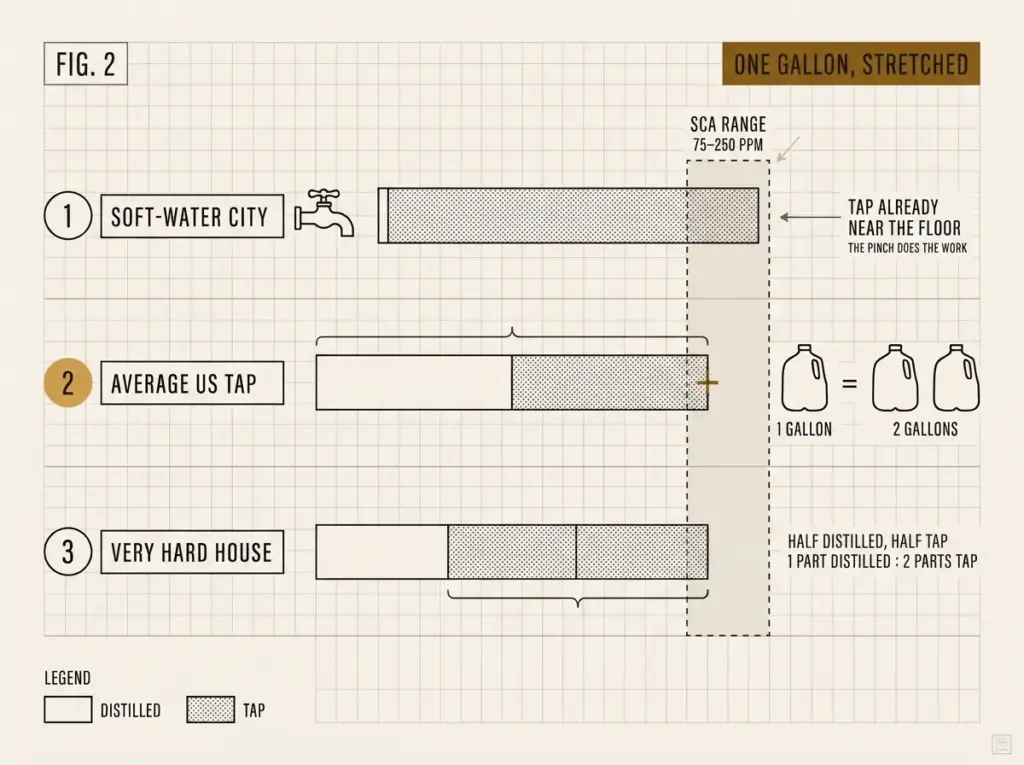
Tank size sets how far the gallon goes.
A gallon is 128 ounces; a 12-cup pot on a drip machine’s 5-ounce cup holds 60, so the two gallons of blend fill about four pots. How much water a coffee maker takes per cup covers the rest of that arithmetic. Brew one pot from the blend and taste it against a plain-tap pot: the blend should have its middle back and a rounder edge. If it is still thin, the next move is the pinch under the minerals heading.
Mix the blend in a clean jug the night before and brew from it in the morning with nothing else moved. The one thing that changed is the water, so the taste gap belongs to the water.
Very Hard Water, Soft Water, and Where the Cut Stops Helping
The cut is arithmetic, and it points two ways. A house whose tap runs far past the range, say 300 ppm TDS, wants one part distilled to two parts tap, which lands near 200 ppm and back inside it. A soft-water city is the opposite case: if the tap is already under 75 ppm, adding distilled pushes it lower, the same flat cup with extra steps. There the better route is a measured pinch of minerals, added to the tap or to the jug.
Checking the Blend With a TDS Meter
A meter turns a guess into a number. The HoneForest Digital TDS Meter is a handheld unit that reads TDS, EC and temperature across 0–9990 ppm with a titanium probe, and it is the cheapest way to see the 0 in the jug and the figure on the blend. Its limit belongs in the same breath as the recommendation: it is a salinity meter, and what the SCA says a TDS meter can and cannot tell you includes that such meters read about 30 percent under the standard coffee testing uses. The SCA’s own example is a salinity meter showing 132 ppm for water that is about 187 ppm by that standard, so a blend that reads short of 75 on this meter may already be inside the SCA’s range.
A TDS meter also says how much dissolved material is in the cup of water, never what the material is. A meter that shows the same number for tap and for filtered water is reading a floor.
Putting Minerals Back, by the Gram
If tap is too hard or too soft to cut with, minerals can go back in by weight. The dose is small enough for a scale and large enough that overshooting is possible, and overshooting brings the flat cup back, only rounder.
The Pinch per Liter
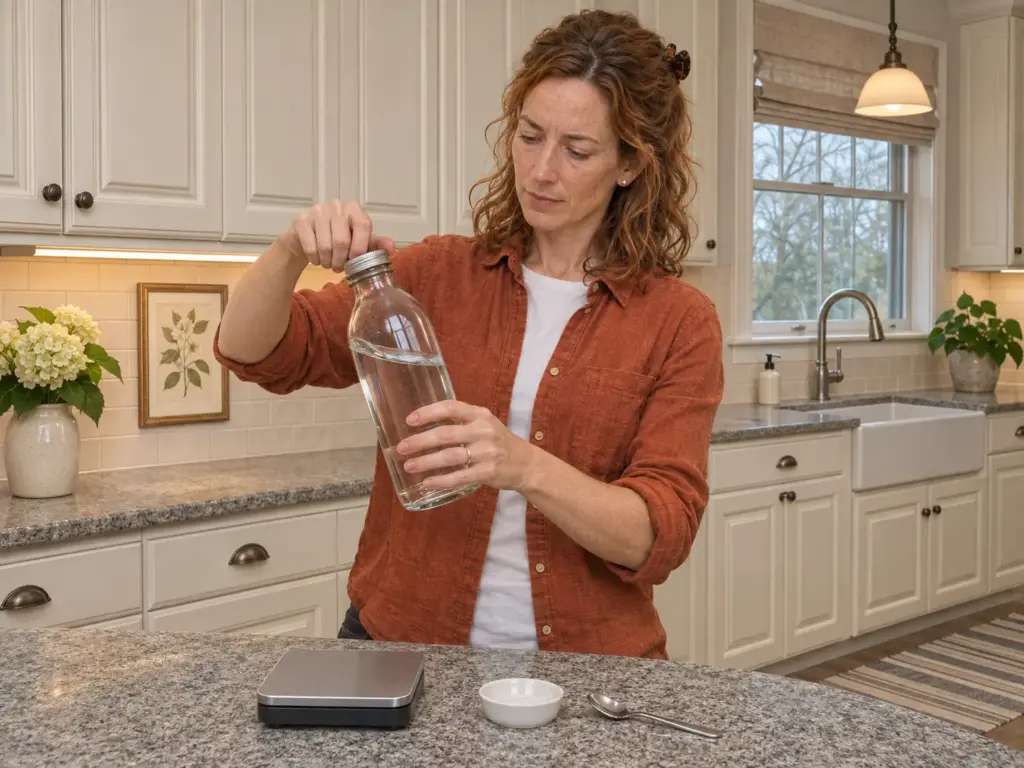
The published starter dose is 0.1 g of baking soda plus 0.12 g of Epsom salt per liter of distilled water, a little over a quart. It lands near the low end of the SCA’s alkalinity range with little scale risk.
For a gallon, which is about 3.8 liters, that is roughly 0.38 g of baking soda and 0.45 g of Epsom salt. That is under a gram, so an ordinary kitchen scale that steps in whole grams cannot hold it; a scale that reads to 0.01 g can. It is the same arithmetic as the brew ratio, grams per liter, with smaller numbers: a 1:16 ratio is about 62 g of coffee to a liter of water, and the minerals are a few hundredths of that.
A concentrate route exists for people who would rather weigh once a month: 10 g of potassium bicarbonate dissolved in a liter of distilled water, then 1 mL of that concentrate per liter of brew water. There is more than one water recipe in circulation, and this one buffers acidity more than it adds fullness.
Weigh the water too. A liter is 1,000 g, so set the bottle on the scale, tare it, pour to 1,000 g, add the dose, and write the dose on the bottle. A pinch weighed once stays right; the unmeasured second pinch is the one that overshoots.
What Happens When You Overshoot
Overshooting is the alkalinity story again. The SCA puts the target near 40 ppm alkalinity, with a range of 40 to 70, and the SCA’s explanation of how much buffer is too much warns that too much suppresses brightness and flattens the cup. That is the same flatness distilled gave, only rounder: the cup stops being sharp and goes dull, with muted brightness and the fruit pressed down.
A dose counts as a change, so the pot gets the pinch and a taste after it, nothing else. The pinch and a finer grind in the same pot leave nothing to read. If the cup after the pinch is fuller and the edge has softened, stop there; if it is dull and the brightness is gone, the dose went past the range, so halve it and brew again.
The Packet Version, and Its Flaw
For the same dose without a scale, the Third Wave Water Classic comes as 12 single-gallon sticks, one per gallon, a magnesium and calcium blend with low alkalinity by design. The mineral packet repeats the dose with no scale. Its flaw is value: the cost per gallon is the part that stings across a month of daily pots, and the improvement over a home pinch can be small enough that some drinkers notice no difference.
Where Distilled Sits Next to Tap, Filtered and Spring Water
Distilled is one point on a map, and no verdict by itself. Next to a tap, a pitcher and a bottle it looks different, and one of the pitchers produces almost the same blank slate.
Filtered Tap, and Why It Usually Beats Both
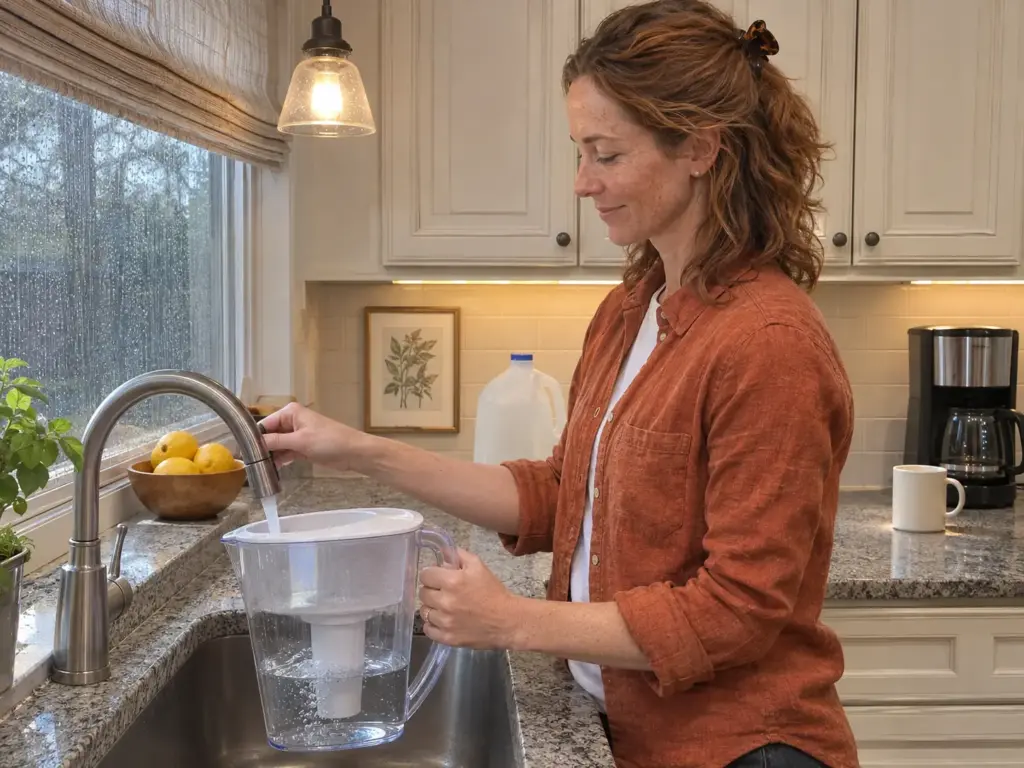
Filtered tap tends to beat both raw tap and distilled, because it keeps the minerals the cup needs and drops what spoils the taste, chlorine above all. When the machine’s manual forbids distilled and the tap glass tastes of nothing wrong, a filter pitcher beats the jug and the faucet. The Brita Small 6-Cup Pitcher holds six cups with one Elite filter rated for 120 gallons or about six months, and it is WQA and NSF/ANSI certified. Its flaws are physical: the plastic shell cracks under a light knock, the lid drips when it closes, and the capacity is smaller than the photos suggest.
Bottled water, spring or otherwise, sits wherever its label puts it, so the mineral figure on the label is the number to read. Alkaline water that runs well past the 40-70 ppm alkalinity range mutes brightness for the reason the last section gave. The full list of brewing waters lays the comparison out in one place.
The Pitcher That Makes Zero Water
The ZeroWater 10-Cup Pitcher uses a five-stage ion-exchange filter that takes water down to almost 0 TDS, and a meter ships in the box. That makes it distilled’s cousin, and it brews flat for the same reason, so it earns its place only when the water is then blended or remineralized as above. Its flaws are the kind that show up in month two: very clean water can turn sour as the filter ages, the cartridges are short-lived and need frequent replacing, the spout drips, and the pitcher is awkward to pour.
What a Jug of Distilled Does After Month Two
Week one says “no scale, no problem”. Month two tells a different story: what distilled goes after is the metal and the sensor, never the heater.
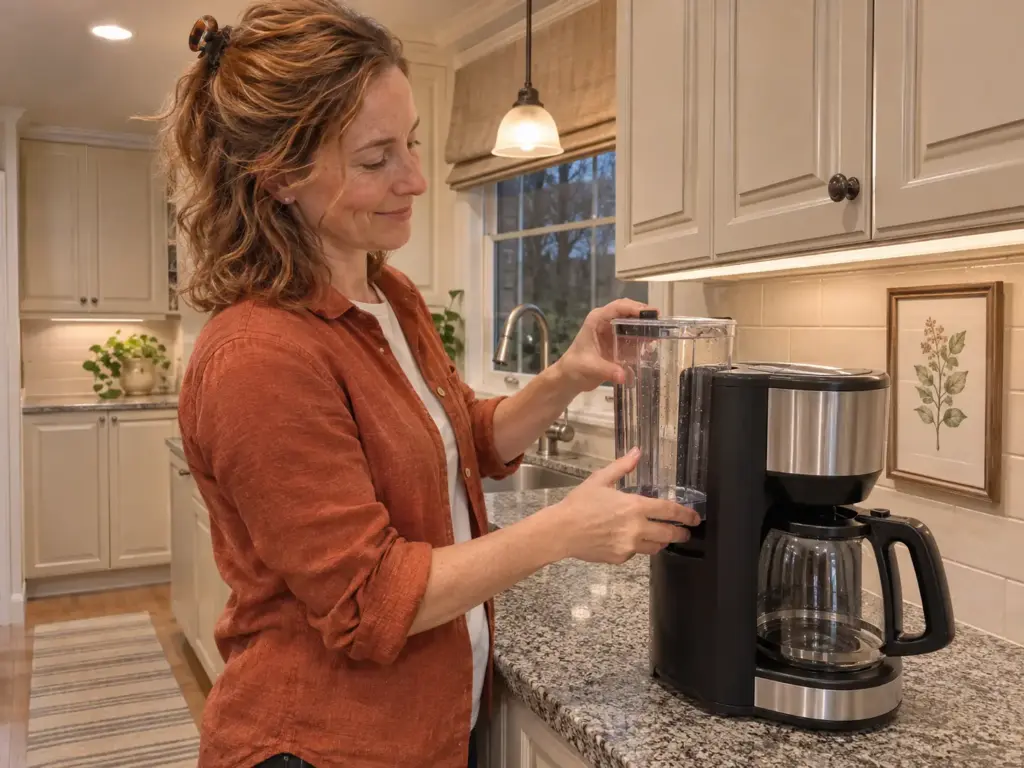
No Scale Is Not No Maintenance
Distilled leaves no limescale and no scale buildup, but it can leach from metal parts and confuse a boiler’s level or autofill sensor, and the maker’s cleaning schedule still applies when the descale light never comes on. A machine can run for months on distilled before the sensor misreads. The first symptom is a pot that pours short or a light that stays dark when it should not. How water hardness sets the descale prompt on a bean-to-cup machine shows how much of the maintenance prompt hangs on the water’s hardness, which a zero-mineral fill leaves at nothing.
The Running Cost of Each Fix
Each fix wears differently by month two.
The mineral sticks cost a little more with every daily pot, and the question of whether the cup is any better than a home pinch gets harder to answer the longer they run. The zero pitcher’s running cost is its cartridges, and the sour turn comes as each one ages. The meter’s surprise is its accuracy: identical readings for tap and filtered water, or a number a lab would never give, so its figure stays a floor. A home pinch of baking soda and Epsom salt is the cheapest to keep up, since it asks only for the scale and the habit.
Brew Half Jug, Half Tap Tomorrow, Then Taste Both
Distilled brews, and it brews flat; the manual’s water line gets read first, and the tap gets tried before any purchase. If a dose is needed, it is weighed once and written on the bottle, and a pitcher is the answer when the manual says no and the tap tastes clean. Look again after a few weeks of daily pots: the reservoir, the area around the sensor, and whether the middle of the cup is still there.
Tomorrow, fill one pot from half jug and half tap and a second from plain tap, same beans, same grind, same amounts, and taste them next to each other. The blend should have a fuller middle and a rounder edge than the pure jug ever gave. If the middle is back but the cup still reads thin, the ratio to check next if the cup still reads thin is where to look once the water is settled.
Frequently Asked Questions
01Why do coffee makers say not to use distilled water?
Makers say no because mineral-free water can wear on metal parts and confuse the sensors that read the tank, and it brews a flat cup. The manual’s water line is the final word for your machine.
02Can you use distilled water in a drip coffee maker?
Usually yes, because a plain drip machine has no autofill probe or pressure to upset, but expect a thin cup. Cut the distilled with tap, or weigh a small pinch of minerals back in.
03Is distilled water better for coffee than filtered tap water?
No, filtered tap keeps the minerals the cup needs and tends to taste better than distilled. Distilled is a blank slate that needs minerals put back before it brews a full cup.
04Does distilled water mean you never have to descale?
No, it leaves no limescale, but the maker’s cleaning schedule still applies, because the metal and the sensor are what mineral-free water goes after. A descale light that never lights is not a clean machine.


How did your cup turn out?
No comments yet. Tell us what you changed — and whether the needle moved.