




We may earn a commission when you buy through links on this page. It never changes what we recommend. How we pick
On this page10 parts
- What a Gooseneck Kettle Changes in the Cup, and What It Leaves Alone
- The Spout and the Handle Decide How the Water Lands
- Electric Kettles That Set the Temperature, Four Ways to Pay for It
- Why the Number on the Display Is Not the Water's Number
- How Much Water One Fill Really Pours
- What a Gooseneck Kettle Does in Its Third Year
- Stovetop Goosenecks and the Thermometer They Need
- Which Kettle Fits Which Kitchen
- What to Try Tomorrow Morning Before a Kettle Arrives
- Frequently Asked Questions
You have a cone dripper on a glass server, a kettle in one hand and a cup that keeps coming out thin on one sip and dry on the next, with ten tabs of kettles open in case one of them is the repair. The best gooseneck kettle for coffee is a clear winner on pour control, with a cheaper one for most kitchens, but no kettle repairs a grind or a pour that is wrong, and what separates the picks is what each one is doing in its third year. What a gooseneck buys is a thin stream that wets the whole bed at once instead of digging one channel through it, plus water that arrives inside the temperature window the coffee world agrees on. Below: what a kettle changes in the cup and what it leaves alone, the spout, nine picks with the flaw of each, where a display’s number stops being the water’s, how much one fill really pours, the third year, the stovetop answer, and which kettle fits which counter.
Quick Answer
Fellow Stagg EKG Pro for pour control; Bonavita 1.0 L, the mid-price buy; Cosori 0.8 L, the cheapest that still sets a temperature; Coffee Gator, the stovetop with a thermometer built in. Judge any of them by the water at the grounds: 194 to 205 °F (90 to 96 °C) is the window, and the base’s display only estimates it. No kettle rescues a wrong grind.
What a Gooseneck Kettle Changes in the Cup, and What It Leaves Alone
A kettle touches two things in a pour-over: where the water lands and what temperature it carries. The dose, the grind and the ratio were settled before the kettle came into it, and they decide more of the cup than any spout does. So the order of spending matters, and a cup that tastes wrong usually has a cheaper cause than the kettle.
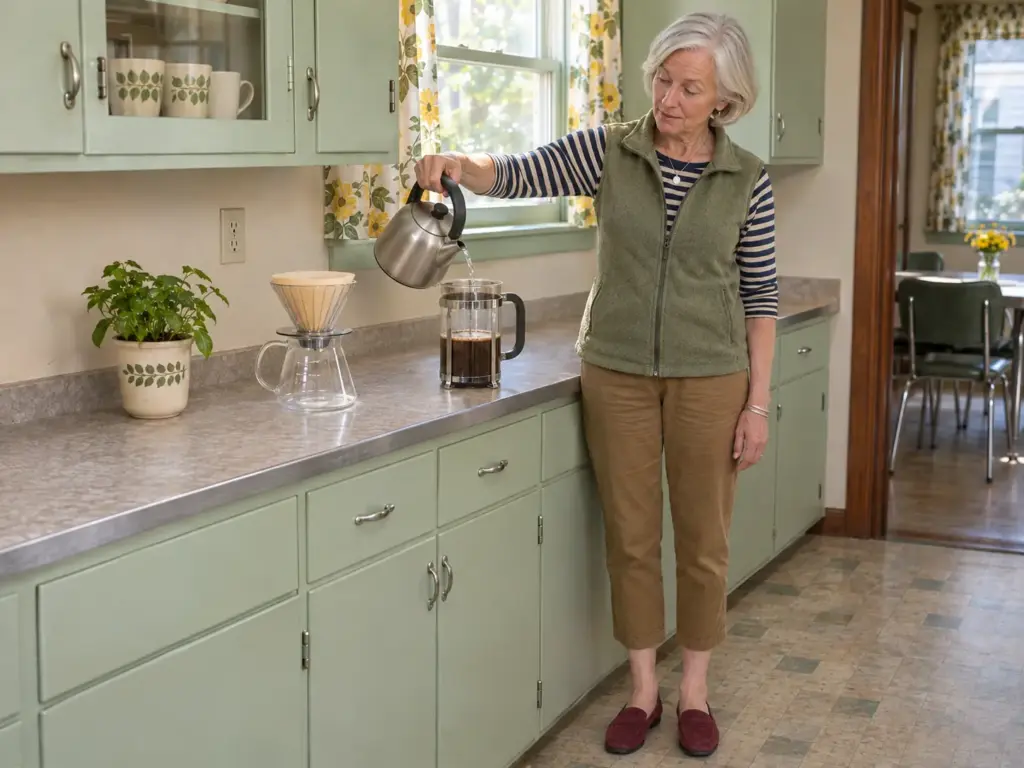
Two things a gooseneck controls: the stream and the temperature
The first job is the stream. A thin, steady line from a gooseneck spout gives even saturation, wetting the whole coffee bed at about the same moment, where a wide spout pours a thick rope that digs one channel and leaves the grounds around it half dry. The second job is the temperature, and the numbers both jobs serve come from the National Coffee Association’s pour-over guide: 1 g of coffee to 13–16 g of water, a bloom of 30 to 45 seconds with water at double the coffee’s weight, and 2 to 4 minutes of contact in all.
A 15 g dose (about three level tablespoons) is therefore 195 to 240 g of water, with 30 g of it going in for the bloom. Everything in that sentence sits upstream of the kettle, which only decides how evenly the water arrives and how hot it is when it does. That holds for a V60 or a Chemex as much as for a flat-bottom Kalita Wave or an Origami: any pour over dripper rewards the same slow steady pour, and none of them forgives a thick rope of water.
Sour and thin, or bitter and dry: which way each one points
Sour and thin means the water left before it finished: the grind was too coarse, the water too cool or the contact too short. Bitter and dry points the other way, to water that stayed too long on grounds that were too fine or too hot. Under-extraction tastes sour and over-extraction tastes bitter, and a cup that is sour on the first sip and dry at the end is a third case, the only one a kettle can cause, because it is the signature of a bed that was watered unevenly. In the dripper it shows as a crater with a dry ring around it.
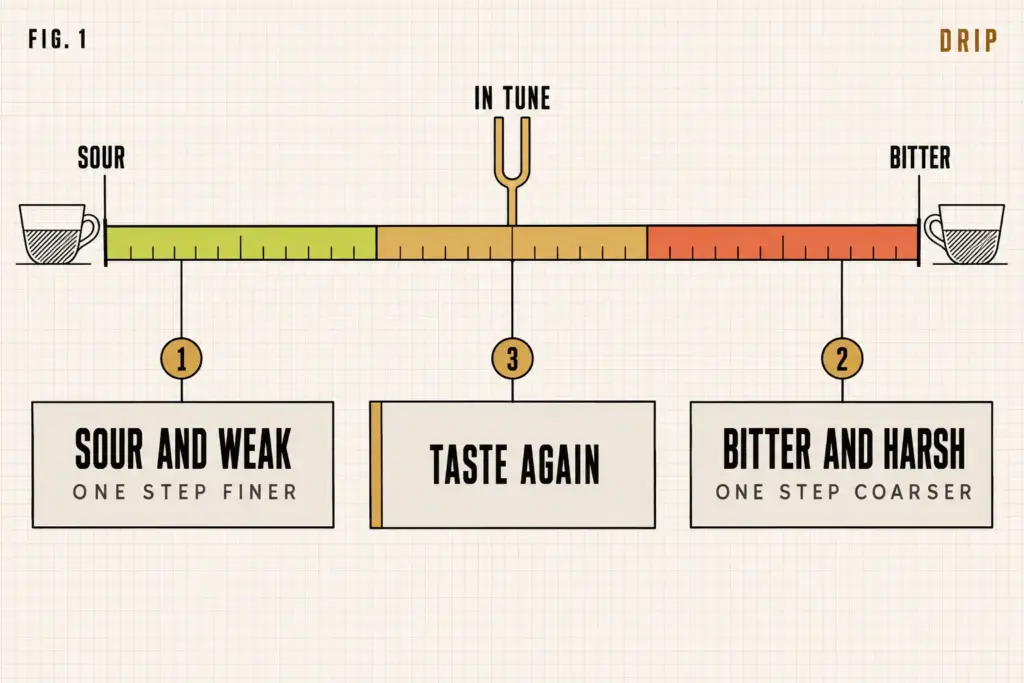
Move a single setting between cups and taste after each. For a sour, thin cup, go a step finer on the grinder first, because it costs nothing and it is the likeliest cause; the next cup should taste rounder and sweeter, and if it turns bitter and dry you overshot, so come back half a step.
If it is flatter but still sharp, slow the pour, a slow steady pour that lets the drawdown finish near three minutes, and taste again. Water comes third: check that it lands in the window before reaching for a dial. A bitter cup runs the same order in reverse, starting a step coarser.
A coarse grind fails every kettle on this list, so grind size for a pour-over by dripper is worth settling before anything goes in the cart. The kettle becomes the suspect only when the grind is right, the contact time is right and the cup is still uneven in a single sip.
The brewers it changes nothing for
For a drip coffee maker, a French press, an AeroPress or a moka pot, a gooseneck changes nothing. A drip machine’s showerhead decides where the water lands, a French press or an AeroPress is an immersion brew that wets every ground at once and lets it steep, and a moka pot runs on pressure. If one of those is on your counter, the guide on whether a pour-over reader needs a gooseneck at all covers why, and your answer in this list is none of the nine.
The Spout and the Handle Decide How the Water Lands
If a kettle’s job is the stream, the spout and the handle are most of a pour over kettle, and the rest is decoration around them. A good stream is thin, steady and slow enough to add water in stages without flooding the bed. The speed comes from the pour-over’s frame, whatever the box says.
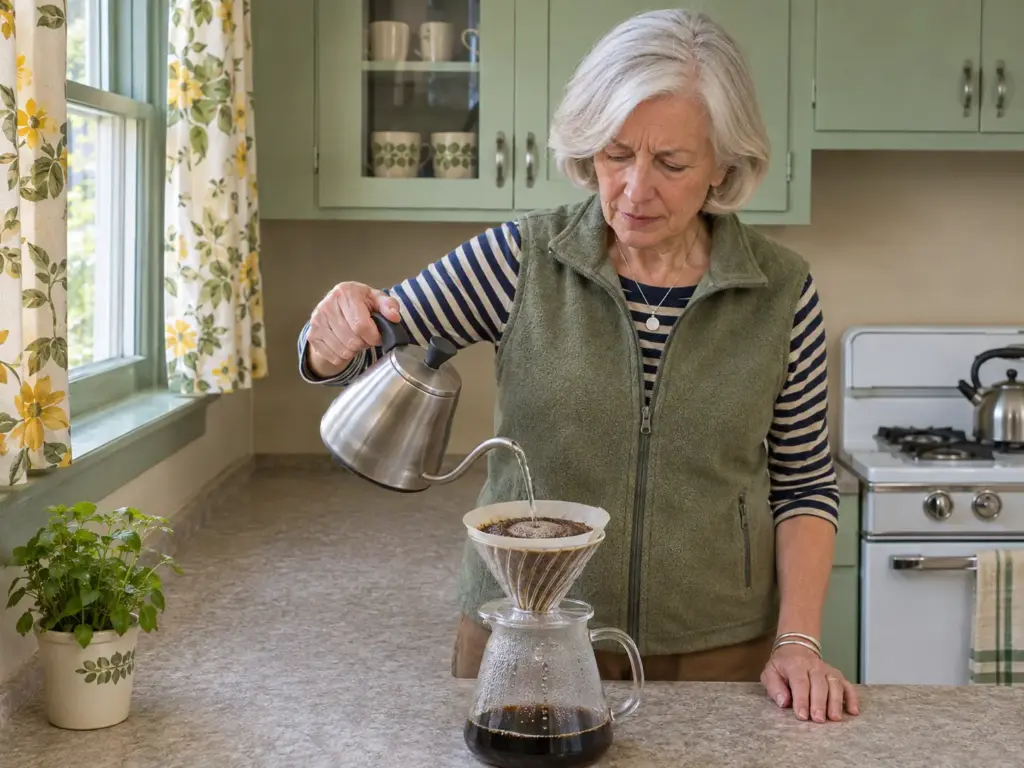
How slow the stream needs to be
A pour-over gets 2 to 4 minutes of contact, so the water has to go in over most of that time, in stages, and never as one dump. That sets the speed. Spouts are sold as fast-flow or slow-flow, but a flat-bottom dripper’s flow is decided by its holes and the grind, and the kettle’s job is to stay out of the way.
The one maker figure on this list is Coffee Gator’s stated flow rate of 2.5 mm per second, a handy reference for a thin line and little else. Pouring by weight, in grams, turns the spout’s real test into whether you can stop within a few grams of the target. A stream that sounds like a thin, steady hiss against the bed passes it, and a splash that moves the grounds does not.
The counterweighted handle and the kettle that is full
The Stagg and the Cosori carry a counterweighted handle, which puts the weight of a full kettle over your wrist so it tilts without twisting. A handle that does not do this turns a 0.9 L fill into a forearm test, and the first pour is where it hurts: the bloom needs the gentlest stream of the whole brew, and the kettle is at its heaviest.
Fill the kettle only as far as the pour will take: the water the brew needs, plus a little for the filter rinse. A kettle filled to the brim is heaviest at the first pour, which is when the bloom needs the gentlest stream.
A spout that forks once it scales
A spout furs with scale from the inside. Once the bore narrows, the stream forks into two threads or sputters, and that happens before the heater gives out, so a stream that no longer leaves as one line is the early warning. Hard water speeds it up. The soak that clears it is in the third-year part below.
Electric Kettles That Set the Temperature, Four Ways to Pay for It
All four electric kettles below are variable temperature kettles that set the temperature in single degrees or finer, and they differ in what the control costs in other ways: a premium for the finest step, a shorter hold, a ceiling below a full boil. A finer step only matters if the cup is off in the direction temperature moves, and for most pour-overs that is not the first thing to turn. Each pick comes with the spec that decides it and the way it is most likely to let you down.
Boil-only, presets and to-the-degree: what each tier buys
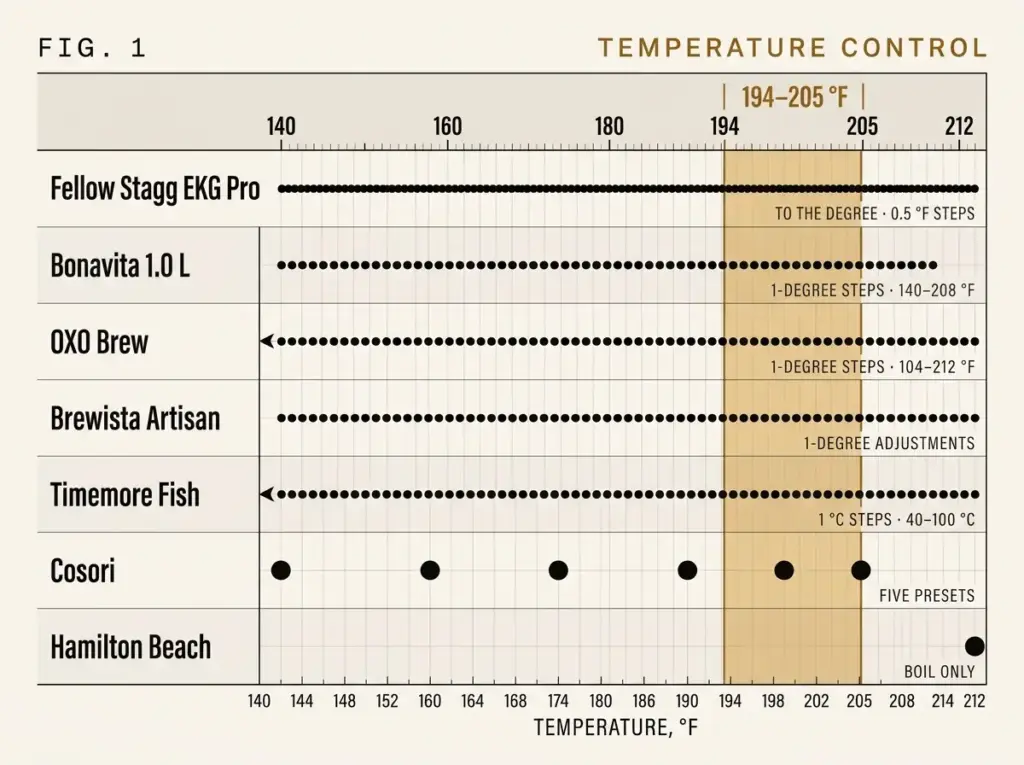
The brewing window that matters is 194 to 205 °F (90 to 96 °C), eleven degrees wide, so the tiers sort by how finely each kettle lands inside it. A boil-only kettle has nothing to set. A preset kettle gives a handful of preset temperatures on buttons (the Cosori’s five come up in a later section). The tier with one degree increments is the Bonavita at 140–208 °F, the OXO at 104–212 °F and the Brewista’s 1-degree adjustments, and the top tier is the Fellow, which steps in half-degrees Fahrenheit.
A 1-degree step is already finer than a cup can taste, so half a degree is for the reader who likes a number on the screen.
The coffee world already has a yardstick for consistency in a brewer. According to the SCA’s certified home brewer program, “SCA Certified Home Brewers are coffee makers that meet SCA’s rigorous standards for brewing quality, consistency, and performance.” Borrow the question for a kettle: does the water arrive in the window every time, and what does the display know about it? If a boil and a rest is enough for you, letting boiled water rest for half a minute is the free alternative to a dial, and what temperature the water should be for coffee covers the numbers behind it.
Fellow Stagg EKG Pro, the control pick
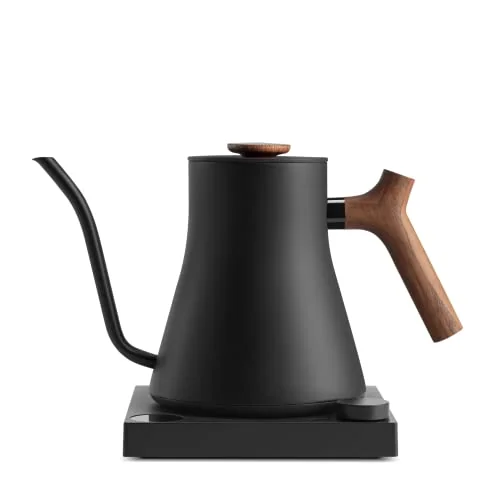
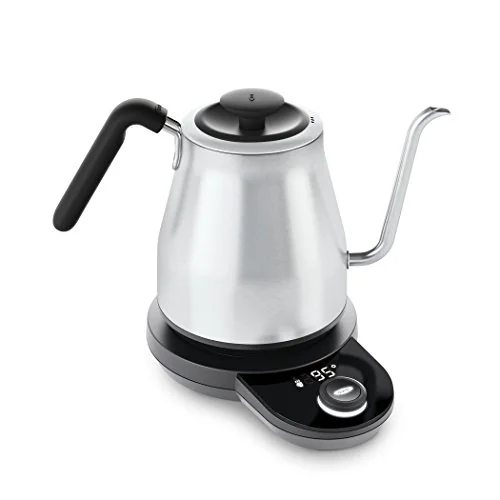
The Fellow Stagg EKG Pro is the pick for control because it is the only kettle here whose maker publishes a step finer than a degree, 0.5 °F, along with a warranty term of two years. It holds 0.9 L (30 oz) at 1200 W and carries a built-in pour stopwatch, a scheduling menu and the counterweighted handle, and the handle and the spout are what the money buys.
The flaw sits in the electronics. The steel jug stays fine while, on some units, the kettle turns on, reads the right temperature and stops heating at around two to three years; on others the reading itself cannot be trusted. Past the warranty the realistic answer is a new kettle, so the two years are the number to weigh against the control.
Brewista Artisan 1 L, the pick for a number instead of a preset
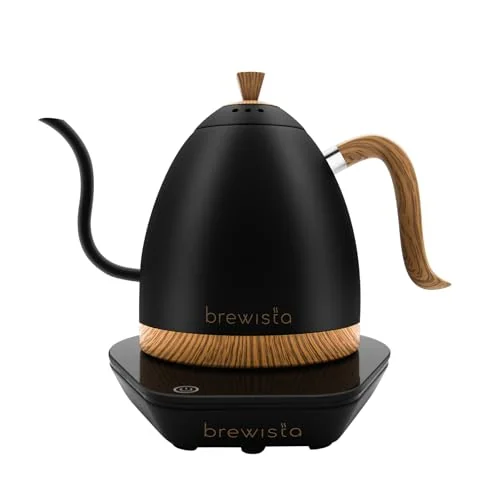
The Brewista Artisan 1 L is for the reader who wants a number rather than a preset: 1 L, an LCD, 1-degree adjustments, a flash-boil setting, a built-in timer and keep-warm. The part that goes is the heating element, inside two years on some units, and a kettle that sits above the Bonavita on price and fails in the same place is hard to defend. Buy it only if the flash-boil and the timer are things you will use.
OXO Brew, the all-round kitchen kettle
The OXO Brew Adjustable Temperature is the better all-round kettle and the second choice at a dripper. It holds 1.1 qt (about 1 L), runs 104–212 °F in 1-degree steps, keeps the water warm for up to 30 minutes and puts a brew timer in the base, with a lift-off jug and a full 212 °F ceiling for tea. In a kitchen that boils water for oatmeal and tea as well as coffee, it is the easier kettle to live with; at the dripper the Stagg’s handle and spout win. Some units break inside a year, and the 30-minute hold, half the Bonavita’s, lives on the base, so it ends when you lift the jug.
Bonavita 1.0 L, the mid-price pick that tops out at 208 °F
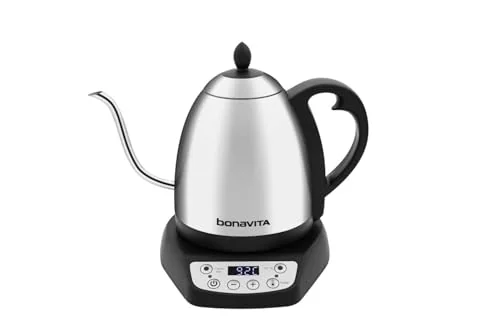
The Bonavita 1.0 L Variable Temperature is the sensible mid-price buy, and its ceiling of 208 °F is the feature. A dark roast wants the low-to-mid end of the window, so a kettle that cannot reach a full boil loses nothing there (how the roast moves the temperature you want explains it for a darker bag). It gives 1 L at 1200 W, 140–208 °F in 1-degree steps, six presets and a hold of up to 60 minutes, double the OXO’s.
Some units never reach the set temperature, and on some the element stops at about five months. For a dark-roast counter this is the better call than the Stagg, whose half-degree steps buy nothing there.
Why the Number on the Display Is Not the Water’s Number
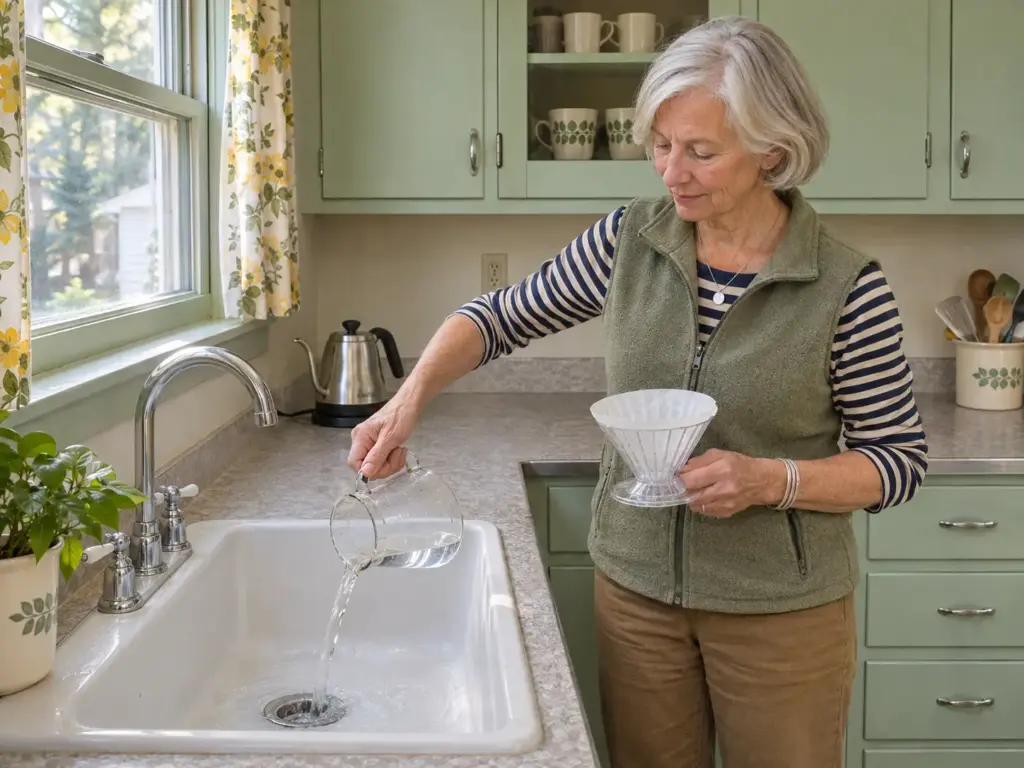
An electric kettle can hold a temperature to the degree, and that is its best argument. The temperature that matters is the one at the grounds, though, and the display does not reach that far. Three things sit between the screen and the dripper: where the sensor sits, the stream, and a hold clock that stays behind on the base.
The 194 to 205 °F window, and where it is measured
The National Coffee Association puts the target in plain words, and the figure traces back to the Specialty Coffee Association’s brewing standard. According to its pour-over guide, “the optimal water temperature before pouring over coffee grounds is 93 ± 3°C”, which is 194 to 205 °F.
The word that matters is before: the reading belongs to the water as it meets the grounds, and the base sensor reads something else, the water in the jug or the plate under it. Between the spout and the bed the stream loses a little, and a cold glass server or a cold dripper claws back a few degrees more, which is why a rinse that preheats both gives most of it back.
What a few degrees do to the taste is the question worth settling before any dial is. A screen that reads 200 °F can still deliver water a few degrees under that at the grounds, and the lighter the roast, the more that shows, since a light roast leans on the upper end of the window. The display also counts up and the kettle clicks before the water at the lip has caught up, so a pour started on the click lands cooler than the screen says.
A hold function that stays on the base
On every electric kettle here, hold, or keep warm on the cheaper ones, is a base function: 30 minutes on the OXO, 60 on the Bonavita and the Cosori. Lift the kettle to pour and the clock stays on the counter.
Age adds a second drift. Some controllers start overshooting the set point by 5 to 10 °F once they are a few years old, and the screen does not mention it. A second pour a minute after the first is where it shows, because the screen has not moved and the water under it has.
One check with a probe, then trust the kettle
A single probe reading settles more than any spec sheet, and measuring the water at the grounds instead of in the kettle is the method. Take the reading from the stream as it leaves the spout, into a cup or a spare server, because that is the temperature the grounds meet. If the reading and the screen disagree by more than a few degrees, trust the probe and adjust the set point to match it.
Boil, set the kettle down, count thirty seconds, then probe the first pour once. If the probe lands inside 194 to 205 °F and the cup tastes right, the kettle has earned your trust and you can stop checking.
How Much Water One Fill Really Pours
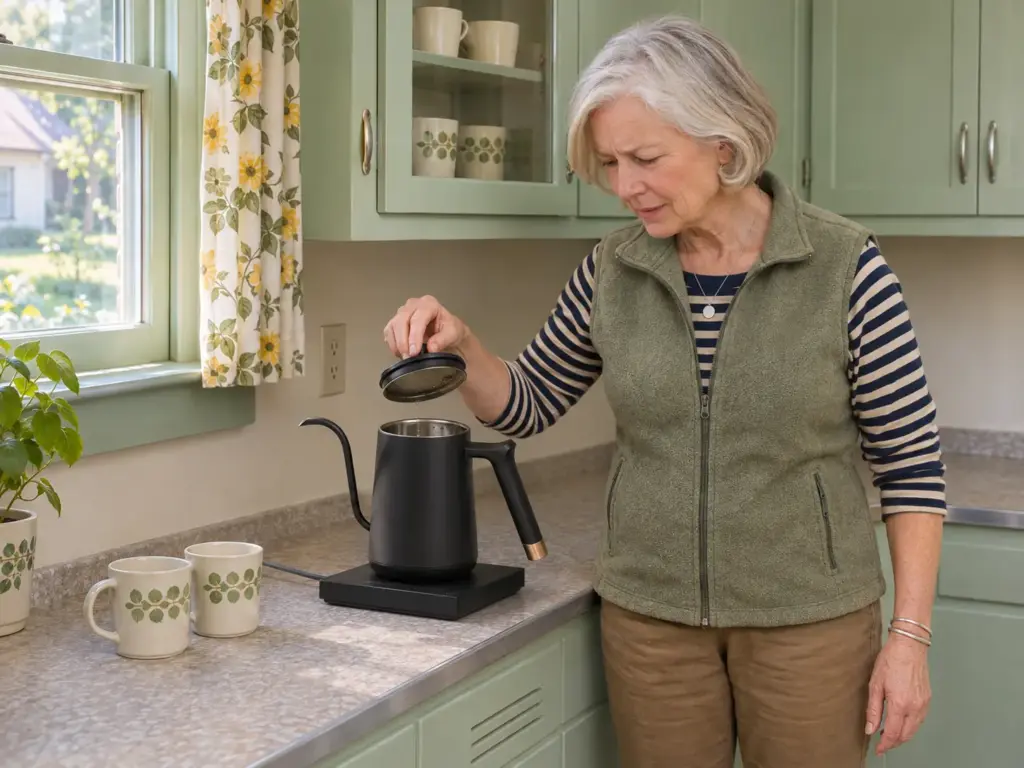
A kettle’s capacity on the box and the water it pours in one go are two different numbers. A single pour-over cup uses less than a quarter of a liter, so a 1 L kettle is mostly spare water. That makes the choice of size a matter of how many mugs you pour in a row.
What a pour-over cup uses: the arithmetic
A 15 g dose (about three level tablespoons) at the pour-over’s 1:13 to 1:16 takes 195 to 240 g of water, roughly 7 to 8 fluid ounces, which is one mug and a quarter of a liter. Cups per fill then run like this: a 1 L fill is four cups, a 0.9 L fill three and three-quarters, a 0.8 L fill three and a 0.6 L fill two and a half. The Timemore’s 560 ml usable fill is two, and the Hario’s 800 ml usable fill of its 1.2 L jug is three.
A large mug at 250 g water pushes each count down a little, so treat them as the upper end. Makers quote size in three ways, the jug, the maximum line and the recommended fill, so the figure that matters is the one you can actually pour.
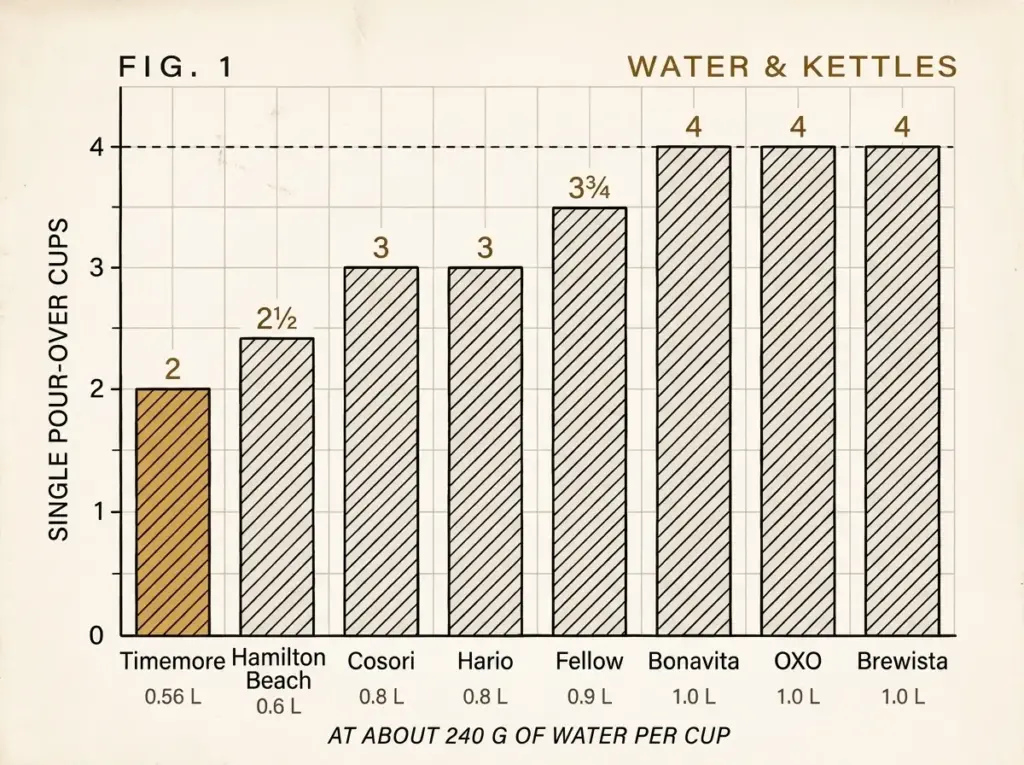
Heat up time is a wash at these volumes. A maker puts a 1200 W kettle at about five minutes to boil 1 L, Timemore says its 600 ml reaches 88 °C (190 °F) in 220 seconds, and Hamilton Beach says one cup takes 90 seconds, so wattage barely separates the nine. The water itself should be weighed, because 240 g cannot be eyeballed, and the rinse takes water too, so a kitchen that rinses needs more than the arithmetic says. A coffee scale that suits a dripper is the accessory that pairs with any of these.
Timemore Fish Smart 600 ml, the one-mug kettle
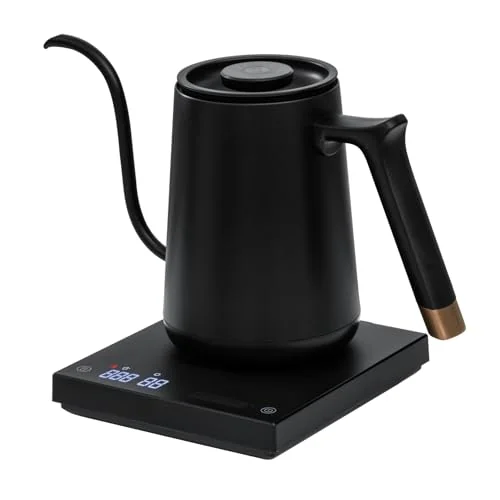
The Timemore Fish Smart 600 ml is the small-kettle answer for a one-mug kitchen, and the only pick here that says in the same listing how much fits and how tight its controller is: a 600 ml jug filled to about 560 ml, 1000 W, a STRIX controller in 1 °C steps (about 2 °F) from 40 to 100 °C (104 to 212 °F), and a hold mode. Two pours fit in a fill, and the second is the cooler one, because a small kettle that is filled, boiled and poured in two goes loses temperature between them. The flaw: the set point is not always reachable, some units died within days, and 560 ml is two pours, never a batch.
Hamilton Beach Compact 0.6 L, the cheap electric that says what it is
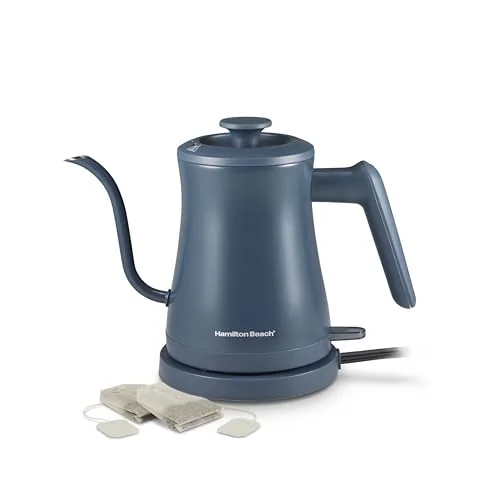
The Hamilton Beach Compact 0.6 L is the honest counter-example: a real gooseneck spout at the bottom of the price range that says plainly it boils and does not set a temperature. It is a 0.6 L (20 oz), 1200 W kettle with auto shut-off and boil-dry protection. Pair it with the free fix, a rest after the boil, and a boil-only kitchen is covered for pour-over. Water seeps out around the switch on some units and lands on the counter mid-pour, and 0.6 L is small for a two-mug kitchen.
Cosori 0.8 L, the cheapest one that still sets a temperature
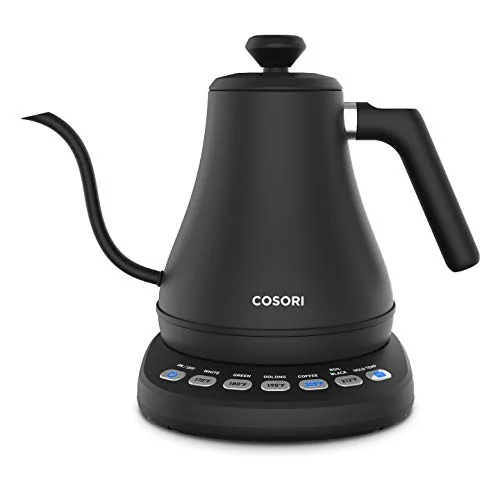
The Cosori Gooseneck 0.8 L is the cheapest kettle here that still sets a temperature, with five presets, a 60-minute keep-warm, a counterweighted handle and an interior, lid and spout in 304 steel, so no plastic touches the water. That last detail is worth reading in any listing, because a plastic smell on the first boil of a cheap kettle is what it is meant to prevent. The flaw: presets instead of degrees, so there is no 199 °F button, and units that die inside four months sit next to units that run for three years.
What a Gooseneck Kettle Does in Its Third Year
Nine kettles all work in week one, and the choice between them is really about what fails first. This part follows the failures in the order they tend to arrive, then the soak that keeps the spout clear and the parts you cannot replace. None of it needs a card.
The steel outlives the electronics
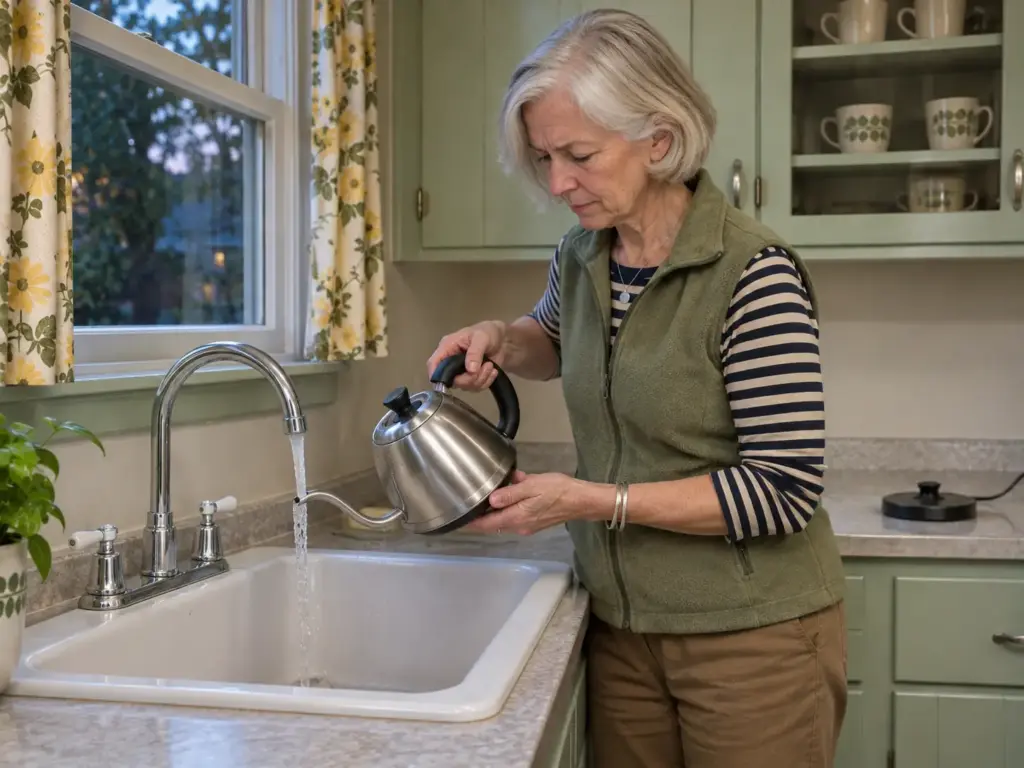
On the premium electrics the steel jug is fine and the electronics are what die. A kettle turns on, shows the right temperature and does not heat: that is the pattern on the Stagg EKG at around two years and ten months, and again after three years of heavy use.
By month twelve the first of them has already shown up on some units, with the OXO and the Cosori the ones reported breaking inside a year. Element failures run shorter, from five months to two years on the Bonavita, the Brewista and the OXO, and inside four months on some Cosori units. On some units drift comes first: the hold starts overshooting by 5 to 10 °F, and a citric-acid soak revives some of them, which makes it the cheapest thing to try before anything is written off. The same failure repeated across many units of one model is a design flaw, and past the warranty the answer is a replacement at full price.
Scale in the spout, and why the neck needs its own soak
The neck is the part a sponge cannot reach. Run the descaler in the jug, then pour it into a deep container and prop the kettle so the spout sits submerged, and push a pipe cleaner through the bore once it has cooled. Citric acid by the bag, a spoonful or two in warm water and left to sit, does the work of branded descaler sachets for less; the maker’s manual is the authority on what the element and the seals tolerate, so read it before the first soak. Hard water, which is mostly dissolved calcium carbonate, speeds up scale buildup in the spout and the element, and white vinegar does the same job as citric acid if that is what the cupboard holds, only with a smell that needs a few clean rinses afterward.
The repair you cannot buy: bases and replacement parts
Out of warranty, the answer to a dead electric kettle is a new one. The base is the part that gets lost, and a replacement base is hard to come by, so a kettle can outlive the piece it sits on. A Bonavita can fail with the panel lit and a temperature on the screen and no heat at all. The cheap stovetop has a version of the same story: the plastic of a dial thermometer can melt inside a year, and a Hario’s steel can rust from the inside, which is where the stovetop kettles come in.
Stovetop Goosenecks and the Thermometer They Need
A stovetop gooseneck kettle has no electronics to die, and the price of that is a thermometer you either bring or build in. The pour is the same, because both kinds carry a gooseneck spout. What changes is who stops the heat.
What the cup does differently, and what the stove cannot tell you
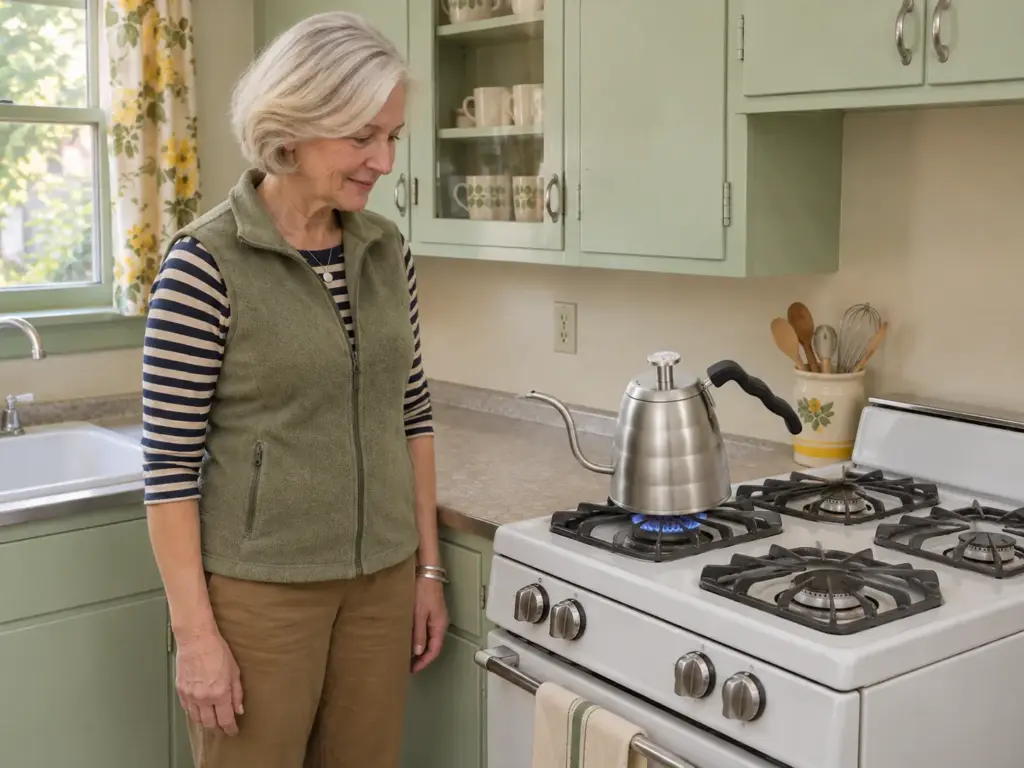
An electric kettle stops at the number you set. A stovetop boils, and you stop at whatever it reads when you take it off the burner. The cup only differs if the number at the grounds differs: a probe through the lid gives a stovetop the same information an electric screen only suggests, and the water can rest after the boil like any other.
The heat-up is the step to time once, because it depends on the burner and on how much you put in. And a stovetop kettle that starts from a full boil makes the first pour the hottest.
The probe goes through the lid hole and stays out of the spout. Read it at the first pour: the water keeps climbing a degree or two after the burner is off, so take the kettle off the heat early.
Coffee Gator stovetop 1.2 L, the one with its own thermometer
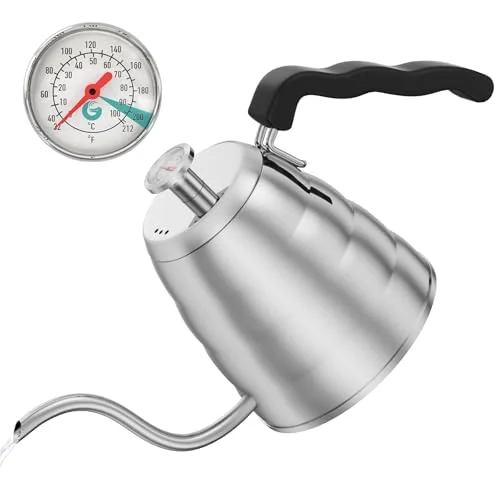
The Coffee Gator stovetop 1.2 L answers the objection that a stovetop needs a thermometer bought separately: a dial thermometer from 160 to 212 °F is built in, the maker states a flow of 2.5 mm per second, the steel is 304 and a triple-layer base works on any stove, induction included. It is the budget stovetop for the reader who wants to see a number before pouring. The flaw is the thermometer itself: the dial’s plastic can melt inside a year, so confirm it once with a probe.
Hario V60 Buono 1.2 L, the classic that needs a probe
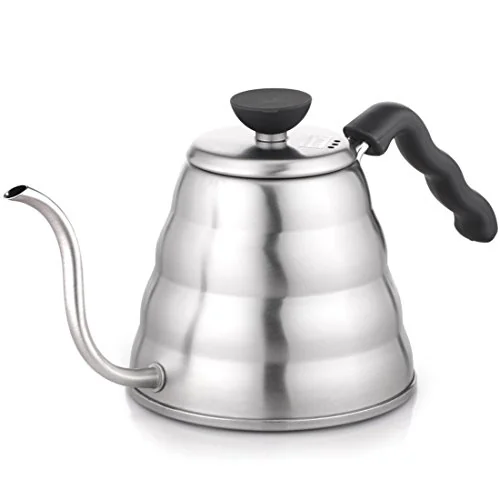
The Hario V60 Buono 1.2 L is the reference stovetop of the niche and the only one that prints its usable fill, about 800 ml of a 1.2 L jug, in the listing. It is stainless with a plastic handle and no thermometer at all. Rust can start from the inside on some units, and for a plain steel jug with a good spout the value is a stretch. A Buono plus a probe is the cheapest way to pour well; the Coffee Gator is the same thing with the thermometer in the lid, and neither will tell you the temperature the water had when it landed.
Which Kettle Fits Which Kitchen
Nine kettles are a lot to hold in your head, so the table below puts each one on the questions a listing never answers: how it sets the temperature, how much it really pours and what fails first. The paragraphs after it say which counter each one belongs on. A kettle only matters after the grind and the pour are right, and a drip-machine reader has no pick here.
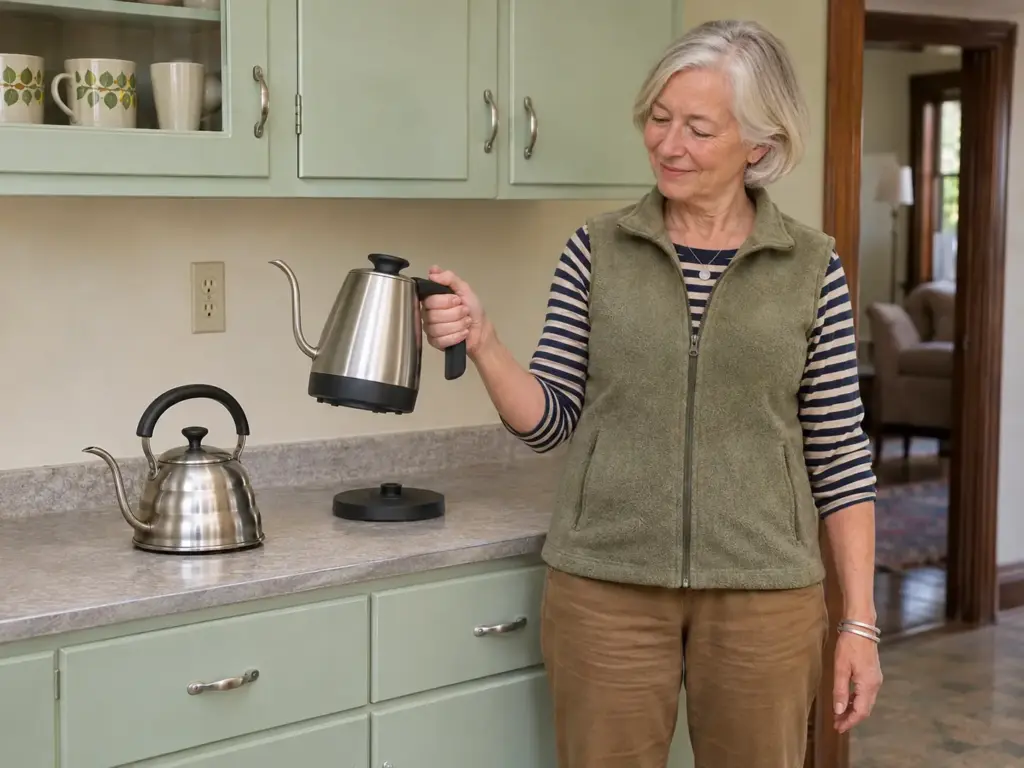
The nine side by side
Fill is as the maker states it, and the last column names what tends to go first.
| Kettle | Electric or stovetop | How it sets the temperature | Fill, as the maker states it | What fails first |
|---|---|---|---|---|
| Fellow Stagg EKG Pro | Electric | To the degree, 0.5 °F steps | 0.9 L (30 oz) | Electronics, around two to three years on some units |
| Brewista Artisan 1 L | Electric | 1-degree adjustments | 1 L | Heating element, inside two years on some units |
| OXO Brew | Electric | 104–212 °F, 1-degree steps | 1.1 qt (about 1 L) | Units that break inside a year |
| Bonavita 1.0 L | Electric | 140–208 °F, 1-degree steps | 1 L | Element, from about five months on some units |
| Timemore Fish Smart 600 ml | Electric | 1 °C steps, 104–212 °F (40–100 °C) | About 560 ml of a 600 ml jug | Set point not always reached; some units fail within days |
| Hamilton Beach Compact 0.6 L | Electric | Boil only | 0.6 L (20 oz) | Water seeping out near the switch |
| Cosori 0.8 L | Electric | Five presets | 0.8 L | Four months to three years, depending on the unit |
| Coffee Gator stovetop 1.2 L | Stovetop | Built-in dial, 160–212 °F | 1.2 L (40 oz) | The dial’s plastic can melt inside a year |
| Hario V60 Buono 1.2 L | Stovetop | None; add a probe | About 800 ml of a 1.2 L jug | Rust from the inside on some units |
The kitchen each one fits
The Stagg EKG Pro suits the reader who wants control and accepts the warranty clock. The Bonavita is the mid-price buy for a dark-roast kitchen, and the Cosori is the cheapest way to a set temperature. The Timemore covers one mug at a time, and the Hamilton Beach covers a boil-only kitchen once a 30-second rest is part of the routine. On the stove, a Buono plus a probe does the job, or the Coffee Gator with its dial.
The Brewista belongs with the reader who wants a number and accepts the element’s risk, and the OXO is the all-round kettle that earns its place in a busy kitchen more than at a dripper. The kettle comes after the grind and the pour, so a grinder that keeps a V60 from running muddy comes first. And if a drip machine is what you own, look at a drip machine picked by its water temperature instead, because for that counter the machine is the purchase and a kettle adds nothing.
What to Try Tomorrow Morning Before a Kettle Arrives
The kettle is the last peg to turn, and what it controls is a thin stream that wets the whole bed and water that lands in the 194 to 205 °F (90 to 96 °C) window at the grounds. The display does not reach the grounds, so a probe reading settles what a spec sheet cannot. The third year is where the nine differ most: the steel outlives the electronics, the spout furs, and a stovetop has nothing to die but its dial.
After the first winter of use, or whenever the stream starts to fork, time how long the kettle takes to reach its set temperature, check that the water still leaves as a single thread, and see whether the hold still holds.
Tomorrow’s first move costs nothing. Rest the boil for about thirty seconds before the first pour, and if the cup was sour, go a step finer on the grinder. The next cup should taste rounder and sweeter; if it turns bitter and dry, back off half a step, and only then decide whether a kettle is still on the list. The scale that weighs the water and the grinder that sets the bed are the purchases that come after it.
Frequently Asked Questions
01What is the best gooseneck kettle for coffee if I only make pour-over on weekends?
The Bonavita 1.0 L is the sensible pick for weekend pour-over, with 1-degree steps, a 208 °F ceiling and a 60-minute hold. If a boil and a 30-second rest is enough for you, a stovetop Hario Buono pours just as well.
02What temperature should a gooseneck kettle be set to for coffee?
Aim for 194 to 205 °F (90 to 96 °C) at the grounds, the window the National Coffee Association gives, printed in some guides as 195 to 205 °F or 90 to 96 °C. Darker roasts do well at the lower end of it and lighter roasts at the upper end.
03How much water does a gooseneck kettle need to hold for one cup?
A pour-over cup takes about 240 g of water, so a 0.6 L fill makes two and a half cups and a 1 L fill makes four. A kettle with a 560 ml usable fill, like the Timemore, runs short on a bigger batch.
04How do I clean the spout of a gooseneck kettle?
Follow the maker’s manual for descaling, then soak the neck, the part a sponge cannot reach, with the spout submerged in a deep container of the solution. Run a pipe cleaner through the bore once it has cooled.
05How long does an electric gooseneck kettle last?
An electric gooseneck kettle’s steel jug outlasts its electronics, and failures on some models start between about five months and three years of use. A warranty term, like the Stagg’s two years, covers part of that window.



How did your cup turn out?
No comments yet. Tell us what you changed — and whether the needle moved.