



We may earn a commission when you buy through links on this page. It never changes what we recommend. How we pick
On this page9 parts
- What "Less Than 14 Inches Tall" Leaves Out
- Measure the Gap at Your Own Counter
- Can It Be Filled Without Sliding Out?
- Two Machines That Fit and Fill in Place
- Short Is Not the Same as Hot
- What to Check Once the Newness Wears Off
- When the Gap Is Too Tight for Any Drip Machine
- Measure With the Lid Up, Then Taste Once
- Frequently Asked Questions
The listing says 13 inches, the gap under your cabinet measures 16, and the subtraction says three inches to spare. Then you lift the lid.
The height printed on a box describes the machine with its lid shut, so a coffee maker less than 14 inches tall can still be a machine that has to be dragged out from under the cabinet every morning. This page takes that number apart, shows how to measure the gap you really have with a measuring tape, tests whether a short coffee maker can be filled without moving, and names the two that pass. After the fit comes the cup, which is where drip coffee makers picked by water temperature settles the heat question for the whole family.
Quick Answer
A coffee maker fits a cabinet by the space it needs with the lid open and the water tank out, not by the height on the box. Measure the clearance from counter to cabinet bottom first, then check whether the machine can be filled without sliding it out.
What “Less Than 14 Inches Tall” Leaves Out
The 14 in “less than 14 inches tall” is a closed-lid number, and the lid is the first thing you open. Before any tape measure comes out, it helps to know what that figure leaves out, because the listing prints it and says nothing about the lid-open height, which is the number an under-cabinet spot cares about.
The box shows the lid closed
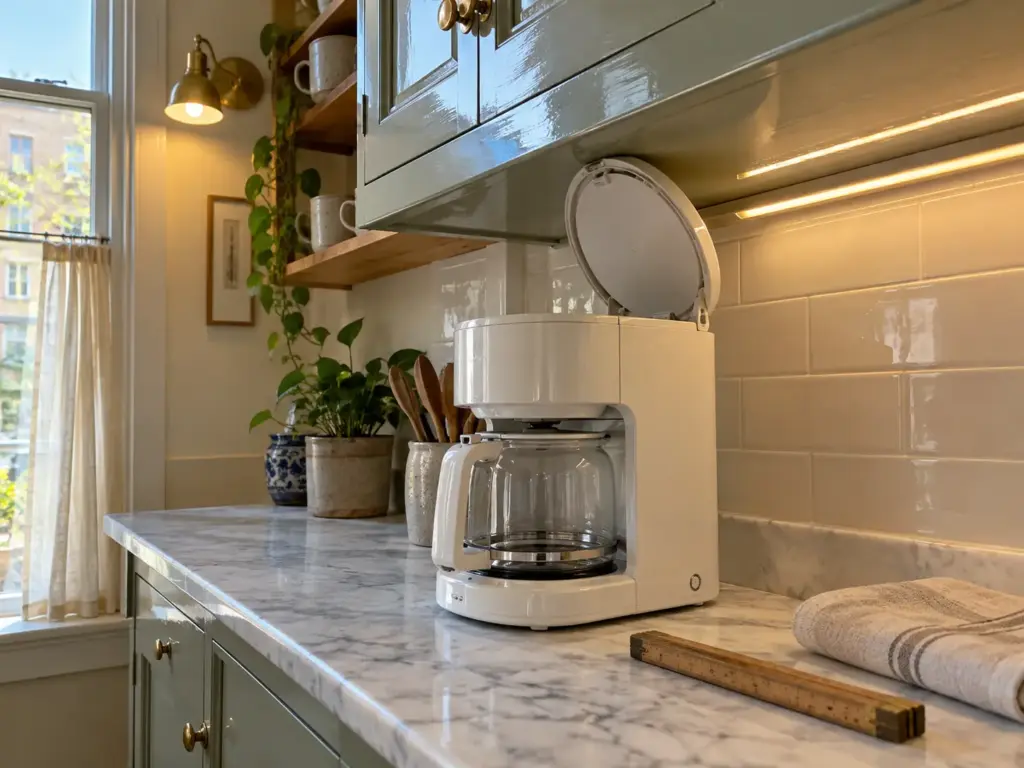
A spec box gives width, depth and height for a machine at rest: lid down, tank seated, carafe on the plate. A drip machine in use is a different shape. The lid rises to load the basket and the water reservoir, the tank may leave for the sink, and the carafe slides in and out beneath the spout.
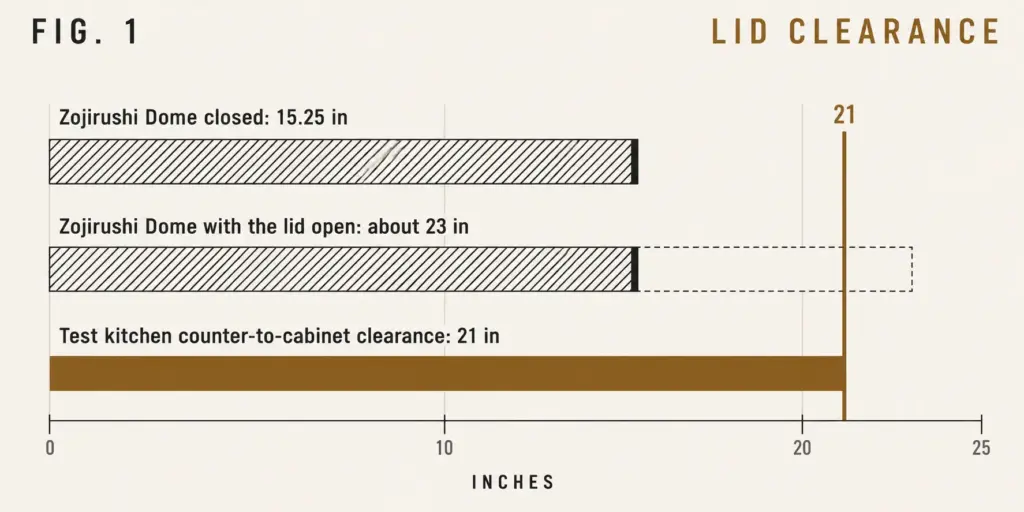
The clearest case is the Zojirushi Dome Programmable in Serious Eats’ test, which stands 15.25 inches tall closed, and where “Opening the lid, however, adds another eight inches.” Add it up and the open machine needs about 23 inches against a test kitchen that cleared 21, which is why the tester “had to scoot them out from under the cabinets to open the lid and add water.”
The two short machines picked later in this article do not escape the question. Neither listing prints a lid-open height, so no figure here can be trusted on your behalf, and the only safe move is to measure the envelope the lid sweeps through. Subtracting the box height from your gap looks like arithmetic and is really a guess about a lid you have not opened yet. Subtract the lid’s travel as well, and the answer changes from “fits” to “fits if the machine comes forward,” which is a different machine to live with.
Three distances make up that envelope: the closed height, the open height with the lid at its stop, and the reach from the front edge to the reservoir, because a hand and a pitcher need that last stretch of air. A lid that taps the underside of the cabinet a few inches into its swing is the first sign the number was wrong, and the knock is audible long before anything is scratched.
Where the 14-inch line falls
Fourteen is an edge, not a magic figure, and the places that sell machines slice height into buckets around it. Amazon’s own height filter runs up to 7.9 inches, 8 to 10.9, 11 to 13.9, and then 14 and above, so a machine sitting exactly on the line lands in the bucket that “less than 14 inches” leaves out.
The Ninja CE251 shows how thin the margin is: Serious Eats prints 14 inches, and the current Amazon listing says 14.6. Either way it is in the 14-and-above bucket. It is named here only as the boundary example, since the rest of the budget field reviews it in full, and in that test it leaned bitter, a flavor note that matters less to someone whose cabinet has the clearance than to someone counting every half inch.
The Technivorm Moccamaster KBGV Select 53941 is the cleaner edge case: exactly 14.0 inches on its listing, which the listing currently marks as limited availability. That is a fact about the listing, not a fault of the machine. Neither is a pick for a gap this tight. They are here to show that the line works as a first filter and fails as a final answer, because a cabinet with 14.2 inches of room does not fit a 14.0-inch machine once its lid goes up.
Measure the Gap at Your Own Counter
No listing can know your kitchen. The only clearance that counts is the one you measure, and the measuring takes a minute and costs nothing, so it comes before any product.
From the counter to the cabinet bottom
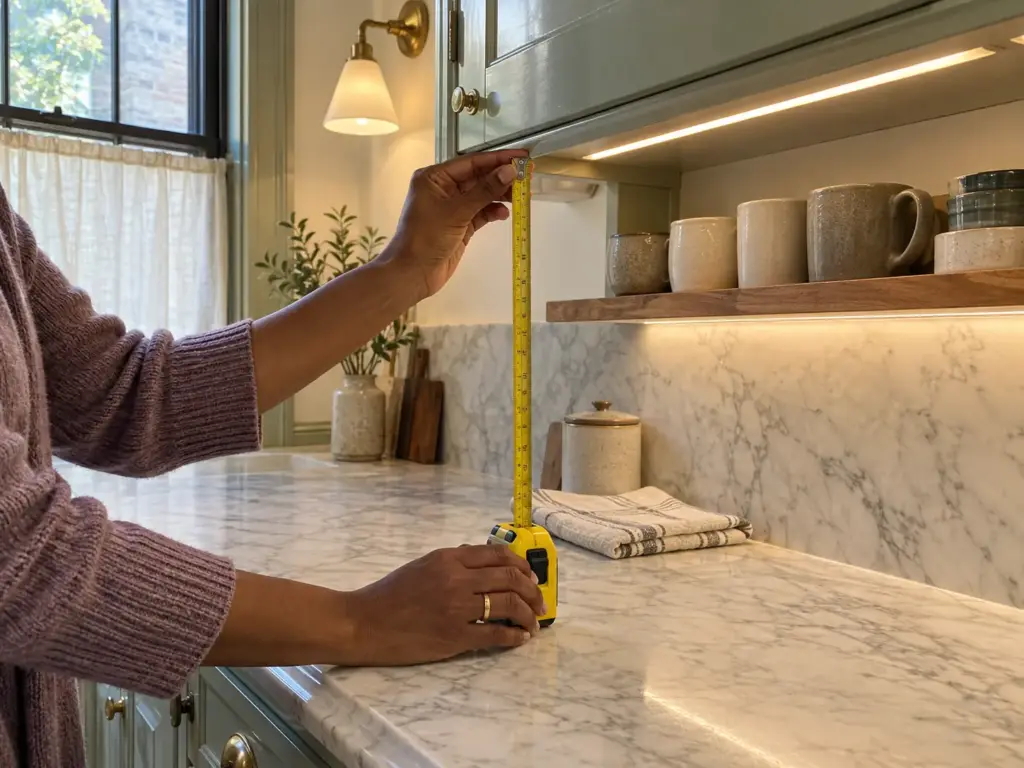
Put the tape on the counter at the exact spot where the machine will stand and read up to the underside of the cabinet, or to its trim if the trim hangs lower. That reading is your real cabinet height for an under cabinet coffee maker. Then do it again at the front edge, because crown pieces and face frames rarely sit at the same height as the back of the cabinet. Keep the lower of the two numbers.
A 10-cup machine no taller than 12.5 inches (32 cm) is what you need when cabinets leave very little space from the countertop to the bottom of the cabinet. That is the kind of kitchen this routine is written for: a gap that was fixed by a carpenter long before anyone chose a coffee maker.
Hook the tape’s end on the counter and read it at the lip of the cabinet’s front edge, not at the back wall. If the two readings differ by an inch, the shorter one is your real ceiling, and it is the number to write down.
Subtract what sits in the way
The cabinet is only the top of the problem. A raised backsplash edge, an outlet cover, a power strip, the tile ledge and the toaster parked next to the spot all take space from the machine’s footprint and its slide. Measure the clear width and depth too, and note where the outlet sits, because a cord pulled tight will pin the machine forward no matter how much headroom it has.
Leave room for the lid and for your hand
The lid’s travel is the open-lid envelope from the first section, and your hand has to get past it to the reservoir and the basket. So the number you want is the cabinet gap minus whatever sits in the way, minus the lid’s swing, with room left to pour. Write three numbers on a scrap of paper:
- The gap at the cabinet’s front edge.
- The gap at the back.
- The lower of the two, minus anything sitting in the way.
A round 14 inches is a rule of thumb for a kitchen that does not exist. The third number is yours, and it replaces 14 as the filter before any brand does.
Can It Be Filled Without Sliding Out?
Fitting under the cabinet is half the test. The machine gets filled every morning, so the second half is whether it has to come out to be filled, and that question starts where the measuring stopped.
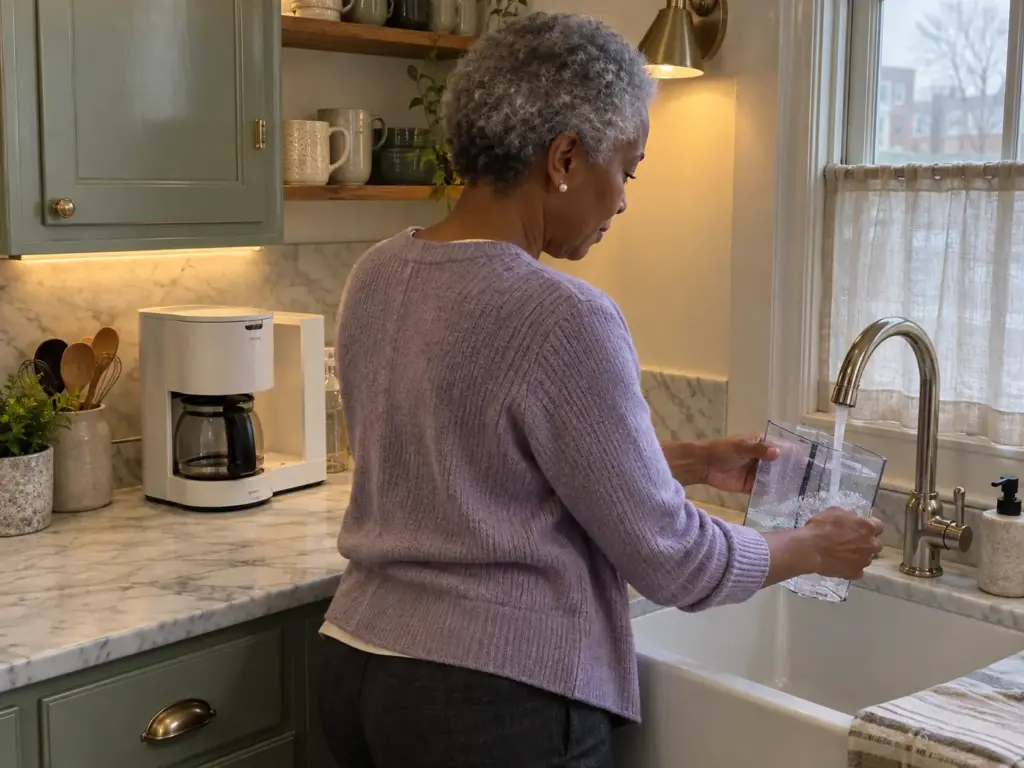
The lid-lift fill
Most home drip machines work one way: lift the lid, pour water into the reservoir, load the basket under the same lid. Home drip machines usually require you to lift a lid to add coffee grounds and pour water into the top. That one fact is the whole problem.
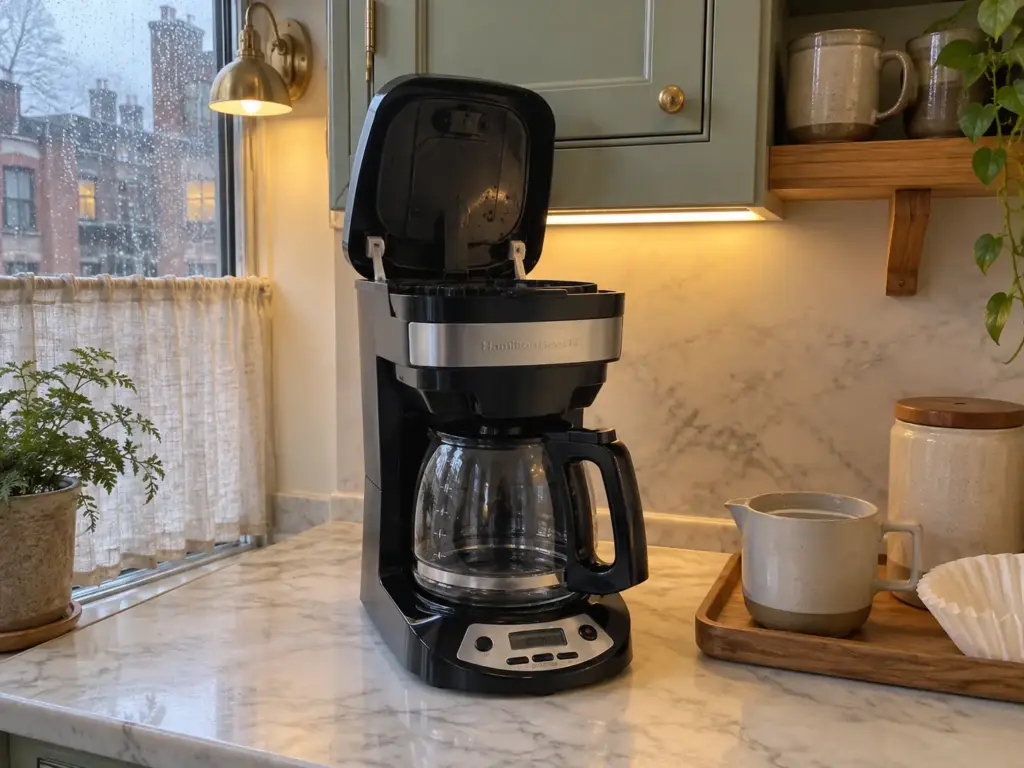
A machine that clears the cabinet with its lid shut gets dragged forward every morning to be opened, and the spot where it used to sit stops being the spot it sits in. Pulling it out to fill it is the whole cost of a top-fill machine.
For a lid-lift machine, the extra eight inches from the Dome is the working number, unless the counter lets the whole machine slide forward. If your counter has a ledge or an appliance garage in the way, that slide is not available, and the machine is the wrong shape for the gap.
The removable tank
The fix for most kitchens is the tank, not the height. In Serious Eats’ test the Zojirushi Zutto, the Ninja and the Mr. Coffee all had a removable water tank, and “Filling these tanks directly in the sink and fitting them back on the machine was an easy, splash-free experience.” The machine never moves; only the tank does.
One caution against over-reading that quote: it describes a sink trip that went well in a test, not a promise about every removable tank.
The tank has its own cost, which is weight. To fill in the sink a tank that holds twelve cups, you carry a lot of water: a full 12-cup tank holds about 60 fluid ounces at the usual 5-ounce box cup, which is close to four pounds of water, a two-handed carry from sink to counter. The Zutto’s 5-cup tank holds about 25 ounces, a pound and a half. The same trip is easy on one and awkward on the other.
Before buying a removable-tank machine, fill the largest pitcher you own to the water your target machine holds and carry it from the sink to the spot, once. If the trip makes you reach for a second hand, the front-fill door is the better answer.
The front door
A third design skips both trips. The Hamilton Beach 46299J has a FrontFill door, and the Amazon listing title reads “Hamilton Beach Front Fill 12 Cup Programmable Coffee Maker.” The water goes in from the front, so the machine can stay put under the cabinet while the pitcher comes to it.
What a door on the front leaves open is how far it swings, because the listing does not print the door’s open height or depth. A door that opens toward you takes space in front of the machine rather than above it, which is the point, but hold your pitcher at the counter’s front edge before relying on it.
So the rule is short. A machine filled in the sink or from the front stays where it is. A lid-lift machine needs the extra eight inches or a counter that lets it slide.
Two Machines That Fit and Fill in Place
Two machines pass both tests on paper, and each passes the fill test a different way. Only two, and the reason is plain: the rest were out of stock, sat on the wrong side of 14, or had a height that would not hold still between sources.
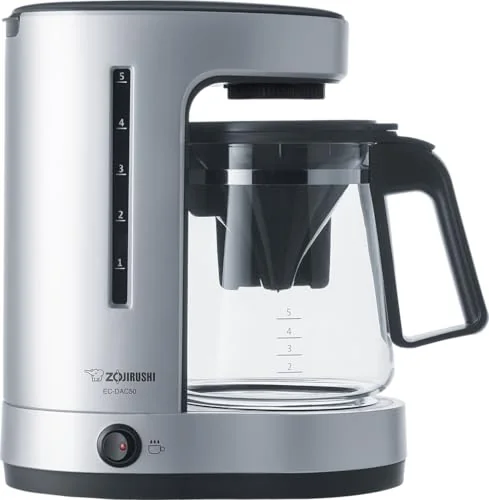
Zojirushi Zutto, filled at the sink
The Zojirushi Zutto EC-DAC50SZ is the short, hot one. It brews five cups, its tank is removable and goes to the sink, and the machine never leaves its spot.
The height needs care because it has two numbers: the current Amazon listing for the EC-DAC50SZ says 12.63 inches, while Serious Eats measured an older Zutto at 10 inches. Both are under the line, but the printed figure always belongs to a model. In that test the Zutto read 199°F (93°C) at the shower head, inside the band, which is the evidence that a short machine can be hot.
Its limit is stated in Serious Eats’ review: it has no programming features, so it is not the machine if an auto brew timer matters. You switch it on, and nothing is waiting at the timer. A 5-cup pot also takes about seven minutes in the same test, which suits a small household and a short list of mugs, and nothing larger.
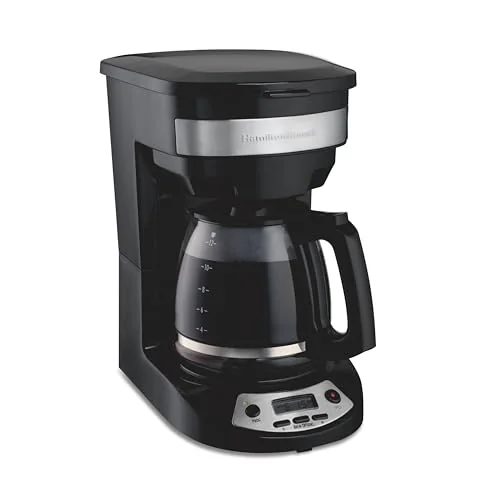
Hamilton Beach FrontFill, filled from the front
The Hamilton Beach 12-Cup Programmable (46299J) is the one for the reader who needs a full pot. The listing gives 11.4 inches deep, 9.5 wide and 12.9 tall, so it clears the line with the lid closed, and its front door means the lid is not the way in. For a pointer on bigger batches, when twelve cups is not enough is a capacity question that has its own page.
What is not known matters here, so it is written down. No repeated complaint turned up for this machine, but the only evidence is its listing, and no multi-week report exists to lean on. The door’s open height is not printed, and no test has measured its brew temperature, which is the number to check against the band in the cup section below.
The three side by side
The table puts the two cards next to the one-cup machine covered at the end of the article, with the height each listing prints, how it is filled, and the catch.
| Machine | Height on its listing | How it is filled | The catch |
|---|---|---|---|
| Zojirushi Zutto EC-DAC50SZ (5 cups) | 12.63 in (an older Zutto measured 10 in) | Removable tank, filled at the sink | No programming, so no auto-brew |
| Hamilton Beach 46299J (12 cups) | 12.9 in | FrontFill door, from the front | Door height and brew temperature not printed |
| Moccamaster Cup-One (1 cup) | 11.75 in | Water measured for one 10 oz mug | One cup at a time |
Read the table with the catches in mind. The Zutto has no auto-brew, the Hamilton Beach has unknown door height and unmeasured heat, and the Cup-One makes one cup at a time. Whoever needs a full pot with no sliding picks the Hamilton Beach and checks the temperature; whoever wants a small, proven-hot pot picks the Zutto and sets a manual routine.
That leaves the machines that fell out, in a sentence: the Black+Decker SpaceMaker and a 12-cup KITCHENTREND are not for sale right now; the Ninja (14.6 inches), the Balmuda The Brew (14.9) and the Moccamaster KBGV (14.0) sit at or over the line; and for the Cuisinart DCC-1200P1 and the Krups Simply Brew the height could not be confirmed.
Short Is Not the Same as Hot
The fit is settled and the cup is next, because a machine can fit perfectly and still brew cool. The question changes from does it fit to what the cup tastes like.
What the band is, and where it comes from
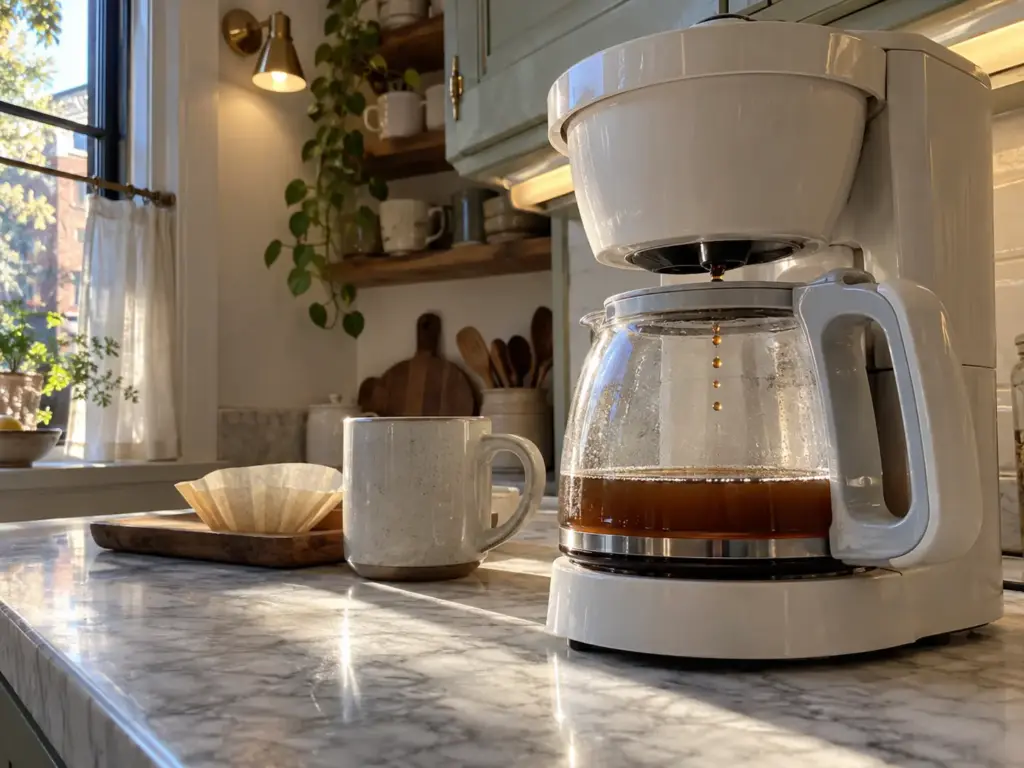
Serious Eats, reading the Specialty Coffee Association’s protocol, puts the brewing temperature of a drip machine between 195°F and 205°F (91°C to 96°C), and it took its readings at the shower head, where the water meets the grounds. Below that band the water gives up less of the coffee before it runs through, which is the mechanism behind a sour or weak cup.
Before buying, check the exact model on the Specialty Coffee Association’s certified home brewer list. According to the SCA, “SCA Certified Home Brewers are coffee makers that meet SCA’s rigorous standards for brewing quality, consistency, and performance.” Match the full model name, not just the brand, since a maker can sell a glass carafe version on the list and a thermal carafe version that is not on it.
The short machines that ran cool
Height decides nothing about heat. In Serious Eats’ brewing test, the 10-inch Zutto read 199°F (93°C), the 14-inch Ninja CE251 read 195°F (91°C), and the 15.25-inch Zojirushi Dome read 200°F (93°C). At the other end, the Melitta Aroma Enhance read 186°F (86°C) and tasted watery, the BUNN Speed Brew Elite was under-extracted, and the Mr. Coffee “failed to reach 195˚F during brewing, and the resulting coffee tasted dull.”
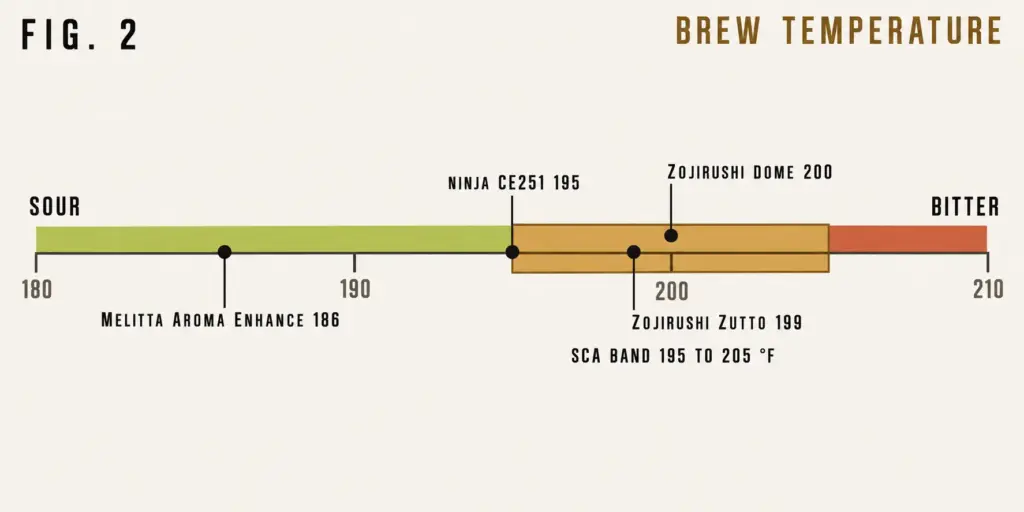
A machine that fits and a machine that heats the water are two separate facts, and a small one can fail the second. The cool results in that test came from an inexpensive field, so a small machine at the bottom of the price range is where to look hardest. The heat you give up at the lowest prices is its own story, and the fit question does not answer it.
The practical reading of all this is that a hot reading is a property of the heater, the shower head and the tank together, and none of the three is printed next to the height. A cool cup in a short machine is not the beans’ fault, and it is not fixed by buying a different bag of beans; changing the bag leaves the water exactly as cool as it was.
Pour a splash from the start of the pot and one from the end, and taste them side by side. If both are the same kind of sour, the water ran too cool to begin with, and the carafe has nothing to do with it.
Sour or weak? One change, then taste
A sour or weak cup points to under-extraction: the water left before it finished. The change to make first is free, and it is only one: go a step finer on a drip machine, keep the scoop count the same, and brew again. The next cup should taste rounder and less sharp. If it turns bitter, you went too far, so back off half a step.
If the cup is better but still thin or sharp, that is the machine’s ceiling, not a failure of technique. A finer grind can make up part of the gap, because more surface gives the cooler water more to work on, but it cannot lift water that never reached the band. Past a point, a finer grind also slows the flow through a basket and starts to push the cup toward bitter, so the repair has an edge on both sides.
Order matters, because a reader who changes the grind, the dose and the beans together cannot tell which one worked. Keep the dose, change the grind, taste. Only if the machine still reads sharp does the next change belong to the machine: a different one, chosen with the heat in mind. And for the opposite complaint, bitterness, which the Ninja leaned toward in that test, the same single change runs the other way: a step coarser, then taste.
What to Check Once the Newness Wears Off
No multi-month report on these machines turned up, only one test and a set of listings. So this section gives checks, not a timeline, and none of them claims a failure that has not been shown.
- The tank still seats flat after being carried to the sink and back.
- The lid still opens to its stop without touching the underside of the cabinet.
- The cord still reaches the outlet without being pulled tight.
- The carafe and the basket are wiped dry at the end of the day.
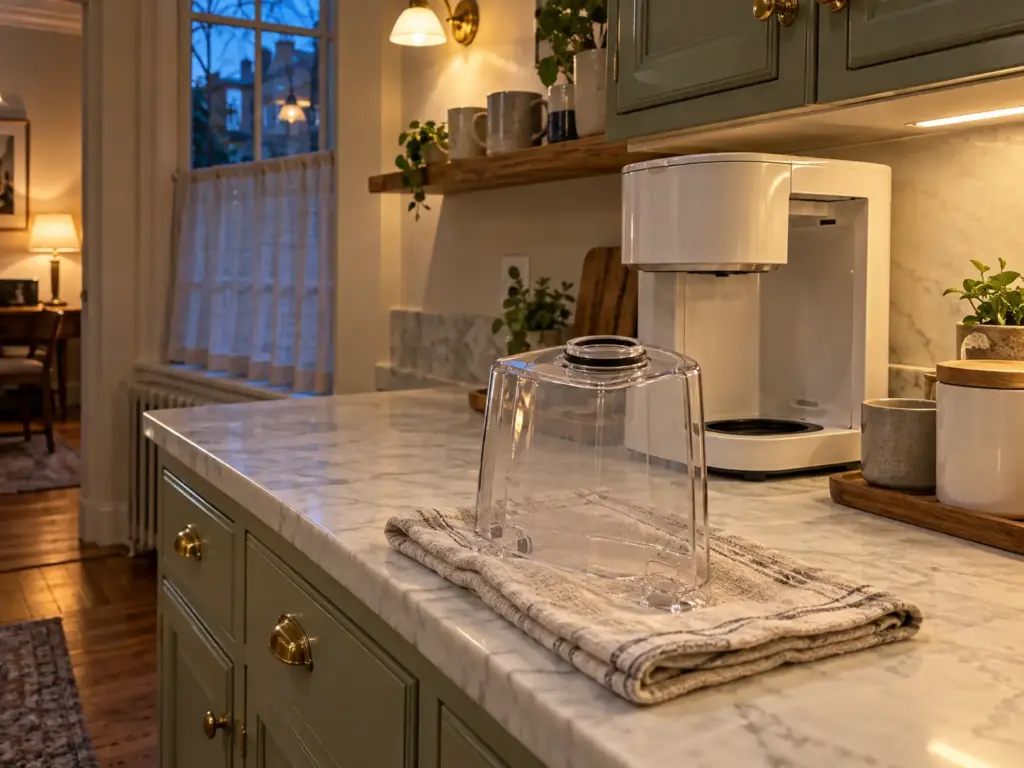
The one signal that something has gone wrong is travel: the machine has crept forward on the counter, because the reader is sliding it out again to fill it. That means the fill test failed in real life, and the machine is in the wrong place or the wrong design. A lid that now clears the cabinet by less than it did is the same signal, seen from above.
Wipe the counter under the feet while you are at it. Drips from a carried tank collect under a machine that never moves, and a damp spot there is easy to miss.
Put a short strip of masking tape on the counter behind the machine’s back feet. When the feet start to sit an inch ahead of the tape, it has begun to travel.
When the Gap Is Too Tight for Any Drip Machine
Some gaps are too low for any machine that fills from the top, and this section is the bridge for that case, and for the purchase that follows the machine: the grinder that fits the same counter.
One cup at a time
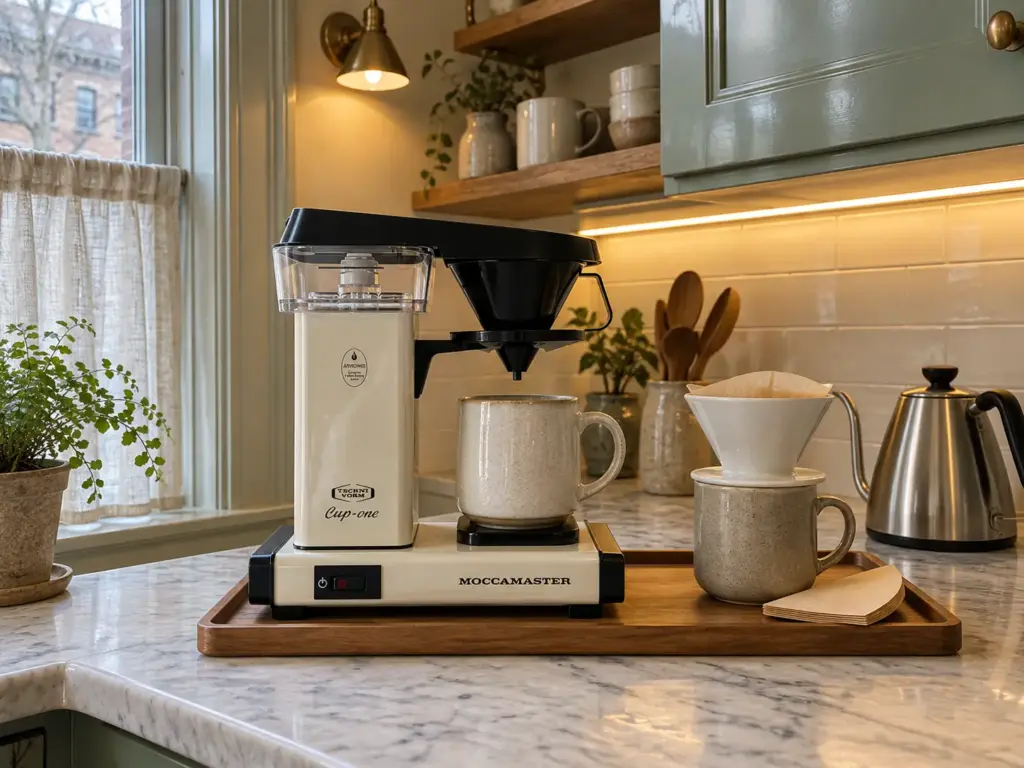
The Technivorm Moccamaster Cup-One is the one-cup answer. It stands 11.75 inches tall, 6.5 deep and 10.25 wide, its listing puts the water between 197°F and 204°F (92°C and 96°C), and the SCA’s certified list names it at about four minutes for a 10-ounce cup.
It fits under almost any cabinet with room to spare, and it works as a single-serve machine without a pod. Its limit is a limit of use, not a defect: one mug at a time. A coffee maker for one person is a bigger question than the fit one, and it has its own page.
Pour-over, AeroPress or a K-Cup
Some gaps do not need a machine at all, and the honest answer for a very low shelf is a method rather than a model. A pour over cone on a mug and an AeroPress need almost no height: they sit on the mug or the counter, and a kettle pours into them from the side. For a compact coffee maker alternative that needs no cabinet clearance at all, they are the simplest place to start.
The grind an AeroPress wants is the one change to learn before the first brew. A pod machine like the Keurig K-Mini is built narrow, and the grind for a reusable K-Cup matters if you are filling your own pods.
The grinder is the next measurement
A built-in grinder makes the machine taller, which is why grind-and-brew machines are the tall ones; the Cuisinart Burr Grind & Brew is a tall design that may not clear a cabinet. The grinder you will need next is a separate piece, and it is the next measurement. Coffee makers with a built-in grinder settles blade versus burr in the same machine, and the coffee grinders worth a spot on the counter are the better question once the machine fits. The scale comes after the grinder.
Measure With the Lid Up, Then Taste Once
Three things carry the rest. The number on the box is the lid-closed height, so measure the gap with the lid open and the tank out. A machine that fills in the sink or from the front stays put, and only two checked here came out under 14 inches. Fit is not heat, so read the temperature and change one thing, the grind, then taste.
A month from now, look at whether the machine has crept forward on the counter; if it has, the fill test failed in real life.
Tomorrow morning, raise the lid on the machine you already own, measure the space it needs, and write that number on the inside of the cabinet door before opening a single listing.
Frequently Asked Questions
01What are some good low-height coffee makers?
Two machines under 14 inches on their listings can be filled without leaving their spot: the Zojirushi Zutto, whose tank goes to the sink, and the Hamilton Beach 46299J, which fills from a front door. For one mug, the Moccamaster Cup-One stands 11.75 inches tall.
02What is the standard height of a coffee maker?
There is no single standard height: the machines here run from about 10 to 12.6 inches (Zojirushi Zutto, by model) and 12.9 inches (Hamilton Beach) up to 14.6 inches (Ninja CE251) and 15.25 inches (Zojirushi Dome). Check the lid-open height before trusting any of them.
03What are some good coffee makers that are less than 12 inches tall?
The Moccamaster Cup-One at 11.75 inches is the clear one, and it makes a single 10-ounce cup. The Zojirushi Zutto is under 12 inches only on the older listing, at 10 inches; the current EC-DAC50SZ listing says 12.63.
04What is the smallest size coffee maker?
By height and footprint, the Moccamaster Cup-One is the smallest drip machine here, at 11.75 inches tall and 6.5 inches deep, and it makes one cup at a time. Below that, a pour-over cone or an AeroPress needs almost no height at all.
05Can I fill a coffee maker without pulling it out from under the cabinet?
Yes, if the tank comes out (Zutto) or the fill door is at the front (Hamilton Beach 46299J). A machine that fills through a lid on top usually needs the extra clearance the open lid takes, or a counter that lets it slide forward.



How did your cup turn out?
No comments yet. Tell us what you changed — and whether the needle moved.