




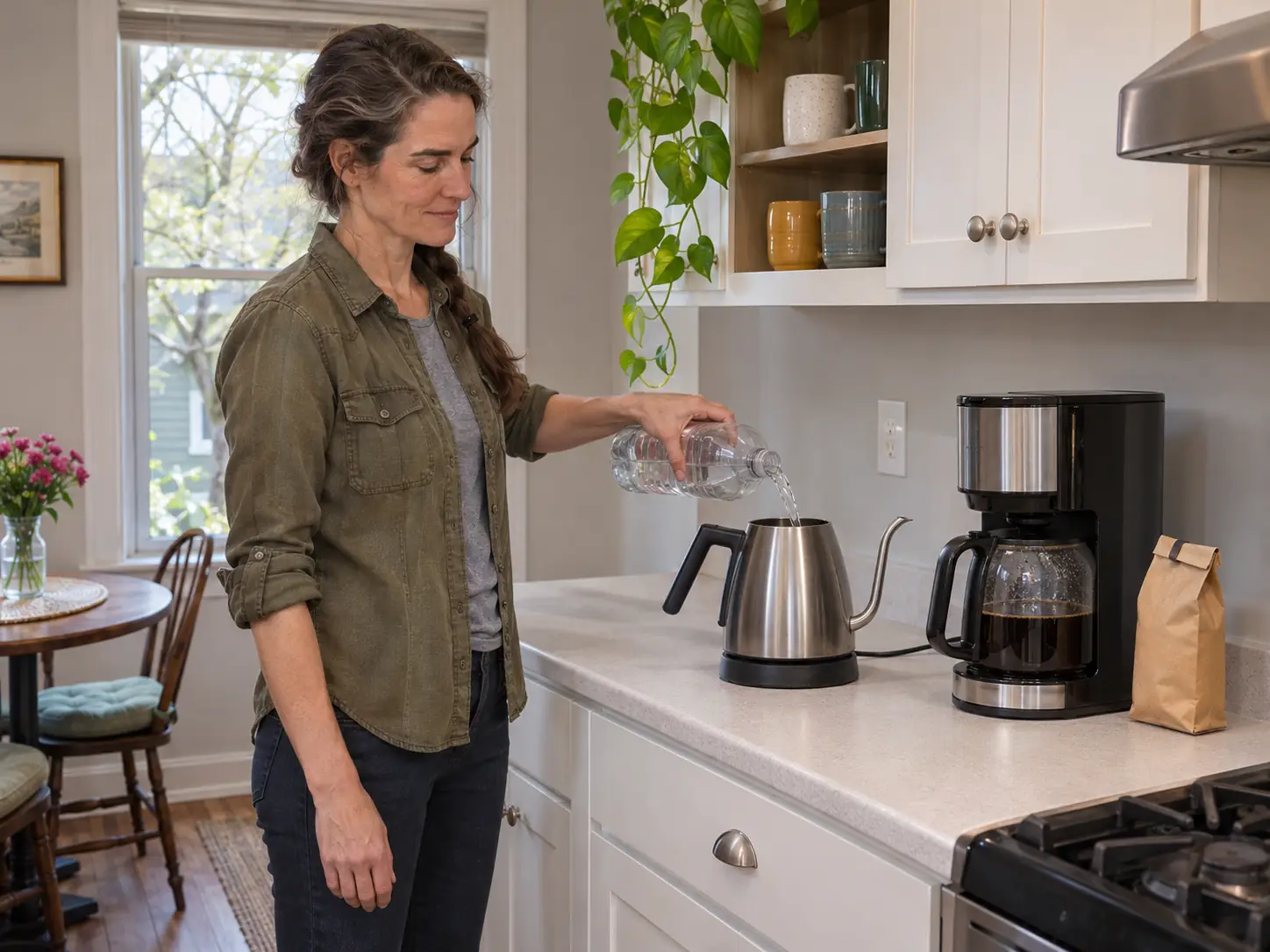
We may earn a commission when you buy through links on this page. It never changes what we recommend. How we pick
On this page8 parts
- What the Alkaline Label Measures, and What It Skips
- What Bicarbonate Does to a Light Roast and a Dark One
- The SCA's Numbers Against the Number on the Bottle
- Taste It Side by Side, Then Measure It
- If the Cup Is Flat, Change the Water in This Order
- What Alkaline Water Leaves Behind in the Kettle and the Machine
- Brew Two Cups, Read the Buffer, Leave the Grinder Alone
- Frequently Asked Questions
You filled the kettle from a bottle that says pH 9 and brewed the same dose with the same grind as yesterday, and the cup came out quiet: nothing sharp, but nothing rising out of it either. Is alkaline water good for brewing coffee? Only when the cup is harsh and the water is very soft, because the pH printed on the bottle is not the number the coffee reacts to.
What the water does inside you, to the kidneys or the stomach, is a question for a doctor, so this page stays with the cup. Below: what the label measures and skips, what bicarbonate does to a light roast and a dark one, the SCA’s figures set against the bottle’s, a two-cup test, the fixes in order, and what the water leaves behind in the kettle.
Quick Answer
Rarely. The pH on the label is not what decides the cup; alkalinity is, the bicarbonate that buffers coffee’s acids. Alkaline water trades brightness and clarity for a flatter, softer cup, so it earns a place only when the coffee tastes harsh and the water is very soft.
What the Alkaline Label Measures, and What It Skips
A bottle that sells itself on a pH number sells one measurement, while coffee reacts to another. Pulling the two apart comes first, because every later decision depends on knowing which number you are holding.
Brewed Coffee Sits Near pH 5 on Purpose
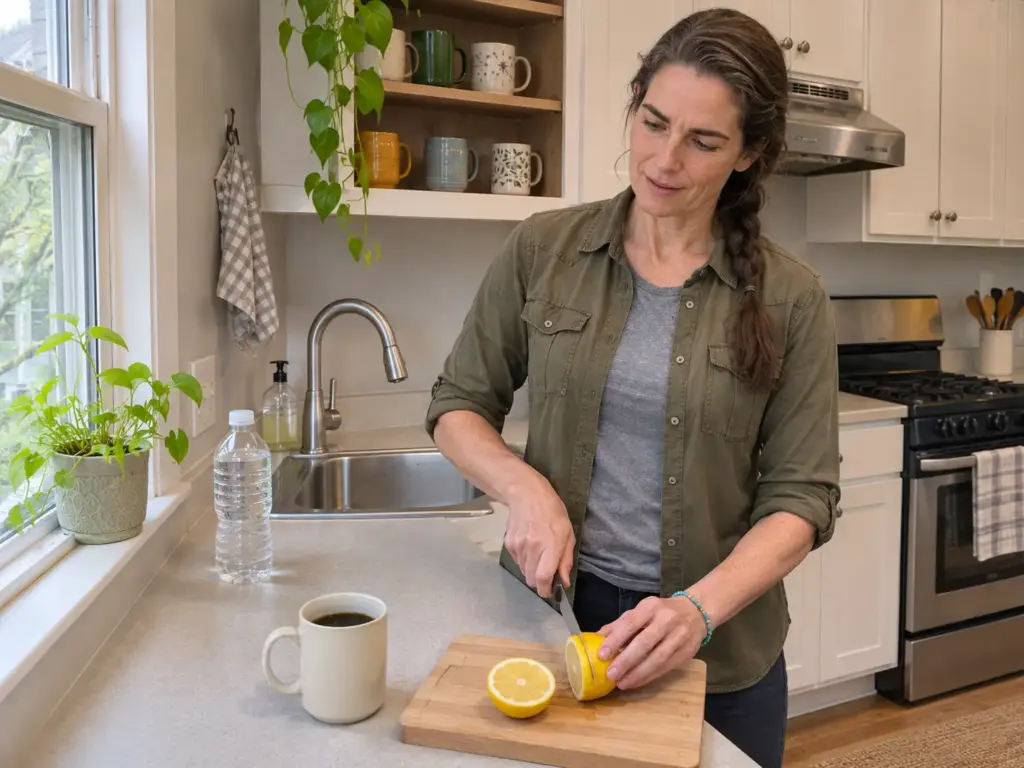
Brewed coffee lands around pH 5, according to Scott Rao’s water primer, and that acidity is where the brightness, the fruit and the structure of the cup come from, which is why an acidic coffee is not a flaw to filter out. A lemon sits near pH 2, so coffee is mild by comparison. The sharp edge you want gone is mostly a sign that the water left the grounds early, which a finer grind size or hotter water corrects at the source; chemistry in the water only sands it down. And if you could strip the acid out entirely, the fruit would leave with it, which is the part you paid for.
Alkaline Only Means Above 7
On the 0 to 14 pH scale, alkaline is only a position: anything above 7. Rao’s definition keeps two ideas apart, since a solution can be very alkaline and still have low alkalinity, and the reverse. A pH 9 water can carry almost no buffer behind that number, and a pH 7 water can carry plenty.
The label describes where the water sits and says nothing about its buffering capacity, how much acid it can soak up before it moves. Getting that straight is the first step toward knowing what makes water good for brewing in the first place.
Alkalinity Is the Number the Acids Notice
Alkalinity is the amount of bicarbonate in the water, and bicarbonate is what soaks up the coffee’s own acids as it brews. At near-neutral pH, the SCA’s Marco Wellinger writes in 25 Magazine, the effect of alkalinity on the cup’s final acidity is several hundredfold higher than the effect of pH. The association puts the priority in one line: according to the SCA’s own explanation of why alkalinity matters more than pH, it is “far more important to keep alkalinity within a certain range than pH” when choosing a water for coffee extraction.
So a pH 9 bottle and a pH 7 tap water can carry the same alkalinity. You may be brewing with alkaline water that does almost nothing to the cup, or with plain tap water that flattens it harder than the bottle would. The label describes where the water sits; the cup responds to how much buffer is in it, and the two readings can disagree about the same glass.
There is a mechanism behind that. Once coffee grounds are in the water, their acids pull the pH down toward 5 whatever the starting pH was, and the alkalinity decides how far that drop is allowed to go. A buffer that is large enough holds the cup near the pH of the water it started as, and that is the quiet, flat taste. A pH 9 water with little buffer behind it gives way almost at once, and the coffee tastes like itself.
What Bicarbonate Does to a Light Roast and a Dark One
With the buffer named as the suspect, follow it into the cup: what it quiets, which roast notices and which barely does, and why the hope of a smoother cup is only half true.
A Light Roast Loses Its Fruit First
Direction first. A cup that is sharp and bright points one way: too little buffer, a harsh cup. A cup that is flat and dull points the other: too much buffer.
Alkaline water moves the coffee toward flat, so it can only help a cup that sat on the harsh side to begin with. A bitter, drying cup is a different signal: that is over-extraction, and the grind size or the water temperature answers it, not the bottle.
The evidence comes from cupping. In the Crown sensory tests reported by Daily Coffee News, high-alkalinity water gave coffee the tasters called very flat and chalky, with muted acidity and muddled flavors, and a water carrying only bicarbonate with no hard minerals scored lowest on sweetness.
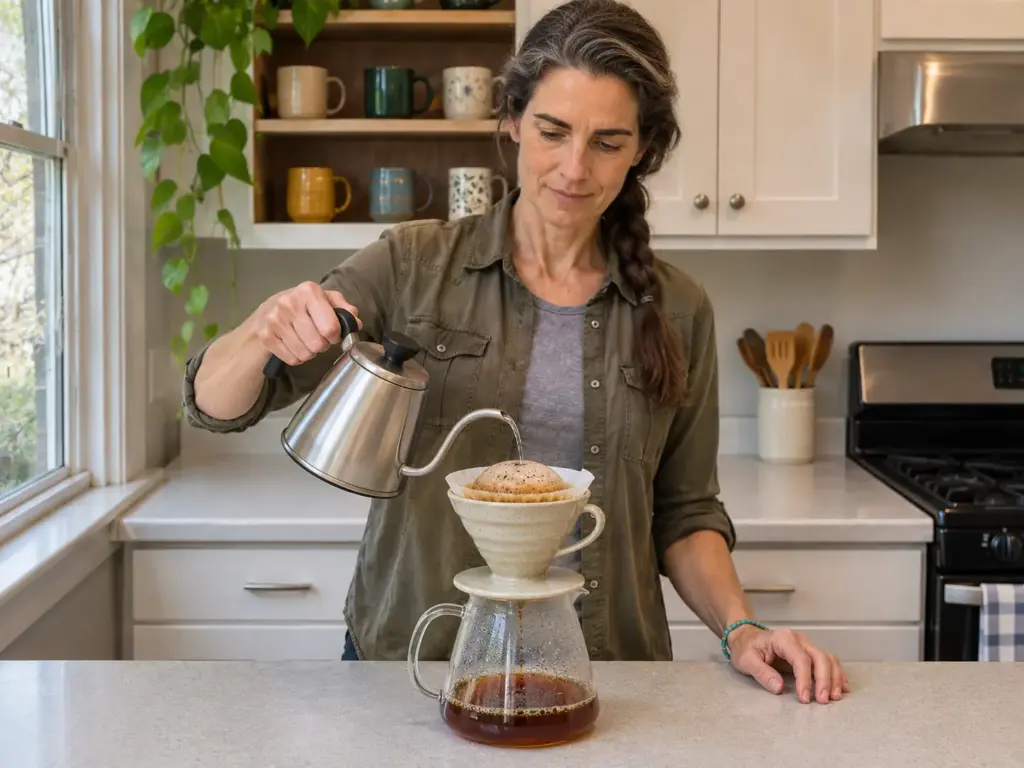
A light roast carries its fruit in exactly the acids the buffer swallows, chlorogenic acid among them, so it loses the most. The muting arrives in the aroma and the first sip as nothing missing and nothing there, and sweetness drops with it. That sends you to the grinder and the scale, chasing a brightness the water removed.
A Dark Roast Barely Notices
A dark roast has little acid left to neutralize, so the same buffer changes it less. That is how a very alkaline water can sit fine on a dark roast and ruin a light one from the same shelf, and why the promise of a gentler cup holds only for the roast that had little to lose. The wider contrast between which roast goes sour and which goes harsh is laid out in another guide; here it is enough to know that the lighter the roast, the louder the water.
Judge a water on the lightest roast you drink. A dark roast that tastes fine from the bottle only shows that the dark roast had little acid to lose; the light one is the bag that tells you whether the buffer is too high.
Muted Is Not Smooth
Bicarbonate does not give the cup a creamier, more velvety mouthfeel. The cupping data point the other way: high-alkalinity water came out flat, chalky and muddled, and no standard or published test credits it with velvet. If the goal is a low-acid coffee, a darker roast changes the cup at the source; the water only mutes it.
A cup can feel thick and still be dull. The chalky part is the dry, powdery finish a high-alkalinity water leaves on the tongue once the acids that lift a finish are gone. A smooth cup has acids and sweetness in proportion after a balanced extraction; a muted cup has lost the acids, and the sweetness goes with them.
Espresso Is the Exception
The same water behaves differently in a shot. The beverage ratio spans about tenfold, from near 1.5 parts of liquid to 1 part of coffee in a ristretto to near 15 in a filter cup, so only about a tenth of the water’s alkalinity meets the same amount of coffee acids. According to the SCA’s 25 Magazine, that tenfold spread is why a water that flattens a pour-over can be nearly invisible in espresso. A pour-over drinker and an espresso drinker can read the same label and reach opposite verdicts, and both can be right.
On an espresso machine the lever is the ratio itself, and why the brew ratio changes how much of the water’s buffer reaches the acids is the thread to pull if the shots taste different from the filter cups.
The SCA’s Numbers Against the Number on the Bottle
Two figures travel with no owner attached: pH around 7, and 20 to 40 ppm of alkalinity. The standard’s own numbers go beside what a bottle, an ionizer and a kitchen pinch actually deliver.
What the Standard Asks For
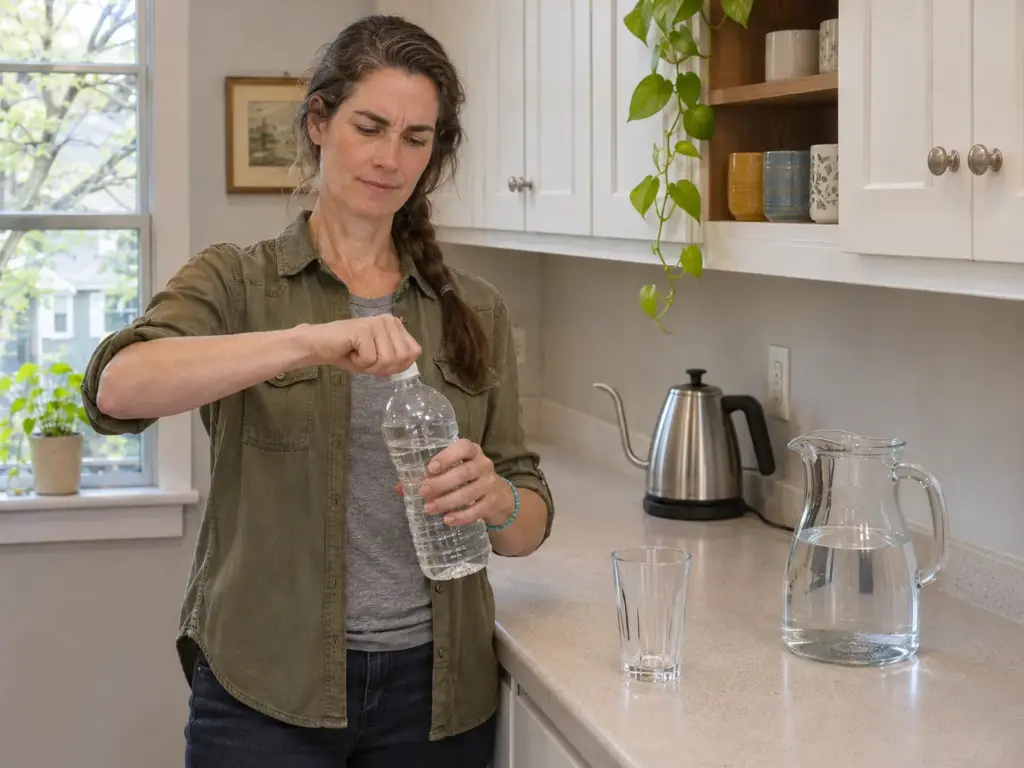
The 2009 SCA standard for brewing water targets total alkalinity of 40 mg/L, calcium hardness of 68 mg/L (17 to 85 acceptable), total dissolved solids of 150 mg/L (75 to 250) and a pH of 7.0 (6.5 to 7.5). The current SCA figures, from Standard 102-2024, widen the picture: calcium hardness of 50 to 175 ppm, alkalinity at or near 40 to 70 ppm as CaCO3, pH 6 to 8 and no chlorine. (In water, ppm and mg/L are the same unit, so the two lists compare directly.)
Read together, they say the pH can sit anywhere from 6 to 8 and still pass, while alkalinity is the number with a ceiling. Those figures live in the SCA’s published coffee standards.
Why 20 to 40 ppm Isn’t the Standard
The line that circulates as ideal, 20 to 40 ppm of alkalinity, has no owner in the standard, whose range is 40 to 70. It traces to Scott Rao, whose personal target for lightly roasted, well-developed coffee is 30 to 40 ppm, and who calls 20 to 50 reasonable in general. That is a taste preference for one kind of cup, and it sits below the SCA’s floor on purpose. If the bag is a medium or dark roast with less acid to protect, there is no reason to chase 30; start from the standard’s range, and let Rao’s number be where a light-roast drinker ends up after tasting.
What a Bottle, an Ionizer and a Pinch Deliver
A bottle sold at pH 8.5 or pH 9.5 is judged by its alkalinity, and the label rarely prints it. Spring water carries whatever minerals its source did, and purified water has had most of them taken out, so neither name tells you the mineral content that matters here. A water ionizer, or a remineralizing cartridge on a home reverse-osmosis unit, can push the output past pH 10 while the owner has no buffer number at all. The label says alkaline; the cup stays a mystery until somebody runs a test.
The kitchen version is the one you can measure. According to Daily Coffee News, 0.1 g of baking soda in 1 liter of distilled water lands near 50 ppm of alkalinity, inside the SCA band, and 0.2 g jumps to about 100 ppm, well past it.
Some recipes buffer with potassium bicarbonate instead of baking soda; the grams differ, so follow one recipe whole and never mix two. In US kitchen terms that is about 0.4 g in a gallon (a liter is roughly 34 fluid ounces), and an eighth of a teaspoon weighs around 0.6 g, so a single eighth of a teaspoon in a gallon already lands at the band’s ceiling or a little beyond it. Doubling the pinch takes the cup out of range.
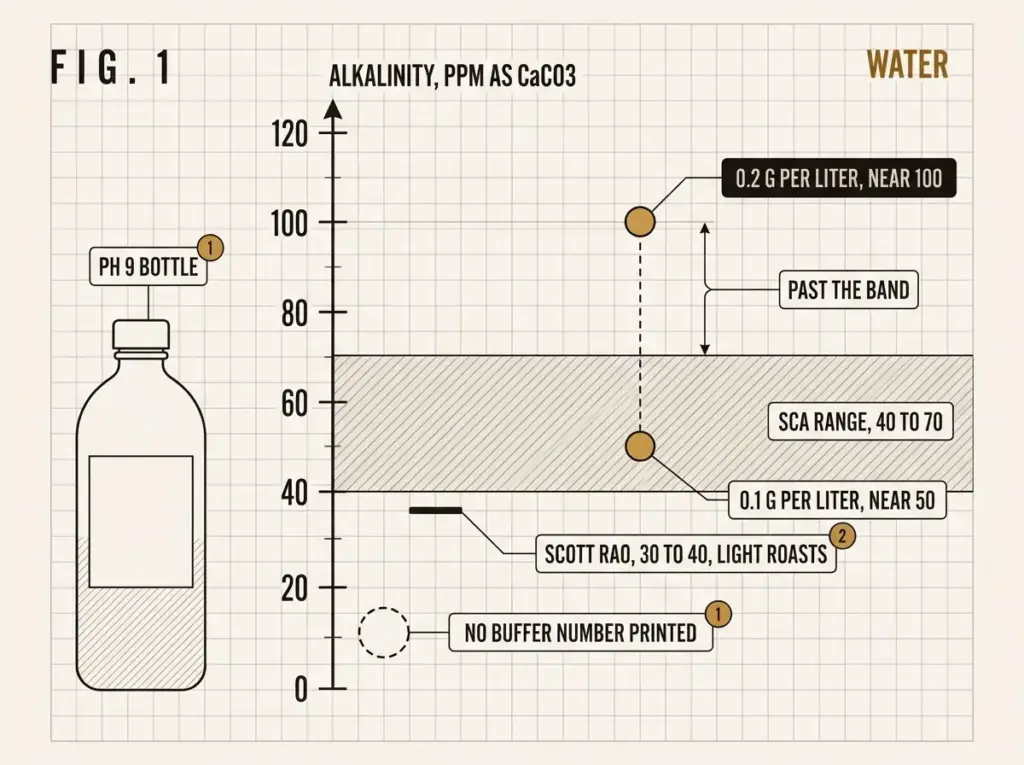
A bottle’s missing number is not always out of reach. When the label prints the minerals, how to read the minerals on a bottled water’s label shows where the bicarbonate hides, and bicarbonate is the figure that converts to alkalinity.
When a label lists bicarbonate (HCO3) in mg/L, multiply by 0.82 to get alkalinity as CaCO3 in ppm. A bottle that prints 120 mg/L of bicarbonate carries about 98 ppm, well past the top of the SCA band.
Taste It Side by Side, Then Measure It
Nothing above needs a purchase, so start with what you already own: two cups and a water report. A meter and a kit come after, each with its limit stated.
The Two-Cup Test
Brew the same coffee twice, once with your usual water and once with the alkaline one, keeping the dose, grind and method identical. It is a plain taste test, and it works in a pour-over, a drip coffee maker, a French press or a cold brew, as long as the method stays the same across both cups.
A 1-to-16 brew ratio is a fair default for the coffee to water: 20 g of coffee (about 4 level tablespoons) to 320 g of water (about 11 fluid ounces). If the alkaline cup is flatter and quieter, stop there and either cut the bottle with a softer water or keep it for a dark roast. If your usual cup is the harsh one and your tap water is very soft, the alkaline water earns a second try. A cup does not get worse in a straight line as the buffer climbs; it goes quiet first, and that is how a doubled pinch slips through.
Put tape on the base of each mug and have someone else swap them before you taste. The difference you are hunting is quiet enough to be talked into or out of existence.
The Water Report Nobody Opens
Your city publishes an annual water-quality report, and it carries an alkalinity line (or a bicarbonate one). That line can explain a whole season of flat coffee that no grinder setting fixed. The cold glass carries the chlorine and the crust on the kettle element carries the hardness; what to smell for in a glass of tap water covers the first of those.
What a TDS Pen Cannot See
A TDS meter reads total dissolved solids. It cannot separate hardness from alkalinity, and the SCA’s water quality specialist notes that it only tells you how much of something is there. That still suits a first reading, tap against filtered, and proving that a filter works; as a verdict on a light roast it is useless.
The HM Digital TDS-3 does the first-reading job in two seconds: 0 to 9,990 ppm in 1 ppm steps, plus or minus 2 percent, with a built-in thermometer and a carrying case. Accuracy varies from one unit to the next and the box ships with thin instructions, so read the same water twice before believing a number.
The Kit That Reads the Right Number
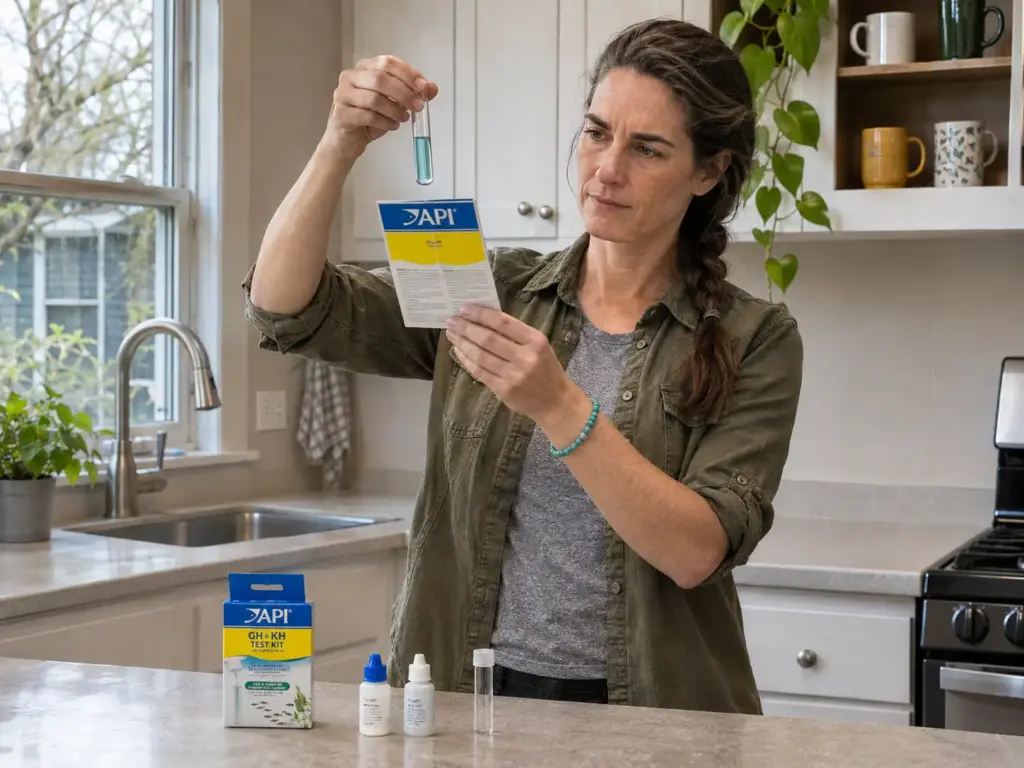
The only cheap tool that separates carbonate hardness (KH, the alkalinity) from general hardness (GH) is a drop test. The API GH and KH Test Kit, model 58, comes with two reagent bottles and two test tubes and no meter to calibrate: you add drops to a water sample and count until the color changes, and API’s instructions treat each drop of the KH bottle as one degree, about 18 ppm. That coarse step is the first limit, because a light-roast target of 30 to 40 ppm falls between the counts.
The second is the color charts: the change can be hard to see and the reading instructions are unclear, so run the test twice, in daylight, against a sheet of white paper. Test strips work the same way, a color matched to a chart, and share the same reading limit.
If the Cup Is Flat, Change the Water in This Order
The test said flat, so now the fixes, free and likeliest first, with a taste between each. The first costs close to nothing: cut the alkaline or hard water half and half with a gallon of distilled water from the store, or keep the bottle for the dark roast. Move on only if the cup is still dull.
Start With What a Pitcher Removes
The water filter pitcher most kitchens already have is a carbon filter, and the Brita Small 6 Cup with an Elite filter (model OB11/OB06, rated for 120 gallons or about six months, WQA and NSF/ANSI certified) reduces chlorine, lead and microplastics. It leaves the alkalinity exactly where it was, and so does a carbon filter of any size, pitcher or under-sink. On a chlorine problem it is the right pitcher; on a flat light roast it is the wrong tool, and a reader who bought one for dullness keeps changing grind, dose and pour while the muting stays put.
The plastic shell cracks from a slight knock and the lid leaks when it closes, and because hardness stays in the water, no kettle or boiler is protected. How carbon and ion exchange each change the water separates the two filter types.
Start From Zero and Add Back
Why a water with nothing in it brews flat is the reason a blank base cannot be where this ends: distilled and reverse osmosis water (RO water) have no minerals to carry flavor out of the grounds, so the cup comes out hollow. The ZeroWater 10-Cup Pitcher (ZP-010) reaches a near-zero reading with five-stage ion exchange, and the TDS meter in the box proves it. The cartridge wears out quickly and the pitcher spills when filled too far. A gallon of distilled water from the store does the same job with no equipment.
The meter in the ZeroWater box doubles as the cartridge timer: the maker’s rule is to swap the cartridge when it reads 006. Hard water gets there sooner than soft water, so check the reading on a schedule you set, not by the date on the box.
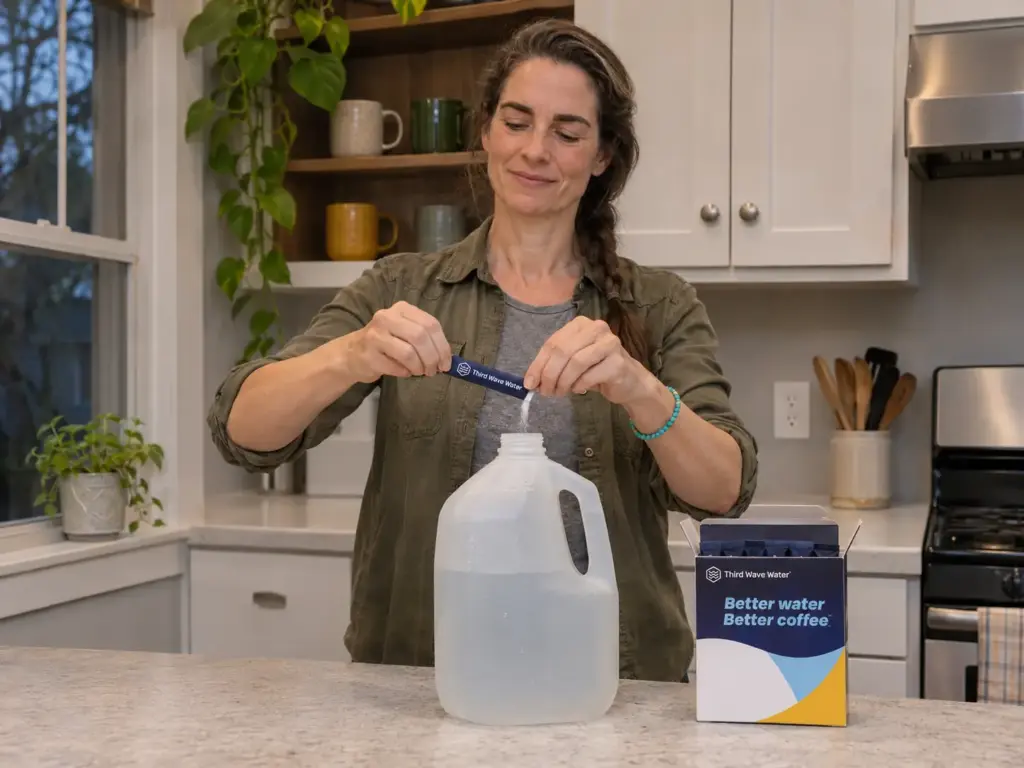
Minerals go back onto that blank base with Third Wave Water Classic: twelve single-gallon sticks of magnesium and calcium with low alkalinity, which rebuild a profile inside the SCA ranges without a scale or a shelf of salts. Against a good filtered tap the difference can be too small to taste, and the sticks are a recurring cost, one per gallon.
The Pantry Version
The home route is a mineral recipe built on distilled water: a small pinch of baking soda and a spoon of Epsom salt for magnesium. Keep the baking soda inside the band: 0.1 g per liter, about 0.4 g per gallon, lands near 50 ppm, and the measured version of the whole water recipe is in the recipe in grams, step by step.
Brew, taste, and stop at the first cup that comes back bright. The order is dilute, then filter, then rebuild on a blank base, then the pantry mix, with a taste between each so you know which move worked. Never two at once.
What Alkaline Water Leaves Behind in the Kettle and the Machine
The cup is only half the bill. The bicarbonate that quiets a light roast is also what crusts a kettle element, and the schedule for removing it follows the water, so the calendar is a poor guide.
Bicarbonate Plus Heat Makes Scale
Scale, or limescale, forms when bicarbonate meets heat. According to Roastopedia, calcium bicarbonate breaks down on hot metal into calcium carbonate, so the part of hardness that turns into scale is the carbonate part: the lower of total hardness and alkalinity. The belief that hard water is bad for coffee is half true for that reason, because it sends people to check hardness when the number doing the crusting is the carbonate one.
Water at 212°F (100°C) in a kettle, or running over a heating element in a drip machine, is exactly the heat the reaction needs, and why the water temperature matters as much as the water is the other half of that story. The early sign is a pale film at the base of the carafe or on the element, and it shows up before the descale light does.
The same rule explains why a bottle can mislead in both directions. An alkaline water with plenty of bicarbonate and little calcium scales less than its pH suggests, because the part that crusts is capped by the lower of the two numbers. A hard, high-alkalinity tap water scales the most, and that is the water behind most early descale lights.
The Descale Interval Follows the Water
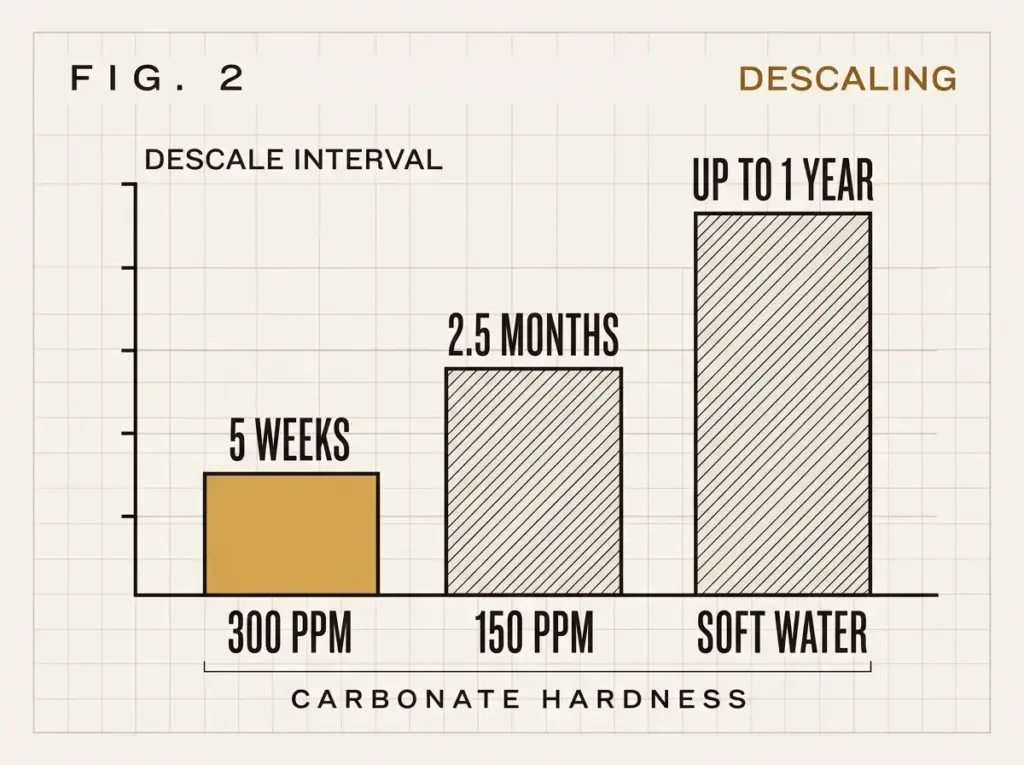
The descale interval tracks carbonate hardness. In Barista Bench’s water map, water near 300 ppm needs descaling in about five weeks, water near 150 ppm in about two and a half months, and genuinely soft water can go up to a year. Of the 81 US cities with published figures, only 27 fit a one-to-three-month schedule. Switching to alkaline water, filtered water or a built water changes that number, up or down.
Here, how an automatic machine decides when to ask for a descale rests on the water hardness setting it was given, so entering the real number matters on an automatic espresso machine. A wrong setting makes the prompt arrive early or late for the water you actually pour.
What the Machine Shows First
A drip coffee maker shows scale buildup first as a cooler brew and a slower one. Scale conducts heat poorly, so a crusted element takes longer to bring the water up, and both effects feed back into a thinner, sourer cup, because water that leaves the grounds early under-extracts them.
Brewing is a short event, so a few degrees lost at the start never get made up. Filters wear on the same clock: a cartridge rated for months can slow to a trickle early in hard water, and the change is gradual enough to be taken for the coffee. What scale does to a drip machine by the second month is the longer view.
Stick a strip of masking tape on the machine and write the date of each descale. When the water changes, the interval changes with it, and the tape shows whether the next light came early or late for the new water.
Brew Two Cups, Read the Buffer, Leave the Grinder Alone
The number that decides the cup is alkalinity, and the pH on the label is a different measurement. Alkaline water mutes a light roast and barely touches a dark one; the SCA aims for a lightly buffered water near 40 to 70 ppm of alkalinity; and the two-cup test and the water report cost nothing, so they come first. If the cup is flat, fix it in order: dilute, filter, rebuild on a blank base, then the pantry mix, tasting between. The same bicarbonate that flattens the light roast also brings the descale sooner.
Tomorrow, brew the same dose twice with two waters and taste before you touch the grinder or open a new bag. After a season on whichever water wins (a city adjusts its supply and a cartridge wears by volume), brew the same light roast again and look at the kettle element and the descale light for the pale film. If neither water explains a dull cup, the grinder becomes the next suspect. From here the question turns to which water to brew with every day, and which bottled water to brew with, read by its minerals is one route, with the filter and recipe guides above covering the other two.
Frequently Asked Questions
01Is alkaline water good for brewing coffee if I want it less acidic?
It does neutralize some of the coffee’s acids, but through the bicarbonate behind its alkalinity, and the result is a quieter, flatter cup instead of a smoother one. A light roast loses the most. A small buffer helps only when the cup is harsh and the water is very soft.
02Does the roast change whether alkaline water works?
Yes, a light roast loses its fruit first because the buffer swallows the acids that carry it, while a dark roast has little acid left to lose. So the same water can ruin one bag and sit fine on the other.
03Can I just add baking soda to my brewing water?
A measured pinch in distilled water works as a real buffer: about 0.1 g per liter lands near 50 ppm of alkalinity, and 0.2 g reaches about 100 ppm. A second pinch can push the cup past the 40 to 70 ppm range, so weigh it instead of guessing.
04Will a TDS meter tell me if my water is too alkaline?
No, a TDS meter reads total dissolved solids and cannot separate hardness from alkalinity. It works for comparing tap against filtered water. A drop test kit reads carbonate hardness, the number that flattens a light roast.
05Does alkaline water leave more scale in a kettle?
Yes, because bicarbonate plus heat deposits calcium carbonate on hot metal, so the descale interval follows carbonate hardness. Boiling in a kettle is exactly that heat. Water near 300 ppm needs descaling in about five weeks.



How did your cup turn out?
No comments yet. Tell us what you changed — and whether the needle moved.