



We may earn a commission when you buy through links on this page. It never changes what we recommend. How we pick
On this page11 parts
- Who the Fellow Coffee Maker Is For and What the Price Buys
- The Temperature Dial and the Medium Roast Fix
- Checking the Dial Against the SCA's Standard
- Baskets, Showerhead and the 1 to 10 Cup Range
- The Thermal Carafe and the Heat After an Hour
- Month Two and the Add Water Warning
- Checks to Run Before You Send It Back
- The App, Guided Brews and Cold Brew
- Against the Moccamaster, the Breville and a Cheaper Machine
- What to Change Tomorrow Morning
- Frequently Asked Questions
Your medium roast tastes fine in the first mug and turns bitter by the third, and the drip machine on the counter has one temperature to offer, so the grind is the only thing left to adjust. This review of the Fellow coffee maker is about the one machine in its family where you set the water temperature phase by phase, and whether that dial earns its place. Hotter water pulls more out of the same grounds, so the dial and the grind do the same job from two ends, and you only learn what either one does by changing one at a time. What follows covers the dial and the free change that comes before it, the faults owners write down in month two, and the cheaper machine that makes the daily pot.
Quick Answer
Worth it if you will change the water temperature from roast to roast and brew anywhere from one mug to a full pot. Not worth it as a set-and-forget pot: owners’ complaints land on the “add water” warning and the app, and a cheaper machine with a clock covers the daily pot.
Who the Fellow Coffee Maker Is For and What the Price Buys
The test for this whole review is the cup from the introduction: the machine earns its place only if the water temperature is something you will change from one bag to the next. If you got here by asking which brand of drip coffee maker is best, this page narrows the field to one machine and to what it asks of you besides money.
What the Extra Money Buys Over a Fixed-Temperature Pot
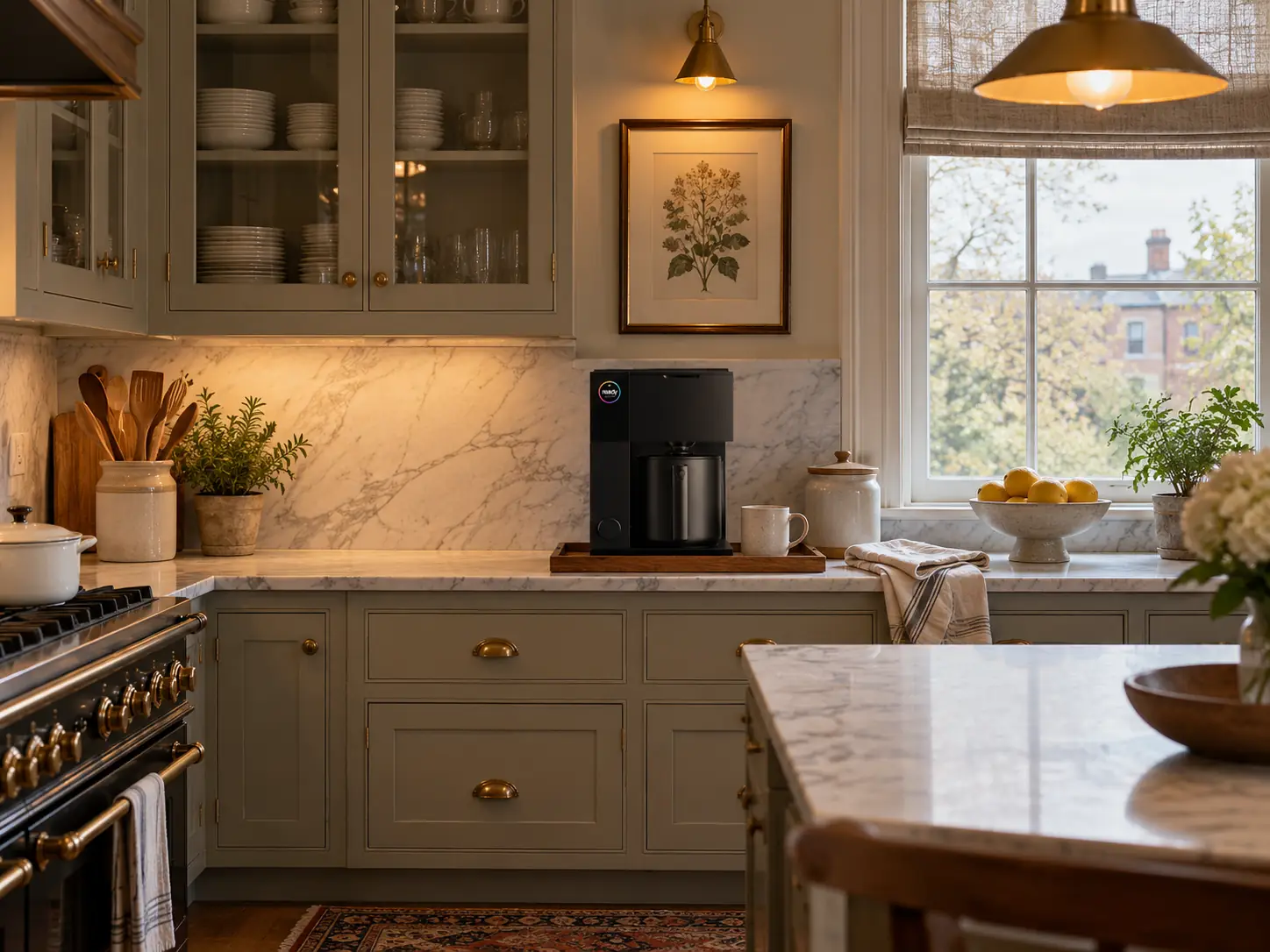
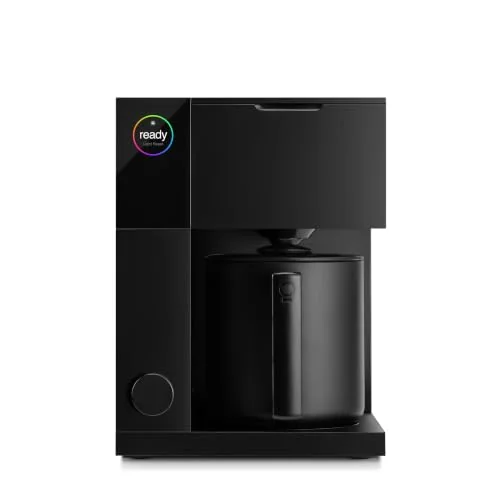
The maker’s page says the Fellow Aiden controls temperature, timing and water flow on its own, from a single cup to a full carafe, with built-in Brew Profiles by roast level or ones you build and save yourself. The same page says the machine works without the app. Tested Hub’s reviewer calls it the highest-priced machine in the consumer drip category, so what the premium buys is easiest to see against the pots people cross-shop it with.
A Technivorm Moccamaster 53941 KBGV Select brews at one temperature, around 93 to 94 °C (about 199 to 201 °F) by CoffeeChronicler’s account, and gives you nothing to adjust. A cheaper programmable pot such as the Cuisinart DCC-1200P1 Brew Central keeps its coffee on a warming plate, where the Aiden uses a double-wall thermal carafe. So the money buys two things: control over the water at each stage of the brew, and a carafe that does not sit on a heater. Neither one matters if every pot you make is the same bag at the same strength.
Measure from the counter to the underside of the cabinet before it arrives: the maker lists the machine at 12 inches tall and 9.6 lb. Leave room above it for the lid and to lift the basket straight out, or the daily basket swap turns into a fight with the cabinet.
Who Should Skip It
Skip it if your routine is one pot, one bag, one hour. A programmable pot with a clock has the coffee ready when the alarm goes off, and Tested Hub’s reviewer says a simpler machine brews just as well for someone who drinks the same beans every day. The owners’ complaints in month two cluster on a warning, not on the cup, and that is a different kind of cost from the one on the price tag.
The machine suits the reader who changes bags often, drinks a light roast one day and a medium roast the next, and brews one mug on some days and a pot on others. For that reader the dial is the whole argument.
The Temperature Dial and the Medium Roast Fix
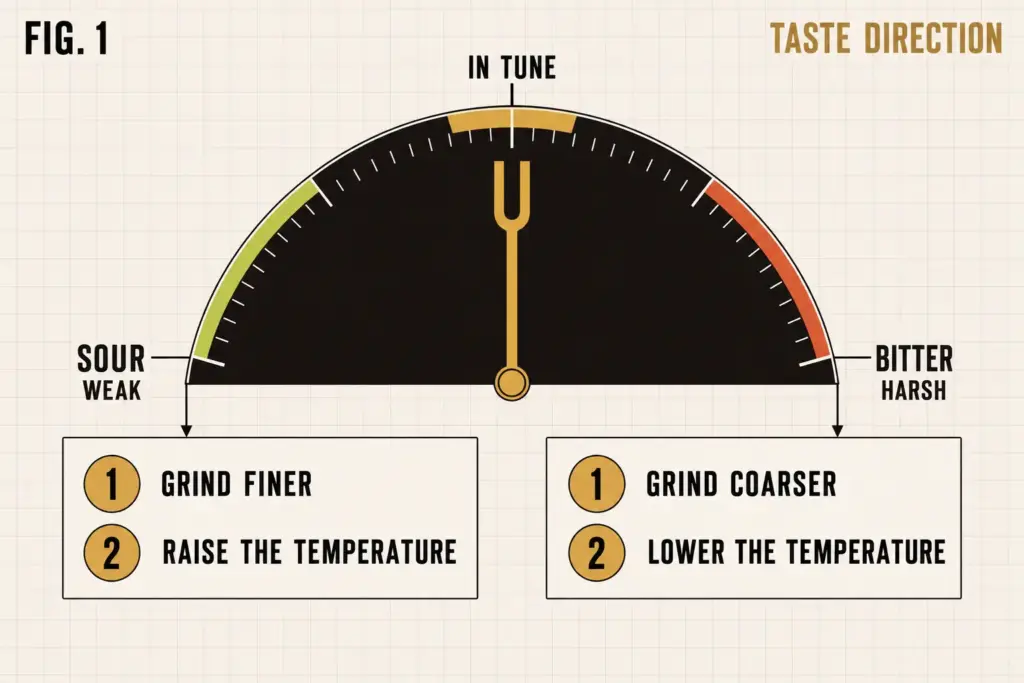
The dial is the reason to buy this machine, and it is the last thing to touch. A bitter pot points in one direction, the free grind change comes next, the dial comes third, and you taste a full cup between each step so you know which change did the work.
Which Way the Cup Is Off
Bitter means the water kept pulling after the good part was already out of the grounds: the finish is dry and harsh and clings to the back of the tongue. Sour is the reverse, water that left before it got there, and the cup tastes thin and sharp with little sweetness behind it. The two call for opposite moves. For a bitter pot you want less extraction (a coarser grind, or a cooler phase); for a sour one you want more (finer, or a hotter phase).
The roast sets where you start, and why light roasts go sour and dark roasts go harsh explains the mechanism. A medium roast sits between the two and, going by CoffeeChronicler’s tester, is the kind of bean that often turns bitter in an automatic brewer held at one temperature.
The Free Change First, Then the Dial
Take the bitter medium roast. Go one step coarser on the grinder, brew the same dose of the same coffee with the same water, and taste the full pot. If the finish is rounder and the dryness has eased, stop there. If the cup went thin and sharp, you overshot, and half a step back is the answer.
Grind size for a drip coffee maker is the free change, which is why it goes first. A blade grinder is the exception: it makes boulders and dust in the same dose, so the pot is bitter and sour at once and no temperature phase will sort that out.
Only if the pot is still bitter after that, lower the temperature of one phase of the profile, brew again and taste again. This order is the site’s rule, not a finding from any test. The grind costs nothing and is the likelier cause, and changing the grind and the temperature in the same pot leaves you unable to say which one fixed it.
What the Only Blind Test Found
One test sits behind the claim that this dial fixes a medium roast, and it has one tester. CoffeeChronicler’s reviewer built a declining profile that starts at 199 °F (93 °C) and falls to 190 °F (88 °C) across the pulses of the brew, then tasted it blind against the same coffee on a Moccamaster. The Aiden’s medium roast came out with chocolate and nutty notes and a clean finish; the Moccamaster’s had a lingering bitterness. A refractometer put the Aiden’s cups at 20 to 21 percent extraction, inside the 18 to 22 percent Golden Cup range.
No tasting numbers were published, and the tester credits the machine’s gentler water distribution along with the temperature, so two things changed at once. Read it as the direction the dial can move a bitter medium roast, not as a setting to copy.
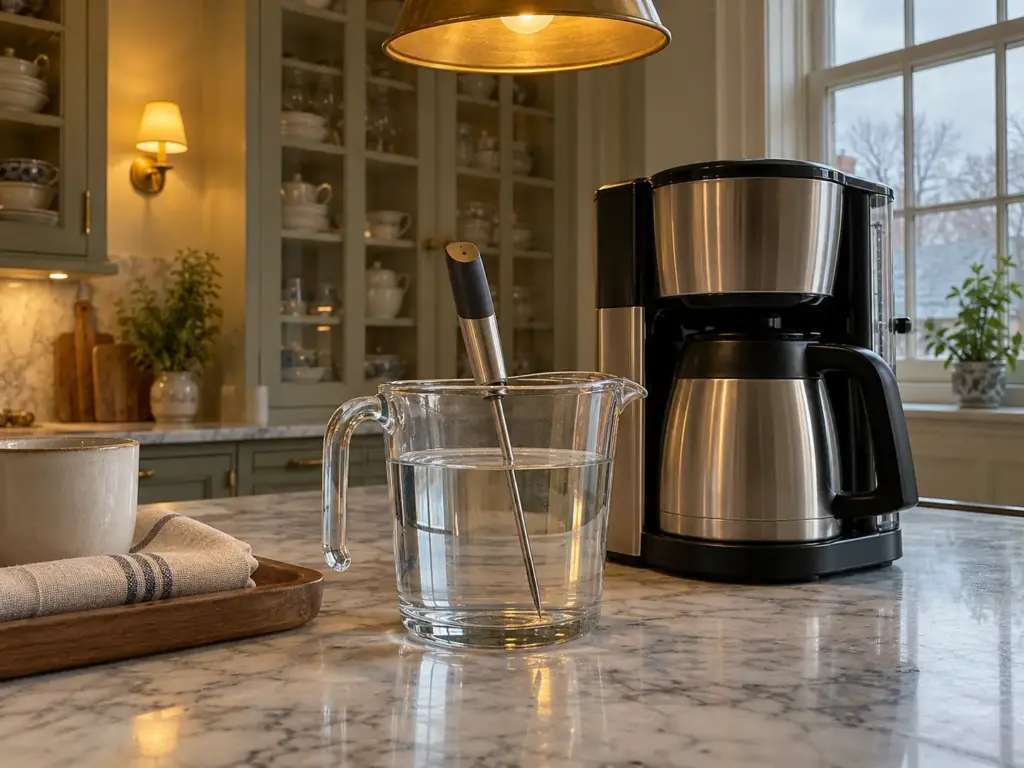
Tested Hub supplies a second reading: its reviewer put a thermocouple in the bed over seven months and about 1,200 brews and reports the temperature held within about one degree Fahrenheit of the setting. Treat that as one reviewer’s reading, because the same review describes a glass carafe that the maker’s page does not. That review lists the range as 175 to 205 °F (79 to 96 °C) in 1 °F steps, while CoffeeChronicler’s tester says the dial runs from 122 to 210 °F (50 to 99 °C). The maker’s page prints no range, so the limits you can use are the ones the app lets you enter.
Check one more thing before you blame the dial. If the bloom runs well under the temperature set on the profile, check the bloom temperature in the profile on the app first, because a mismatch on that line is the first suspect.
Change one phase of the profile per pot. Keep the dose, the grind and the water the same, brew, and taste before the next edit. Two edits in one pot leave you guessing which line moved the cup.
Checking the Dial Against the SCA’s Standard
The winning profile ended at 190 °F (88 °C), and the next question is whether that sits inside the standard. The public documents settle less of that than the box suggests, so this section says what can be checked and what cannot.
What the SCA List Says About This Machine
According to the Specialty Coffee Association’s certified home brewer list, “SCA Certified Home Brewers are coffee makers that meet SCA’s rigorous standards for brewing quality, consistency, and performance.” The Aiden is on that list (10-cup, certified in 2024), and so is the Moccamaster KBGV Select (certified in 2026). The Breville Luxe Brewer is listed too, but the Breville BDC400BSS Precision Brewer this review compares is a different machine and is not.
Fellow’s page goes further and says the benchmarks behind the certification include precise water temperature and optimal brewing time. That is the maker’s wording, and the standard itself is not public. The SCA’s program page adds that only equipment evaluated at its third-party testing center is considered, so the mark does mean a model was tested outside the maker’s own walls.
A mark cannot rank cups. Two of the four machines in this review are on the list, the Aiden and the Moccamaster, and in the one blind test above they produced different medium-roast cups. A mark tells you a model passed; it says nothing about the pot in your kitchen or about month two.
What Stays Unchecked
The SCA’s equipment standards sit behind its membership portal, so the certified window for brew temperature cannot be quoted here, and any figure for it would be somebody’s guess. The 190 °F (88 °C) end of that blind-test profile is one tester’s taste, and no public document says whether it falls inside the certified window.
Treat it that way. Start from the built-in profile for your roast, change one phase at a time, and trust the cup over the screen. Tested Hub measured the bed, not the dial, which is the right instinct: the number on the display and the number in the coffee are two different numbers. If you want every certified model side by side, the full certified list is covered in the brands guide.
Baskets, Showerhead and the 1 to 10 Cup Range
The other selling point is that one pot size does not fit every day: a single mug on a weekday and a full carafe on Sunday come out of the same machine. The baskets and the showerhead are how it manages that.
Cone Basket or Batch Basket
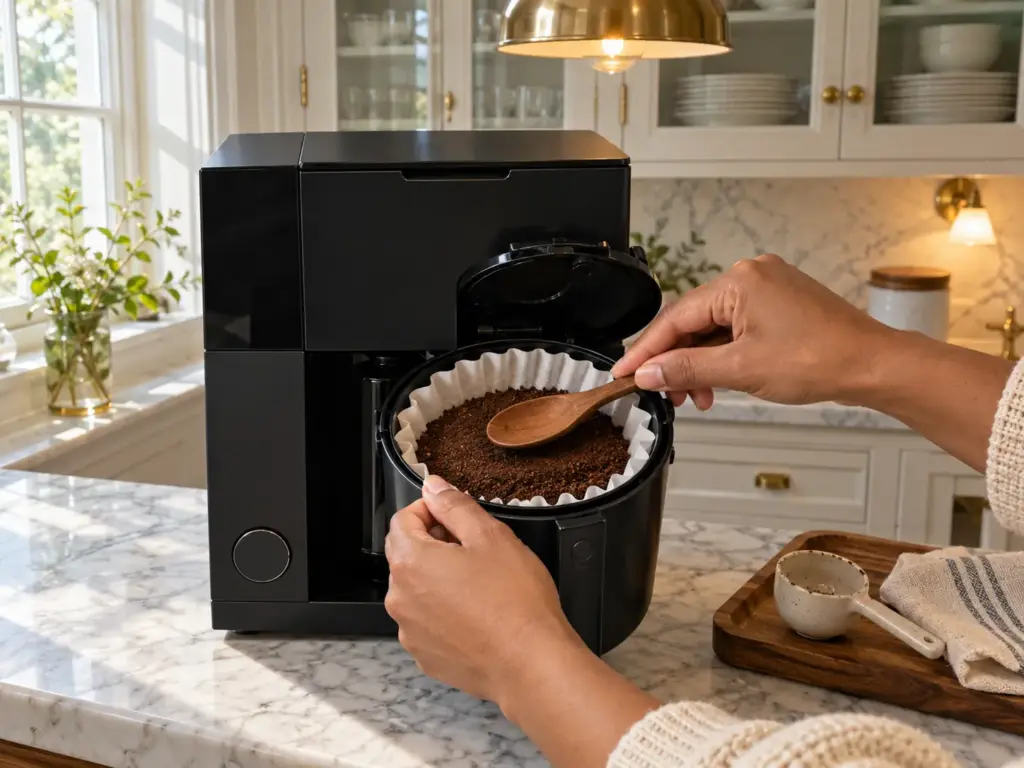
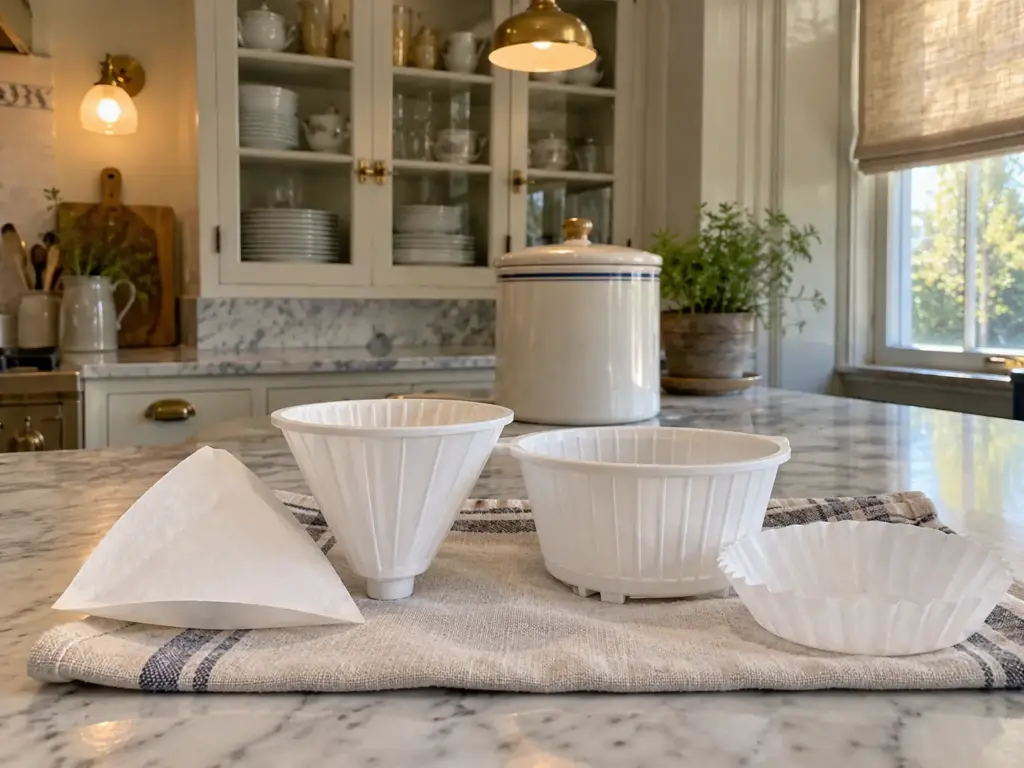
The machine ships with two baskets. The single-serve basket takes standard #2 cone filters and the batch basket takes standard 8 to 12 cup basket filters, and the box includes 15 cone and 15 flat-bottom filters to start. A dual showerhead with an adjustable spray spreads the water over the bed for one cup or a full carafe, which is the job a plain drip machine does badly at low volume. The no-drip basket stops dripping the moment you lift it out, so swapping one basket for the other is less messy than it sounds.
The reviewers split the way the baskets suggest. Tested Hub’s reviewer finds the Aiden strongest on a single cup and small batches, where the single-cup mode “rivals a manual pour”, and says the Moccamaster’s full carafe was slightly cleaner in blind side-by-sides. CoffeeChronicler’s tester says the Aiden held its quality down to 200 ml and that the Moccamaster struggles under half a liter. Same direction, one reviewer each.
What “10 Cups” Means
The maker lists a 1.5 liter maximum, “up to 10 cups”. Divide it: 1.5 liters over ten cups is 150 milliliters, a little over 5 fluid ounces, which is a coffee-maker cup and not a mug. A full pot is closer to four 12-ounce mugs.
At a 1 to 16 ratio, the example CoffeeChronicler’s tester uses, that pot is about 94 g of coffee for 1.5 liters of water, roughly 18 to 19 level tablespoons; a single 12-ounce mug is about 22 g, or four to five tablespoons. Brands define a cup differently, so count ounces, not cups before you decide a machine is big enough.
The Thermal Carafe and the Heat After an Hour
The reviewers disagree about how long this carafe holds heat, and you can settle it in your own kitchen in an hour.
How Long the Carafe Holds Its Heat
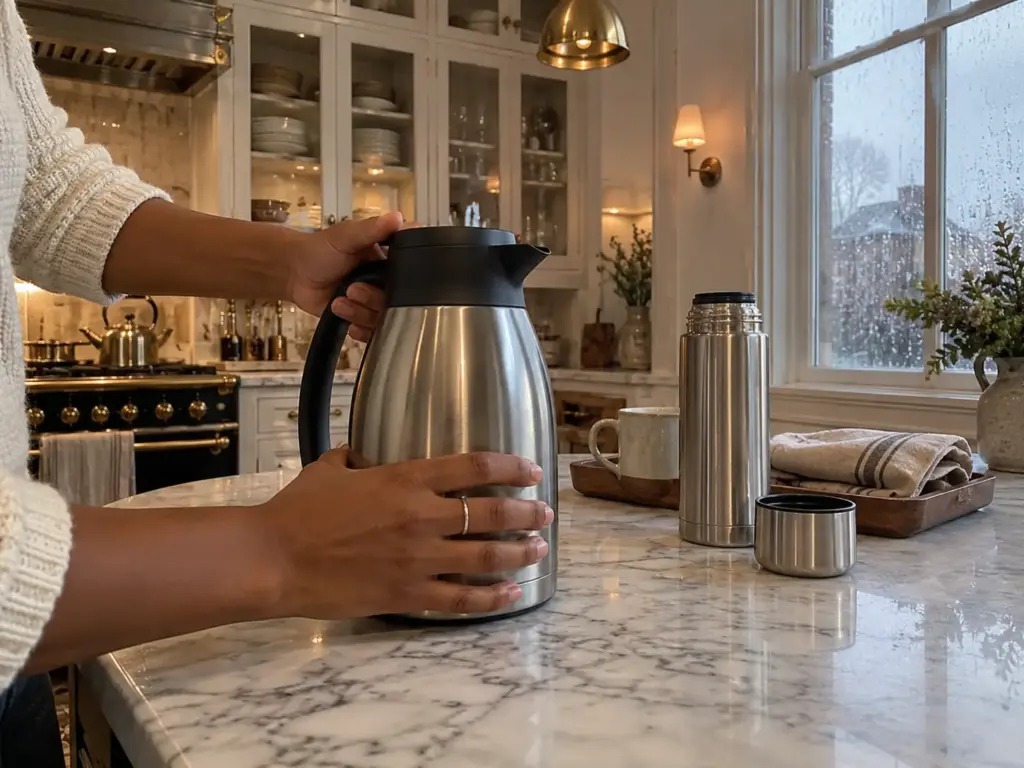
The maker lists a double-wall thermal carafe and says it keeps coffee hot without scorching it. CoffeeChronicler’s tester found no heating plate under it and says the coffee stays warm “for several hours”. Tested Hub’s reviewer says the coffee drops out of the drinkable range within an hour, and that review describes a glass carafe on a heating plate, which the maker’s page does not. The maker’s spec settles the type of carafe, not the minutes, so this article prints neither review’s heat figures.
The minutes are yours to check. Brew a full pot, leave it closed, put a kitchen thermometer in at 60 minutes and decide whether the coffee is still hot enough to drink. If it is not, Tested Hub’s own advice for later cups is a separate thermal flask. To set that hour against the cheaper pots that sit on a plate, drip machines sorted by carafe heat are the next comparison.
The Strength Gradient in a Big Batch
A carafe that holds heat can still pour uneven coffee. CoffeeChronicler’s review says the Aiden’s lid lacks the funnel that other brewers use to mix the coffee as it drips, so the concentration gradient is steep in a big batch: the bottom of the carafe can run nearly twice as strong as the top. The fix costs nothing. Stir before you pour a big pot, and at about half a liter a swirl of the closed carafe does it.
You can find the gradient without a refractometer. Pour the first mug and the last from the same full carafe and taste them side by side; if the last one is clearly heavier, stir the next full pot before pouring.
The housing is a smaller complaint. CoffeeChronicler’s tester found the plastic shell lighter than expected and the reservoir lid flimsy, and the maker lists plastic, stainless steel and silicone.
Month Two and the Add Water Warning
Reviews get written in week one, and week one hides the faults that need time. Reports on this machine are mixed: some owners run into a recurring warning, while a long-term review of a single unit saw none of it.
The Warning With a Full Tank
The most repeated fault is a message. A common complaint is an out of water error that appears even with plenty of water in the machine, and the advice is to add water with a full reservoir. The same warning comes up again and again.
Two of them went through a replacement: one got the same message from the new machine within two weeks (with firmware 1.1.7 that would not update), and the other was on a second unit when it came back. Support is praised for exchanging machines quickly, but an exchange did not remove the warning.
Returned machines have reportedly had debris in the flow sensor, which points to a cause worth checking. That is a clue to what to check, not an official finding. Setting the elevation in the app to 10,000 feet can stop the error for a while, though it may return. Searching for “add water” or “out of water” finds the warning fast.
The Basket Handle and the Lid
A second complaint is mechanical. The basket handle is described as flimsy by some owners, and replacement baskets have been sent when it breaks. When the handle goes, the whole basket has to be popped out from underneath to dump the filter and grounds. CoffeeChronicler’s tester adds the reservoir lid, which felt flimsy and which the tester doubted would last through daily use.
The Reviewer Who Saw None of It
Against that, a reviewer who bought the machine at retail and used it heavily for seven months reports no rattles, drips or service issues.
Both accounts stand: a collection of complaints shows what breaks and not how often, and one reviewer’s trouble-free months are one unit’s story. The cup can be excellent and the warning can still appear. Another machine gets the same month-by-month count in the year-two test on the Mr. Coffee.
Checks to Run Before You Send It Back
The owners’ reports turn into an order here: free and likeliest first, one test between each, and the warranty last. Run them with filtered water if you have it, a dry towel and ten minutes.
The Free Checks, in Order
- Power-cycle the machine. Switch it off at the wall, switch it on and open the app. Updates may not load until you notice the machine is not showing as online; cycling the power can fix that. If the warning came from a sync problem, the next pot should brew without it.
- Descale it, by the maker’s Safety Manual. The maker’s page says cleaning and maintenance instructions live there, and this review prints no interval because the page gives none. A descale has cleared the warning for some, even on a machine that had not asked for one. Another descales every three weeks with mineral-heavy spring water and says it “seems to help”, which is a personal routine and not a maker’s interval.
- Try the elevation setting in the app. The elevation setting can clear the error for a while, and for others it does nothing. Treat it as a stopgap, and tell support you used it.
Apart from the warning, dry the filter basket and leave the lid open after each brew. CoffeeChronicler’s tester found that closing the lid on a damp basket trapped moisture and left a mildew smell, like a towel that was never dried. Wipe the insert and let the machine air out.
When to Use the Warranty
The maker’s page lists a 2-year standard warranty with the option to extend. If the free checks do not clear the warning, support is the next step, and it goes better with the facts written down: the date, the message, the firmware version if the app shows it, and which checks you tried. Support is described as fast, and warranty replacements do happen. A replacement is not a guarantee: one came back with the same warning inside two weeks.
The App, Guided Brews and Cold Brew
The app is optional, and the guided path is where a beginner can start before touching the dial at all. The maker’s page, as read on 21 October 2026, says the machine works without the app and handles scheduling, Brew Profiles, notifications and updates through it.

The built-in profiles are organized by roast level, so a first week can be nothing more than choosing the profile that matches the bag. The maker says Brew Profiles from Fellow Drops coffees sync automatically; CoffeeChronicler’s tester says a profile created in the app did not sync to the brewer on its own, which may describe a different kind of profile, and found the click wheel tedious for building profiles. Keep the machine on your home Wi-Fi, since updates can arrive only after the machine shows as online again.
The maker also lists a cold brew profile that starts with a hot bloom and brews with cooler water, ready in 90 minutes instead of an overnight steep. That is the maker’s claim, and it has not been verified here.
Against the Moccamaster, the Breville and a Cheaper Machine
Three machines come up next to the Aiden: the one with a fixed temperature, the other one with a dial, and a plain programmable pot. They are lined up here by what each costs you after the cup goes right.
The table compares the four on what the sources report, with no price column.
| Machine | Water temperature | On the SCA list | Flaw in writing |
|---|---|---|---|
| Fellow Aiden Precision | Set for each phase of the brew | Yes, 10-cup, 2024 | Owners report an add water warning with a full tank; big pots run stronger at the bottom of the carafe |
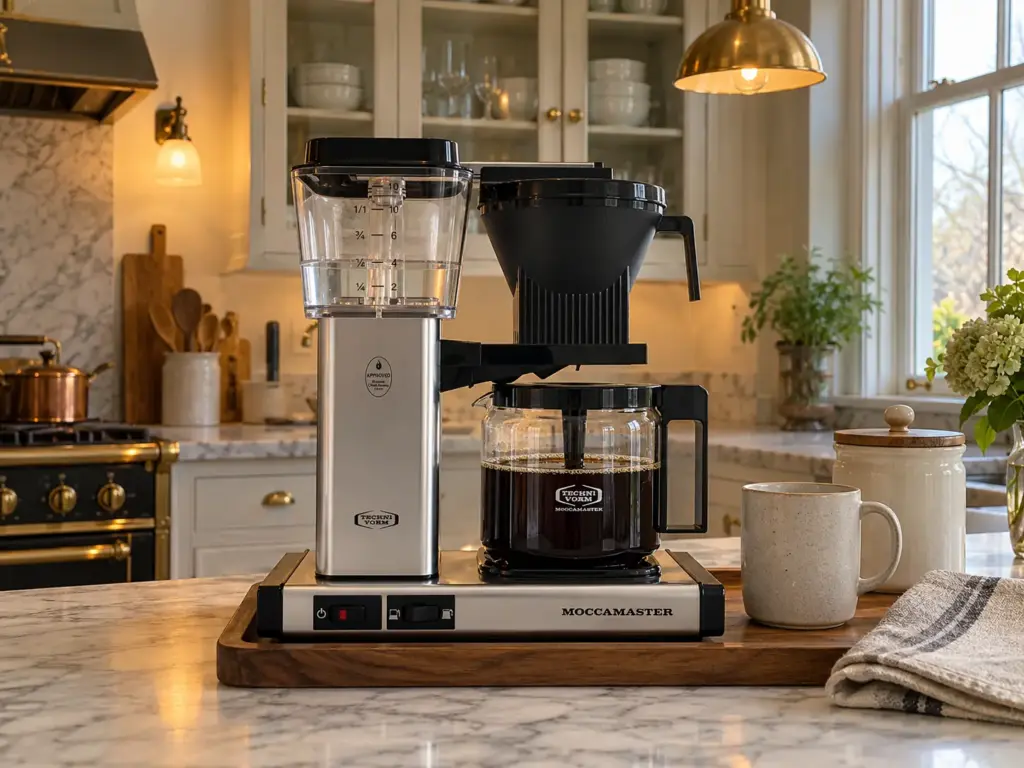
| Moccamaster KBGV Select | One fixed temperature, around 93 to 94 °C | Yes, certified 2026 | No dial; one tester found a medium roast bitter on it, and the glass carafe sits on a hot plate |
| Breville Precision Brewer | Adjustable; its curves are simpler than the Aiden’s | No (the Luxe Brewer is listed) | Loud, a significant learning curve, and a reservoir attached to the machine |
| Cuisinart DCC-1200P1 | No temperature control; programmable start time | No | Warming plate; one 2015 review of the DCC-1200 reports leaks and smoke |
The Moccamaster, the Fixed-Temperature Benchmark
The Technivorm Moccamaster 53941 KBGV Select is the benchmark for a full pot. It holds 40 oz (1.25 L), sits on the SCA list (certified 2026) and brews at one temperature, around 93 to 94 °C (about 199 to 201 °F). The trade-off is that fixed temperature: CoffeeChronicler found a medium roast bitter on it, though the steady heat suits light roasts. Tested Hub’s blind side-by-sides gave the Moccamaster’s full carafe the cleaner cup.
So the obvious pick for a full pot may not be the dial after all. Pour one roast every day and the fixed-temperature machine is the safer buy; change roasts all week and it gives you nothing to turn. The Moccamaster review covers the machine on its own terms.
The Breville Precision Brewer
The Breville BDC400BSS Precision Brewer is the other temperature-controlled drip a reader weighs. It has a 60 oz (1.7 L) reservoir and a glass carafe, and it is not on the SCA list. Its costs are the ones Tom’s Guide lists: it makes too much noise and has a significant learning curve, and the reservoir is attached to the machine with only the lid lifting off. Owly Choice counts a non-removable reservoir against the BDC450 thermal model too, a different model, so take that as a hint.
CoffeeChronicler’s tester found the Breville better built, larger and more intuitive than the Aiden, but weaker with small batches and less sophisticated at temperature curves. Between the two dials the Aiden takes the small batch and the Breville takes the sturdier build and the bigger tank. If temperature is the deciding factor, drip coffee makers picked by water temperature lines up more of them.
The Cheaper Machine for the Daily Pot
The Cuisinart DCC-1200P1 Brew Central does the daily pot: 12 cups, a start time you can program up to 24 hours ahead, an auto shut-off, and a warming plate with three heat settings. It has no water-temperature control, and that is the point of this section. A pot that finishes before the alarm goes off, with the same roast every day, gets nothing from a dial. The dial earns its cost on a week that changes roasts, and it sits idle on a week that never does.
The plain version of its flaw: a 2015 buydontbuy review of the DCC-1200, which is not necessarily the unit you would buy today, reports that a handful of owners saw coffee leak onto the heating plate after anywhere from one to twelve years, and a handful reported smoke or a hard rolling boil. No known fires turned up, and that still does not make it a recommendation. It is one old review, not a survey, but a plate that smokes is worth ruling out before you spend. The Cuisinart review goes through the brand by cups brewed.
Two siblings cover other ways to make that pot: the Ninja review puts the flaw first, and the Bunn always-hot tank is the one for a machine that stays hot at a set temperature.
What to Change Tomorrow Morning
Three things hold up after the details.
- The dial is the reason to buy this machine and the last change to make. A bitter pot starts with the grind, and the temperature comes after, one phase at a time.
- The SCA list proves a mark, not your cup, and the certified temperature window stays unchecked, so one tester’s 190 °F (88 °C) is a taste and not a standard.
- The month-two fault is a warning with a full tank, and the free checks (power-cycle, descale by the manual, the elevation setting) come before the refund.
A month from now, look at two things: whether the warning has appeared, and whether the carafe still holds its heat at the 60-minute mark on the thermometer. The reviews disagree on the second one, and your own kitchen is the tiebreaker.
Tomorrow morning, if the pot is bitter, grind one step coarser, brew the same dose and taste it before you open the profile. If it is rounder and the dryness is gone, leave the dial alone; if it is still harsh, lower one phase and taste again. What feeds this pot, the grind and the dose, is the next decision, and the grind size for a drip coffee maker is where it starts.
Frequently Asked Questions
01Is the Fellow coffee maker worth it?
It is worth it if you will change the water temperature by roast and brew anywhere from one mug to a full pot. For one pot at a set hour, a cheaper programmable machine does the daily job. Owners’ complaints center on an add water warning, not the cup.
02Does the Fellow Aiden work without the app?
Yes, the maker’s page says the machine works without the app. The app handles scheduling, Brew Profiles, notifications and updates, and the maker recommends syncing it so you get the latest firmware.
03Why does the Fellow Aiden say add water when the tank is full?
The warning can appear even with a full tank, and three free checks are worth trying in this order: power-cycle the machine, descale by the Safety Manual, then try the elevation setting. If it stays, contact support under the 2-year warranty; one replacement unit showed it again.
04Is the Fellow Aiden SCA certified?
Yes, it is on the Specialty Coffee Association’s certified home brewer list as a 10-cup model, certified in 2024. The list is a mark, not a verdict on your cup, and the SCA’s equipment standards sit behind its member portal.
05How does the Fellow Aiden compare with the Breville Precision Brewer?
Both control water temperature, but only the Aiden is on the SCA list. Tom’s Guide lists the Breville as loud, with a significant learning curve and an attached reservoir; the Aiden’s flaw is the add water warning owners report.


How did your cup turn out?
No comments yet. Tell us what you changed — and whether the needle moved.