
We may earn a commission when you buy through links on this page. It never changes what we recommend. How we pick
On this page10 parts
- Why a Brand Name Does Not Set the Cup
- What the SCA Stamp Covers and What It Doesn't
- The Brands to Look At for a Daily Pot That Has to Last
- The Brands for a Precision Pot, and the Flaws Owners Write Down
- The Budget Brands, and What the Cheap Ones Give Up
- How to Read a Brand's Reputation
- What Goes Wrong First, and the Free Check Before You Blame the Brand
- The Brands Without a Verdict
- Pick the Model, Then Judge the Brand on Year Two
- Frequently Asked Questions
Your machine comes from a brand everybody recommends, and the pot still comes out flat: thin, a little sour, nothing like what the box promised. Before you cross that name off, it helps to know what a name can and cannot decide. The temperature of the water and how evenly it wets the grounds belong to the model on your counter, while the brand decides what happens once the cup is right: whether a basket can be bought on its own, what the warranty covers, and what the maker does when a part gives out. So asking which brand of drip coffee maker is best is really asking two questions, and the table below keeps them apart, with the flaw written next to every name.
Ten brands, what each is known for, the flaw that goes with it, and whether any of its models is on the SCA’s certified list as it stood on October 14, 2026.
| Brand | What its cup and its years are known for | The flaw, written beside it | SCA list status |
|---|---|---|---|
| Moccamaster | Wirecutter’s top simple-machine pick; five-year warranty; replaceable parts | No clock, no descale reminder; narrow carafe mouth on the KBT; poor with small batches | Eight models listed (2026) |
| Fellow (Aiden) | Bon Appetit’s top pick overall; app control of the brew | Lightweight plastic and a frustrating app; rust through the basket has been reported | Aiden Precision listed (2024) |
| OXO | Wirecutter’s top drip pick (the Brew 9); two-year warranty on the 12-cup | The Brew 9’s lid traps old coffee and the machine stands 17.2 in tall | 8-Cup (glass) and 12-Cup listed; Brew 9 not |
| Ratio | Bon Appetit’s pick for a simple machine; five-year warranty | Narrow carafe mouth; no repeated complaint found in what was read | Not on the list |
| Breville | Temperature control; in CoffeeChronicler’s top three | Huge; parts availability; a carafe lid that will not open to rinse; one report of a failed button | The Luxe Brewer listed (2025); the Precision BDC400BSS not |
| Ninja | Wirecutter’s best-tasting low-budget machine; owners “extremely satisfied” in Consumer Reports surveys | Carafe drips (on the 14-cup CE451); lid screws on rather than flipping up | Not on the list |
| Black+Decker | Amazon’s top-selling coffee maker; very good predicted reliability in Consumer Reports | That score belongs to the 5-cup CM0755S, not the 12-cup CM5000B | Not on the list |
| Bunn | Owner satisfaction and reliability, per Consumer Reports | About 12 minutes a pot; no strength selector; no small-batch setting | Not on the list |
| Bonavita | Eight cups, one-touch, auto pause | Can back up and brew only halfway after months of use. | 8-cup and 5-cup listed; match to the Amazon model unconfirmed |
| Braun | A 24-hour timer; more than 10 °F hotter than other cheap makers, per Bon Appetit | No repeated complaint found; Bon Appetit notes real trade-offs | MultiServe Plus listed (2023); the BrewSense not |
Why a Brand Name Does Not Set the Cup
A brand puts out a dozen machines, and the cup in your hand came out of exactly one of them. So before ranking logos, the useful question is what the water does inside whichever machine sits on your counter. That part can be measured, and the name on the front has no say in it.
What the model does to the water
Consumer Reports describes its drip tests in a single line: “Our brew performance tests measure brew temperature and contact time.” The target is water between 195 and 205 °F (91 to 96 °C), a refractometer then reads how concentrated the finished cup is, and every machine runs about 65 cups before the testing is done. That last detail matters more than it sounds, because a machine that behaves for the first pot and sags later has time to show it.
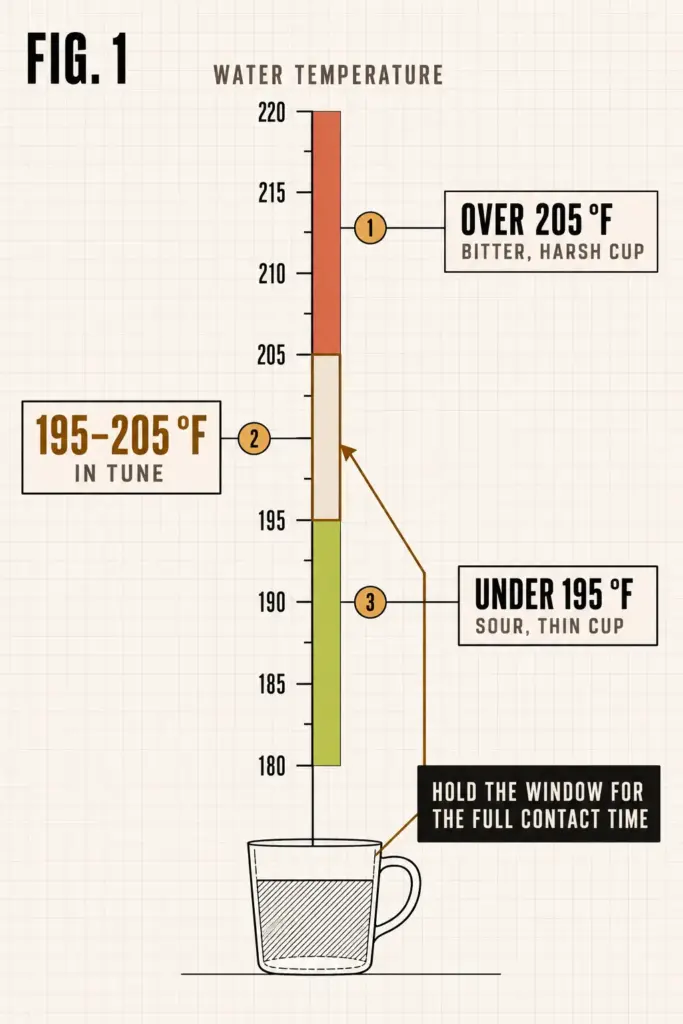
What decides the cup, then, is the brewing temperature the water holds while it is in contact with the grounds. Two models from the same maker can land on opposite sides of that band: one heats the water properly and spreads it evenly across the bed, the other starts hot and finishes cool, or waters one patch and skips the rest. The first makes a clean pot. The second makes the thin, sour one, and the logo on both is identical.
The tells at the counter are small: a pot that finishes in a short trickle, and one corner of the grounds still pale and dry in the basket when the brew is over. Either means the water skipped part of the bed, whatever the box says. A brand cannot hand you the band; a model holds it or it does not, which is why the drip pillar picks by water temperature and leaves the logo out of the decision.
Reading the cup before blaming the logo
The direction of the taste tells you where to look. Sour and thin means the water left too early: the grind was too coarse, the water too cool, or the brew too short. Bitter or astringent points the other way, with water that stayed too long or churned the grounds too hard. Neither is a verdict on a brand.
Even the praised names turn up on both sides of this. A Moccamaster is poor with small batches, and the reason is mechanical: the basket spreads the water wide, so a small dose gets over-agitated and comes out bitter or astringent. Run that same machine with a full dose and the complaint disappears.
Lifespan varies: some of these machines run for twenty years, and some do not seem built to last. Wirecutter, meanwhile, names it the top pick for a simple machine. A single brand cannot be all of those things at once. A model, a dose and a number of years can.
The one free change to make first, then taste
If the cup is sour, go a grind step finer and brew the same amount of the same beans the same way. Then taste before you touch anything else. A cup that comes out less thin but still a little sharp means the water is the next suspect; a cup that has turned harsh means you went too far, so come back half a step. That order costs nothing and tells you which change worked, and that is the whole reason to move one setting at a time.
If you need a starting point for the machine’s grind, a grind step finer for a sour pot is where the grinder article begins.
Run the free test before you blame a brand: the same beans, the same dose, the same water, one grind step finer. Taste it before changing anything else, because if two things move at once you will never know which one fixed the pot.
What the SCA Stamp Covers and What It Doesn’t
If the brand does not set the cup, the one thing a reader can actually check is a third party’s test. That test exists, it is public, and it too belongs to models rather than to brands.
What the list is and what it measures
The Specialty Coffee Association keeps the SCA Certified Home Brewers list, and the page states its own terms: “The following models have successfully completed SCA third-party testing and satisfied the certification requirements for home brewing equipment.” In plain terms, it is a licensed mark. The maker pays an annual license fee on a three-year term, the machine goes through a published test at an outside testing center, and the result is a name on a list. That is worth something, because it is the only per-model cup claim you can look up yourself instead of taking from a box.
It is also narrow. The stamp says a specific model was tested against the SCA’s brewing standard. It does not say the untested ones are bad, and it says nothing about how long any of them will last.
The brands and models that are on it
As the list stood on October 14, 2026, it carried eight Moccamaster models (the KBGV Select, Cup-One, KBT, KBGT, KBTS, KB, CDT Grand and KBG, all certified in 2026), the Bonavita 8-cup in three entries plus a 5-cup, the OXO Brew 8-Cup (2025) and 12-Cup (2023), the Fellow Aiden Precision (2024), the Breville Luxe Brewer (2025), the Braun MultiServe Plus (2023) and the GE Café Specialty Drip (2026), along with a longer tail of smaller names.
Not on it: Ninja, Cuisinart, Black+Decker, Bunn, Mr. Coffee, Smeg, Ratio, Zojirushi, the Braun BrewSense, the Breville Precision BDC400BSS and the OXO Brew 9. Read that sentence for what it says. “Not on the list” means not certified on that list; it does not mean the cup is poor, and it does not measure the cup at all.
Reading “not listed” without over-reading it
The trap is treating the brand as the unit. Breville is on the list, but the entry is The Luxe Brewer, not the Precision BDC400BSS that the drip pillar picks. OXO is on the list, but the entry is the glass-carafe 8-Cup, not the thermal 8-cup and not the Brew 9 that Wirecutter ranks first (Bon Appetit says that model lacks the Golden Cup standard).
One coffee site calls its three top picks certified and includes the Breville Precision among them; the list names the Luxe Brewer, and where the two disagree, the list wins. A retailer’s description of the Ratio Six makes the same claim of certification, and the list does not carry it either.
So the stamp does not travel to a sister model. And nobody can see from the counter who paid the fee, which is the other reason to keep the claim small: a listing proves a model was tested, and a missing listing proves only that the maker has not paid for the test.
The check is two names that must match. Turn the machine around, find the model name on the label at the back or underneath, and compare it, letter for letter, with the entry on the list.
Match the exact model name against the list before treating a badge as a fact. A brand name alone proves nothing, and a sister model’s stamp is not yours.
The Brands to Look At for a Daily Pot That Has to Last
The years are the brand’s half of the bargain, so the first job is the plainest one: a pot made every morning that is still working in year three. These are the names that keep coming up for it, and each comes with what is wrong with it.
Moccamaster, the name the sources repeat most
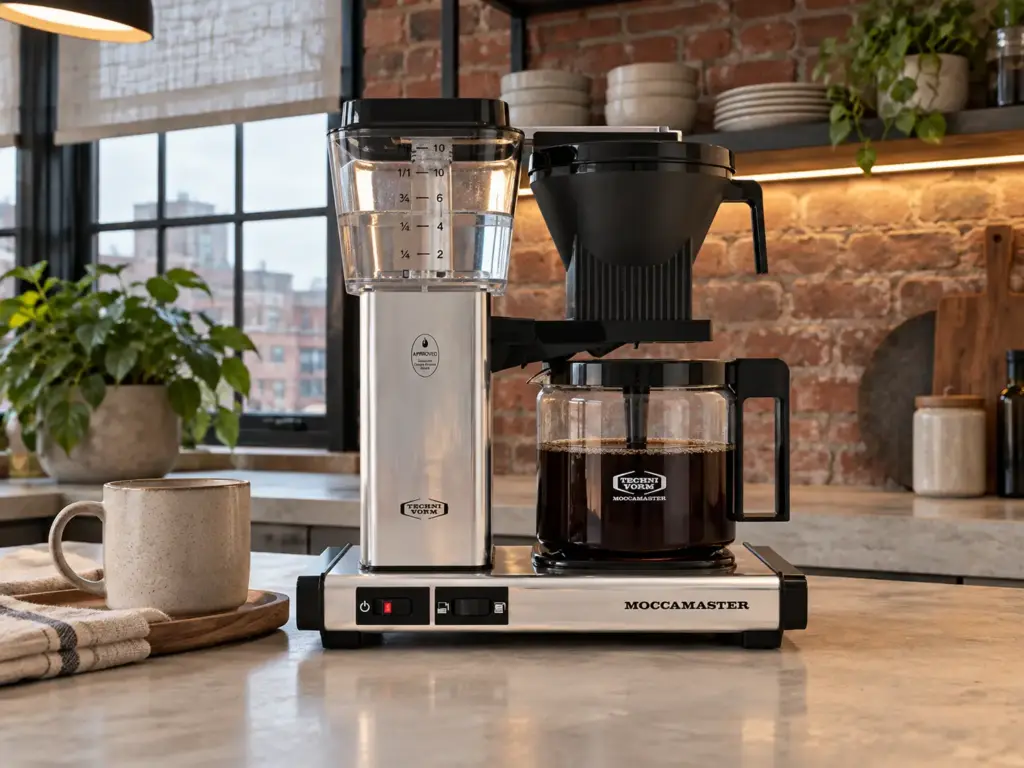
Wirecutter makes Moccamaster its top pick for a simple machine, CoffeeChronicler puts it in its top three, and it is the brand most often named by home brewers. The case rests on a five-year warranty and on repairable parts: CoffeeChronicler describes inexpensive replacement parts and a modular spray arm and carafe.
The Technivorm Moccamaster KBGV Select is the model the drip pillar picks, a 10-cup machine that brews 40 ounces (1.25 L) in four to six minutes on a 1475-watt copper heating element, has a half/full selector for a half batch, and keeps its warming plate at 175 to 185 °F (80 to 85 °C). It is on the SCA list (2026), along with seven of its siblings.
Its flaws sit beside that. There is no clock and no descaling reminder, the KBT’s carafe mouth is narrow, the machine brews a bit hot for medium and dark roasts, and it is poor with small batches. The plate can also overcook a pot left on it, and an overcooked pot tastes burnt. If you pour one or two mugs a day, this is the machine the brand is worst at, and the brand’s own answer is the Cup-One, a separate model that is also on the list.
Lifespan reports like these are anecdotes, not a count, so they do not settle anything. What you can weigh is the warranty and the parts, and before you decide a brand “didn’t last,” rule out the free cause. Descale on the manual’s schedule to keep limescale off the heating element, and use filtered water if your tap leaves scale. A filter removes sediment and does little about hard water.
For the model that fits your kitchen, the drip pillar names the model for the job.
Ratio and OXO, the other two names for a long-lived pot
The Ratio Six is Bon Appetit’s pick for a simple machine, with a five-year warranty that Bon Appetit says is longer than almost any other maker’s, with Moccamaster the only one matching it. It is easy to service, and the second version of the carafe fixed the first. The narrow carafe mouth is the thing to plan around; it needs a brush.
It is not on the SCA list, so its cup claim is unchecked, and no repeated complaint turned up in what was read. There is no Amazon listing in the pack for it, so it is named here and left unlinked.
OXO is a different case, because the brand name stands for several machines. Wirecutter ranks the Brew 9 first, and its water runs 197 to 204 °F (92 to 96 °C). The 12-cup carries a two-year warranty, and the Brew 9’s lid traps old coffee while the machine stands 17.2 inches tall.
The OXO Brew 8-Cup with a thermal carafe is the one the drip pillar picks for keeping a pot hot without a warming plate: 8 cups of 5 ounces (10 to 40 ounces per brew), 1400 watts, the Rainmaker showerhead, and a stainless steel carafe, with water at 194 to 205 °F (90 to 96 °C) according to the listing. The catch is paperwork rather than plumbing. The stamp on the SCA list belongs to the glass-carafe 8-Cup, not to this thermal version, so the certification does not carry over, and the lid and height complaints above are the Brew 9’s.
What a warranty tells you and what it doesn’t
Five years on a Moccamaster or a Ratio Six, two on the OXO 12-cup: those are the figures the outlets print, and they are the brand’s own statement of what it will stand behind. A warranty is a promise about who pays for a failure. It is not a lifespan, and it says nothing about whether the part that fails is the one you needed.
The part that wears first is the one the warranty has to name. On a drip machine that is usually a basket, a carafe lid, a gasket or a shower head, and a maker that sells those on their own has already admitted they wear.
Before buying on a warranty, ask which parts are sold on their own: a basket, a lid, a carafe. Those are the pieces that wear, and a long warranty on the machine means little if the cheap part is not for sale.
The Brands for a Precision Pot, and the Flaws Owners Write Down
Precision is the other job: a pot where the temperature and the flow are the point. These brands put that on the box, and the flaws show up in the same reviews that praise them.
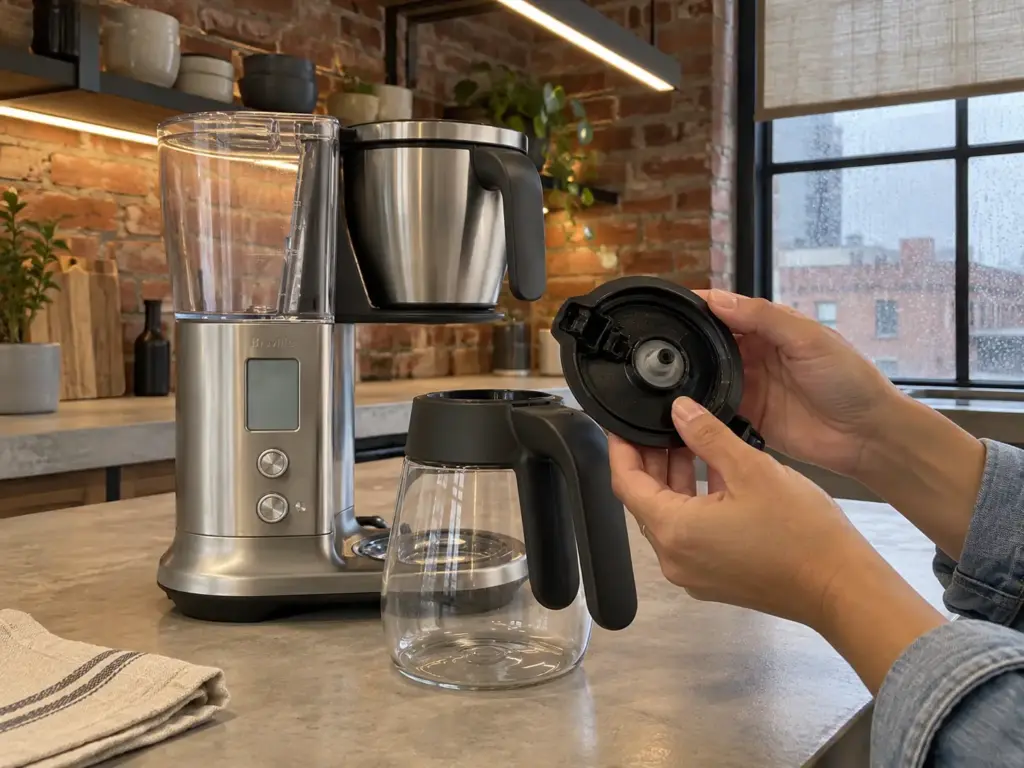
Fellow Aiden, the app and the plastic
The Fellow Aiden Precision is Bon Appetit’s top pick overall, and CoffeeChronicler names it too. It is on the SCA list (2024), which is the checkable fact; Fellow’s own wording about Golden Cup capabilities is not the same thing as certification, and the list entry is the one to trust. There is no Amazon listing for it in the pack, so it is named here with no link.
The complaints are consistent. Reviewers note lightweight plastic and a frustrating app, a full batch needs the carafe stirred, and skipping descaling can lead to a noisy pump.
Rust can show up on the shower head and the brew basket. Treat it as a reason to check your own basket, not as a pattern. The machine’s stated temperature range is 122 to 210 °F (50 to 99 °C); its warranty is left out here because the figures disagree.
Breville, the lid and the button
The Breville Precision Brewer BDC400BSS is the drip pillar’s precision pick, a 60-ounce (1.7 L) glass-carafe machine. It is not on the SCA list; the Breville that is, is The Luxe Brewer. Reviewers flag its size, its parts availability and a weakness with small batches, and a lid that does not open for rinsing and a button that can stop working come up as well. The button line is one person’s impression, not a count.
A sour smell from the carafe a day later is the sign that the lid is holding water. One owner’s workaround was to drill holes in the lid to rinse it; I would not recommend modifying the carafe, but it shows how bad the problem is for the person doing it.
When precision pays and when it doesn’t
Precision means the water temperature and the flow stay inside the SCA’s range, and the stamp is the only per-model check on that. An app does not change the shower head, and a brewing profile does not save a machine that waters one patch of the bed.
It pays when your coffee changes: a roast that wants cooler water, a bag that wants hotter, a pot that is sometimes two mugs and sometimes eight. It pays less when the coffee is the same every day and the cup is already right. And the small-batch weakness reported for the Breville is the flaw that matters most if two mugs is your usual pot, because the precision is spent on a dose the machine is poor at.
The Budget Brands, and What the Cheap Ones Give Up
The third job is a pot that costs a fraction of the splurge. The brand matters less for the cup here and more for what the cheap machine drops: the timer, the heat of the carafe, the parts. Free fixes come first, since the grind and the water move the cup further than a new logo does.
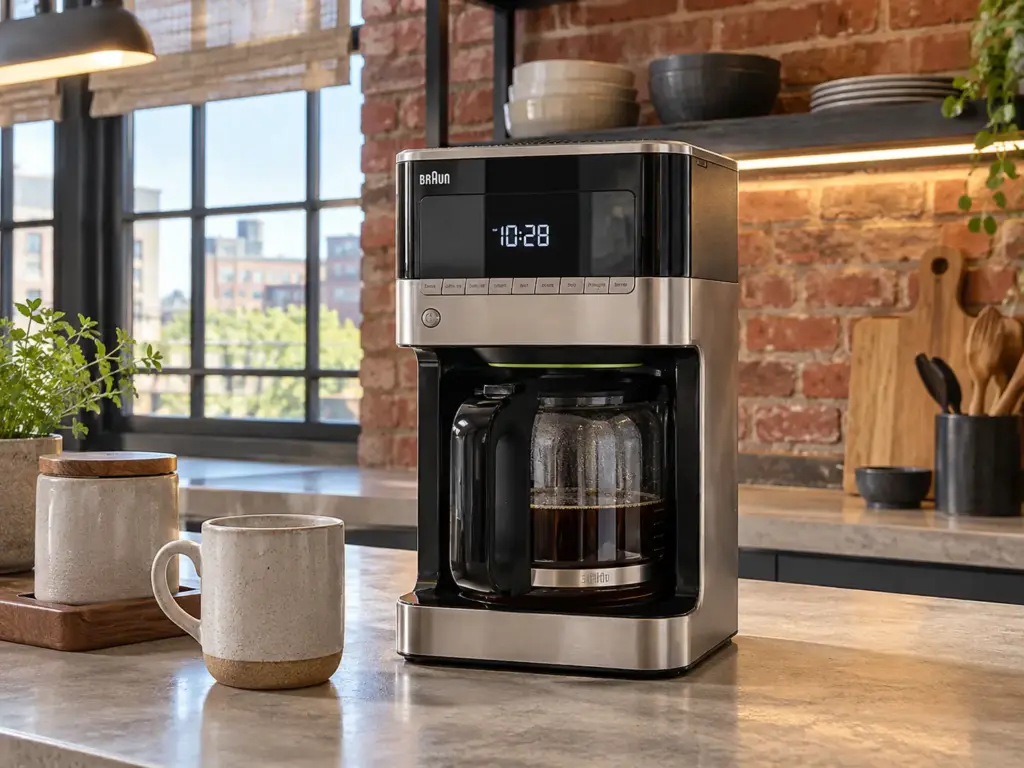
Ninja and Black+Decker, the brands owners rate, and the models the ratings are for
Wirecutter calls the Ninja CE251 the best-tasting machine among the budget ones it tested, and Consumer Reports says “owners of Ninja coffee makers are extremely satisfied with their machines, based on CR’s member surveys.” Read the second sentence with the model in mind: that survey result comes from the 14-cup CE451, which brews a full pot in about 11 minutes. The machine in the drip pillar is the Ninja 12-cup CE251, a sister model, with a glass carafe.
Consumer Reports found the CE451’s carafe a little tricky to handle without drips, and the CE251’s lid screws on rather than flipping up. It is not on the SCA list. If the cheapest tier is where you are shopping, the cheapest drip makers and the heat they give up goes through the model-level picks.
Black+Decker is the brand on top of Amazon’s bestseller list, and that is a sales rank, not a test. Consumer Reports’ line is that “Black+Decker drip coffee makers receive a very good score for predicted reliability,” meaning fewer problems in the first four years, but it was measured on the 5-cup 4-in-1 CM0755S. The one in the pack is the 12-cup CM5000B grind-and-brew, a different machine, so the score does not carry across.
No repeated complaint turned up for it either, and that gap is the honest answer: nothing is known, good or bad. If a built-in grinder is the reason you are looking at it, grind-and-brew machines are covered on their own.
Braun, Bonavita and Bunn
Braun is the quiet entry. The Braun BrewSense 12-Cup has a programmable 24-hour timer and two brew styles, and Bon Appetit measured it running more than 10 °F (about 6 °C) hotter than the other cheap makers it tried, with real trade-offs that it describes in its own review. The Braun on the SCA list is the MultiServe Plus, a different model, so the BrewSense carries no stamp. Bon Appetit also gives it a three-year warranty.
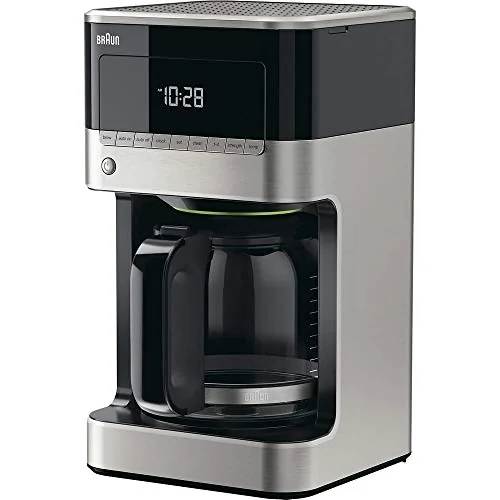
Bonavita is the drip pillar’s budget name, and the Bonavita 8-cup has one-touch pour-over brewing and auto pause. The SCA list has Bonavita 8-cup entries (three of them) and a 5-cup, but the Amazon listing prints no model number, so the match to the list is unconfirmed. That is a pattern to check for, a clogged tube, not a flaw to attach to this particular machine.
Bunn is the one on this list with no listing in the pack to link. Consumer Reports says “Bunn drip coffee makers have earned an excellent reputation for owner satisfaction and are more reliable than most.” The trade-offs are written in the same entry: about 12 minutes for a full pot, no brew-strength selector and no small-batch setting. Like the rest of the budget tier, it is not on the SCA list.
When the cheap one does the same job
The cheap one does the same job when the cup is already right: fresh grounds, a grind that suits the basket, clean water and a clean machine, and a pot that is not asked for two mugs. Then the difference between brands is the carafe heat, the timer and what you can replace. A cheap machine can show it by stopping halfway and leaking when the tube backs up.
So the order is the free fix, then the cheap pot, then the splurge, in that order. If you are comparing the next tier, drip makers sorted by carafe heat lays them out by the thing that separates them.
How to Read a Brand’s Reputation
Everything above rests on evidence that disagrees with itself, so the skill worth having is weighing it. A sales rank, a member survey, a casual remark and a third-party test are four different kinds of proof, and each one can say something about the years while missing the rest.
A sales rank is not a test
Amazon’s top-selling coffee maker is a Black+Decker 12-cup, and another best seller is a Hamilton Beach. That is a count of purchases. It cannot say whether the pot tasted right or whether the basket held up, and neither Wirecutter nor Bon Appetit picks either as a top pick. A sales rank answers whether people buy a machine; it was never built to answer whether they are glad they did.
Owner surveys and predicted reliability, and the model they were measured on
Consumer Reports’ reliability and satisfaction numbers come from member surveys, grouped by brand, and its lab tests run each machine for about 65 cups. That is a longer run than a week of use, which is its strength.
The weakness is the model gap: the Black+Decker score belongs to the CM0755S and not the CM5000B, and the Ninja satisfaction line belongs to the CE451 and not the CE251. Cuisinart shows the same pattern, with excellent owner satisfaction recorded for the DGB-800 and DCC-3200 specifically. A brand’s score is the score of a machine, and a sister model is not that machine.
How much a single story can prove
A flaw that shows up once is a warning, not a rate: treat the problems listed here as things to watch for, not as how often they happen. Each is a prompt to check your own machine, not a verdict. The same complaint two hundred times is a design flaw. One comment is a prompt.
The date matters as much as the content. A review written in week one cannot see the basket in year two, and a machine that has run for six months shows things a launch review never will.
The warranty is the last piece: five years on a Moccamaster and a Ratio Six, two on the OXO 12-cup, according to Bon Appetit and Wirecutter’s specs. It is what the maker will cover, not how long the machine lasts. None of the four kinds of evidence covers all of the years, and the SCA list covers only the cup, by model. That is why this article gives you a method instead of a winner.
What Goes Wrong First, and the Free Check Before You Blame the Brand
The cup can go off in month two for reasons that have nothing to do with the logo: scale, a lid that traps water, a clogged tube. The checks below cost nothing, so they come before the complaint.
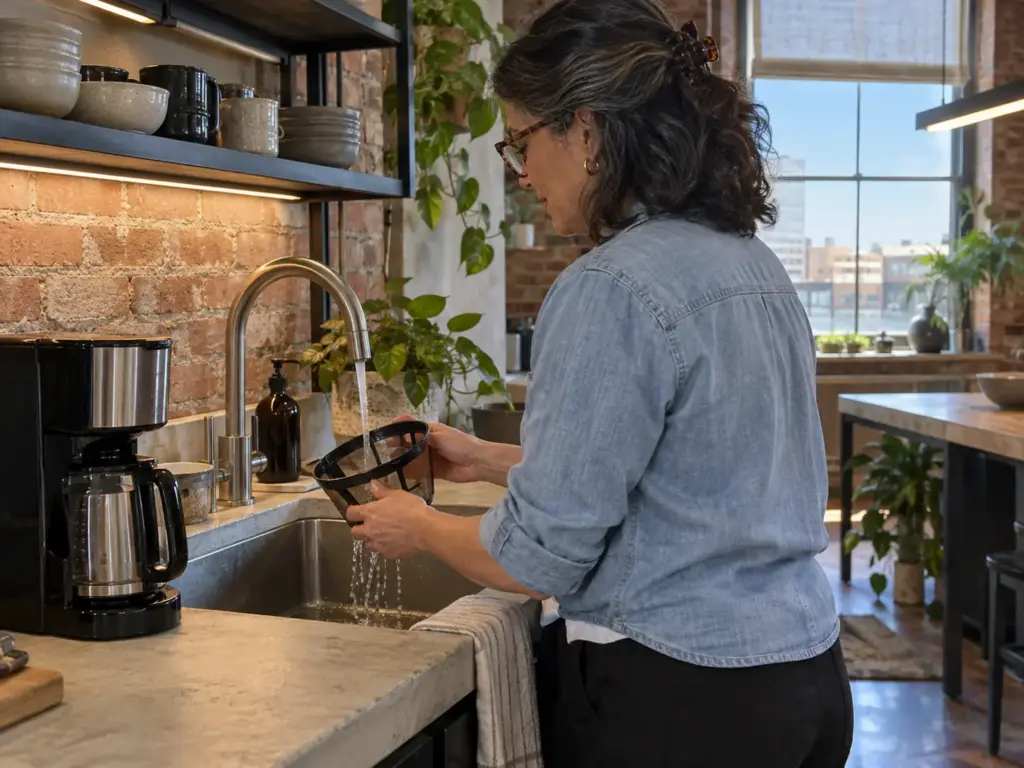
The brand-by-brand list of what the sources say breaks
Each of these has a source and a count attached, and the count is small:
- The Breville Precision’s lid that cannot be opened to rinse and a button that fails: two flaws to check for.
- The Fellow Aiden’s basket and shower head rusting through: a flaw to check for.
- The Bonavita backing up and brewing halfway at six months: a flaw to check for.
- An Aiden owner who skipped descaling and got a noisy pump: a Bon Appetit reviewer, after about two years.
- A Moccamaster that keeps brewing at the twenty-year mark is the best case. The Ratio Six making the same quality of coffee more than a year later: Bon Appetit.
Good news and bad news sit side by side here, and the useful column is the count.
The scale and the water, before any brand blame
Hard water leaves limescale. Scale slows the machine and cools the brew, and the sour, thin pot that follows looks exactly like a brand that has gone downhill. A water filter takes out sediment and does little about hard water, so a filter is not a substitute for descaling.
The method and the interval are in the manual, and the manual is the authority: follow its schedule and its product. Fellow’s own support recommends descaling the Aiden monthly, which is a useful reminder that “as needed” and “monthly” are different schedules for different machines. Look at the water tank too, where a pale film at the waterline is the first sign.
The carafe mouth and the lid you can’t rinse
A narrow carafe mouth (the Moccamaster KBT, the OXO Brew 9, the Ratio Six) needs a bottle brush, and a lid that will not open holds the water left inside. Rinse it cold, with the brush, and check the smell a day later. If the smell comes back, that is the lid.
Then there is the one thing you cannot see from the counter. The coffee that tastes like the basket is the stale film on the basket where the paper filter sits, and in the showerhead’s holes. Take them out and look at them under a light before you decide the brand has failed you. And when the same part fails across several of one brand’s models, that is a design flaw, and it is the part to ask the warranty about by name.
The Brands Without a Verdict
Some of the names a reader will ask about get no verdict in this guide, and the honest move is to say what would settle each one.
Smeg, Mr. Coffee and Zojirushi: no verdict
Smeg gets no verdict in this guide; its drip machine has its own review.
Mr. Coffee appears only as a budget benchmark and in retail listings. Zojirushi shows up in Bon Appetit’s budget picks, with trade-offs and a two-year warranty on the Zutto, and that is all. Neither has an opened test behind it.
Cuisinart and Bunn: what the sources do say, and what they don’t
Cuisinart appears in Consumer Reports, which records excellent owner satisfaction for the DGB-800 grind-and-brew and the DCC-3200, and it is not on the SCA list. Bunn appears only in Consumer Reports, as covered above: 12 minutes a pot, no strength selector, no small-batch setting, and reliability that beats most. Past that, there is nothing more to write.
The next decision: the model inside the brand, then the grinder
What would settle any of these is four things: the exact model, its entry on the SCA list, a count of owner reports for that model, and a year of use. Until those exist, a guess would be worse than the gap. The model number is on the back of the machine even when the name is on the front, and that number is what you look up.
From here the next decision is the model. Pick the model for the job once you know which of the three jobs you have. And if the cup is off before you buy anything, the grinder comes first: set the grind for a drip machine, taste, and only then decide whether the brand was ever the problem.
Pick the Model, Then Judge the Brand on Year Two
The best drip coffee maker brand depends on which of the three jobs you have, and three things carry over from the table. The model sets the cup and the brand sets the years, so you compare water temperature and flow between machines and parts, warranty and repair between makers. The SCA list is the one claim you can check yourself, and it is per model, so a stamp on one machine says nothing about its sister. And a reputation is a pile of different kinds of evidence, a sales rank, an owner survey, a casual remark and a test, each of them saying something different about a different machine.
A month from now, look at the basket, the shower head and the carafe lid before you blame the brand, and match the model name on the back of the machine to the entry on the list. Those three look at the places a pot goes wrong first, and they cost nothing.
Tomorrow morning, if the cup is sour, go a grind step finer and brew the same dose the same way. Taste it; if it is flatter and cleaner, you have your answer, and if it has turned harsh, come back half a step. Then choose the model for the job, not the logo.
Frequently Asked Questions
01What is the best brand of drip coffee maker?
No single brand is best, because the model sets the cup and the brand sets the years. Moccamaster is the name most often tied to a pot that lasts, a precision brand suits control, and a budget brand suits a fraction of the splurge.
02What is the best drip coffee maker for home use?
It is a model, not a brand. Pick the one whose water holds 195 to 205 °F (91 to 96 °C) while it wets the grounds, and whose carafe suits your pot size. The drip pillar names the model for each job.
03What is the best drip coffee maker according to Consumer Reports?
Consumer Reports tests each machine’s brew temperature and contact time against 195 to 205 °F and runs about 65 cups. It praises Bunn, Ninja and the Black+Decker CM0755S for owner satisfaction or reliability, but those ratings belong to the models it tested.
04Is an SCA-certified drip coffee maker worth looking for?
It means a third party tested that exact model. A machine that is not listed can still brew well, so treat the stamp as one check. Match the model name on the machine to the entry on the SCA list.
05Which drip coffee maker brand has the longest warranty?
Of the brands whose warranty is stated, Moccamaster and the Ratio Six carry five years and the OXO 12-cup two. A warranty is the maker’s promise about who pays for a failure. It is not a lifespan.


How did your cup turn out?
No comments yet. Tell us what you changed — and whether the needle moved.