



We may earn a commission when you buy through links on this page. It never changes what we recommend. How we pick
On this page8 parts
- What the Reviews of the Smeg Agree On
- The Hot Plate Timer the Reviews Disagree On
- Weigh the Scoop Before You Blame the Machine
- Descaling and Hard Water, Past Week One
- The Flaws, Each Next to the Owner Who Saw It
- Is the Smeg Worth It, or Is Another Drip Machine the Better Buy?
- What to Change Tomorrow, and What to Check in a Month
- Frequently Asked Questions
You pour the first mug and it is right. By the second, ten minutes on, the carafe has been sitting on the plate and the cup is cooler and flatter, and you cannot tell whether the machine is at fault or the habit is.
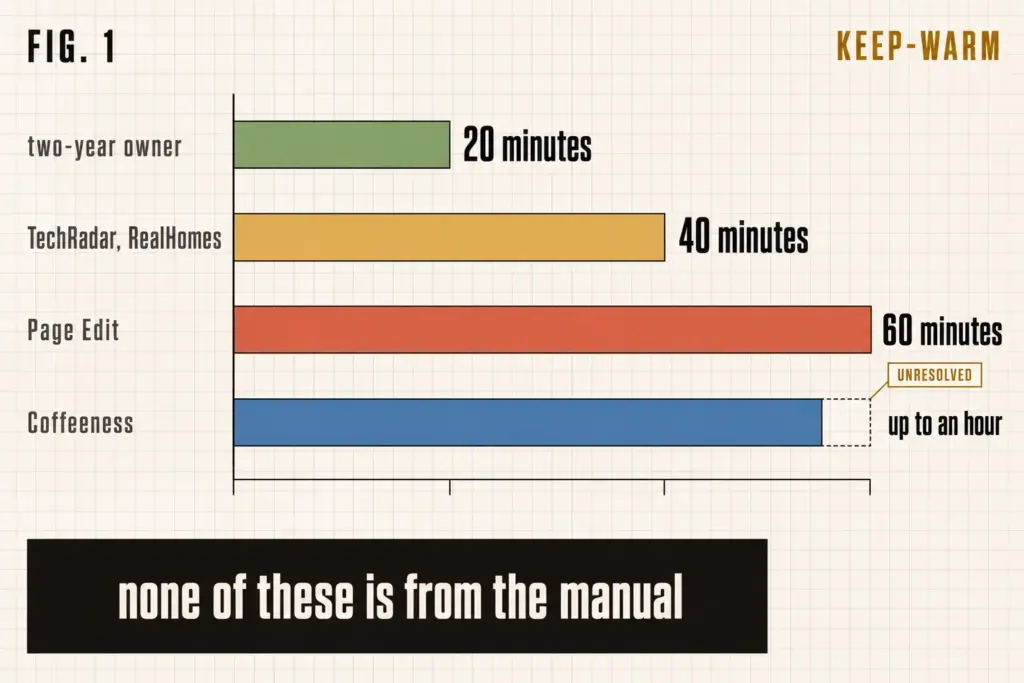
The reviews of the Smeg drip coffee maker praise the cup and then disagree about everything around it, starting with that plate: 20 minutes in one account, 40 in two others, a 60-minute plate in a fourth. Coffee left sitting on a hot plate keeps changing in the glass, so the minutes on the plate shape the second mug as much as the brew did. What follows covers what the reviews agree on, how to find your own plate time, the weighed scoop, the descale light past week one, each flaw next to the owner who saw it, and who should buy the machine.
Quick Answer
In the reviews that actually brewed with it, the Smeg drip coffee maker makes a good cup, so its price buys the look. It is worth keeping only if the look is why you want it. The hot plate’s timer and the descale light decide the rest, and the reviews disagree about both.
What the Reviews of the Smeg Agree On
Before arguing about the plate, it helps to know what the reviewers who brewed with this machine settle on, and what they accept as the cost of owning something shaped like a 1950s appliance. The cup is not where they fall out; the trouble starts once the carafe leaves the stand. If you are still choosing between brands rather than between reviews, which brand of drip coffee maker is best is the wider comparison this one sits inside.
The cup in the reviews that brewed with it
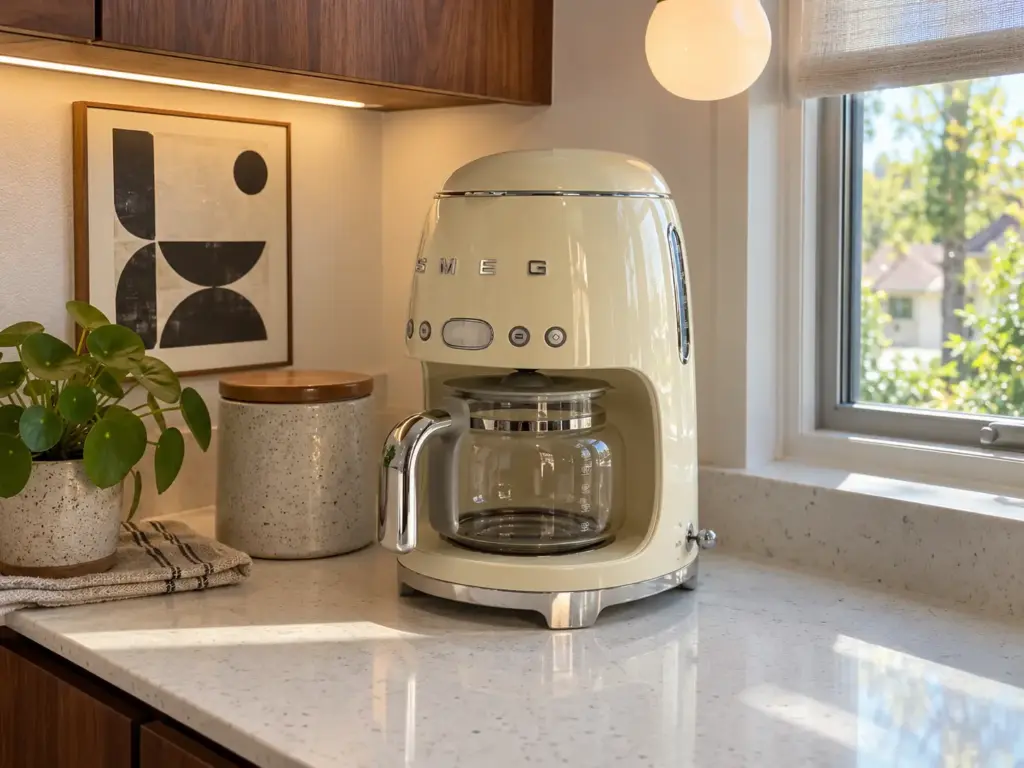
The Smeg 50’s Retro Style drip coffee maker is a machine with a 10-cup glass carafe, a water hardness setting with three levels (hard, medium and soft), an aroma setting that runs from Delicate to Intense, and a plate under the carafe to keep warm the coffee that is left, with an auto shut-off. The basket carries an anti-drip valve and a reusable filter, and Coffeeness says a number 4 paper filter works too, with no sediment in its carafe or cup.
Every figure here comes from owners’ and reviewers’ accounts, because the manufacturer’s manual could not be read for this review, so the plate time and the descale steps are given as readings and never as specs.
The reviewers who brewed with it report a good cup. Page Edit says “we’ve never had trouble with the brewing temperature,” and treats the lid, the beep and the plate as complaints that do not hold up for its owners. Coffeeness lists the temperature among its complaints but gives no reading. No review measured the brew temperature; until someone puts a thermometer in the basket, a good cup in one kitchen is all either side has.
What the look costs in the carafe and the lid
The look is paid for in the parts you touch. Abigail Albers, who used the machine for more than two years, writes that “the lid does not flip all the way back,” so she poured the water in from a height and spilled some at the reservoir.
Coffeeness also calls the carafe’s plastic handle a little flimsy. On a rushed morning that lid is the first thing you meet, and filling from a small jug with a spout, so the pour stays low, would sidestep it. The published heights disagree as well, so measure the gap under your cabinet against the figure in your own manual before the box arrives.
Reading the label on the box instead of a color name
Match the model code printed on the box or on the label under the machine, not the color name, when you buy, look up a manual or compare reviews. The same machine is sold in several finishes and each carries its own code, so a retailer page, a review and a manual only line up when the codes do. The sources disagree on what the letters in the code stand for, so this review prints none.
The Hot Plate Timer the Reviews Disagree On
You met the problem in the opening: a cup that cools while the carafe sits. This section explains why no review page can tell you how long your machine keeps its plate on, and gives the change that costs nothing.
Four reviews, four plate times
Take the readings one at a time, because they do not agree. Abigail Albers wrote that “The coffee pot does not stay on longer than 20 minutes”. TechRadar found that it “did a very good job of keeping coffee warm for up to 40 minutes”, and RealHomes describes a plate that runs “for about 40 minutes after the coffee has brewed”. Page Edit lists “a 60 minute warming plate”.
Coffeeness gives two numbers of its own: the plate used to last 20 minutes, and after a manufacturer update the machine “now keeps a full carafe of coffee warm for up to an hour”. None of the four comes from the manual.
Warm for 40 minutes and hot for 10 are different claims, which is how these numbers can sit beside the complaints. Coffeeness found that “once the carafe had been on the warming plate for 10 minutes, the coffee was even cooler,” and RealHomes, after a month of testing, wrote that it “dropped in temperature pretty soon after the coffee was made”.
RealHomes adds that some owners found the plate went off after barely a minute. A plate that keeps a carafe from going cold for 40 minutes and a cup that has already lost heat at 10 can both be true, and neither tells you what yours will do. A bigger pot makes it worse, because the last cup waits longest, which the last cup on the plate in a bigger pot goes into.
Finding the number on your own unit
Your phone is enough. Brew a small batch, note the time the brew ends, and watch from across the counter, with no hand on the plate, until the machine switches the plate off. That gap is your plate time, and it is the only one of these numbers that applies to your kitchen.
Run it once more after a month, since Coffeeness reports a plate whose time changed after an update. The manual that came in the box is the authority on the plate and outranks every review here, this one included.
The other side of the same plate shows up in Abigail Albers’s account: a shut-off at 20 minutes, which she handled by pressing On again every 20 minutes while she drank, or by making smaller pots. She adds that the longer coffee sits on the burner, the more bitter it becomes.
The free change first: a smaller batch and an early pour
A carafe that has sat on heat goes wrong in a direction you can taste: cooler first, then flat, and after a long stretch bitter.
Change one thing. Brew with the 4-cup button instead of a full carafe, pour the mug you will drink as soon as the brew ends, and taste it against yesterday’s second mug. If it worked, the last cup tastes like the first, with the same warmth and no flat edge. If it is still thin, the plate was not the whole story, and the next section is the one to read.
Use the same mug for yesterday’s test and today’s. A cold, thick mug takes heat out of a fresh pour, and that drop looks like a plate problem when it is a mug problem.
The other way to build a machine is around an always-hot tank, the route Bunn takes, and a list of drip machines sorted by carafe heat is the place to see how much the carafe itself changes the second mug.
The budget comparison for a reader who wants the plate length printed is the Hamilton Beach 12 Cup Programmable: twelve cups, a glass carafe, and a nonstick plate that shuts itself off at two hours, a number on the spec sheet and not a reading in a review. The catch is the Smeg’s problem in reverse. A plate that stays on for two hours keeps heating a carafe that lost its best cup long before, so the early pour still applies.
Weigh the Scoop Before You Blame the Machine
The plate is the first change. The second sits one step earlier in the cup, in how much coffee goes into the basket, and it costs less than any change to the machine.
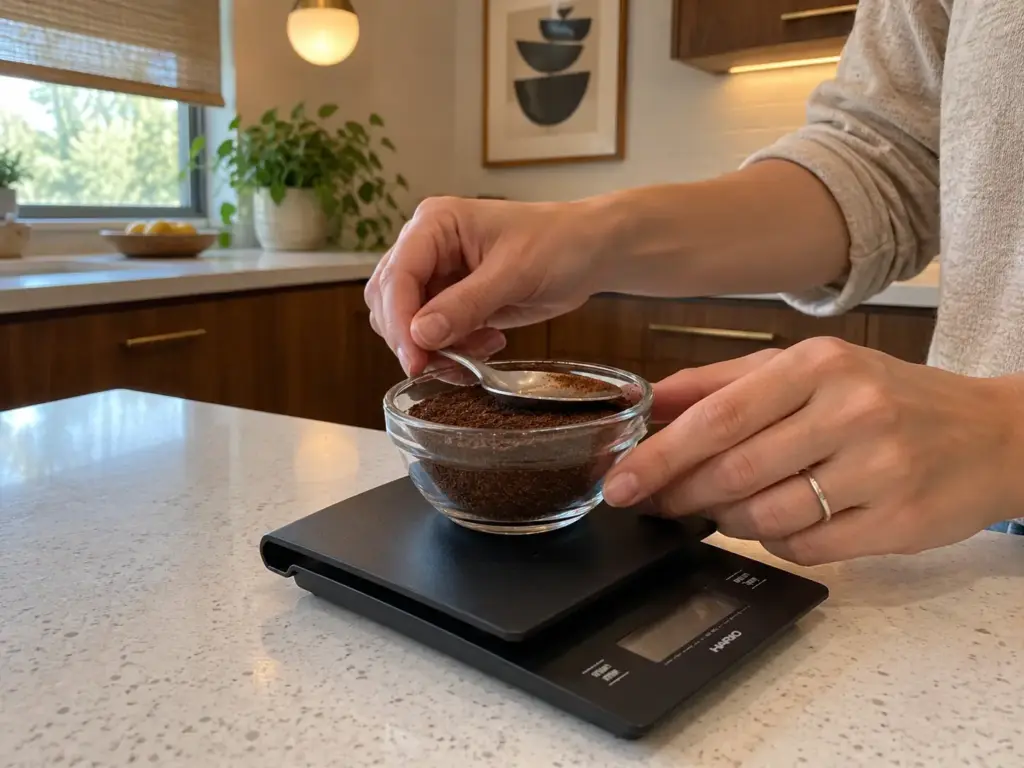
What one level scoop weighed in a reviewer’s kitchen
Coffeeness puts one level scoop at 8 grams of coffee. The maker’s line in that review is one level scoop per cup, while the reviewer’s own practice is about 10 grams per cup. That is a quarter more coffee than the leaflet, and across a full ten-cup carafe it is 100 grams against 80.
The leaflet’s line holds if you like a light pot. For anyone else the better call is to weigh instead of count, because a scoop measures volume and the cup depends on what the grounds weigh. The Specialty Coffee Association’s published brewing chart is the thing to hold your own ratio against, not the leaflet and not a number copied from another site.
A scale turns that check into a ten-second job. The Hario Drip Scale Timer is a coffee scale that reads in 0.1 gram steps and has a built-in timer, which would time the plate test above about as well as a phone does. It turns itself off after five minutes, it is one more object on the counter, and the 8 grams is one reviewer’s scoop, not a standard: yours will land somewhere else.
Weigh one level scoop of your own grind once, and weigh it again whenever the bean or the grind setting changes. A scoop of a finer grind packs heavier than a scoop of a coarser one, so the same scoop quietly becomes a different dose.
Taste again before touching the grind
Change the dose by a gram or two per cup, brew, taste, and stop. If the cup got fuller and the thin, watery edge is gone, the scoop was the problem. If it turned heavy and harsh, you went a gram too far; give a gram back. And if it is fuller but still sharp or hollow, the grind is next: the grind size that suits a drip machine sets the starting point, and how grind size changes the taste from sour to bitter says which way to move from there.
Descaling and Hard Water, Past Week One
Nearly every review of this machine was written in its first week or month. One was written after two years on a well-water line, and it is the only account that says what scale does to the machine once the novelty is gone. That is also where the descale light, which the short reviews barely mention, stops being a detail.
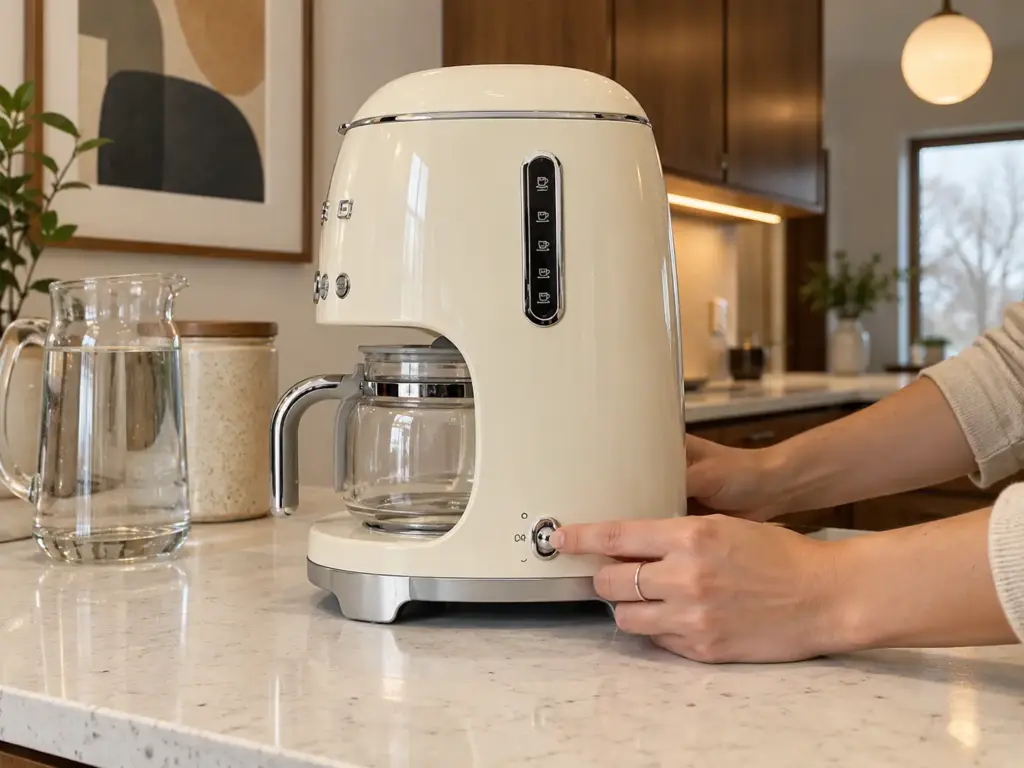
What happens on well water
Abigail Albers ran the machine for more than two years on well water and wrote that it needed descaling “about once a week”. When it started misbehaving she “descaled it heavily a couple of times”, and the machine broke around Christmas 2020. Customer service, she reports, offered no remedy, so she opened it up and repaired it herself; afterward it “doesn’t quite run the same as it used to”.
That is one kitchen, one water supply and one machine, so read it as one owner’s record and not as a failure rate. What carries over is the mechanism. Hard water leaves scale in the heating path, scale slows the brew and takes heat out of it, and a machine that asks to be descaled weekly is telling you about the water before it tells you about itself. For the same two-year question asked of a cheaper machine, see the year-two test on a cheaper drip machine.
There is a cost the week-one reviews never price in: the descale program takes the machine out of service while it runs, so a weekly descale on a well-water line is a weekly gap in the mornings. If your tap leaves a white crust on the kettle, you are closer to her kitchen than to a reviewer’s with soft water, and the hardness lever is a decision to make now rather than after the light starts flashing.
When the light does come on, the product type is a descaling solution or powder made for coffee makers, and the manual says what Smeg allows. Read it before anything goes into the reservoir.
The hardness setting and when the light comes on
RealHomes and Coffeeness both describe the same lever: a setting for “water hardness (hard, medium and soft)”, in RealHomes’ wording. According to RealHomes, the descale alert follows that setting, so the light is not a plain calendar: set the lever for harder water and it asks sooner. What no review says is whether the setting slows scale itself. That is a manual question, and it is left unclaimed here.
The flashing descaling icon stays on until the descale program has run, and it is where two reviews part ways. They describe two different button sequences for starting the program, so neither is repeated here; follow the manual for your unit. And when the cup tastes off, the scale and the carafe that sat on the plate come before the beans, because a new bag does nothing for a machine whose light has been flashing for weeks. For another brand’s month-two record, month two on a machine with a temperature dial is the next read.
Set the hardness lever on day one against your water, using your supplier’s annual water report or a test strip if you are on a well, instead of leaving it wherever the box left it. The light follows the setting, so a wrong setting means a light that comes at the wrong time.
The Flaws, Each Next to the Owner Who Saw It
Reviews of the same machine contradict each other, and the contradictions turn out to be about who wrote them and when. This section sets each flaw next to the person who named it.
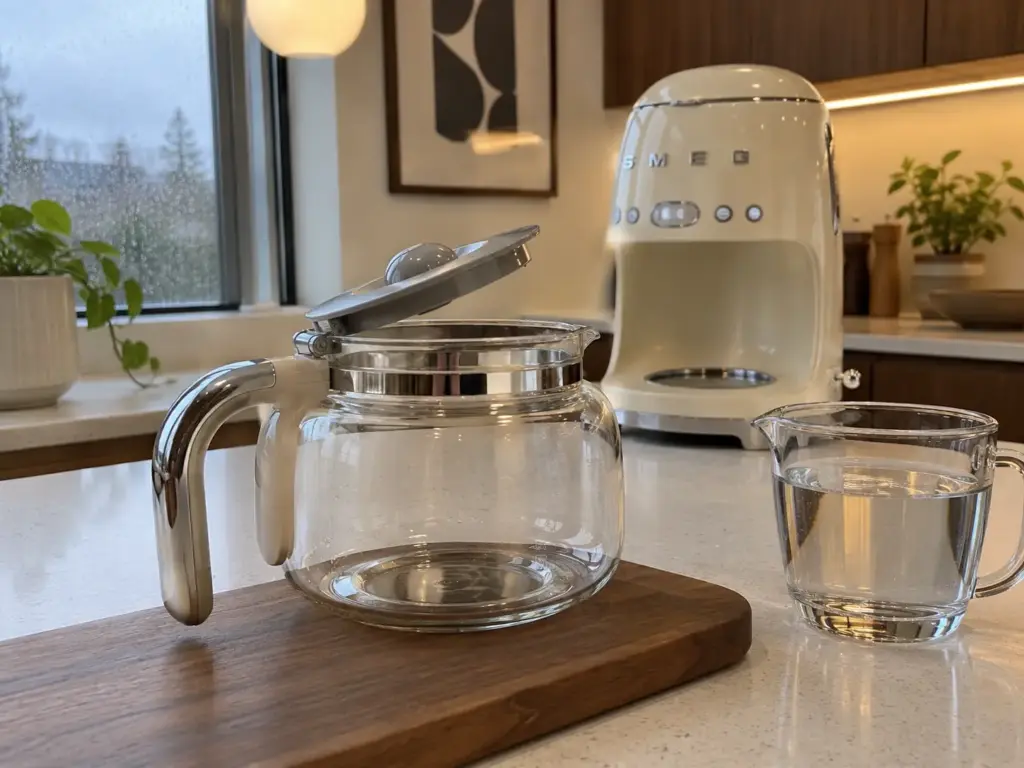
The lid, the beep and the plate
Abigail Albers names the lid that does not open all the way, and a beep on power-on and power-off loud enough, she writes, to wake a baby. Coffeeness and RealHomes name the plate that cools the cup.
Page Edit says the lid, the beep and the plate are complaints that do not hold up for its owners, which is the reverse of the others and worth taking at face value: it is a different unit and a different kitchen. It comes with no month and no reason attached, so it is not counted as a finding here.
Which flaws are week-one and which are year-two
Read down the last column of the table: the plate complaints come from a one-month test and from reviews that do not say how long they ran, while the lid, the beep, the shut-off and the descale come from the only account that ran two years.
| Flaw | Who saw it | Written when |
|---|---|---|
| The lid does not flip all the way back | Abigail Albers, the two-year owner | After more than two years of use |
| A beep on power-on and power-off | Abigail Albers, the two-year owner | After more than two years of use |
| The plate cools the cup | Coffeeness and RealHomes | RealHomes after one month; Coffeeness does not say |
| The shut-off needs a re-press to keep the machine on | Abigail Albers, the two-year owner | After more than two years of use |
| A weekly descale on well water | Abigail Albers, the two-year owner | After more than two years of use |
That split does not mean the short reviews missed the other flaws; a lid opened a handful of times in a test week is not yet a lid that has been opened every morning for two years. It means the week-one reviews are good evidence on the cup and weak evidence on the parts. For the same plate-and-cup record on another brand, the Cuisinart review, counted in cups brewed is the one to read.
Is the Smeg Worth It, or Is Another Drip Machine the Better Buy?
With the flaws on the table, the question is what the money buys. This section says who the machine suits, sets it against the machine it is often compared with, and hands you to the next decision.
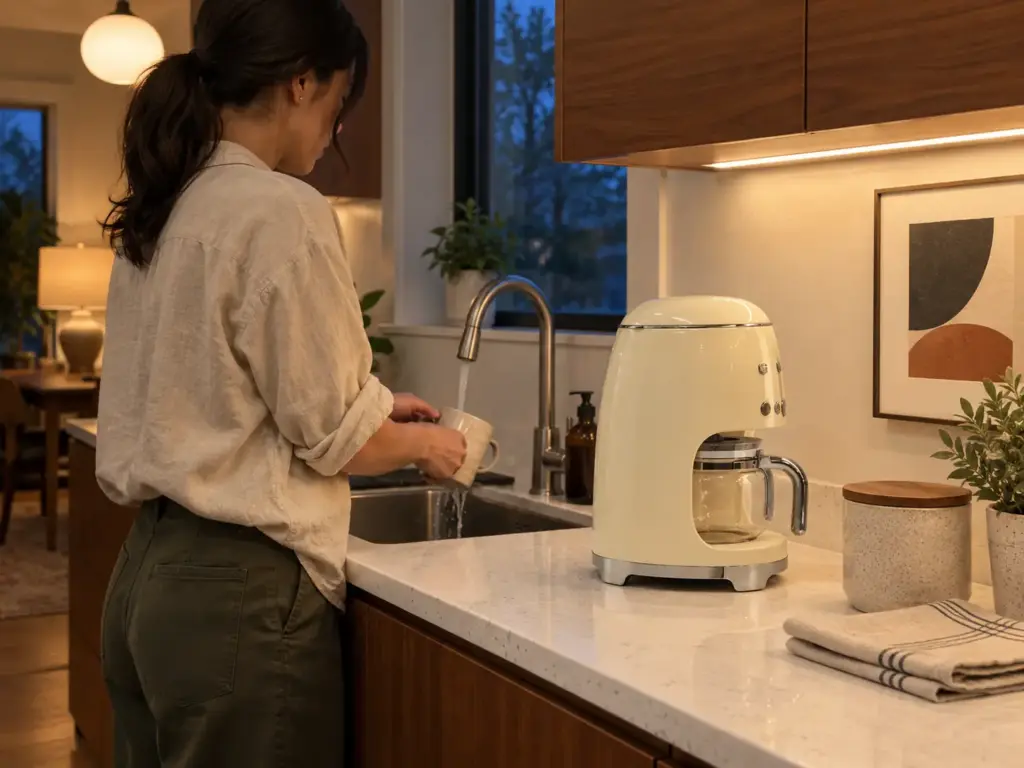
Worth it if the look is the reason
The cup in the reviews that brewed with it is good, so the price pays for the look, and the look is a fair thing to pay for. If it is the reason you want this machine, the flaws above are a trade you are making knowingly, and the three free changes in this review (a smaller batch poured early, a weighed scoop, a descale on schedule) cover most of what goes wrong with the cup. If the reason is the cup alone, the same spend would also cover a grinder, and a grinder moves the cup further than a drip machine does. I would keep the Smeg only for the first reason.
A cheaper route to the same cup is a budget drip machine, and the warming plate on a budget machine shows what the low end gives up in heat.
The Moccamaster comparison people keep making
A Moccamaster against a Smeg is the comparison people keep making, and it is a fair one: both brew a ten-cup pot. The Technivorm Moccamaster 53941 KBGV Select 10-Cup has a copper heating element, brews 40 ounces in four to six minutes, and holds its plate at 175 to 185°F (79 to 85°C) according to its spec, with a five-year warranty. It is a premium machine as well, so it does not save money; it spends it on a brew time and a plate range printed in the spec instead of on a shape.
According to the Specialty Coffee Association’s certified home equipment list, “SCA Certified Home Brewers are coffee makers that meet SCA’s rigorous standards for brewing quality, consistency, and performance”. The pages of that listing that load name Moccamaster entries and no Smeg. That is an absence from a list, not a failed test of the Smeg’s cup.
The Moccamaster stops being the obvious pick when the shape on your counter is the reason you are here, because a better machine on paper is not the one you will want to look at. Where it does earn its place is laid out in our review of the Moccamaster.
The next decision: the grinder
Whichever machine ends up on the counter, the cup depends on the grind before it depends on the machine. The Baratza Encore is the entry grinder for that job: 40 mm conical steel burrs and 40 settings, which turn the grind from a guess into a number you can write down and repeat. Its limit is the plain one of an entry grinder: forty settings and no more, a spot on the counter, and a grind to reset by hand whenever the bean changes. What wears out first in a home grinder is the read to finish before you buy.
What to Change Tomorrow, and What to Check in a Month
Three things hold up across the reviews. The cup in the ones that brewed is good, so the price buys the look. The plate time is four published numbers, so the only one that counts is the one a small batch and a phone give you. And the scoop and the descale light come before any blame on the machine.
A month from now, check how often the descale light has come on at the hardness setting you chose, and whether the habit of pouring early has held or drifted back to the carafe sitting on the plate.
For tomorrow morning, make one change: brew the smaller batch with the 4-cup button, pour it into a mug before it sits on the plate, and taste it against the second mug of today.
Frequently Asked Questions
01Are Smeg drip coffee makers good?
Reviewers who brewed with the Smeg drip coffee maker report a good cup, and the complaints owners name are the lid, the beep and a hot plate that cools the coffee. Whether the look justifies the machine is the real call.
02Are Smeg coffee machines good quality?
This review covers only the Smeg drip coffee maker, so it cannot speak for the brand’s other coffee machines, and one two-year owner’s record is the only long account. She descaled weekly on well water and saw the machine break after about two years, which is one account and not a failure rate.
03How long does the Smeg keep coffee warm?
Published reviews give 20, 40 and about 60 minutes for the Smeg’s hot plate, and none of those numbers comes from the manufacturer’s manual. Time your own unit with a small batch, and pour what you will drink early.
04Which Smeg coffee machine is considered the best?
This review covers only the drip model, so it has no basis to rank the brand’s other coffee machines. If you are choosing among drip machines, the brands guide at the top of this review compares them side by side.
05What is the best drip coffee maker on the market today?
There is no single best drip coffee maker, because the answer depends on how hot the water gets and how long the carafe stays on heat. Our guide to the best drip coffee maker, picked by water temperature sorts them that way.



How did your cup turn out?
No comments yet. Tell us what you changed — and whether the needle moved.