

We may earn a commission when you buy through links on this page. It never changes what we recommend. How we pick
On this page12 parts
- Who This Pot Is Built For
- How the Basket and the Spray Arm Wet the Grounds
- Fast and Flat: Which Way the Cup Is Off, and What Fails Quietly
- The Four Changes, in Order
- The Grinder a Flat Basket Asks For
- The Numbers Against the Standard
- The Letters on the Box and the Half-Pot Switch
- The Carafe, the Plate and the Flaws in Writing
- What Changes in Years Three to Five
- When the Cheap Drip Does the Same Job
- Buy by the Ounce, Fix in Order, Check Again Later
- Frequently Asked Questions
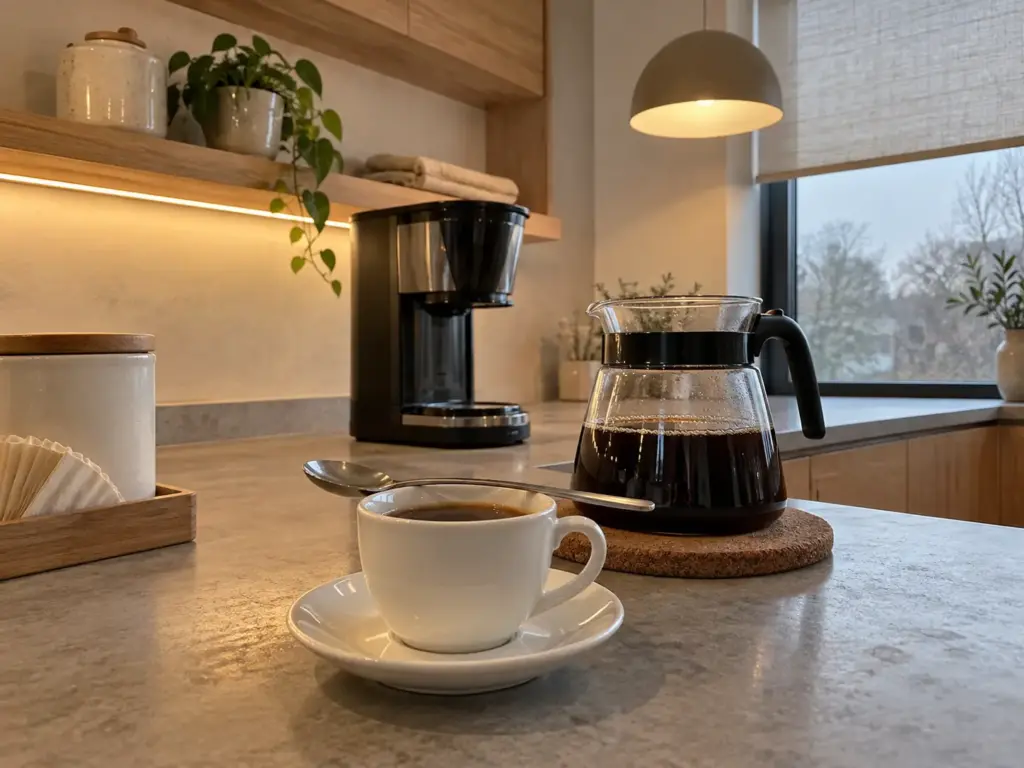
You press the one button, and by one long review’s clock the water for two mugs is through the basket in about two and a half minutes. The cup is thinner than a machine with this reputation should pour, and the setting behind that costs nothing to change. This review of the Moccamaster coffee maker gives the verdict as a batch size, then puts the four changes that tame the basic model’s fast flow in order.
The basket wets the bed quickly and the water leaves before it finishes, so the dose and the grind decide the cup before the badge does, and the certificate on the box covers the machine, not the pot you pour. The grinder, the numbers the basket asks for and what changes once the machine is years old come after the changes.
Quick Answer
A Moccamaster is worth it for a household that brews four to ten cups at a time, because the full pot is what it is built for. For one mug it is the wrong tool. The basic model’s fast flow is the flaw to manage by hand, in order, starting with the dose.
Who This Pot Is Built For
Before any spec, the question is how many cups leave the machine at once. The same Moccamaster is a good buy for batch brewing and a poor one for a single mug.

Four to ten cups, the range owners and the one long review keep returning to
The Coffee Chronicler review of the basic KBG 741, the longest write-up of this machine, says the case changes once you brew bigger batches, 4 to 10 cups. In the reviewer’s words, “most normal people who brew between 0.5 l-1 liter (4-8 cups)” have a good case for it. For someone who brews two cups of pour-over at most, the review sees no convenience gain, and in drip versus pour-over, a pour-over done well still keeps a small edge in the cup.
The design explains why. The Specialty Coffee Association’s own listing describes the basic KBG as “suited to full carafes”, and the reviewer puts the fast brews down to a large basket optimized for big batches paired with a fast water flow. Some people find they hardly need to tweak the grind across different coffees, which suits anyone who bought the machine for ease. How it stacks up against its neighbors is a separate question, and the brand-by-brand view of drip machines takes it up.
Why one mug is the wrong job for it
A small dose in a basket sized for a full one makes a thin bed, and water crosses a thin bed quickly. The reviewer, brewing two large mugs at a time, still stepped in by hand to get the contact time wanted, and another owner who had two of these machines wrote that full automatic disappointed and not to bother brewing less than five cups. The last cup from a half-full carafe has also sat on the plate the longest. If one mug is the daily job, a machine built for one mug is the better starting point, and it gets reviewed there with its own flaws.
The free check before any purchase: how many cups you really pour
Count ounces, not machine cups. A 40 oz carafe sold as ten cups makes each cup about 4 oz, so four cups is 16 oz, which is also where the Select’s half-pot setting bottoms out. Pour your usual morning into the carafe of the machine you own and read the ounces off the side for a week. Under 16 oz most days, this is the wrong machine for the job; from 24 oz up, the rest of the review applies to you.
How the Basket and the Spray Arm Wet the Grounds
The machine is a basket brewer built around a full pot, so the way it delivers water into the basket is the first thing to understand before blaming the beans. Everything the one-button mode does well or badly follows from water dispersion, how evenly that water meets the bed.
What the spray arm does over the bed
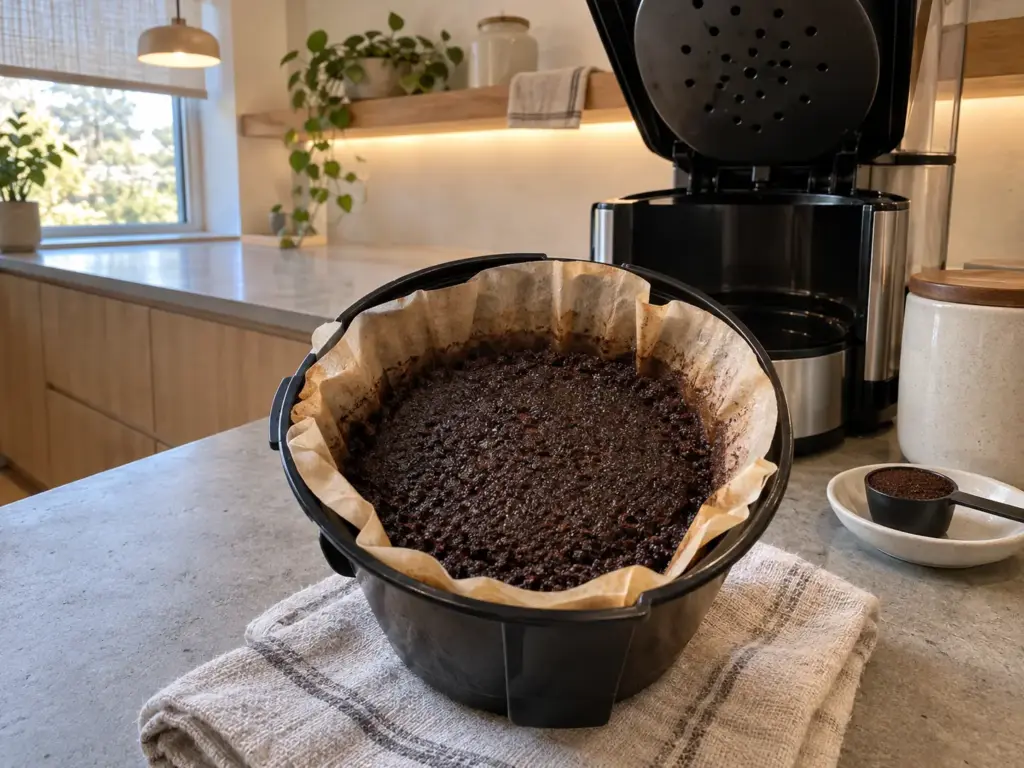
The outlet arm is long and narrow, with nine holes where the water tends to run together into one stream. That stream digs a crater into the middle of the bed, and the reviewer knows from pour-over that the shape is wrong: you want an even spread over the whole bed and a gentle flow, since too much agitation can create bitterness. The newest generation ships with a redesigned arm, with a rib at the holes to spread the water. The drawbacks list says “Poor spray arm: This was the case on all older models”, and points anyone who wants the fix to the Select.
The mechanism is the same on any machine. Where the bed is dug out, those grounds get washed hard and turn bitter, and where it stays dry at the edge the grounds barely get wet and turn sour. Both ends end up in the same pot.
Lift the basket out when the pot finishes and look at the spent bed before you rinse it. A level, evenly dark dome means the water spread well. A dry pale ring at the rim or a pit in the middle is your answer to why one pot tasted two ways.
Why the one-button mode disappoints until the basket is stirred
The machine does not bloom on its own. The reviewer’s workaround was “turning off the machine for 30 seconds after the first water had been dispersed to mimic a bloom”, sometimes stirring with a spoon or angling the arm so the bed was wet through. On full automatic the brew can disappoint, but stirring the basket can turn it into a very good cup.
Two people, two kitchens, one fix by hand. It is a small irritation on a machine whose whole idea is to remove them. For how far a grind should move once the bed is wetting evenly, how grind size moves a cup from sour to bitter is the next page.
Fast and Flat: Which Way the Cup Is Off, and What Fails Quietly
A basket that wets the bed unevenly and finishes a two-mug pot in about two and a half minutes gives a cup that points one way. Naming that direction is the whole diagnosis, and it comes before any change to the machine, the beans or the budget.
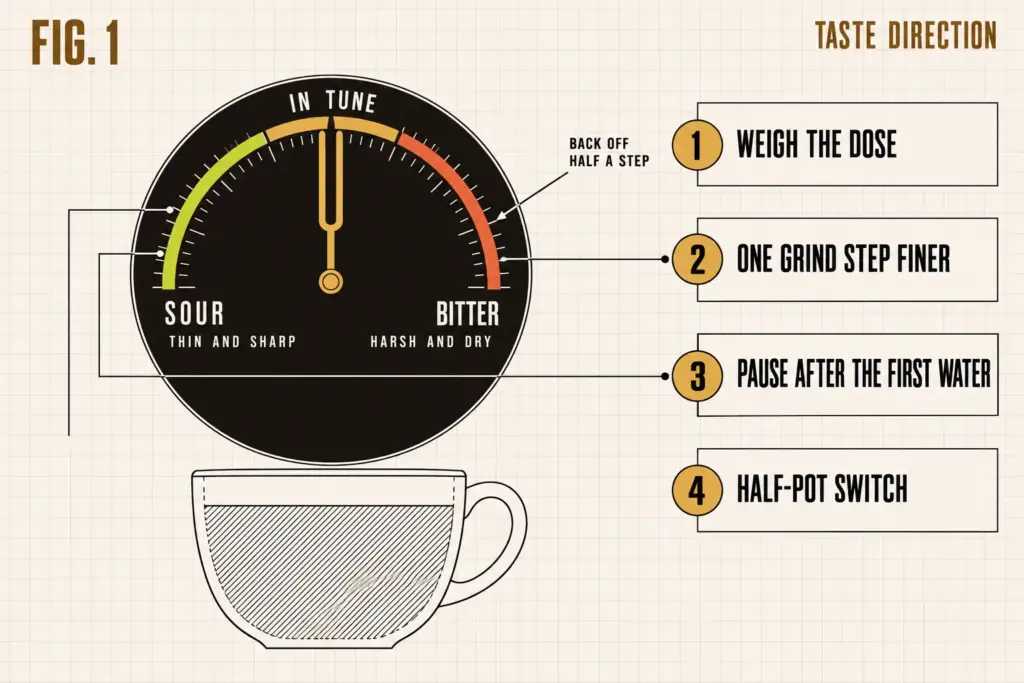
What a thin, sharp pot is telling you
Thin and sharp means the water left before it finished. A coarse grind, a dose too small, or a flow too quick for the contact time can all do it, and only the last of those belongs to the machine. Bitter and dry points the other way: too fine a grind, a bed stirred hard, or water that stayed too long. Sour and bitter in the same mouthful is a third case, uneven grounds, and it belongs to the grinder section below.
So taste first. Name the direction in one word, and only then pick which change to make. A stopwatch helps too: time your own pot from the button to the last drip. If two mugs land near the reviewer’s two and a half minutes, you have the reviewer’s machine behavior, and the same fixes apply.
The flow itself: about two minutes for the first 500 ml
On the basic KBG 741, the free run is quick, and the total time stretches once the grounds slow the water. That batch works out to roughly 1:16. The verdict on the flow rate: “A bit too fast, if you ask me.” After the first 500 ml, the review explains, the grind size dictates the total brew time, which makes the grind the first dial that belongs to you.
The complaint comes from the basic KBG 741. The newer Select, per the same review, has a feature that slows the flow for smaller batches, and that is the fourth change below.
When it is the beans or the carafe, not the machine
A flat pot, with neither a sour nor a bitter edge to point at, is more often the bag than the machine. Stale beans have lost their gas and aroma, they barely bloom, and they give the same dull cup in any brewer you try. If the coffee tastes the same on two machines, how to tell if beans are stale comes before any other change.
The other quiet cause is the carafe left on the plate. Coffee that is already made keeps getting heated, and the last cup tastes cooked, which no grind setting fixes.
The Four Changes, in Order
A sharp, thin pot has four fixes, and the method is to make them one at a time, free first, with one pot and one taste before the next. Stack two changes and you will not know which one worked, or which one tipped the cup into bitter.
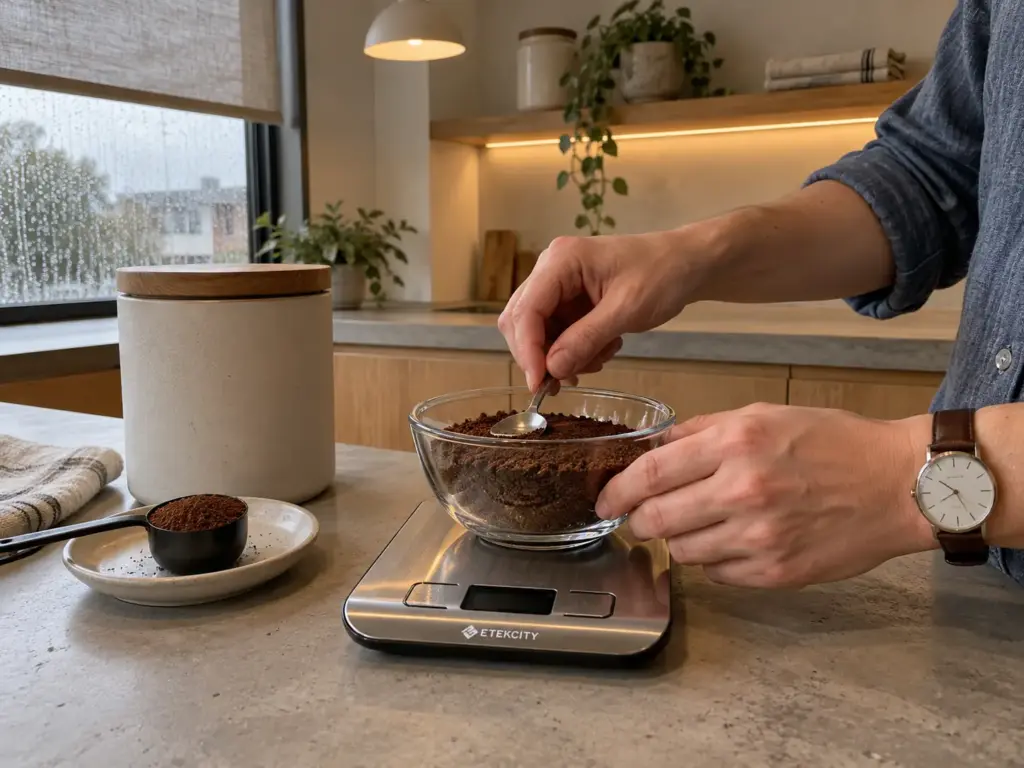
First, weigh the dose (a scale before a new machine)
Start with grams, because they cost nothing to check and everything after depends on them. A scoop is a volume, and a scoop of dark roast weighs less than the same scoop of a dense light roast, so a pot made by scoops swings from one morning to the next without anyone noticing. The only dose figure on the table is the manual’s recommendation.
A scale with 1 g steps and a tare button, such as the Etekcity Food Kitchen Scale, is all the job needs, and a scale changes more cups than a new machine does. No repeated complaint about it turned up in what was read, which says more about the reading than about the scale. If the next pot moves from thin to even, the dose was the lever. If nothing changes, the scoop was already close, and you move on with a number you trust.
Second, one grind step finer
This is the likeliest culprit and it is free. A finer grind gives the water more surface and slows its way through the bed, which hands back the contact time the basic model gives up. How much that moves this particular machine has not been measured in anything read for this review, so the cup is the test.
Move one step, brew the same dose, and taste: the sharp edge should soften and some sweetness should come forward. If the cup turns dry and bitter instead, you overshot, and half a step back is the answer. The page on the grind size a drip basket wants covers how far a basket like this should sit.
Judge a new grind step on the second pot, not the first. The grinder keeps some grounds from the last setting, so the first dose still carries a little of the old grind.
Third, the 30-second pause after the first water
The pause is a hand bloom, and it can improve the extraction, with rounder and more full-tasting cups. That is not a number measured here. The pause is free, but it keeps you standing at the counter on a machine sold on being hands-off. If you stir as well, keep it gentle, because the same review ties too much agitation to bitterness.
Taste again. A pot that comes out fuller and calmer means the pause did the work and the grind can stay put. A pot that turns harsh means the stir was too hard.
Fourth, the Select’s volume switch for a half pot
For small batches the last change is the only one on the list that costs money, which is why it comes last. The SCA listing for the KBGV Select says its “switch selects half or full carafe (16-40 oz)”, and 16 oz is the four-cup floor from the first section. The review credits the Select with slowing the flow for smaller batches. Which letters to look for, and the one thing to confirm on the listing, are in the letters section below.
The Grinder a Flat Basket Asks For
A finer step only helps if the grounds are even, and the basket punishes the dust and boulders a blade grinder makes. This is the next decision after the machine itself, and it changes more of the cup than the badge does.
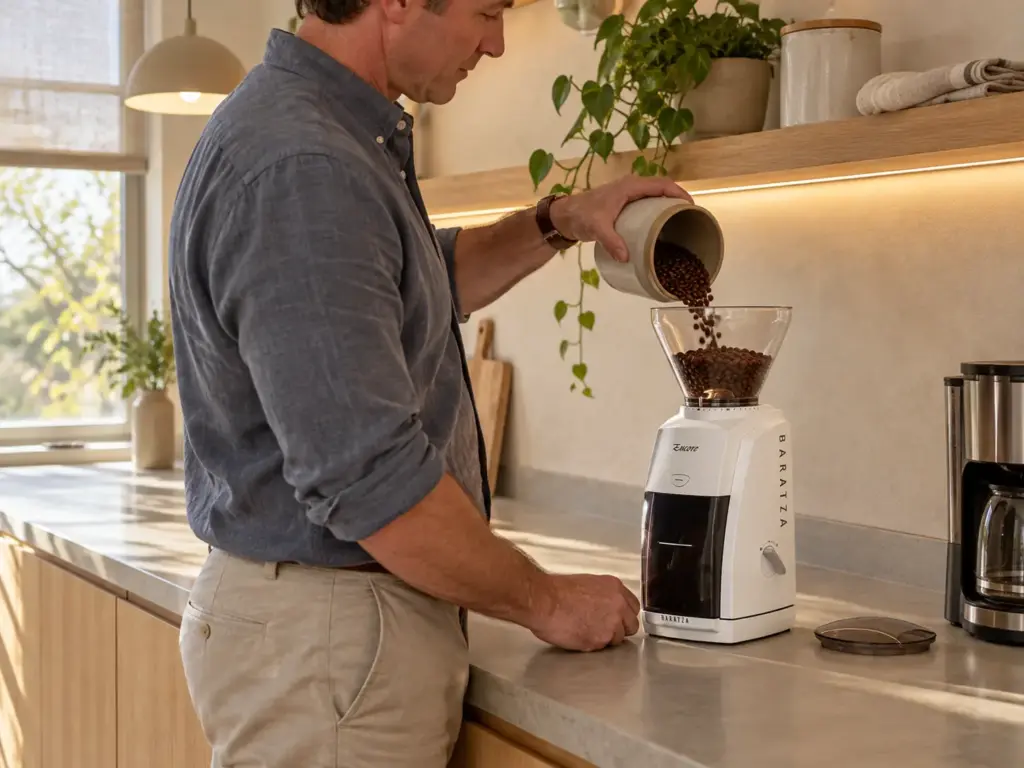
Why a blade grinder fights this basket
A blade grinder breaks beans into chunks and powder at once. The bed wets both sizes at their own pace, so the powder over-extracts into bitter while the chunks under-extract into sour, and the cup is bitter and weak together. That is burr versus blade in one sentence, and no brewer, this one included, can fix it downstream.
There is also a catch with the advice above: going one step finer assumes a grinder that has steps. With a blade, finer means more seconds, and more seconds means more dust, so the free fix backfires a little. If a blade grinder is all you have, timing the grind comes before any purchase.
What an entry burr grinder changes, and what it still gets wrong
The Baratza Encore has 40 mm conical steel burrs and 40 grind settings, so going one step finer is a literal instruction, and the grounds come out far more even than anything a blade makes. The Encore comes up far more often than other Baratza grinders, which says it is common, not that it is flawless.
No repeated complaint about the Encore turned up in what was read for this review, and that is a statement about the reading, not a clean bill. The caution is that people who are happy with a product rarely write about it. Which grinders hold up past the first few months is its own question, and which grinders hold up best works through it.
The Numbers Against the Standard
With the dose and the grind under control, two numbers are left, the water temperature and the ratio, and both get copied from page to page. Here they are held against the standard where it can be read.
Water temperature: one reading, one standard
According to the Specialty Coffee Association’s certified home brewer list, “SCA Certified Home Brewers are coffee makers that meet SCA’s rigorous standards for brewing quality, consistency, and performance.” The whole Moccamaster family is on it as Certified 2026: the KBGV Select, Cup-One, KBT, KBGT, KBTS, KB, CDT Grand and the KBG. So is a run of Bonavita 8-cup brewers, which tells you the mark separates the tested from the untested and not the Moccamaster from everything else. The maker pays a licensing fee over a three-year term, and the test is of the machine, not of the pot you pour.
The SCA’s window itself sits in its home brewer specification, which is open to members only. The one reading in hand is the reviewer’s, who puts the right brew temperature at “around 93-95 C”, or 199 to 203°F, and assumes the machine hits it because it is certified. That is a reasonable guess from one reviewer, and not a measurement of your kitchen. Temperature belongs to the model more than to the brand, which is the argument on the page where water temperature picks the drip machine.
The ratio in grams, with the scoop translation
Two working figures for the brew ratio, coffee to water, are on the table. The reviewer’s two-mug batch was 32 grams of coffee to 500 ml of water, about 1:16. The owner who follows the manual brews 41 g to 24 oz, and 24 fluid ounces of water weighs about 710 g, so the manual comes to roughly 1:17. That is a few grams of difference per pot, and neither figure is checked against the SCA’s own ratio, which sits behind the same members-only wall.
The number depends on the cup. At 1:17 the carafe sizes work out to roughly this:
- 16 oz, the Select’s lowest half-pot setting: about 28 g, or 30 g at 1:16
- 24 oz: about 42 g, or 44 g at 1:16
- 40 oz, the full carafe: about 70 g, or 74 g at 1:16
Start at the lower figure, taste, and move up only if the cup is thin after the grind and the dose are right.
To turn those grams into scoops, weigh three level scoops of the coffee you actually buy and divide by three. A dark oily roast and a dense light one fill the same scoop with different weights, so the scoop count you land on belongs to this bag only.
The Letters on the Box and the Half-Pot Switch
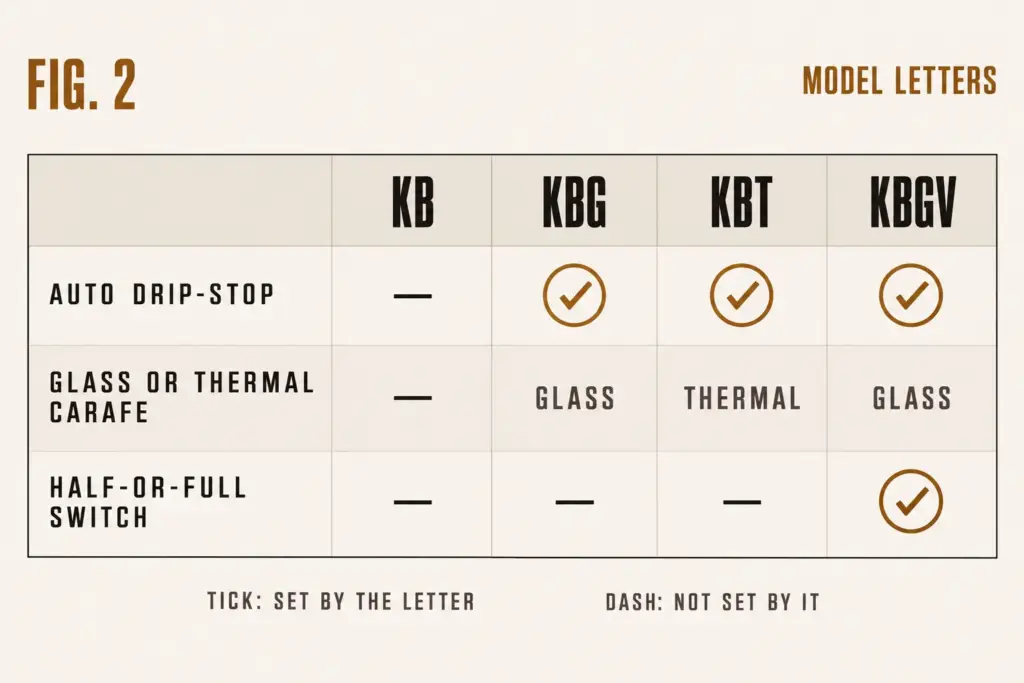
The model letters decide the carafe, the drip-stop and the half-pot switch, and they matter more than the badge. Five similar names on a listing page stop looking alike once you know what each letter adds.
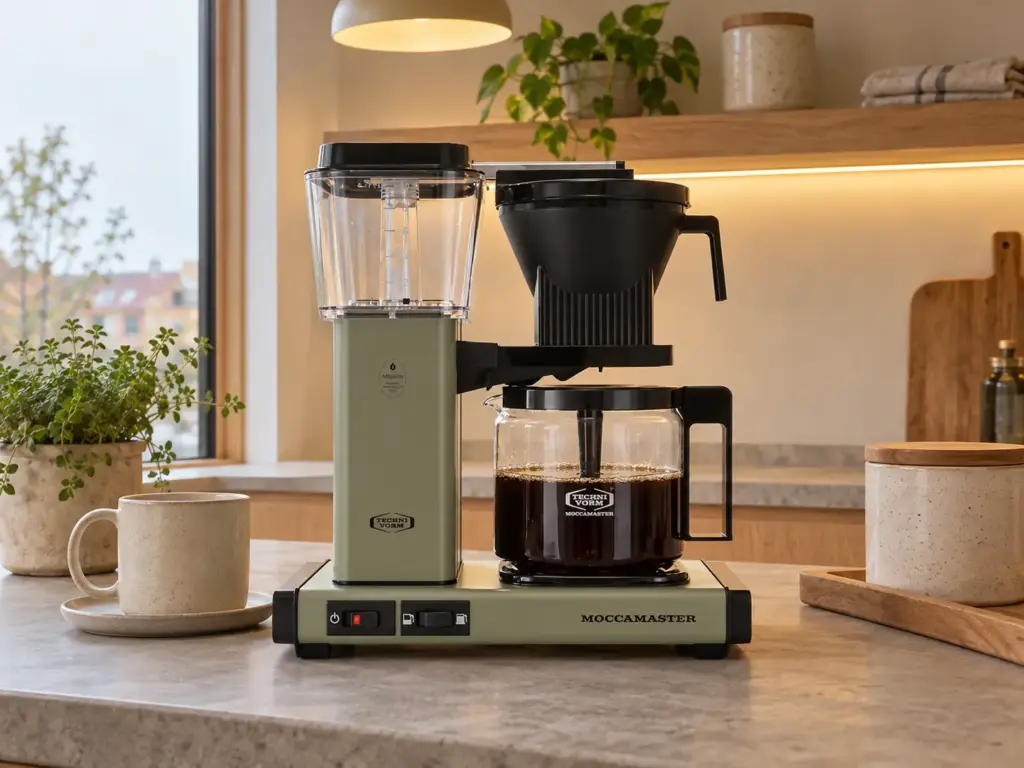
What KB, KBG, KBT and KBGV stand for
KBG is the classic, with a glass carafe, a hotplate and an auto drip-stop basket; the SCA calls it “suited to full carafes”. KB is the same machine without the auto drip-stop, and the SCA lists a manual-adjust drip-stop on it for partial carafes. KBT swaps the glass carafe for a glass-lined thermal one. KBGV adds the V for volume control, and it is the Select, the most updated version according to the reviewer, with the half-or-full switch the SCA describes.
The glass-versus-thermal question has its own page, sorted by carafe heat, and it is worth reading before the letters, because the carafe is where this family splits.
The Select: the half-pot switch, and what is unconfirmed on the listing
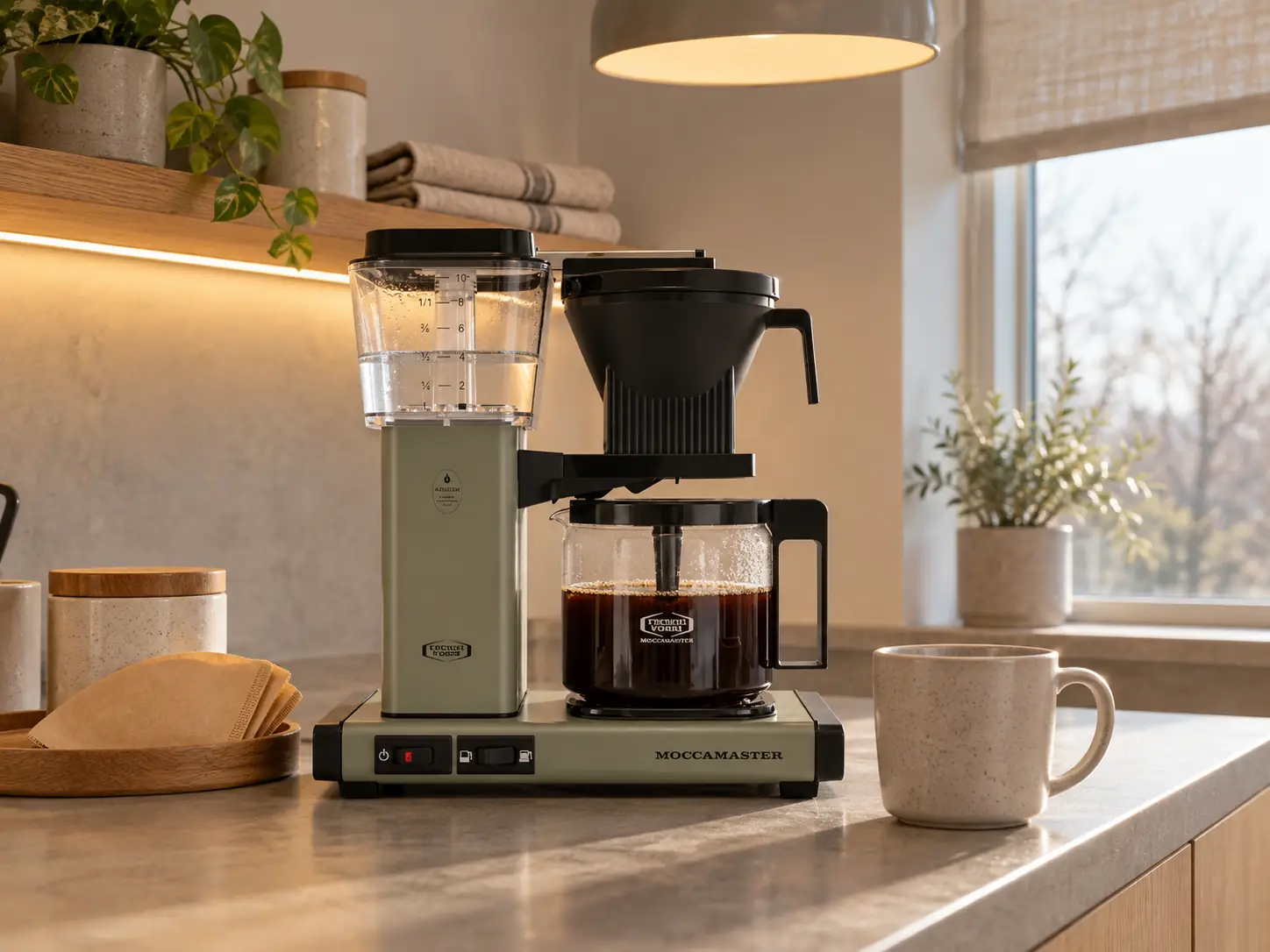
The Select is the model of the line to buy, and the Technivorm Moccamaster KBGV Select in Eucalyptus is the colorway in stock on Amazon as this is written. It holds 40 oz, with a glass carafe, a hotplate and a copper heating element. The SCA describes the half-or-full switch for the Select (16 to 40 oz), but this colorway’s listing title says only KBGV, so confirm the switch on the listing before you pay. It is the answer to the small-batch flaw, and its own flaws, the carafe and the reservoir, are written out in the next section.
The basic model that no longer shows a live listing
The KBG 741, the basic model the fast-flow complaint comes from, has no live listing on Amazon to send you to today. It still appears on the SCA list as the KBG, so the machine is certified, and the flow and carafe complaints in this review come from the reviewer’s unit of it.
The Carafe, the Plate and the Flaws in Writing
A machine that lasts is still made of a glass carafe, a plastic tank and a plate that keeps cooking the pot, and each has its own way of failing. This section is what the sources report about those three, and no more than that.
The glass carafe and its handle
On the basic KBG 741 the carafe is the biggest letdown on a premium device: thin, fragile, with a handle that feels flimsy. The review says the thermal version and the Select address many of the cons, and that you can use another brand’s carafe if it annoys you. The Select’s own carafe was not checked in anything read for this review.
A glass-lined carafe can burst, and the maker’s answer may be only where to buy another. The model was not named, and it is one account.
The reservoir and the repair
A cracked water reservoir may have to be shipped away for a paid repair, with the shipping label charged even under warranty. The model is not named here either. The thread keeps its own caveat in view: people who are happy with a machine rarely post, so a list of failures like this one is a list of what goes wrong, not of how often.
On care, the parts are easy to reach and clean, with one exception: fill the water tank with fresh water, never from the carafe, since coffee oils can stick there. A paper filter in the basket is the free part of cleanup, since the grounds leave with the paper. If the outlet flow is slower than you remember, the maker’s manual is the place for what to do next, and what a drip machine is built from helps you read the parts.
The plate that keeps the pot hot
The hot plate is the third quiet flaw. A pot left on it keeps getting heated, and what it adds to the cup is a cooked edge that no grinder setting touches. So the plate matters most for the pot you leave sitting.
Rinse a mug or an insulated bottle with hot tap water, then pour off whatever the household will not drink in the next few minutes. The cup you save is the one that would have sat on the plate longest.
What Changes in Years Three to Five
Early impressions miss the months, and even a month of use is still not a year. This section covers what happens once the machine is old, with no dates or counts behind it and never as a measurement.
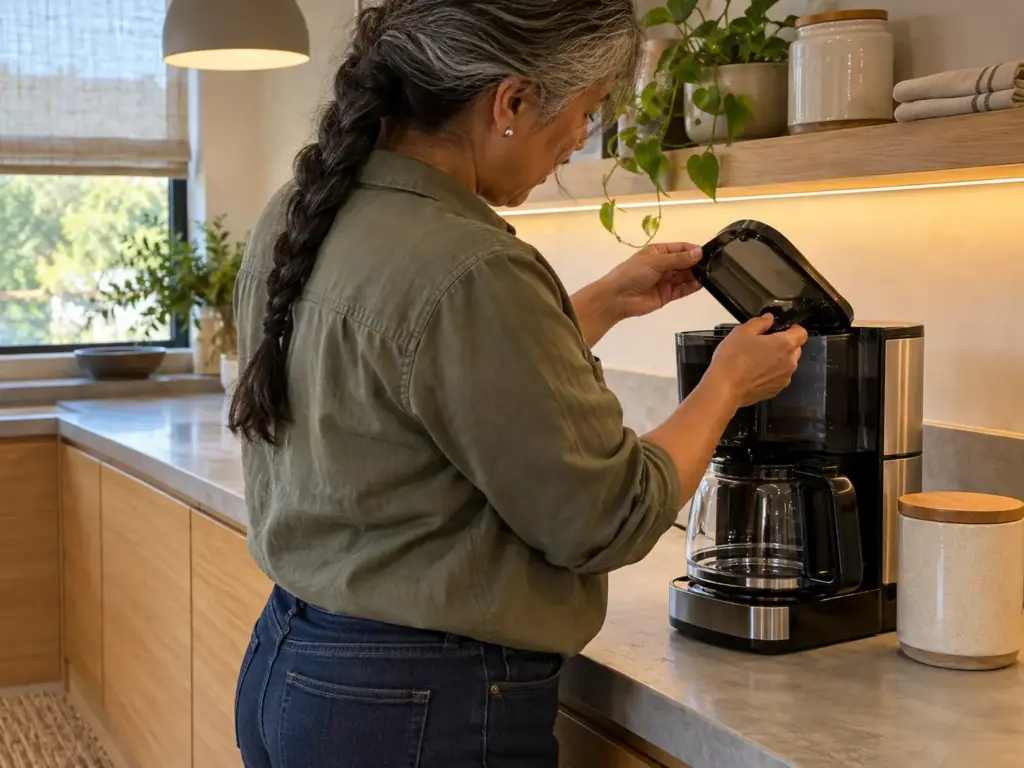
The parts that get replaced
A plastic water tank cover can need replacing after a drop and a footstep, even in the fifth year. Another reported that theirs was “going strong now for over three years”, used every single day.
The parts that fail in these cases are glass or plastic: a carafe, a reservoir, a tank cover. None of the reports is the heater. That is a pattern across a handful of cases, so treat it as a lean and not a finding, and keep in mind that people who are happy rarely write about it.
A design point matters here: the housing is an aluminum block and most of the parts are sold as replacement parts, so a spray arm can be swapped without trouble. A cracked cover or a burst carafe is then a part to replace, not a machine to replace.
As for the warranty, a five-year warranty covers the internal parts, and out-of-warranty repairs are possible for a fee. Read the terms at purchase, because warranty details change.
The descaling question nobody can source
Scale from hard water is the general reason a drip machine slows and runs cooler, and whether yours has any depends on your tap water. Vinegar is a common cleaning step for these machines, and whether it changes the taste is a point of argument.
That is a common habit, not the maker’s instruction. The manual is the authority on descaling this machine. What you can do yourself is watch the first minute of a pot: a flow that slows over the years, at the same grind and dose, is a signal to read the manual, not to change the grind.
When the Cheap Drip Does the Same Job
The other side deserves its hearing: a cheaper machine can cost less than half the price, and the honest question is what the extra money buys. The answer depends on the batch and on whether you will fix the fast flow by hand.
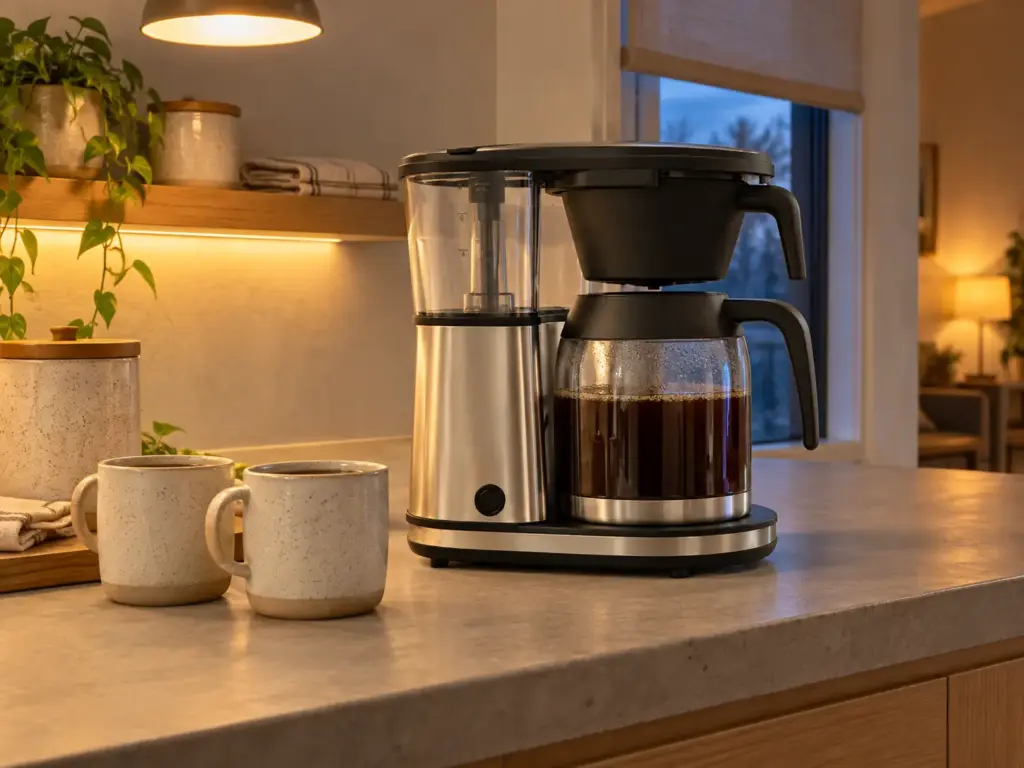
What the cheaper drip gives up
Bonavita machines are offered for less than half the price, and some people prefer their showerhead. The SCA list carries several Bonavita 8-cup brewers too, though not necessarily the exact one linked below. At the cheapest end of drip machines, what usually goes first is water heat, and the heat you give up at the cheapest end works through it. The rule I would use: for one or two mugs, the cheaper machine or the one built for a single mug is the better buy, and from four cups up, the batch size and the years tip it toward the Moccamaster, but only if you will manage the fast flow yourself.
A scale and a finer grind cost nothing, and they change the cup on either machine.
The one most often named
The Bonavita 8 Cup Drip Coffee Maker is the alternative most often named for this job, with a one-touch pour-over showerhead and an auto pause. Its longevity record is a weak point: some units fail early, and some fail after a few years. Those are unverified reports, and a cheaper machine simply sells more, so it gets talked about more.
So the Bonavita buys a lower entry price and a machine whose life is, by the owners’ own account, shorter, with the evidence thin either way. For batches over ten cups, count ounces, not cups before choosing either one. And if the grinder is the sticking point, a grinder built into the machine is the other way to solve it.
Buy by the Ounce, Fix in Order, Check Again Later
The verdict is a batch size: four to ten cups on a drip counter is the job this machine was built for, and one mug is the wrong one. The basic model’s fast flow is managed in an order that costs nothing until the last step: the dose in grams, one grind step finer, the pause after the first water, and the Select’s switch for a small batch. And the standard and the years get checked rather than assumed: the certificate covers the machine, and the rest has no dates behind it.
A month in, weigh the dose again and taste the same pot you tasted on the first day. A year in, lift the tank cover, look at the holes of the spray arm, and watch the first minute of a pot for a flow slower than you remember.
Tomorrow morning, change one thing: weigh the coffee you were going to scoop, brew, and taste for the thin, sharp edge. If it is gone, stop there. If it is not, go one grind step finer and taste again. After that, the next decision is the grinder, the carafe or the model, and each has a page that picks up where this one leaves off.
Frequently Asked Questions
01Is a Moccamaster better than other coffee makers?
It is better at a pot of four to ten cups, though it is not better at brewing a single mug. The SCA certifies the machine, not your cup, and its list carries other brewers too, so the dose and the grind still decide the taste.
02Is the Moccamaster a good coffee maker?
Yes, it is a good coffee maker for a household that brews a full pot of four to ten cups at a time. The basic model runs fast, which owners fix by hand, and the long review calls its glass carafe and handle flimsy.
03What is so special about a Moccamaster?
It is a one-button, full-pot drip machine, and the whole family is on the SCA certified home brewer list. The badge tells you the machine was tested, not how your pot will taste.
04Is a Moccamaster coffee maker worth it for one or two cups?
No, a Moccamaster is not worth it for one or two cups, because the machine is built around a full pot and a small dose runs through too fast. The Select has a half-pot switch, and a machine built for a single mug fits better at that size.
05Can a Moccamaster brew a half pot?
The Select can: the SCA describes a switch for half or full carafe, 16 to 40 oz. The basic model is described as suited to full carafes, so confirm the switch on the listing before you buy.


How did your cup turn out?
No comments yet. Tell us what you changed — and whether the needle moved.