




We may earn a commission when you buy through links on this page. It never changes what we recommend. How we pick
On this page8 parts
- What a Cheap Maker Does Well, and the One Number That Splits Them
- Test Your Own Machine in One Brew
- The Last Mug Is Where a Cheap Maker Gives Itself Away
- Free Changes That Do More Than the Next Tier Up
- What Breaks First, and Why Spare Parts Decide the Lifespan
- The Makers Worth Naming, and When Cheap Is the Wrong Answer
- The Reading That Answers the Question, and the Pot to Brew Tomorrow
- Frequently Asked Questions
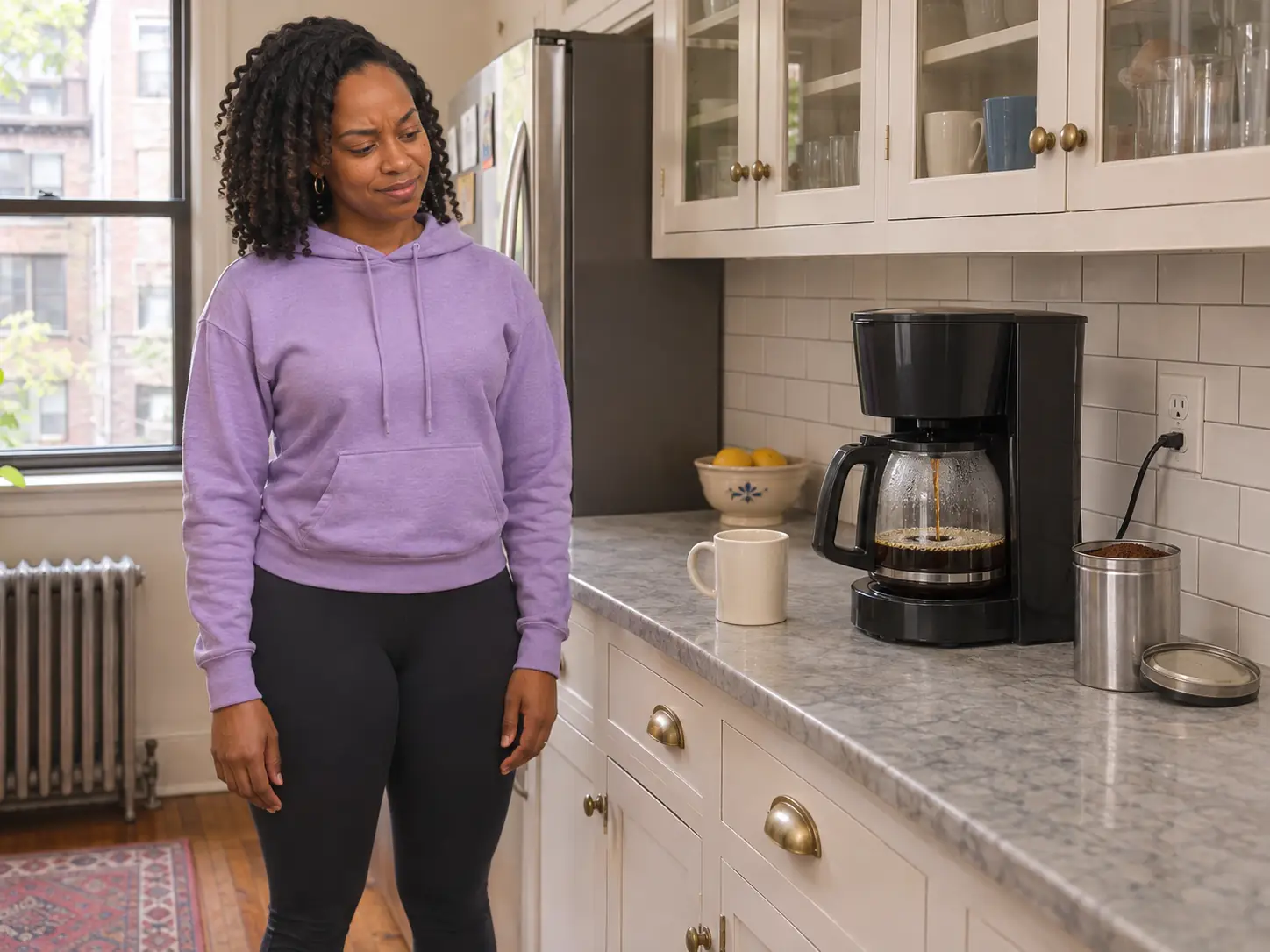
You are at the shelf with the cheapest automatic drip brewer you can find, an inexpensive coffee maker with one switch, or at your own counter with the one you already own, and the cup comes out thin and sharp. Every page you open answers are cheap coffee makers good with a shopping list, when the real answer is a single number: a drip machine has one job that matters, bringing the water into the Specialty Coffee Association’s (SCA) band of 195–205°F (90–96°C) and keeping it there while it wets the grounds. A budget coffee maker at the bottom of the tier can do that as well as one many times its cost, or miss it by 25 degrees. This guide runs in the order you would use it, from the number to a test you can run in one brew, the last mug of the pot, the free changes, the parts and finally the models, while what the extra money buys on the other end of the price range is the same question asked from the premium side.
Quick Answer
Yes, a cheap coffee maker can be good, and temperature, not price, decides it. One that gets the water to 195°F (90°C) and holds it makes a cup a far dearer machine would not be ashamed of; one that stalls near 170°F (77°C) tastes thin and sharp. A thermometer in the brew basket tells you which one you own.
What a Cheap Maker Does Well, and the One Number That Splits Them
The cheapest tier has real strengths that shopping lists skip on the way to the flaws, and one weakness that has little to do with the price tag. This section gives both in the same breath and sets the number that every later section measures against.
What the Cheap Tier Does Well
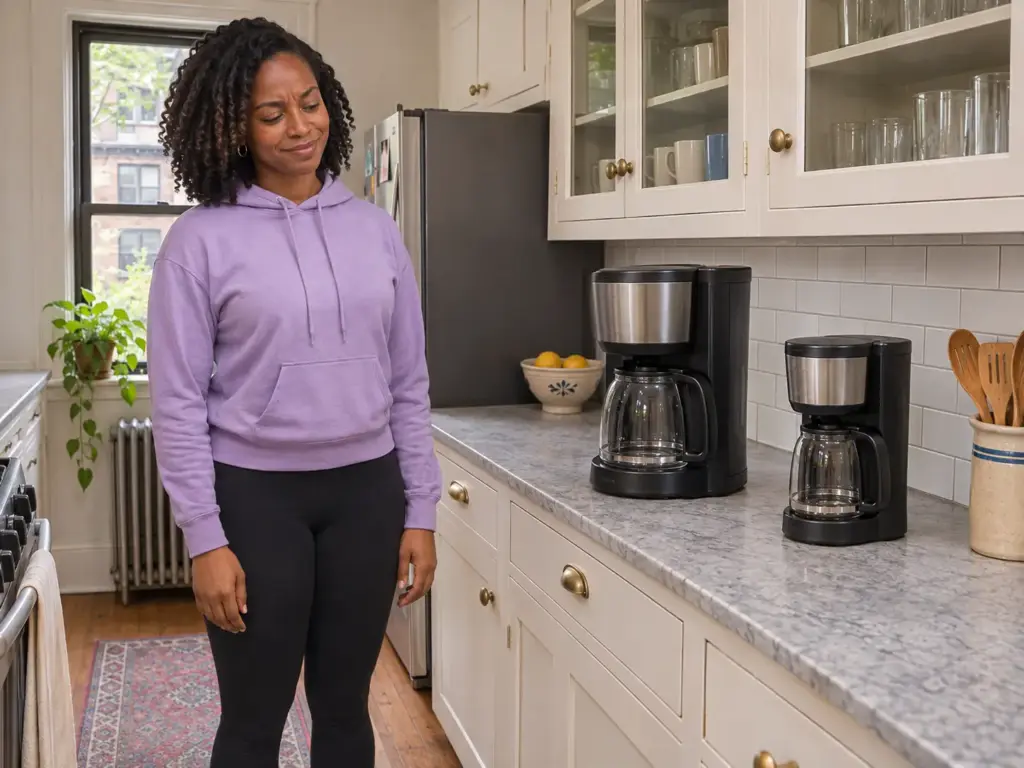
A plain drip machine is simple: fill the water reservoir, drop in a filter, flip the switch. It starts in seconds, takes little counter space, rinses clean by hand, and pours a whole pot at once, which a pour-over cannot do. That last point matters on the morning you need coffee for eight people, because that is the morning a cheap drip machine earns its place on the counter.
What it gives up is quieter and shows later: temperature stability, meaning heat held through the whole cycle, a build that keeps the lid seating and the carafe whole after the first year, and replacement parts you can actually buy. The price does not guarantee any of those three in either direction, and the rest of this guide tests each one.
The Band the SCA Sets, and the Machines That Miss It
The band is the SCA’s, and for a home brewer it works as a pass or fail line. The SCA standard requires a certified machine to reach 92°C (197.6°F) within the first minute of the brew, hold at least that for the rest of the cycle, and never exceed 96°C (204.8°F). According to the UC Davis study on brew temperature, “In particular, drip brewers that do not achieve a minimum brew temperature of 92 °C within a prescribed time period fail their certification.”
A machine that never gets there is not making a weaker version of the same cup. It is extracting a different, thinner set of compounds, and you taste that as sharp, sour and thin with a bitter edge at the back, because the water never reached what makes the cup sweet. A second scoop of the same coffee makes it harsher, not stronger.
The same paper brings a tempering fact. When UC Davis brewed one coffee at 87, 90 and 93°C (189, 194 and 199°F) and adjusted grind and time until strength and extraction matched, trained tasters found no appreciable difference between the three. So a cool machine under-extracts because the water works slower, and heat itself is no magic; the levers it leaves you are a finer grind and more contact time. That is the order the free changes follow later on.
Same Brand, Twenty-Five Degrees Apart
The spread inside the cheap tier runs through single brands. TechGearLab measured the water in the basket of the BLACK+DECKER 12-cup at an average of 169.9°F (76.6°C) across five brews, with the pot at 172°F on the first cycle and 162°F on a later one. The same brand’s 5-cup came in at 199.6°F (93.1°C).
The Ninja CE251 averaged a maximum of 202.5°F (94.7°C) in the basket, and Serious Eats recorded 199°F (92.8°C) for the Zojirushi Zutto 5-cup, one of only four machines out of nine in its test to clear 195°F. Cheap is not the variable.
The model is.
The BLACK+DECKER 12-Cup CM0915BKD is the clearest case of the floor, so it is named here with its numbers: a 12-cup glass carafe, a Vortex showerhead and a plain on/off switch with no timer, sitting about 25 degrees under the band’s 195°F floor. The coffee comes out sharp and bitter whatever beans go in. The machine’s habit is to start failing between the third and fifth month, and the carafe tends to crack around year two.
Treat anybody’s number as a hint about a model and never as a reading of yours. The test that follows uses how to read water temperature at the grounds to put the number in your own basket.
Test Your Own Machine in One Brew
A review can only measure the unit that reached its bench. The machine on your counter can be measured in a single water-only cycle with a cheap thermometer, and the reading tells you more about what you own than any lab note will.
What You Need and What the Cycle Is
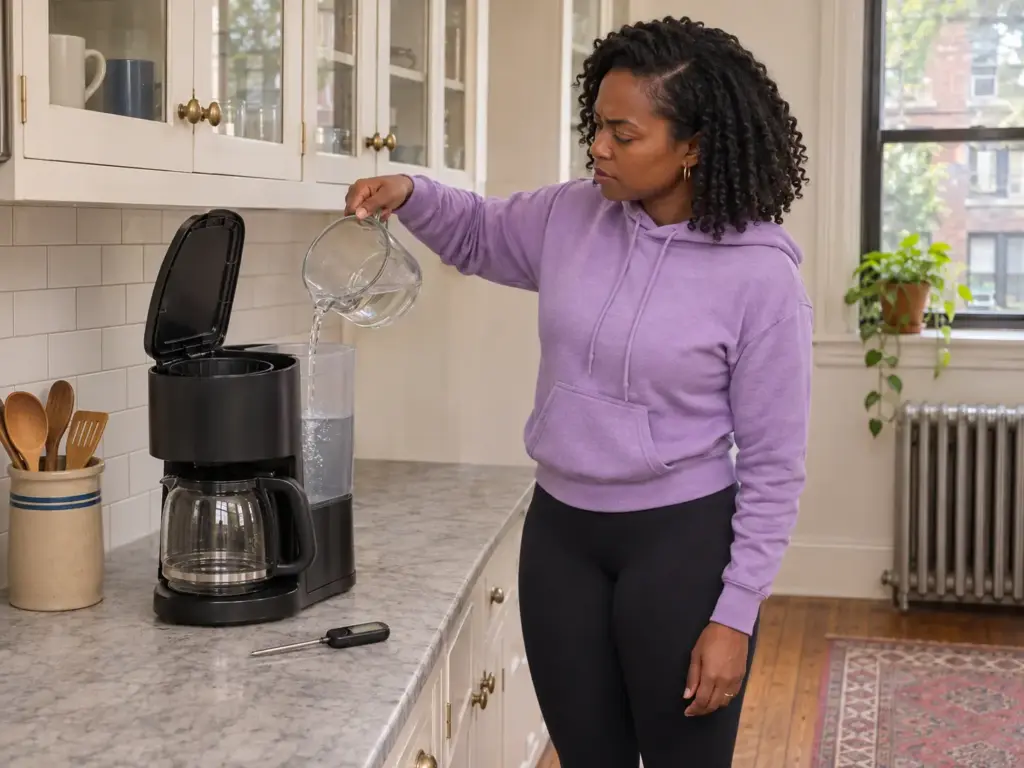
You need a digital instant-read thermometer and a water-only cycle: no coffee in the basket, nothing to taste.
The procedure follows Breville’s support page. Run four cups of water through the machine and discard it, since that first cycle only warms everything up. Run four cups again and, as soon as the cycle ends, hold the probe steady in the brew basket for a few seconds until the number settles. Breville runs the cycle with no carafe in place; on a machine whose carafe has to sit under the spout, leave it there and still take the reading from the basket.
Measure the water, not the coffee. The coffee that reaches the pot answers a different question and reads lower: the same page expects the water standing in the basket at 180–190°F (82–88°C) and the coffee in the carafe at 160–190°F (71–88°C). A cold mug or carafe pulls heat out of the brew too, so warm both with hot water before you judge the machine. And run the test twice, because the first cycle of the day goes through a cold reservoir and a cold machine, and it reads cool for that reason alone.
Reading the Number
Read the basket against four marks.
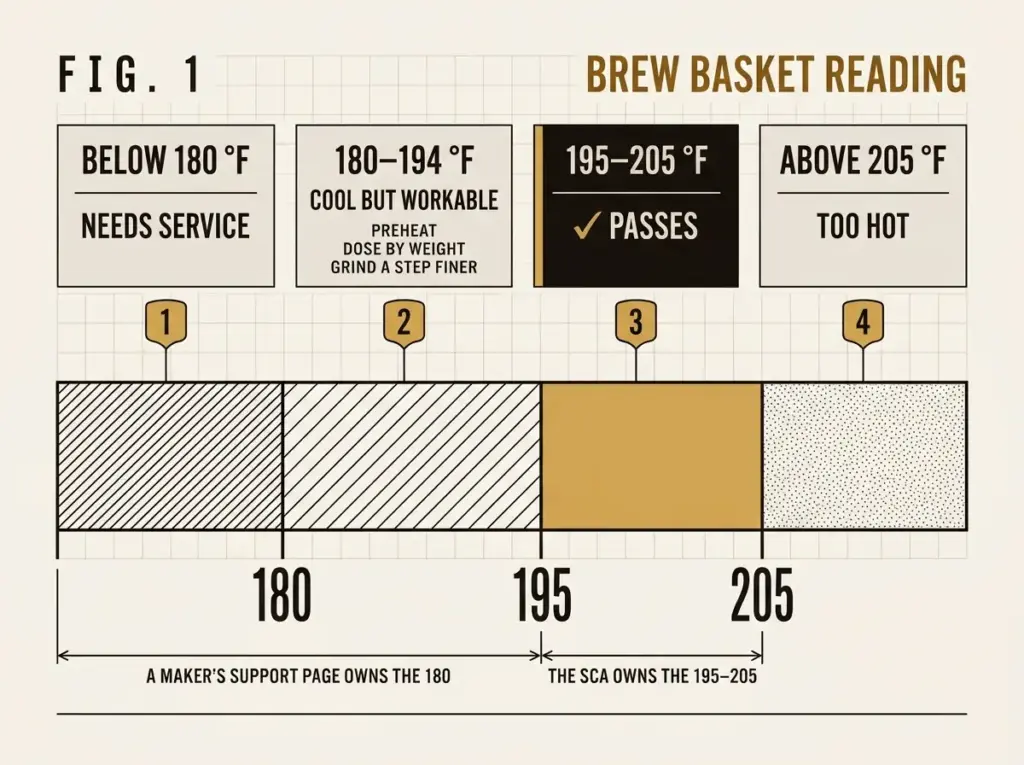
Under about 180°F (82°C) is a maker’s floor: Breville’s page treats a machine that keeps reading there as one that needs service. From 180 to 194°F (82–90°C) the machine runs cool but is workable with the changes later in this guide. From 195 to 205°F (90–96°C) it passes the SCA’s band, the same 195 to 205°F the SCA standard names. Above 205°F (96°C) the water is past the SCA’s ceiling.
Two owners stand behind those marks, a maker’s support page for the 180 and the SCA for the 195–205, and a machine that reads 185°F has passed one and failed the other.
What to do with the reading comes in an order too, free first, with a taste between steps. A cool reading is a reason to preheat and to grind finer long before it is a reason to shop, and the first of those steps is the dose, which how to use a drip machine in grams, not scoops shows how to set.
Keep in mind what a thermometer is. It is a cheap stand-in for the SCA’s measurement, which times the first minute of the brew, and a probe held in the basket gives a spot reading. It tells you whether the water gets there and where it ends up, though it cannot tell you whether it got there inside the minute. The number climbs through the cycle, so the late reading is the one that counts, and if the late reading still sits under the band the machine has nothing more to give.
Run the test twice on different days, once with the reservoir filled from the cold tap and once with water warmed in a kettle. The gap between the two numbers shows how much of your machine’s heat comes from the machine and how much from the water you hand it, and it tells you in advance what preheating will buy.
A Machine Missing From the SCA’s List
If your machine is absent from the SCA’s list, that tells you less than it seems. According to the SCA’s list of certified home brewers, “SCA Certified Home Brewers are coffee makers that meet SCA’s rigorous standards for brewing quality, consistency, and performance.” Certification is a paid program that makers choose to enter, so a cheap machine that is missing may simply never have been submitted, and the list itself includes budget-minded compact machines, which settles that cheap and certified can sit in one box. A missing badge is not a failed test.
The thermometer is the test.
The Last Mug Is Where a Cheap Maker Gives Itself Away
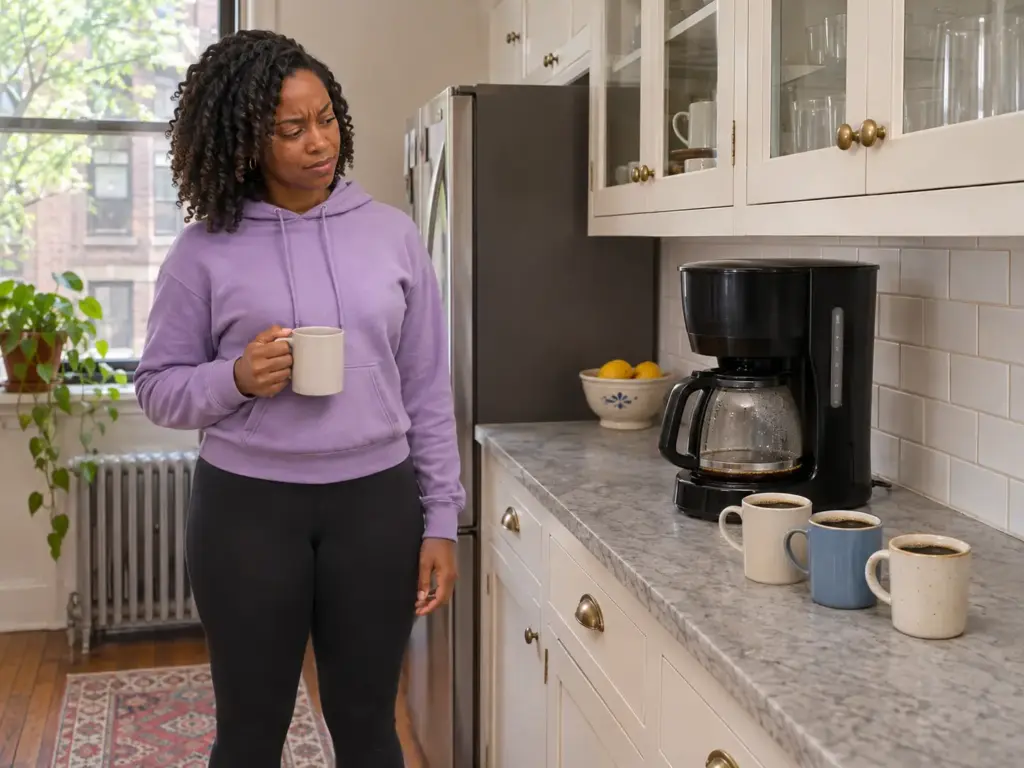
The box counts cups and you pour mugs, and the distance between the two is where the second and third mug of a pot go thin. After that, the plate under the carafe decides what the pot turns into during the second hour.
The Pot Is Smaller Than the Box Says
A drip machine’s cup is 4 to 6 ounces, not 8, so a 12-cup box holds about 60 ounces, roughly six mugs (Wirecutter counts twelve 5-ounce servings, about six standard mugs).
The compact 5-cup holds a little under 23 ounces: five small cups of about 4.5 ounces. The SCA tests from 55 grams of coffee per liter of water, which works out to 1.63 grams per ounce of water. That is about 98 grams for a full 60-ounce pot and about 8 grams for one 5-ounce cup. In kitchen terms Wirecutter puts a level tablespoon of ground coffee at roughly 7 grams, so the full pot is close to fourteen tablespoons, and the scoop on the lid measures neither.
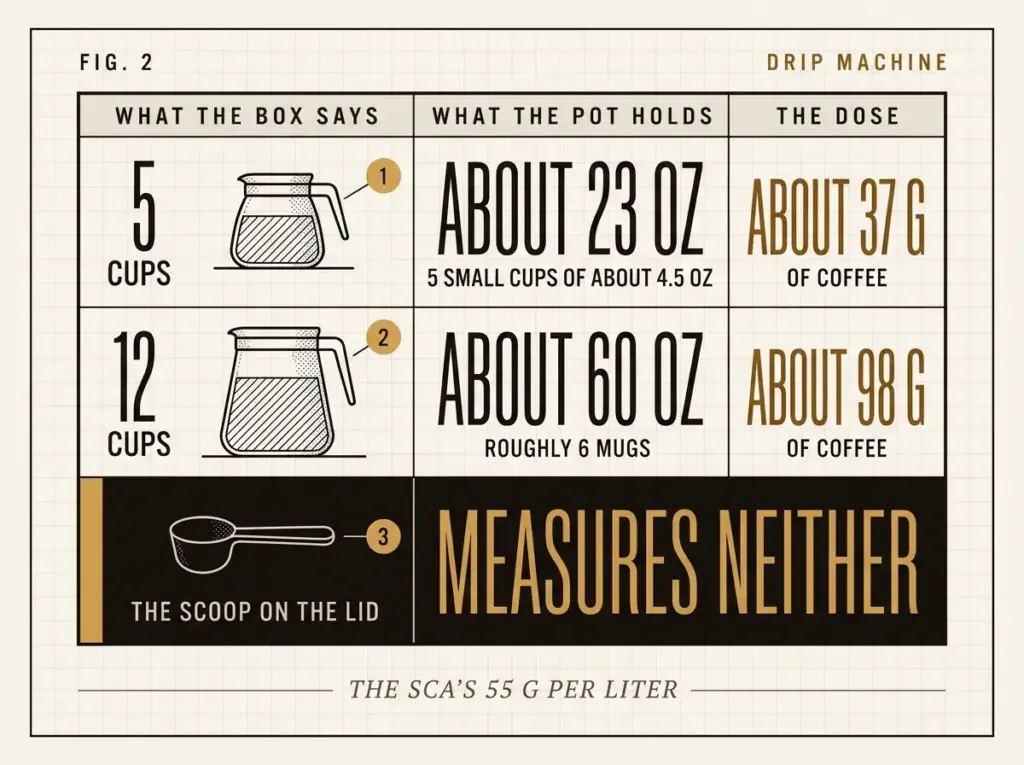
Run that arithmetic once for your machine and the tablespoon count stops being a guess. For the water half of the sum, how much water a drip machine’s cup really is lays out the 4-to-6-ounce cup in full.
Why the First Water Is the Coolest
Two things change between the first mug and the last, and they compound. The pot itself is uneven: inside a cheap brewer the heating element sends water up a tube that runs through the cold reservoir, so the first water of the pot is the coolest and the last is the hottest, and the grounds are more extracted by the end than at the start. And the last mug has stood in the carafe the longest.
So taste the third mug of a 12-cup pot from a machine that runs cool, and what you meet is flat and sharp at once: the early water under-extracted part of the coffee, and an hour of standing took care of the rest. The real test of a cheap maker is its last mug, because that mug carries both the brew and everything that happened to it after.
What the Plate Does to the Pot
The plate is the second half of the machine, the part the keep warm function runs on, and the numbers on it are blunt. In TechGearLab’s test the Ninja CE251’s plate let the coffee lose 10°F over an hour. In Serious Eats’ two-hour test the Cuisinart Brew Central failed to hold its coffee at a consistent temperature.
On the other side, TechGearLab found a BLACK+DECKER 5-cup’s plate raising already-brewed coffee from about 178°F (81°C) to 182°F (83°C) after an hour on it. That is cooking coffee that is already made, which is a different thing from holding it, and the taste goes burnt and acidic.
Wirecutter, testing the Ninja’s plate, which stays on for four hours, noted that the flavor turned a little acrid after the second hour.
The two losses need different fixes. A pot that cools wants a thermal carafe, or a mug filled inside the hour. A plate that adds heat wants the switch off. Auto shut-off times differ by model and are the maker’s to publish: the Krups holds for 30 minutes, the Ninja’s plate adjusts up to four hours, and the Cuisinart’s runs from off to four hours, so the manual is the authority on yours.
The Cuisinart DCC-1200 Brew Central 12-Cup is the full-size programmable for anyone who wants the features and will drink the pot inside the hour: a variable plate (low, medium or high), an auto-off up to four hours, 24-hour programming and a charcoal filter in the tank. The praise has its price in the same breath, though. It failed to hold a consistent temperature across a two-hour test, and units tend to give out somewhere around the one-year mark.
On a machine with no timer, an ordinary plug-in timer at the outlet does the scheduling it lacks: it switches the brewer on, not the water. And pour the whole pot into a preheated thermos the moment the cycle ends, which is the cheapest cure for a plate that cooks.
If the plate is the part of your machine you trust least, a thermal carafe instead of a warming plate takes it out of the pot’s life altogether.
Free Changes That Do More Than the Next Tier Up
Five changes cost nothing, and each one moves the cup of a machine that runs cool. They come in an order, the cheapest and likeliest first with a taste between each, and only the last one touches the machine itself.
Preheat the Water and the Mug, Then Weigh the Dose
A thin, sharp cup points at water that left the grounds too early, so heat is the first thing to give back.
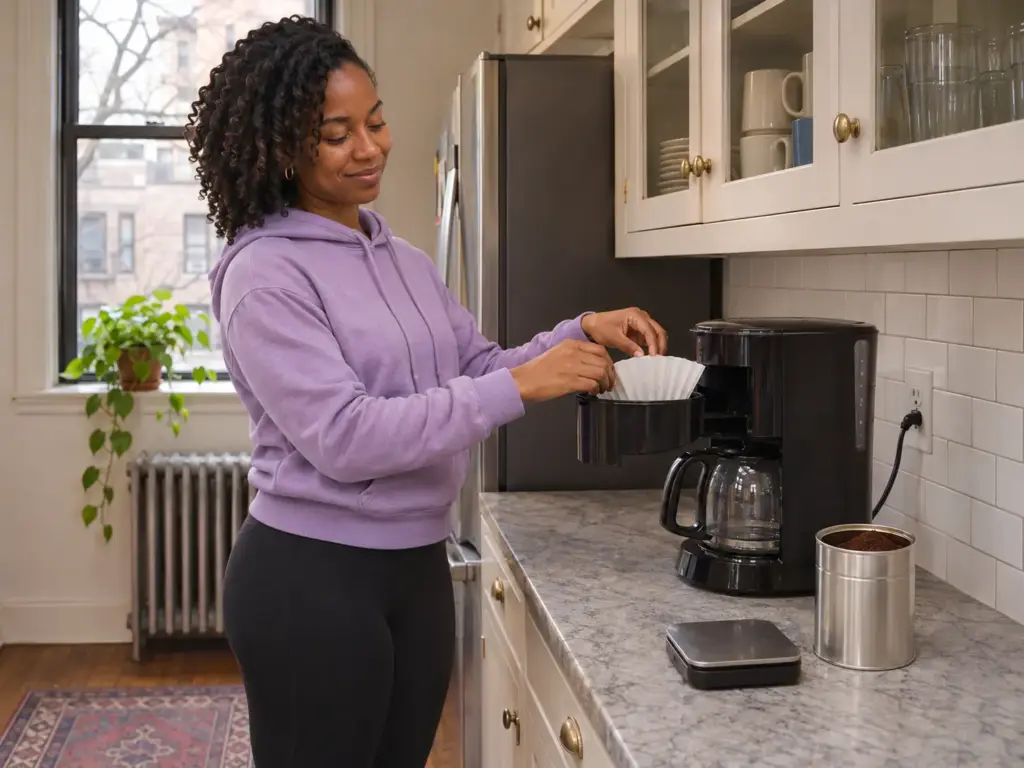
Fill the reservoir with warm water from a kettle, never from the household hot tap, because the kettle’s water is a temperature you chose and the machine only has to finish the job (it heats as it brews). Then rinse the carafe and the mug with hot water before the cycle starts. Pour, taste, and expect the first mug to lose some of its watery edge. If it tastes the same, heat was not what you were missing, and that is useful to know.
Then weigh the dose. The SCA’s starting point of 55 grams per liter is 1.63 grams per ounce of water, so a full 60-ounce pot wants about 98 grams and a 5-ounce cup about 8, while a lid scoop lands wherever it lands. A 1:16 ratio, the brew ratio of one part coffee to sixteen of water, runs stronger, near 62 grams per liter, so treat the SCA’s figure as the lighter end of the range to try.
Too little coffee gives a cup that is weak and watery with no particular direction, as against a sharp one, which points at extraction; if yours is both, fix the dose first. The next pot should be fuller and less watery. If it turns heavy and bitter at the back you passed the mark, so take away one level tablespoon (about 7 grams) and taste again.
Weigh what your scoop actually holds, three times in a row. Heaped, level and pressed hold different amounts, and the number you land on is the dose to use until a scale is on the counter. A scale changes more cups than a new machine does.
Grind a Step Finer and Use a Paper Filter
If the cup is still sharp after the dose is right, start from the setting in which grind size a drip machine wants, move one step finer from a medium grind and brew the same amount the same way. That is where the UC Davis result earns its keep: with strength and extraction held equal, tasters could not separate 87, 90 and 93°C, so grind and contact time are the lever a cool machine leaves you. The next cup should come out flatter and less sharp.
A second step finer on the same machine can overshoot into bitter, and if it does, come back half a step. (Pre-ground coffee takes this lever away, so the filter comes next.)
A paper filter in the basket takes the bitter edge off a pot brewed cool. A permanent filter, the reusable metal mesh kind, passes fines that paper holds back, and fines cloud the cup, so if your machine came with a gold-tone or mesh basket, brew one pot through paper and compare. How a paper filter and a permanent one change the pot goes through the difference in full.
The Bold Button Slows the Water, It Adds No Coffee
Press the bold button expecting a stronger cup and you get the same coffee, poured more slowly.
On the cheapest machines the setting slows the stream of water to the grounds or splits the brew, which is how the manuals describe it, and it adds no grounds. On a machine that heats as it brews, a slower flow also keeps the water in the heater longer, which is the only reason the cup might taste a little different. If you want more strength, the dose is where it comes from; if you want less sharpness, the grind is. The button does neither.
Descale, and What Not to Blame
Descale last, because scale slows the machine and cools the brew, and it is the one change that touches the machine. The manual is the authority on the method, and on any clean cycle the machine has, so this guide leaves the steps to it and says only when: once the water-only reading you took on the first day has fallen. After a descale the reading should climb back toward that first number, and the first mug of the day should lose its lukewarm edge.
Before anything else gets the blame, look at how the coffee bed ends up.
Single-hole and sprinkler showerheads, the spray head of the cheapest machines, wet the grounds unevenly: the water finds one path, so part of the dose gets washed and part stays untouched (channeling, in plain terms). Open the basket after a brew. A flat bed means the water wetted evenly, and a dipped one means it did not. On the cheapest 12-cup machines the basket’s solid plastic bottom pools water and never drains the last of it, so the grounds sit in water instead of being rinsed through, which muddies a cup that was brewed hot enough.
A bloom, the quick wetting of the bed before the main flow, is something a pre-infusion machine does for you and a plain one does not; stirring the bed is something this guide leaves out.
And a bag of whole bean medium roast with a roast date on it is the usual suspect on the wrong list, because new beans will not repair a machine that never reaches the band.
What Breaks First, and Why Spare Parts Decide the Lifespan
The question under the question is how long a cheap machine lasts, and the useful answer is two clocks that run separately: how long the machine is covered, and whether the part that fails first can be bought at all.
The Failure Order
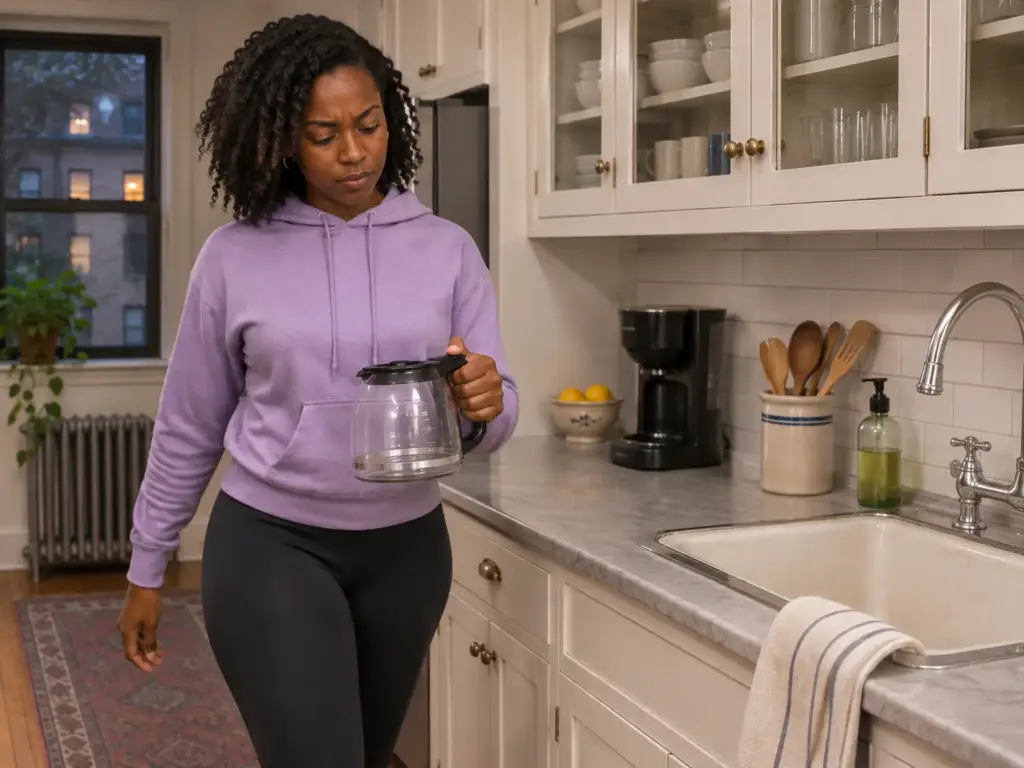
A bottom-tier machine fails in a recognizable order: the carafe lid first, a piece of thin plastic, then the glass, then the plate’s coating, then the switch, then the gasket. On the cheapest models the first failures show between the third and fifth month, and the pot cracks around year two. Another pattern is the machine that works well for a while and then stops, somewhere near the two-year mark.
The warning is usually a sound or a smell before it is a failure: a lid that no longer clicks, a plate that smells of hot plastic, a carafe that drips down the spout. Any of those means the first clock has already started.
Two Clocks, Not One
The first clock is the warranty, and it is whatever the maker publishes. Ninja gives one year on labor and parts. Krups gives two years on the machine and one on accessories and spare parts.
Mr. Coffee gives one year, and replaces a discontinued unit with a comparable model, which is a different promise from a carafe that fits the machine you already own.
Each warranty page and manual is the place to read what that cover includes.
The second clock is parts availability, and it starts whenever the model is dropped. Ninja runs an accessories site that sells replacement parts, which is where a carafe comes from once the machine is out of cover. A machine discontinued within a year leaves people hunting for a carafe that fits, measuring and trying pots from other machines, and a brand that goes out of business leaves none at all.
The Rule That Follows
Look for replaceable parts: check that the carafe and the reservoir are sold as separate parts before paying, because the day the carafe goes is the day the machine is over otherwise. A machine whose carafe can be replaced outlives one whose carafe cannot, whatever the warranty term says.
Type the model number plus the words replacement carafe into a store search while the machine is still in the cart. If the exact carafe shows up for sale by itself, the second clock is on your side. If you only see whole machines, or pots from other models, you are buying a machine that ends when its carafe does.
The same rule applies across makers, and which brands still sell their parts years later takes it from one machine to the whole shelf.
The Makers Worth Naming, and When Cheap Is the Wrong Answer
The machines that pass share one trait, a measured number at or near the band, so each one below is named for the cup it makes, with its flaw in the same paragraph as the praise. The second half of the section covers the cup this whole tier cannot make.
The Full-Size One That Reaches the Band
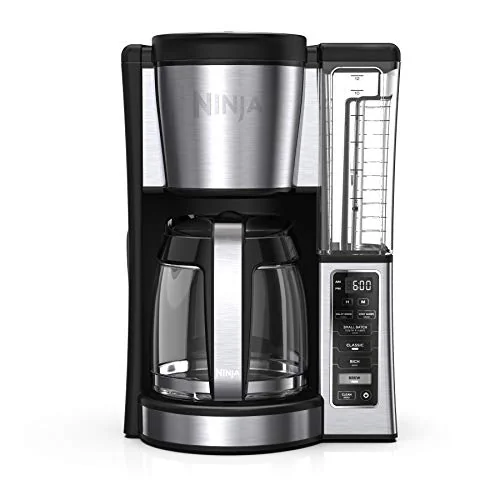
The Ninja 12-Cup Programmable CE251 is the cheap machine that crosses the line, and it is the honest yes to the question in the title. TechGearLab measured an average maximum of 202.5°F (94.7°C) in the basket, with a showerhead that spreads the water and a pre-infusion step that wets the bed before the main flow. It has Classic and Rich brew programs, a small-batch setting for one to four cups and a 24-hour delay start.
The trade shows after the brew. The plate runs cool, and the pot lost 10°F in an hour in TechGearLab’s test. The machine is slow too, 7 minutes 48 seconds for six cups, so the second pot of the morning means waiting. Serious Eats found the cup leaned slightly bitter next to the Zojirushi machines it tested, which is the sound of a very hot brew with a long contact time.
The Compact One That Is Hot
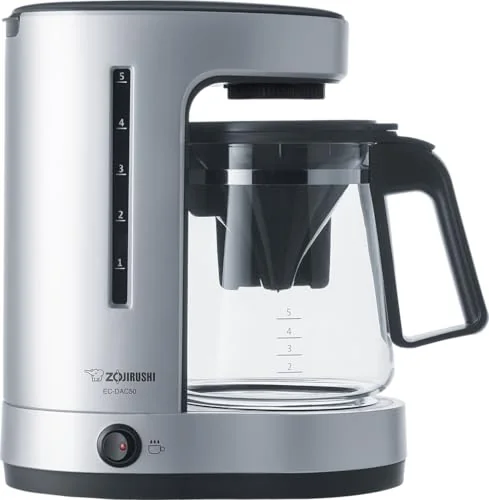
When two mugs are the whole pot, the Zojirushi ZUTTO EC-DAC50SZ shows that small and plain does not mean cool, which suits a small kitchen’s counter too. It reached 199°F (93°C) in Serious Eats’ test, one of only four machines out of nine to pass 195°F, and its filter sits in the carafe so the bed wets the way a pour-over’s does. The water path is short, which is why compact machines like this one hold their reading. It holds just under 23 ounces, five cups of about 4.5 ounces, with a removable tank and no PFAS where the machine touches the food.
The compromise is that there is no timer and no auto shut-off, so the plate keeps cooking the pot until somebody switches it off. Pour the coffee out as the cycle finishes. The cost of small shows on the second pot, because a 5-cup carafe has to be filled again for two mugs of company.
The One-Button Machine, and What One Button Costs
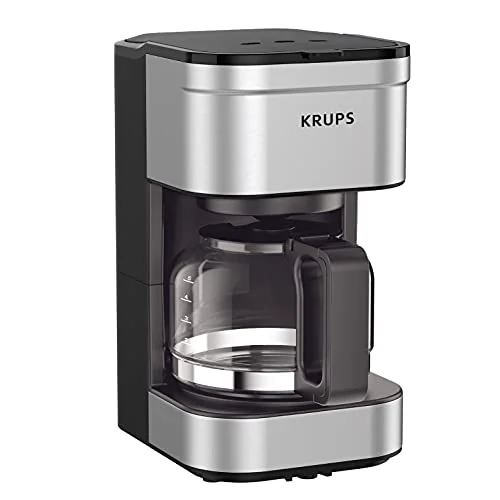
The KRUPS Simply Brew Compact 5 Cup is the simplest machine here: one switch, a top-fill tank, a pause-and-serve spout and a 30-minute hold, built for somebody who wants a mug of coffee and no routine around it. Krups backs it with two years on the machine and one on accessories and spare parts.
The permanent mesh filter passes fines into the cup, and the plate quits after 30 minutes, which is a different loss from the Zojirushi’s, since this one cools while that one cooks. Two small habits cover both: a paper filter in the basket and a mug warmed with hot water first.
When Cheap Is the Wrong Answer
A light roast drunk black is the cup this tier struggles to make. It needs the top of the band, and the weaker machines in the tests above land anywhere between the low 160s and the mid 180s°F. For that cup, the answer that costs less than a mid-tier drip machine is a cone dripper and a kettle, or a French press. Both give you control of the temperature and a bed you can clean out completely, which no drip machine can promise.
The skip rule fits in a sentence: a machine with no independent temperature test and no replaceable carafe stays on the shelf, and the BLACK+DECKER 12-cup above is the example. If it is a whole kitchen’s worth of money you are weighing, what a whole budget kitchen covers beyond the machine puts the machine in its place among the grinder, the scale and the kettle.
The Reading That Answers the Question, and the Pot to Brew Tomorrow
A cheap machine is good when the water reaches the band and holds it, and the sticker decides none of that. One water-only cycle with a thermometer tells you what you own before you spend anything. The last mug of the pot is where a cool machine shows itself, and preheating, weighing the dose, grinding a step finer and adding a paper filter, in that order, move the cup before any purchase. The lifespan is two clocks: the term of the cover, and whether the carafe can be bought alone.
After the first descale, take the basket reading again, and notice whether the lid still seats and whether the last mug of the pot still tastes like the first. A reading that has fallen or a last mug that has gone thin is the machine’s first sign, long before it fails outright.
Tomorrow, fill the reservoir with warm kettle water, run the water-only cycle with the thermometer in the basket, and write the late reading down. If it lands in the band, the machine was never the problem, and the dose is the question to settle. If it does not, grind a step finer, put a paper filter in the basket, and taste the last mug of the pot, not the first. From there the decision is which kind of maker fits the mugs you actually pour, then which single upgrade moves the cup most, and then the burr grinder that feeds the machine.
Frequently Asked Questions
01Are cheap coffee makers any good?
Some are, because a cheap coffee maker is good when the water in the brew basket reaches 195°F (90°C) and stays near it, whatever the price. A thermometer and one water-only cycle tell you which kind you own.
02How long does a cheap drip coffee maker last?
There is no single number of years, because two clocks run apart: how long the maker covers the machine, and whether the carafe and reservoir are sold alone. The carafe usually goes first, and without a spare on sale the machine ends with it.
03Are home espresso machines worth it?
Only if you will make espresso drinks often enough to use one, because it sets a temperature and a pressure that a drip machine cannot. A good drip cup is far cheaper to reach, so test the drip machine you own first.
04What is the 80/20 rule for coffee?
It is a rule of thumb, not a measurement: the beans, the grind, the dose and the water decide most of the cup, and the machine’s job is to deliver that water hot enough. On a cheap machine, the free changes come first.
05Should I throw away my Keurig?
Not if you like the cup it makes: a pod machine is a different tool with different limits. If you want more control over the cup, a drip machine and the one-brew test above are the next step.



How did your cup turn out?
No comments yet. Tell us what you changed — and whether the needle moved.