
We may earn a commission when you buy through links on this page. It never changes what we recommend. How we pick
On this page11 parts
- What the Extra Money Pays For, and What It Doesn't
- Heat That Is Still There at the Last Pour
- An Even Bed, a Bloom, and What the SCA Badge Leaves Out
- The Dials You Will Actually Turn
- When the Price Is Automation, Not Coffee
- Espresso: What PID, Dual Boilers and 9 Bar Add
- What the Premium Costs in Year Three
- When the Cheap Machine Is the Right Machine
- Spend in This Order, and What to Do When the Budget Isn't There
- The Question to Ask Before Paying More
- Frequently Asked Questions
The sticker on the premium box says thermal, programmable, bean-to-cup, and you are standing at your own counter with a maker that still works, a blade grinder that does the damage before the water arrives, and a cart open on a second screen.
So, are expensive coffee makers worth it? A maker controls three things: how hot the water is from the first pour to the last, how evenly it wets the grounds, and how many years it keeps working. Everything else printed on the box is convenience. This guide sorts the price in that order and ends on what to spend first, starting from the order to buy coffee equipment in.
Quick Answer
An expensive maker is worth it only when the money buys three things: water that holds 194–205 °F (90–96 °C) from the first pour to the last, an even bed with a bloom, and parts on sale in year three. Spent on presets or a badge, the same money does less than a burr grinder and fresh beans.
What the Extra Money Pays For, and What It Doesn’t
A price tag is a bundle of unrelated things, and only a few of them ever reach the mug. The rest changes the counter: the finish, the touchscreen, the app, the name stamped on the lid.
Three Things a Cheap Maker Cannot Do
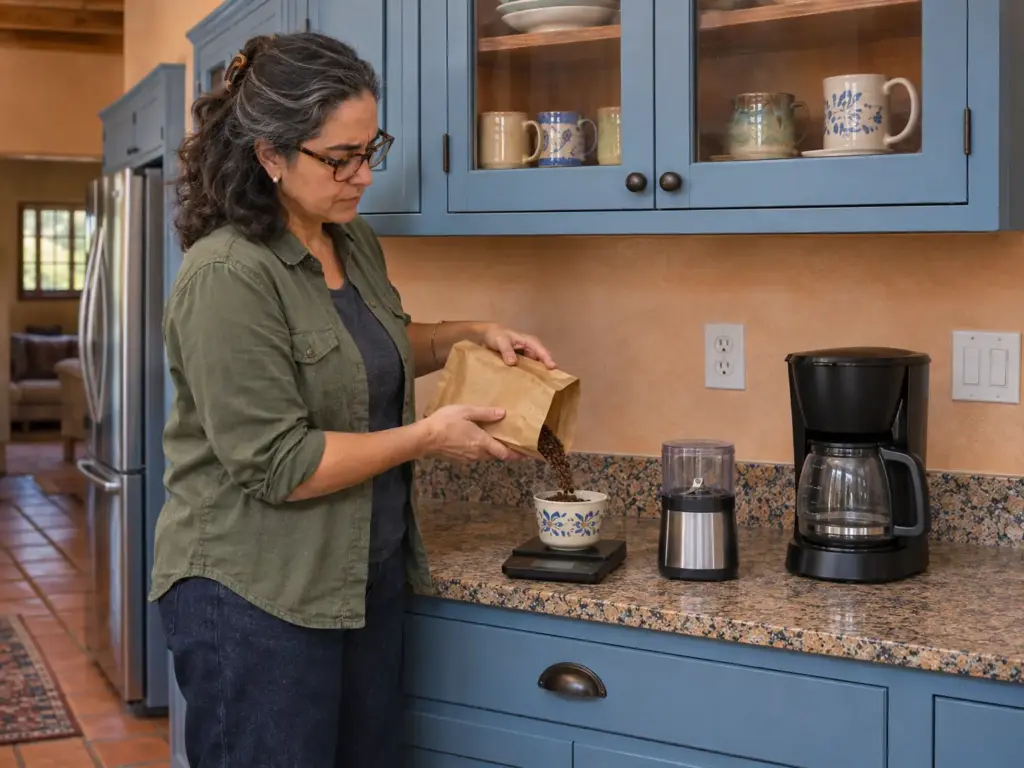
The verdict is conditional, and it is yes in exactly three places: heat still in range at the last pour, a showerhead that wets the whole bed and lets it bloom, and a gasket, carafe and showerhead that are still sold in year three, so a worn seal costs you a part instead of the machine.
Everything outside those three is a purchase. The gains are steepest between a machine that cannot hold its heat and one that can; past that point the price-versus-performance curve flattens, with diminishing returns, and the extra money mostly buys convenience and finish. A badge on the box says the water was hot and the bed even. It never tasted the cup, and the same machine still pours a thin first mug if the water in the reservoir starts cold.
Three Things the Money Does Not Touch
The grinder, the beans and the water are decided before the maker sees them. A blade grinder cuts boulders and dust at once, so the cup comes out sour and bitter together whatever sits under the funnel, and a bag past its roast date gives the same flat result in a premium brewer as in a cheap one. Picture the new machine arriving, the same supermarket beans going in, the blade grinder still on the counter, and the first sip tasting like the old cup. Before spending anywhere, decide which kind of maker fits the mugs you actually pour, because a drip coffee maker, a single-serve pod machine and a pour-over cone answer different mornings.
Heat That Is Still There at the Last Pour
What a premium brewer can sell first is a pot that stays in range from the first drop to the last. The number has an owner, and a cheap machine can fall out of it in two opposite directions.
The Band, and Who Owns the Number
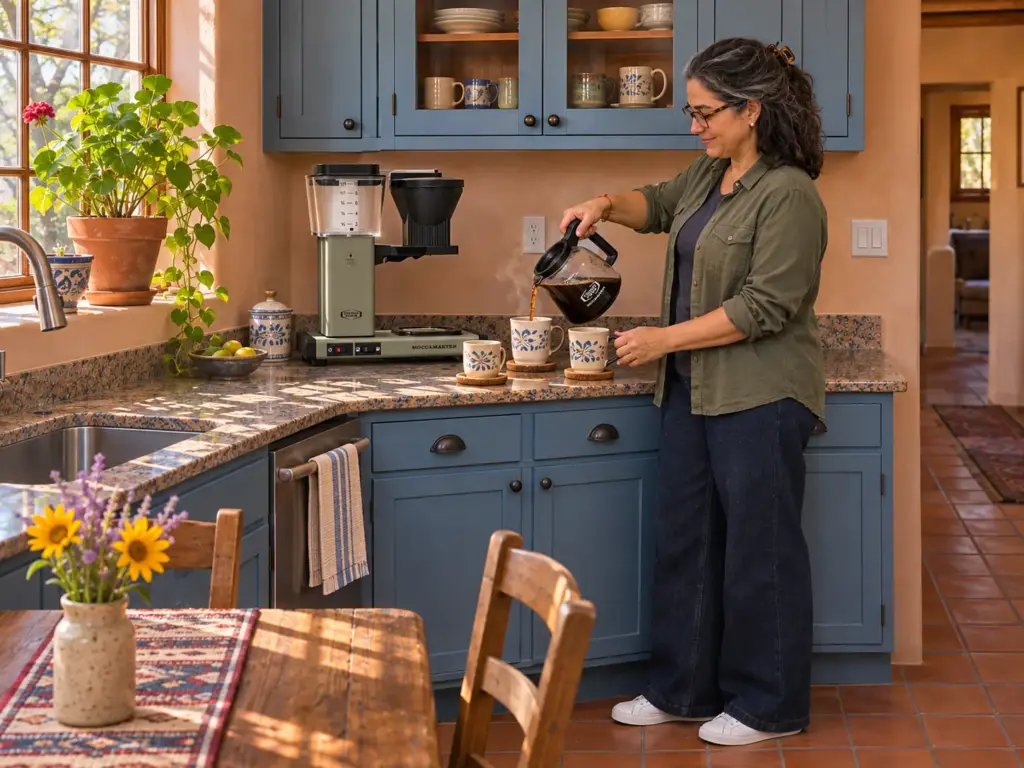
The Specialty Coffee Association’s Standard 310-2021 for home brewers asks for the slurry, the mix of water and grounds in the basket, to reach 90–96 °C (194–205 °F) by the time 33 percent of the water has been sprayed, and to stay inside that range for the rest of the cycle. The band is usually quoted as 195–205 °F; the standard starts a degree lower, at 194 °F.
The word that carries the weight is stay. A machine can touch 200 °F early and sit well under the range by the end of the pot, and that lack of temperature stability is where a cheap machine loses to a good one. Sorting machines by that number is how you get to a drip machine picked by its water temperature.
Why a Cheap Machine Starts Cool and Ends Hot
A first mug that tastes thin and sharp points to water that left the grounds too early; a last mug that tastes scorched points the other way. The mechanism is the thermosiphon: in many cheap drip machines the feed tube runs up through the cold reservoir, so the first water is cooled by the water around it, and the last water has the whole pot’s heat behind it. The average reads as a bad bean, when the water path was the variable. The free fix is warming that path before the real brew.
Run half a carafe of plain water through the empty machine and pour it out, then brew the coffee straight after. The warmed tube, brew basket and pot stop pulling heat out of the first pour. Taste the first mug against the second: the pinched sharpness on the first should fade. If the last mug turns harsh instead, the pot sat on the plate too long.
What a Held Band Does for the Cup
A held band does not make 203 °F taste better than 199 °F. In the UC Davis study on brew temperature and taste, Batali, Ristenpart and Guinard brewed drip coffee at 87, 90 and 93 °C (189, 194 and 199 °F) and reported that “Although the TDS and PE both significantly affected the sensory profile of the coffee, surprisingly the brew temperature had no appreciable impact.” TDS is the strength of the cup and PE is the extraction yield. With those two held equal, the panel could not tell the temperatures apart.
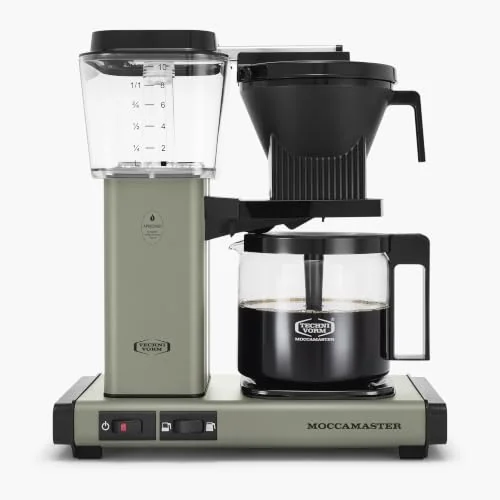
So the band matters for how fast the water extracts. A machine that runs cool under-extracts and tastes sour; a machine that reaches the band lets you fix the dose and the grind and get the cup you aimed at. The Technivorm Moccamaster is the batch brewer built around that idea: a copper heating element, no pump, a full 40 oz (1.25 L) pot in 4 to 6 minutes and a model on the SCA list. The plastic parts feel thin next to the copper inside, and a machine with one switch and no dials is a lot to spend on if you wanted something to adjust.
For a reader who already has this machine in mind, the same worth-it question for one machine from four cups gets a one-machine verdict.
An Even Bed, a Bloom, and What the SCA Badge Leaves Out
Hot water is half the job; the other half is how the showerhead lays it on the grounds, and this is where a badge on the box begins to mislead. A machine can carry the SCA name and still pour a sharp cup.
Why a Cheap Showerhead Channels
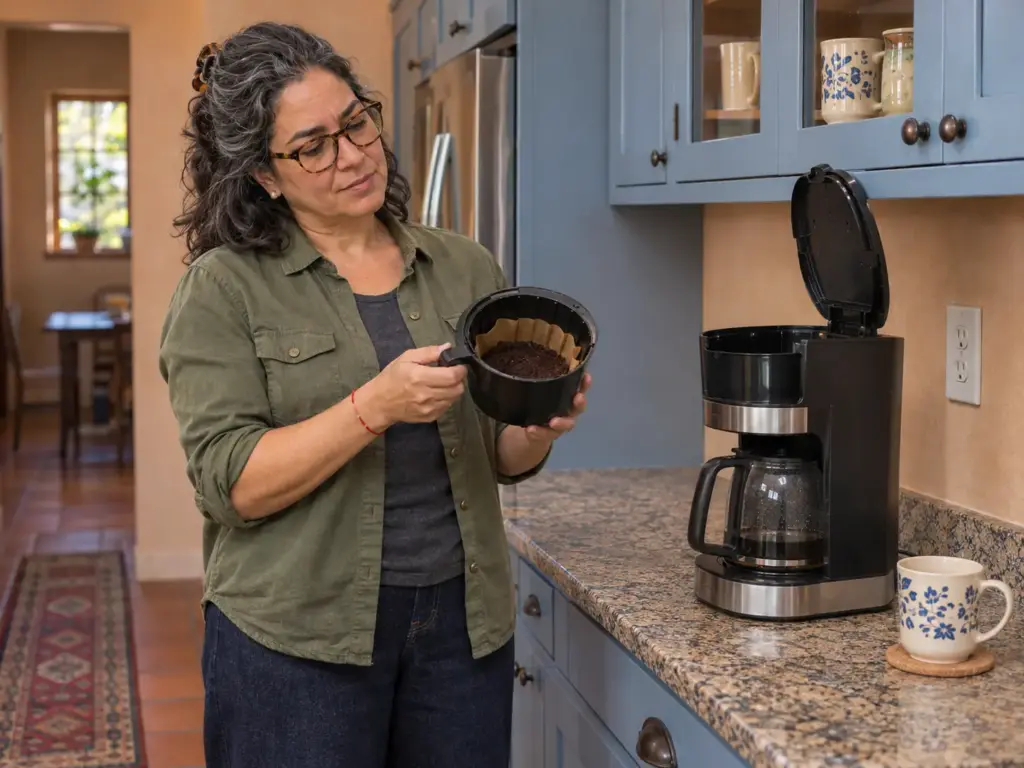
When water runs through a few channels in the bed of grounds, the grounds along those channels over-extract while the rest barely get wet, and the cup comes out sour and bitter at once. A wide, even showerhead and a bloom reduce the channels, because the first small wetting lets gas escape from the grounds before the main pour pushes through. A worn showerhead stops doing that evenly: the bed rises in one patch and the water pools somewhere else. The split between which drip features change the cup and which are decoration follows this same heat-and-bed test.
After a brew, lift the basket and read the spent bed. A flat, evenly dark puck says the water spread; a crater in the middle with dry grounds up the walls says it took a shortcut. If the cup was also sour and bitter together, suspect the showerhead and the grinder before the beans.
What the Certification Tests and What It Skips
The standard tests how hot the slurry gets and how long it stays there, and it rates the uniformity of extraction on a scale where 100 is perfectly even, with 60 or above required, measured from the solubles left in the outside, middle and inside of the spent bed. It also tests how long a heated carafe holds: 80–85 °C (176–185 °F) for the first 30 minutes and never above 185 °F. And the manual has to state a grind, the SCA’s 55 grams of coffee per liter of water, a filter type and cleaning instructions.
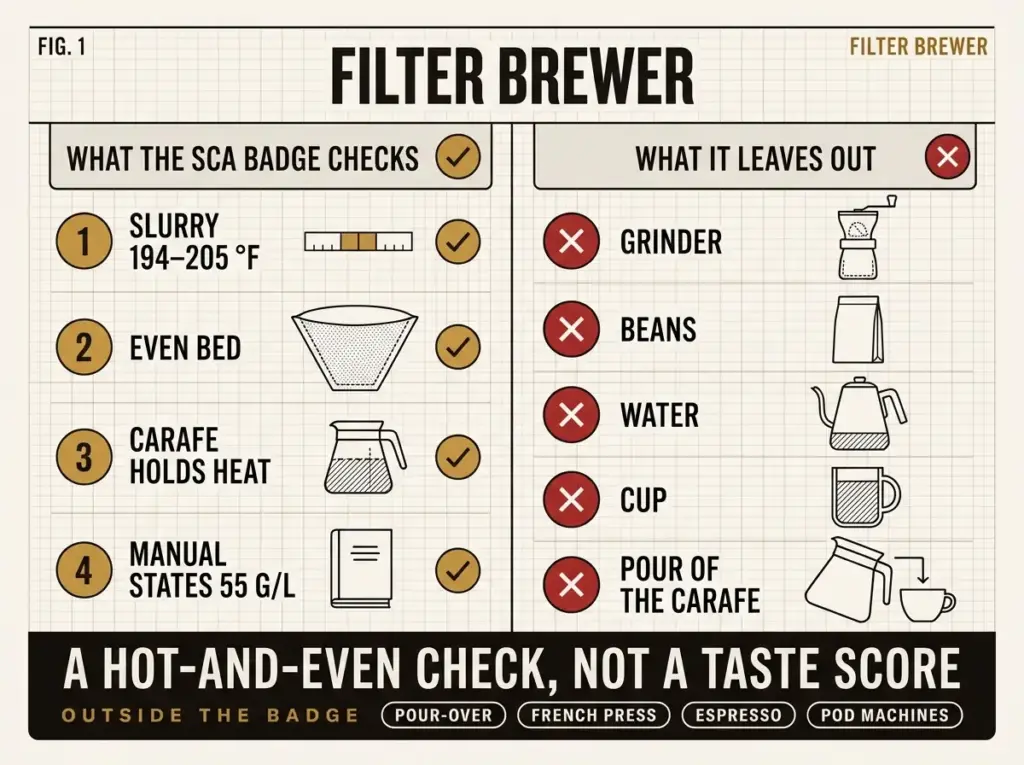
What it leaves out is most of the cup: the grinder, the beans, the water, the taste, how the carafe pours. It covers filter brewers only, so manual pour-over, French press, home espresso, pressurized and pod brewers sit outside it.
The list follows the model, not the brand and not the price. According to the SCA’s own certified home brewer program, “SCA Certified Home Brewers are coffee makers that meet SCA’s rigorous standards for brewing quality, consistency, and performance.” A budget model and a Moccamaster can both sit on that list, so the badge alone never settles whether a machine is worth it.
The Dials You Will Actually Turn
After heat and bed, the only premium a tinkerer can taste is a dial that moves a variable the cup depends on. A cheap machine locks one water curve; a pricier one lets you move temperature, bloom, flow or dose and read the result.
The Ten-Second Self-Test
Ask what you have already changed on the machine you own. If the answer is never the grind size and never the dose, no dial will matter, because you would not turn it. If you have moved the grind, weighed the coffee and want the next variable, then temperature or bloom is the premium that can reach the cup, and you can move them one at a time and taste between. A dial that never gets turned is the least useful premium on the shelf.
Which Machine Gives You Which Dial
A cheap machine lets you change the beans, the grind and the dose and nothing else. A premium one adds variables, and each one has a flaw hiding next to it. The table below shows what each of four machines lets you move and what stays locked.
| Machine | What you can move | What stays locked |
|---|---|---|
| Cuisinart DCC-3200 | Brew strength, a 1 to 4 cup setting, warming plate level | Brew temperature and bloom |
| Moccamaster KBGV Select | A half-or-full carafe selector | Temperature, bloom, flow |
| Breville Luxe Brewer Thermal | Brew temperature, bloom volume, bloom time, flow rate | Very little, which is the flaw: the menu is long |
| Café Specialty Grind and Brew | Six grind settings, one mug to ten cups | The dose, because there is no gram dial |
The Breville BDC465BSS Luxe Brewer Thermal is the one that can answer it. Its brew temperature, bloom volume, bloom time and flow rate can each be moved separately, and it adds a cold-brew preset, a dual-wall carafe that holds above 150 °F for up to 4 hours and a 24-hour timer. That is the premium a tinkering drinker can taste, and the only one in this group.
The Flaw of the Dial Machine
The showerhead and its retaining ring on the Luxe work loose and pop off under the lid, units have stopped inside two months, and the preset menu is more complicated than most mornings need. A machine that is all dials, and what its second month looks like is the extreme case of the same argument.
When the Price Is Automation, Not Coffee
Much of what a high price pays for is the machine doing a chore: grinding, dosing, timing, reporting to an app. That is a real purchase, and it leaves heat and bed exactly where they were.
What a Built-In Grinder Takes Off Your Counter
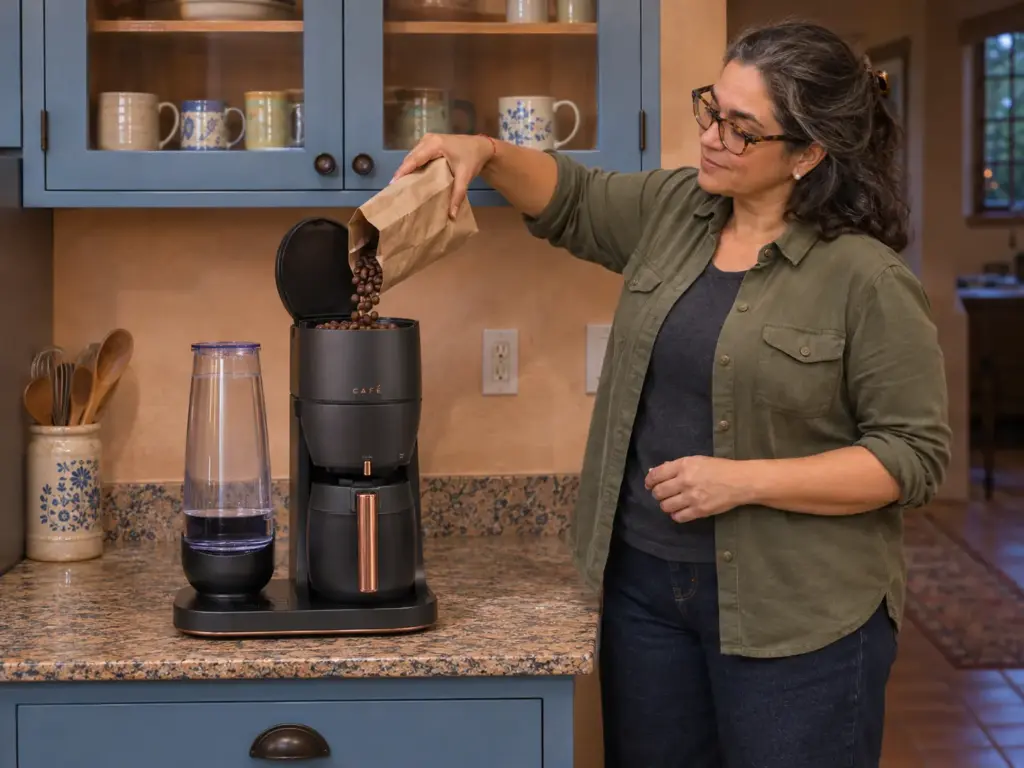
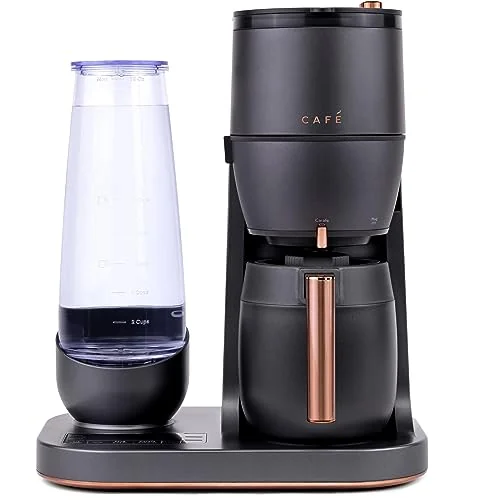
Automation is a legitimate buy when the chore is the problem: a weekday pot that has to be ready when the alarm goes. The all-in-one takes a grinder off the counter and a step out of the routine, and it takes your hand off the dose at the same time. The grinder, the scoop and the app do nothing about the heat or the bed.
The Weak Link Is Usually the Grinder
The Café Specialty Grind and Brew puts a burr grinder with six settings, a removable 75 oz reservoir, SCA certification (2023) and WiFi control through SmartHQ in one thermal-carafe box that brews from one mug to ten cups. In an all-in-one the grinder is the component that quits, and it also sets the cup. When it stops, the owner runs pre-ground through a machine that was paid extra to grind. Cleaning the grinder path is a chore, the unit has leaked water, and at about 20 lb and 17.5 in tall it is a lot of machine for under a cabinet.
A Cheap Maker Plus a Good Grinder
The comparison that decides most carts is a plain maker plus a separate burr grinder against an expensive all-in-one. For the cup, the pair usually wins, because the grinder changes more of the taste than the maker does, and a separate grinder can be replaced when it dies without throwing out the brewer. The all-in-one wins on the chore, and carries its own flaws: the counter footprint, presets that never change, an app that can stop receiving updates, a proprietary part only one maker sells. If the grinder is the question, built-in grinder, blade or burr, and what each one costs the cup goes through it model by model.
Espresso: What PID, Dual Boilers and 9 Bar Add
An espresso machine is where a price gap looks widest and the numbers on the box mean the least.
What PID and a Dual Boiler Change
A single-boiler machine cannot brew and steam at the same time. A heat exchanger can: one boiler with a tube running through it, heating the brew water as it passes, so it needs a short cooling flush before the shot. A dual boiler keeps a brew boiler held by a PID controller, the thing that holds temperature steady, to within about 1 °C, as makers such as ECM describe it, with a separate steam boiler beside it. So a dual boiler is not the only way to brew and steam at once; a heat exchanger does it for less.
What the money buys here is repeatability, two numbers you set, and it does nothing for the bean. It also buys a warm-up of about 15 to 25 minutes on home models, two descale cycles and more parts to fail. The flaws of the class: a steam wand stronger than most home milk skills, a footprint that takes a corner of the counter, and a grinder it still needs.
Nine Bar Is a Convention
The Italian Espresso National Institute defines certified Italian espresso at 9 ± 1 bar, 88 ± 2 °C (190 ± 4 °F) at the group outlet, 25 ± 5 seconds and 25 ml in the cup. The 9 bar is inherited from the 1961 Faema E61 pump, and it is a convention the industry converged on, not a published optimum. The 15 or 18 bar printed on a box is the pump’s ceiling; the pressure at the coffee is set by the resistance of the puck. A bigger number on the panel is not worth extra money.
The Stovetop Answer to the Espresso Question
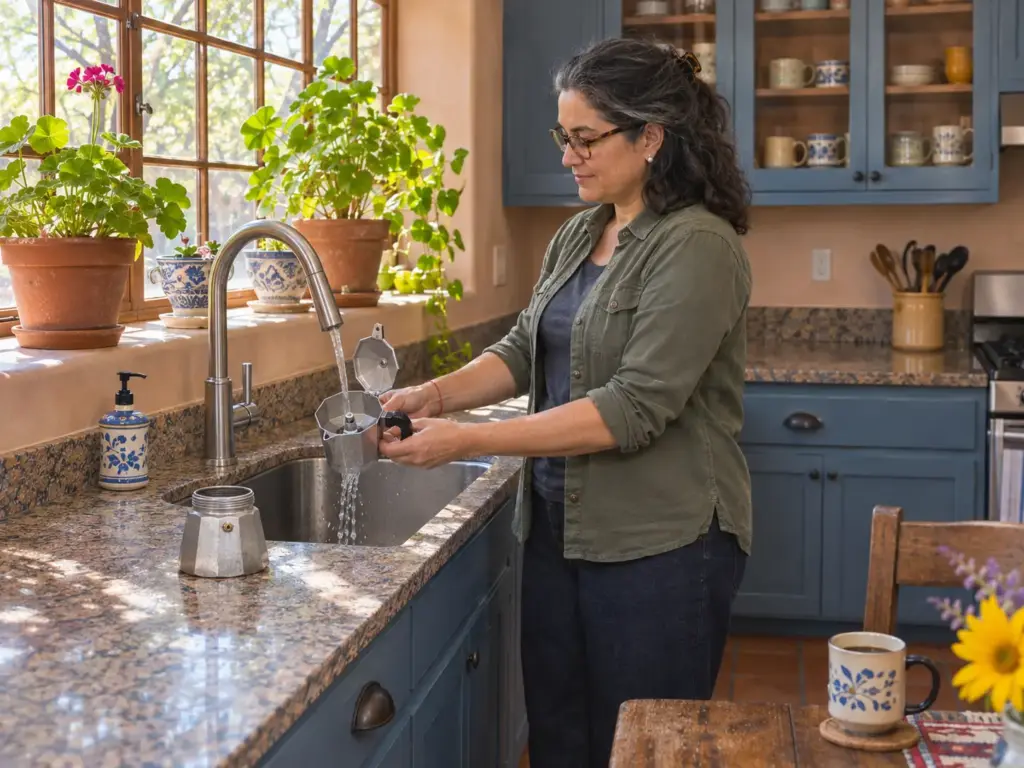
If what you want is strong coffee, a small, concentrated brew with the weight of espresso, the cheapest honest answer has no pump, no PID and no boiler to descale. The Bialetti Moka Express in the 6-cup size is a stovetop moka pot with a patented safety valve; it works on gas, electric and induction with an adapter plate. That is stovetop pressure, not 9 bar. The aluminum pot breaks for some units within about five months, and it is hand-wash only, no detergent and no dishwasher.
What the Premium Costs in Year Three
The real price of a machine is what it costs when a part gives out, and a long-life promise on the box is only as good as the shelf of spare parts behind it.
A Ten-Year Machine Discontinued in Year Three
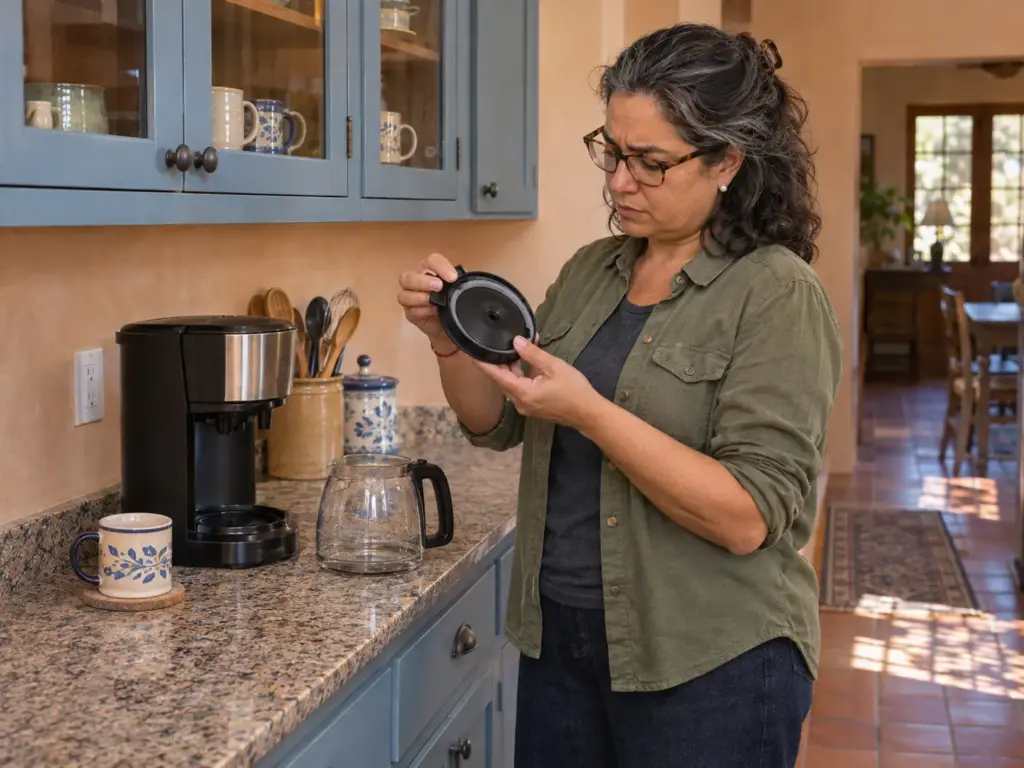
The check is two questions. Is the model still sold, and are the gasket, the carafe, the showerhead and the control board still listed as parts? A ten-year machine discontinued in year three is a four-year machine with a premium.
The one concrete answer sits with Moccamaster USA, which repairs any brewer or grinder after the five-year warranty for a flat fee covering parts, labor and shipping, and keeps selling parts for models it no longer carries. Repairability is that kind of promise: it names a part.
The Parts That Actually Fail
The heater is rarely the thing that fails. The parts that break are seals, plastic, the carafe spout, the showerhead retainer and the built-in grinder; build quality shows in those, not in the finish. The first sign is a lid that stops sealing or a carafe that drips at the spout, long before any heater gives up. Which part breaks first, brand by brand carries the verdict this section only points at.
Open the maker’s parts page before the cart and look for three names: the carafe lid or gasket, the showerhead or its retainer, and the basket. If all three can go in a cart, the machine can be repaired. If only the machine is listed, treat the length of the warranty as the length of its life.
When the Cheap Machine Is the Right Machine
After all that on what the premium buys, the cheap machine deserves its flaws and its cases, so the verdict is not an upsell.
The Budget Benchmark and Its Certificate
The cheap machine does the same job when you brew a full pot with fresh beans, a burr grinder and a weighed dose. Hot and certified is possible below the premium because the SCA list follows the model, not the price, and a budget Mr. Coffee model sits on it; the budget end of the same question, tested through year two, has the long version.
The honest budget benchmark is the Cuisinart DCC-3200, a 14-cup glass-carafe machine whose PerfecTemp system is meant to brew hotter than the plain basic models, with brew-strength control, a 1 to 4 cup setting and an adjustable warming plate. It lacks the SCA badge, some units quit inside the first year, and the value is mixed. What the mid budget buys is laid out in drip machines sorted by how long the carafe stays hot.
A Thermal Carafe Instead of a Hot Plate
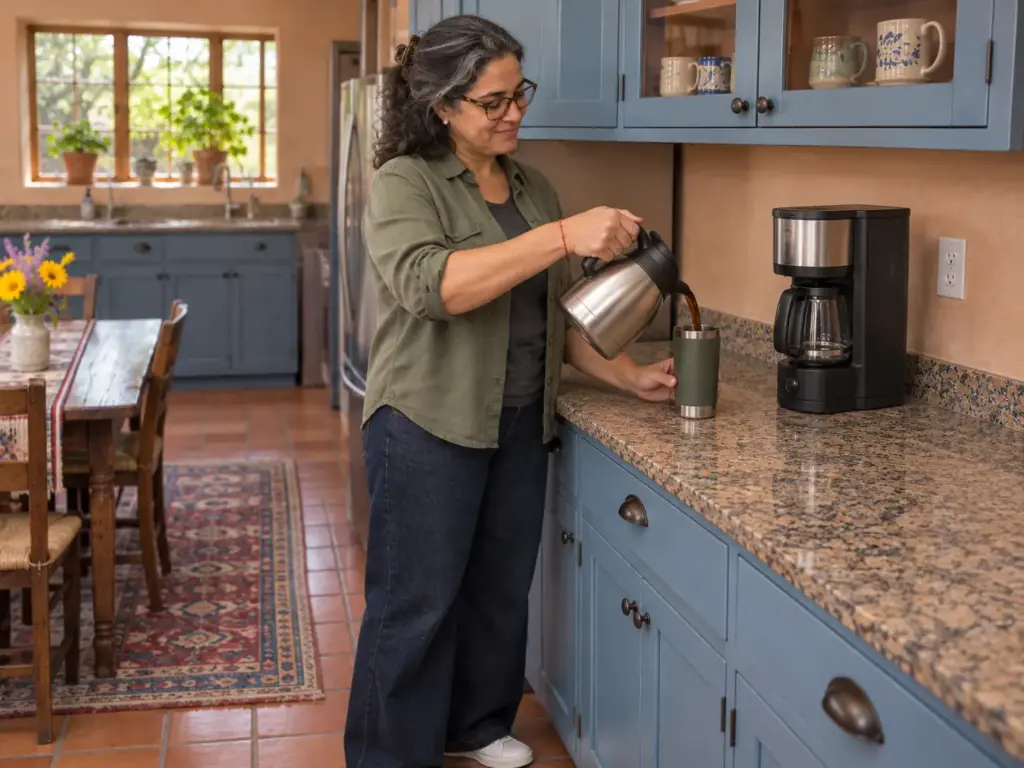
A glass carafe on a hot plate turns the last cup bitter long before the pot is empty, because the plate keeps cooking what is left. The BLACK+DECKER 12-Cup Thermal Coffeemaker CM2035B is the cheapest way to get the coffee off the plate: a double-wall thermal carafe and a timer with no hot plate, a brew-strength selector, a no-drip spout and a dishwasher-safe basket. No certificate, no pretense. The carafe leaks at the pour, it may not hold the heat the box promises, and units have broken around six months.
If the pot sits on a plate, get it off within half an hour and pour what is left into a thermos rinsed with hot water. The SCA’s test for a heated carafe asks 176–185 °F (80–85 °C) for the first 30 minutes and never above 185 °F; a plate that runs hotter than that is cooking the coffee.
The Flaws of the Cheap Pick
The cheap pick has a cold first pour from the thermosiphon, a hot plate cooking the last cup, a thin carafe and parts you cannot buy. The premium one has a footprint, presets, an app and a proprietary part. The cheap pick plus the free fixes (a warmed water path, a weighed dose, a burr grinder) beats the expensive pick fed stale beans.
What the lowest budget gives up in water heat puts a number on the floor.
Spend in This Order, and What to Do When the Budget Isn’t There
The same money in the wrong order changes nothing, so the purchase goes in order: the free fixes, the grinder, the scale, then the maker.
Beans, Grind, Ratio and Water Come First
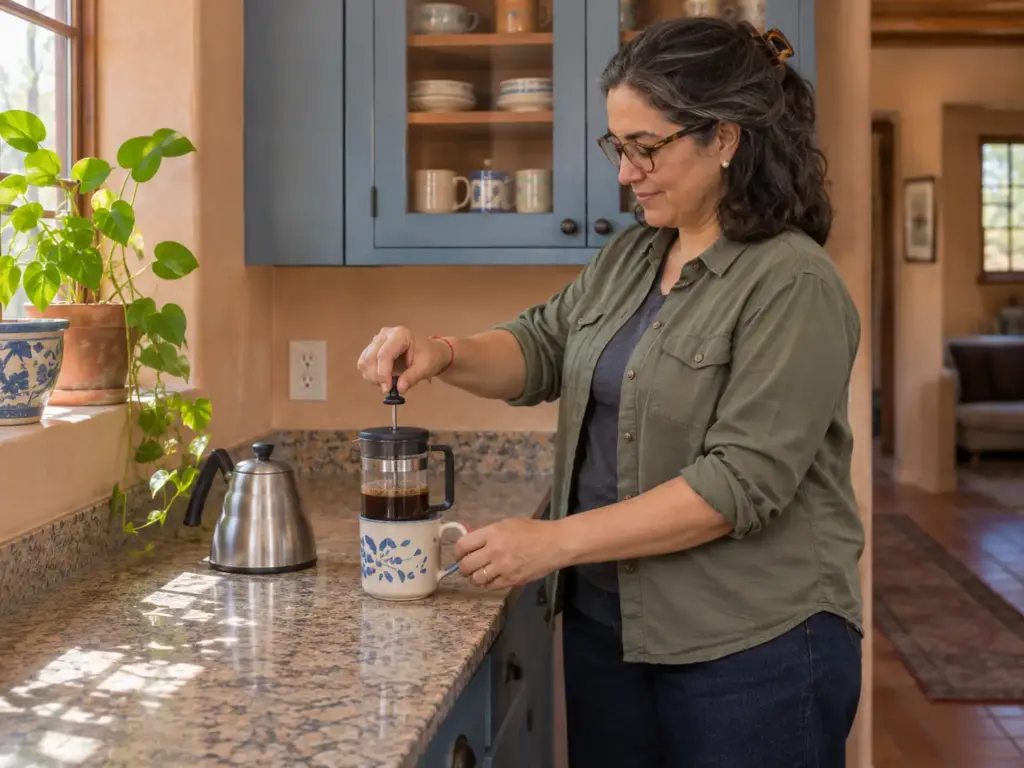
The 80/20 rule for coffee is a rule of thumb that was never measured: beans, grind, ratio and water set most of what is in the mug, and the maker sets the last slice, which is heat, evenness and how long the pot stays drinkable. The free fixes come before any purchase: a weighed dose, a grind step finer or coarser, whole bean coffee with a roast date you can read, a paper filter.
The SCA’s brew ratio is 55 grams of coffee per liter of water (give or take 10 percent), so a full 40 oz (1.25 L) pot like the Moccamaster’s wants about 69 grams. Most people scoop well under that, and a thin cup gets blamed on the machine.
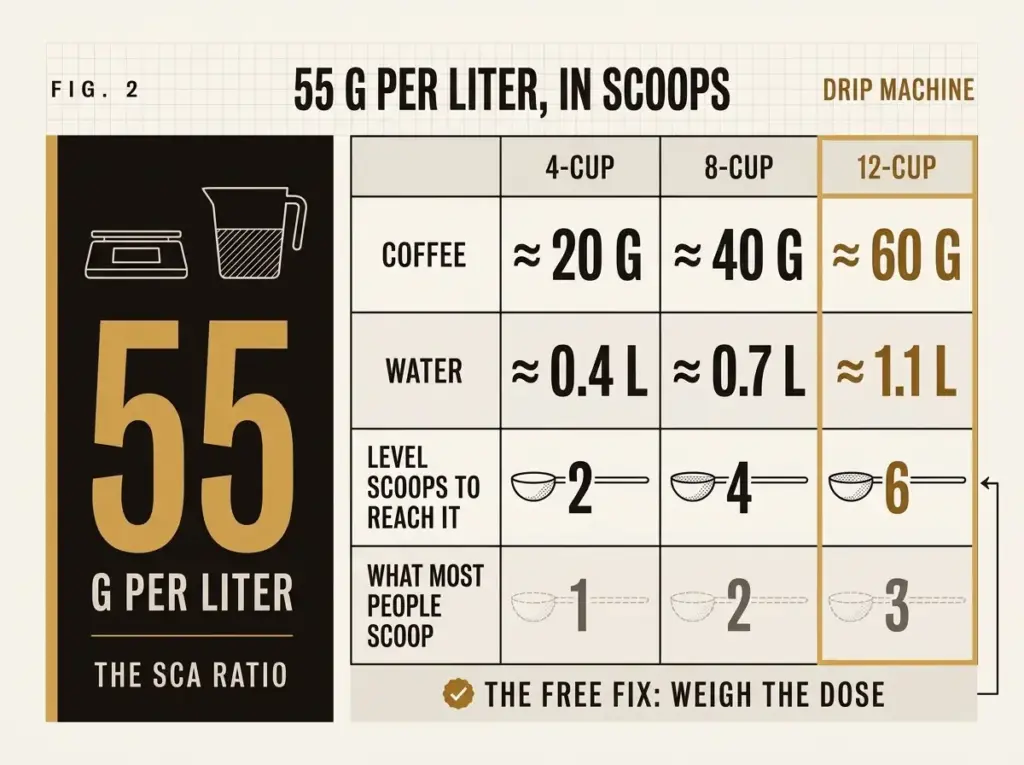
Where the roast date is the problem, how to read a roast date before you buy a bag is the free fix one level down, and the free fixes to try on a drip machine before buying anything puts them in order.
The Order of Spend
The order runs: the free fixes, then a burr grinder, then a scale, then the maker that matches the mugs you pour, then the upgrade. Why a burr grinder comes before the maker is the one purchase that changes the cup before any machine does. The café-drink arithmetic is arithmetic too: a 12-ounce (340 g) bag at 55 grams per liter makes about 6 liters, roughly 20 ten-ounce mugs, so divide what one café drink costs you by what one home mug costs and the cost per cup decides how fast a premium maker pays back.
No Machine at All, and One Mug at a Time
When the budget is not there, a manual brewer removes every variable the premium sells and leaves the pour. The CHEMEX Classic 6-Cup bundle with 100 square bonded filters is borosilicate glass with no heater and nothing to wear out; the thick filters are a recurring cost, and the pour needs a controlled kettle or the bed floods and the cup goes thin.
The AeroPress Go travel kit is the single-mug answer: a brew of about two minutes, an 8 oz mug in the box, and the cheapest way to control dose, time and temperature without a machine. It makes one mug per press, with no pot and no second cup, which is the whole point and the whole limit.
The Question to Ask Before Paying More
A premium maker earns its price in three places: heat held to the last pour, an even bed with a bloom, and parts still sold in year three. It earns nothing for the presets, the finish or the badge. A dial is worth buying only if you will turn it, and a plain maker with a burr grinder, a scale and dated beans beats the premium maker fed a blade grinder. The same price argument one category over is in why grinders cost what they do and what the extra buys.
Once the machine has been through a couple of hundred pours, look again at three things: whether the carafe still seals and pours clean, whether the showerhead still wets the bed evenly, and whether the last mug tastes like the first. For tomorrow, warm the water path with a blank run and weigh the dose on whatever machine is on the counter, then taste. If the cup moves, the maker was never the problem; if it does not, the dial or the part is the question. The budget setup and what it does by month two is the same answer at the low end of the range.
Frequently Asked Questions
01Is there a difference between coffee makers?
Yes, in three places: how hot the water stays from the first pour to the last, how evenly it wets the grounds, and how long the parts last. Everything else is convenience.
02What is the 80/20 rule for coffee?
It is a rule of thumb: beans, grind, ratio and water set most of what is in the mug, and the maker sets the rest. That is why the grinder comes before a new machine.
03What is better, French press or pour over?
Neither wins outright: a paper filter holds back the oils for a cleaner cup, and a metal mesh lets them through for a heavier one. Pick the cup you like; both skip the heater.
04Does an expensive espresso machine make a difference?
It makes the shot repeatable, with a set brew temperature and a steam boiler that works while you brew, but it does not make a better bean. The 9 bar is a convention.
05Is a cheap maker with a good grinder better than an expensive all-in-one?
Usually for the cup, because the grinder changes more than the maker, and a separate grinder can be replaced alone. The all-in-one wins on the chore, not the taste.

How did your cup turn out?
No comments yet. Tell us what you changed — and whether the needle moved.