



We may earn a commission when you buy through links on this page. It never changes what we recommend. How we pick
On this page8 parts
- Flat or Cooked? Which Way the Scheduled Pot Is Off
- The Grounds Wait Before the Water Does
- The Pot Keeps Cooking After the Timer Ends
- Set the Clock Before You Trust the Timer
- Which Machines Keep Their End of a Schedule
- A Plug Timer or an App for a Machine With No Clock
- Tomorrow Morning: Take the Grounds Out of the Open Basket
- Frequently Asked Questions
You set the timer last night, and the pot waiting this morning tastes either papery or scorched. A coffee maker you can schedule did exactly what it was told, which is the odd part: Serious Eats reported that every brewer it tested “started exactly on time”, cheap or expensive, so the timer is the one piece of a scheduled brew that almost never fails. What decides the cup is the stretch on either side of it, the hours the grounds waited before any water reached them and the hours the finished pot sat hot afterward.
This guide reads the taste first, then moves the grounds, shortens the wait, checks the clock, sorts the machines and ends with a plug-in timer for a brewer that has no clock at all. The wider question of what a good drip coffee maker needs besides a timer sits one page up.
Quick Answer
A programmed brew starts on time on the machines tested, so a bad scheduled pot comes from the hours around the timer. Flat or papery points to grounds that waited in the basket; cooked or bitter points to a pot that sat on the plate. Shorten the grounds’ wait and the pot’s hold; leave the timer alone.
Flat or Cooked? Which Way the Scheduled Pot Is Off
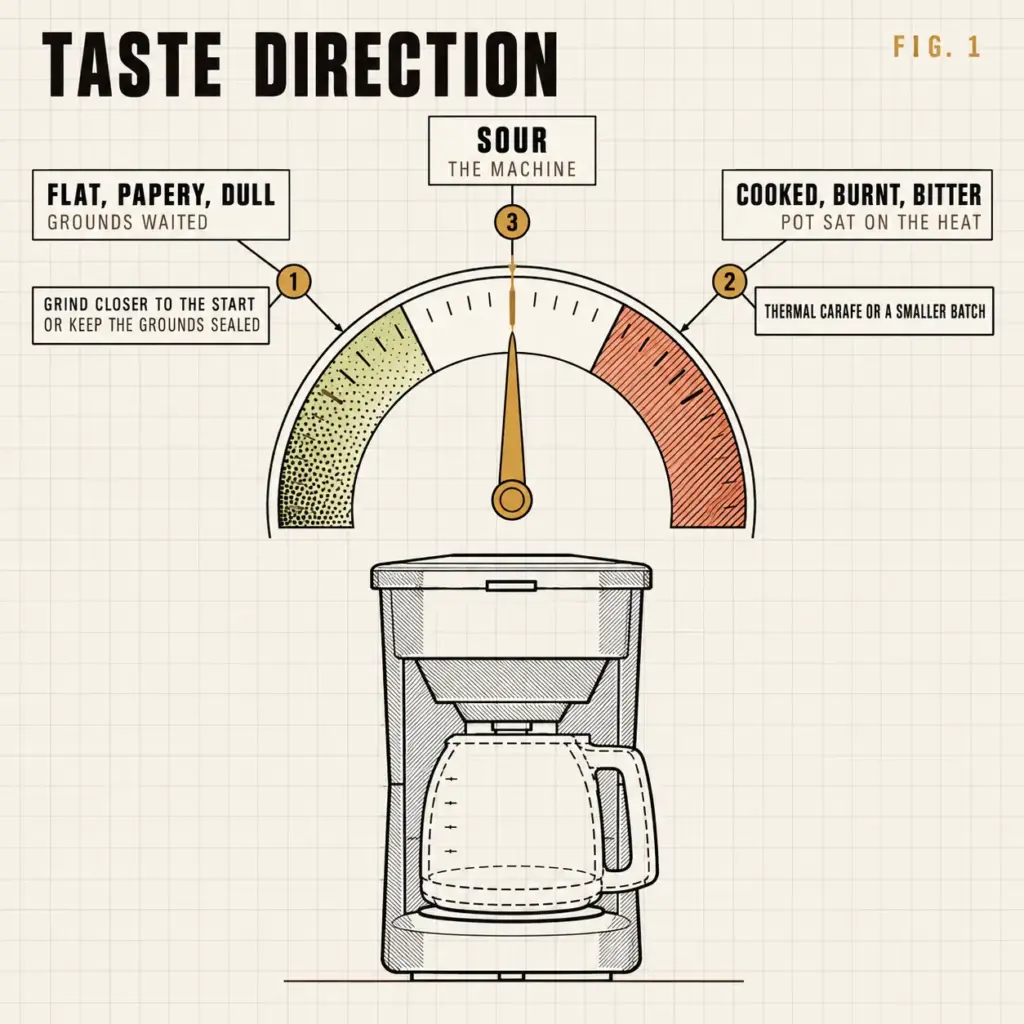
The timer is the one part of a scheduled brew that works, so the bad pot has to come from somewhere else, and the taste says where. Read the cup before touching a single setting, because the two ends of the schedule go wrong in opposite directions. The first question to ask of a wrong-tasting mug is how long that coffee waited, on either side of the brew.
Flat, papery or dull points to the grounds
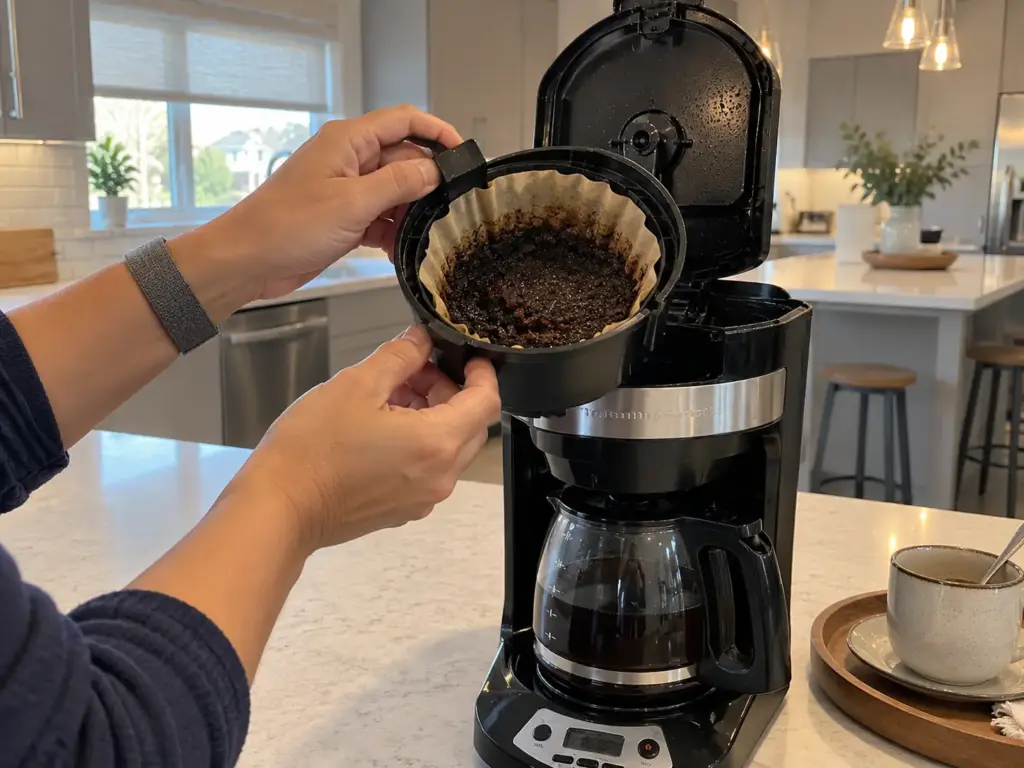
A flat cup has lost its sweetness and its edge without turning sharp or burnt: it tastes of cardboard, or of very little. That points to the end of the schedule before the brew, because coffee starts going stale the moment it is ground and an open filter basket gives the air all night to work. The Spruce Eats makes the same point in its FAQ: grounds sitting in the machine are exposed to air, an exposure that “starts the oxidation process, which can dull the flavor over time.”
Home brewers argue about how much that wait costs. Grinding the night before leaves ground coffee sitting for hours, which can cost a noticeable dent in quality, though it will not go stale. Both are one person’s estimate, not a measurement, so the next section gives you a way to run the comparison on your own bag.
Cooked, bitter or burnt points to the hours on the plate
A cooked cup points the opposite way: bitter, with a burnt edge and no brightness left. That is the other end of the schedule, after the brew. The timer finished the pot long before you poured it, and a warming plate keeps heating the coffee for as long as it waits.
Pour a second mug from the same pot after it has stood for an hour and set it beside the first. The beans are the same and the water is the same, so whatever changed between the two mugs happened on the plate.
Sour, or sour and bitter together, points to the machine
A cup that is sour and bitter at once is neither the grounds nor the plate. In Serious Eats’ tests, brewers that hovered near 180°F (82°C) for most of the cycle and then spiked past 210°F (99°C) in the last minute made coffee that “tasted both sour and bitter”, because the grounds were unevenly extracted. The window that testing looks for is 195 to 205°F (91 to 96°C) within the first minute, and no schedule moves a machine into it.
Water at the right temperature can still deliver a bad pot if it never reaches all the grounds. Serious Eats found that on a Hamilton Beach 12-cup programmable the coffee bed was “unevenly saturated”, which left the center over-extracted and the edges under-extracted, so bitter and sour came out of the same pot. The Hamilton Beach 12 Cup Programmable 46299J is a 12-cup glass-carafe machine of the same kind, with a two-hour auto shut-off on its listing, but Serious Eats printed no model number, so take the finding as a warning about this kind of machine and not a verdict on one model. If a pot tastes both ways, no timer setting will change it.
The Grounds Wait Before the Water Does
Reading the cup left one suspect with a free fix: the hours the coffee spends in the machine before any water reaches it. This section moves those hours one change at a time, with a taste between each change, so you can tell which one worked.
What an open basket does to ground coffee overnight
Grind at bedtime for a start at wake-up and the arithmetic is simply the night itself, between the grind and the first drop of water. Ground coffee has far more surface than whole beans (that is the point of grinding it), so the air reaches every particle for as long as the basket sits open. The clock for whole beans runs much slower and is covered in how long coffee beans keep after opening; the clock for grounds is the one your schedule is spending.
Lift the lid on a basket that has waited all night and smell it, then do the same on a morning you filled it just before brewing. The waiting basket smells fainter and flatter, and that smell is a preview of the cup. One caution: how long a grind can sit is a starting point for your own check, not a rule.
Whole beans in the morning, or grounds in a sealed container
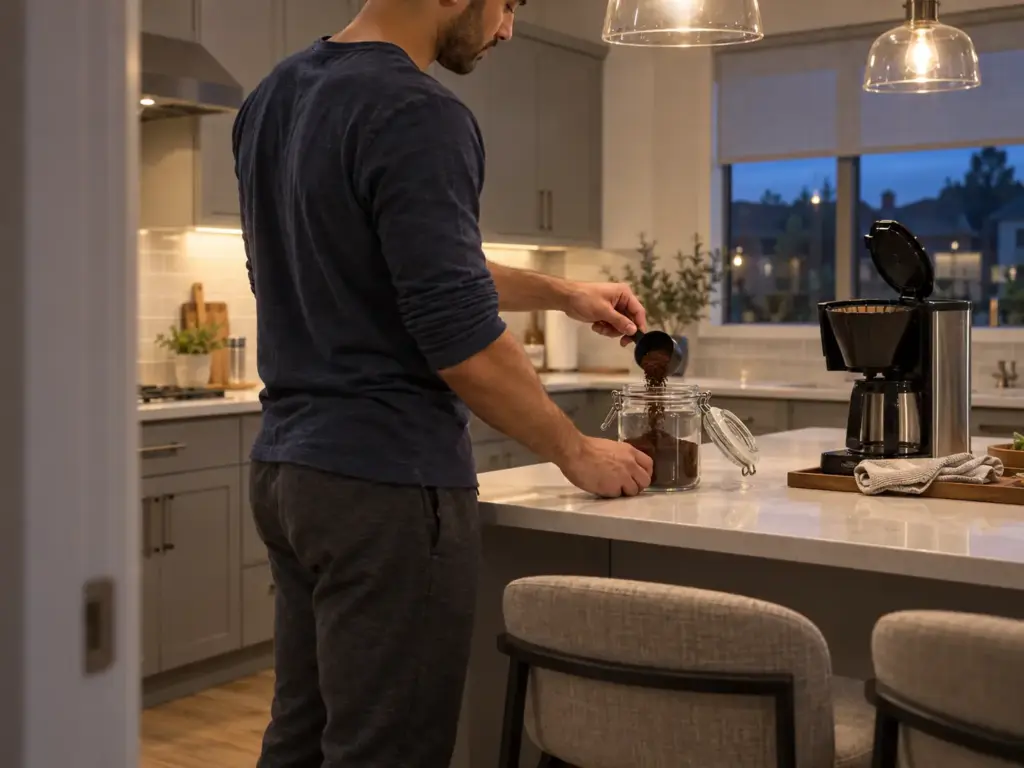
Grinding right before brewing is the textbook rule, and a timer breaks it by design, so the better call is to shrink the gap and seal what is left. Free changes come first, one at a time. The first costs nothing: grind as close to bedtime as you can, not earlier in the day, keep the basket lid closed, and brew. The next cup should taste a little sweeter and clearer at the first sip; if nothing moved, the wait was not your problem.
The second change, a week later, takes the grounds out of the basket altogether. Either grind into an airtight container at bedtime and tip it in when you wake, or keep the coffee whole and grind it in the morning, then fill the basket and press start. You give up the unattended start (the water and the filter stay ready, so it costs about two minutes), and the cup should come back sweeter with the flat edge gone. Which of the two suits your bag depends on its size and roast date, which when to grind coffee beans works through.
A one-week test with the same bag
Run the comparison once and the argument ends. Use one bag of coffee, one machine, the same water and the same dose weighed in grams on a kitchen scale (or scooped the same way both mornings).
On a morning you are up, grind right before brewing and brew at the counter. The next morning, brew the same dose on the schedule, from grounds that waited in the basket all night. Taste both hot, before anything else changes, and write down which way the second pot is off.
Repeat the pair on two more days so one odd pot does not decide it. If the scheduled pots are only a shade duller, the wait is a small cost and the plate is your next suspect. If they are flat or papery, that is the grounds, and the second change above is the one to make.
Weigh the dose once and write the grams on the bag. A scoop that is level on one morning and heaped on the next can move the cup as much as the night in the basket does, and it will blur the test above.
When the grinder lives inside the machine
A built-in grinder removes the wait by grinding at the start of the cycle, so the beans sit overnight instead of the grounds. Whether the grinder inside a drip machine is any good is a separate question, and combination machines do not always carry high-quality grinders. The page on a coffee maker with a built-in grinder judges the grinders, and for this page the point is narrower: it moves the grind to the one moment a schedule needs it.
The Pot Keeps Cooking After the Timer Ends
With the grounds sorted, the other end of the schedule is how long the finished pot waits before you pour it. A pot that finishes while you are still asleep and a mug poured an hour later are separated by the carafe and the plate, and that gap is the second cup, the one that tastes nothing like the first.
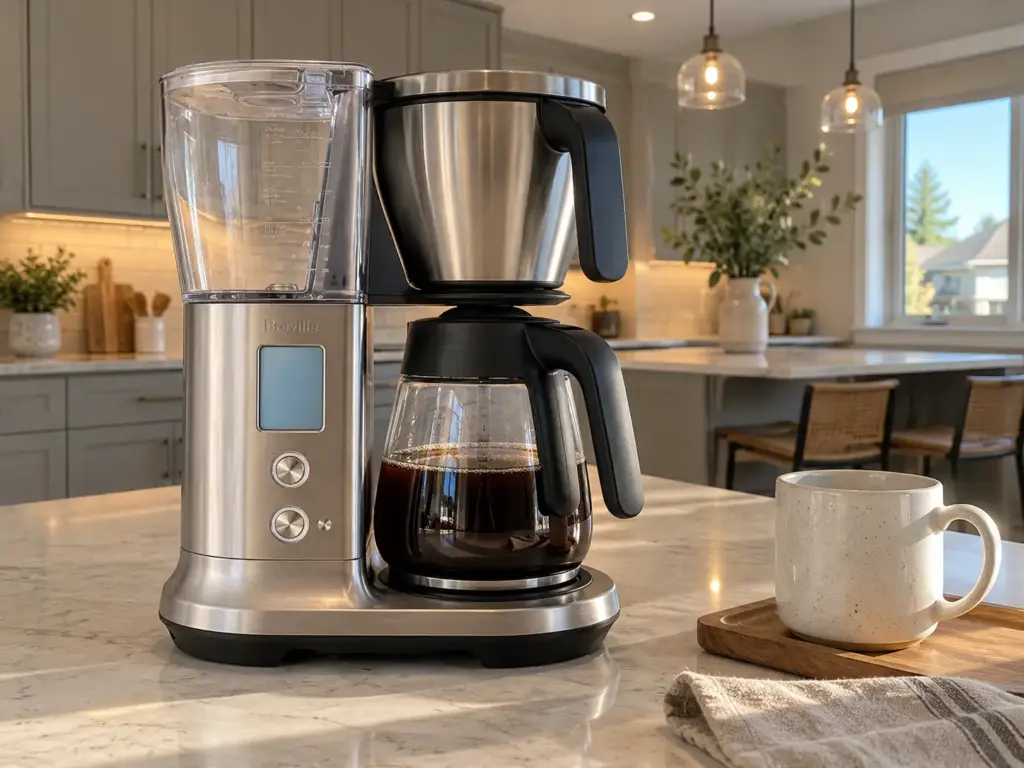
What a warming plate does to the last cup
A warming plate keeps the glass pot on a heating element, which is the problem: the heat that keeps the coffee drinkable keeps cooking it. The Spruce Eats measured the plate of a 14-cup machine at 176°F (80°C) after an hour, still within about 20 to 30 degrees of the brewing window. Another machine’s plate is claimed to hold a drinkable temperature for up to four hours. That is a claim and not a test, and a pot held for four hours has been cooking for four.
Some people take the trade on purpose. Many people accept a small drop in quality in exchange for a pot that is ready when they wake. That is a fair deal as long as you know what you are trading, because the pot at the end of an hour on the plate is not the pot the machine made.
A thermal carafe holds about an hour
A thermal carafe skips the plate: it holds the heat without a heating element, so nothing keeps cooking the pot. Serious Eats found the OXO and Breville thermal carafes kept coffee “pleasant for up to a full hour”, and it argues that this matters more on a programmable brewer, since the pot may finish before you are out of bed. How long a pot can sit in glass against steel is the subject of glass vs thermal carafe by how long the pot sits, so it is not argued twice here.
The Breville BDC400BSS Precision Brewer is the one machine on this page that lets you set the brew temperature, through a PID controller that Serious Eats says holds the water within a degree. That matters if part of a cooked cup is the machine’s own heat. Serious Eats tested the stainless thermal-carafe unit; The Spruce Eats says the glass version is the same model with the same features, and the glass-carafe Breville linked here leans on a plate again, so the hour of hold above belongs to the thermal one.
The menu is where it costs you: Serious Eats says so many customizable options “can also be tricky to navigate” and calls it “one of the pricier coffee makers we recommend”, which puts it at the splurge end of the group. If the plate is still the culprit after the free changes, the next purchase is a carafe, and drip coffee makers with a thermal carafe lists the machines.
Auto shut-off and the timer, read together
Read the shut-off and the timer as one setting, because together they decide what the pot does after it finishes. Serious Eats notes that the OXO’s heating element shuts off immediately after brewing and that the machine turns off after an hour of inactivity, so nothing is cooking on a plate there, and the thermal carafe carries the hour. A glass pot on a machine that shuts off at two hours, like the Hamilton Beach above, cools unattended once the plate goes dark.
A machine that stays on keeps cooking the pot; one that shuts off lets it cool. Neither is wrong, but only one matches how late you pour, so look up which yours does.
Brew for the hour you wake, not the hour you set
Move the start later by the time you spend getting dressed, so the pot finishes as close to your first pour as the morning allows. The next pot should taste closer to the one you remember from the counter; if you overshoot, you stand in the kitchen listening to the machine. The second change is a smaller batch, since a pot that is half the size finishes sooner and has less time to wait. A carafe’s labeled cups are small ones, so count ounces, not cups when you decide how much to brew.
If the pot has to wait on a glass carafe, rinse an insulated mug or thermos with hot tap water and pour the whole pot into it at the first cup. The coffee leaves the plate, and the last mug should taste much closer to the first.
Set the Clock Before You Trust the Timer
Everything so far assumed the brew starts when you think it does. The clock is the one place a schedule can fail with no warning, and it fails at 6 a.m., not on the day you plug the machine in.
The clock comes first
Serious Eats found that the OXO and Breville both “prompt you to set the clock function before you” can select a brew timer, and some machines will not accept a start time until the clock is set. That order is a feature: a start time is an offset from the clock, so a timer set against a wrong clock is a wrong timer. A machine that does not prompt will take a start time all the same, which is why setting the clock is the first step and checking it is the second.
AM, PM and the first Sunday in November
Two things send a 6 a.m. start wrong. The first is the AM/PM setting: a start entered as 6 p.m. runs at supper time and leaves the morning pot unbrewed.
The second is the calendar. US clocks go back an hour on the first Sunday of November, when daylight saving time ends, and a clock set by hand does not follow that change on every model.
On a machine that does not follow it, a brew set for 6:00 runs an hour early in November, because the machine’s unchanged clock reads 6:00 while the wall clock says 5:00. In March it runs an hour late. Your model’s manual says whether it follows the change, and it is worth reading that page once.
How far ahead the machine will take a start time
Most programmable machines let you schedule a brew up to 24 hours ahead, and some limit it to 12 hours, according to The Spruce Eats. A 12-hour machine cannot take a start time further away than that, so programming it at noon for the next morning is out of range. Look up the window for your model before you rely on it, and on a 12-hour machine put the program in during the evening.
Unplug it for a minute
A power outage may reset the clock and the program on some models, and nobody checks until it happens. So cause one on purpose, on a day you are home: with the machine empty, unplug it for a minute, plug it back in and read the display.
If it comes back blinking 12:00, the program is gone, and after any power blip you will need to check the display before bed. If it keeps the time, you have learned your model remembers. Repeat the same check on the Monday after the clocks change.
Once you have run the unplug check, write two things on a strip of masking tape on the side of the machine: its scheduling window (12 or 24 hours) and whether it kept its program. The next time the power blinks, the answer is on the machine.
Which Machines Keep Their End of a Schedule
With the grounds, the wait and the clock handled, what is left is the machine, and three earn a place here: two with a card and one cheap one inline. The yardstick for the numbers is the Specialty Coffee Association’s home-brewer standard, SCA-310, “Home Coffee Brewers: Specifications and Test Methods”. Serious Eats times each brew against the SCA Certified Home Brewer window of four to seven minutes of total brew time for a full pot and looks for water at 195 to 205°F (91 to 96°C) in the first minute, a range The Spruce Eats attributes to the National Coffee Association.
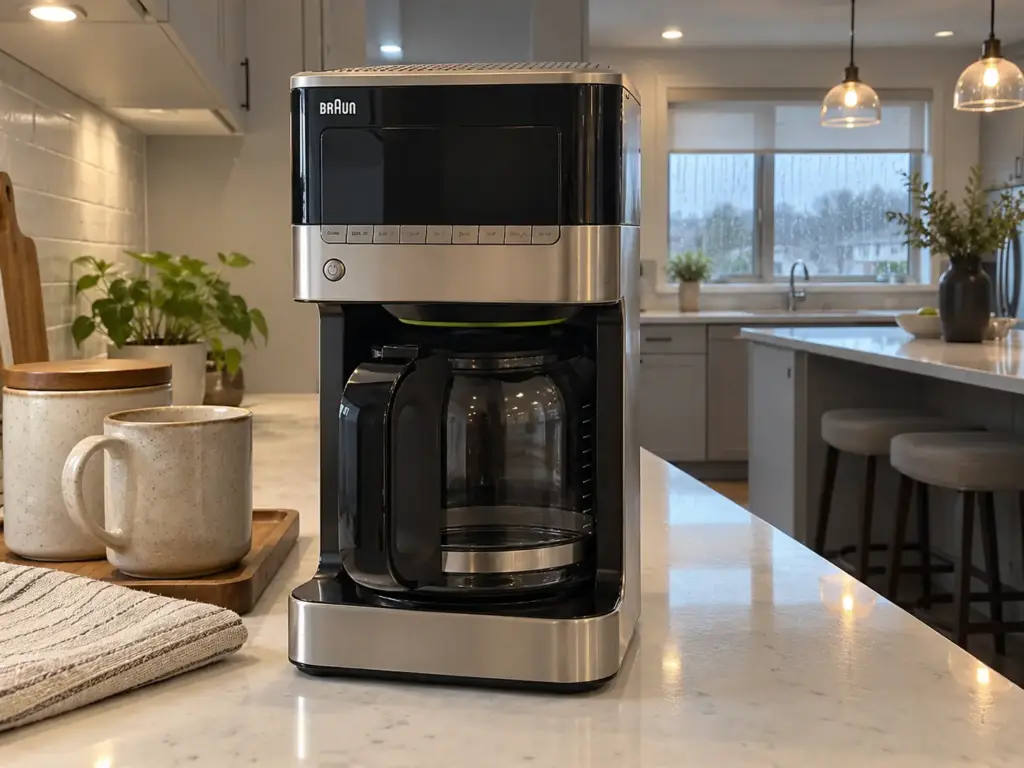
OXO Brew 9-Cup, the one that held the pot
Serious Eats named the OXO Brew 9-Cup its best programmable: a powerful heating element, the win in its tasting rounds, and a thermal carafe that keeps coffee fresh for up to an hour. The Spruce Eats measured its water at 197.8°F (92°C), in the middle of the brewing range. One dial sets the cup count, the brew time and the start, the machine prompts for the clock first, and its heating element shuts off right after the brew, which is what lets the carafe carry the wait without a plate.
Two things count against it, both in writing. The Spruce Eats found no option to change brew strength or temperature, so what the machine does is what you get. And Serious Eats’ earlier tests found that its conical filter “struggled to brew darker roasts as well as it does lighter roasts”, so a dark roast is where it shows.
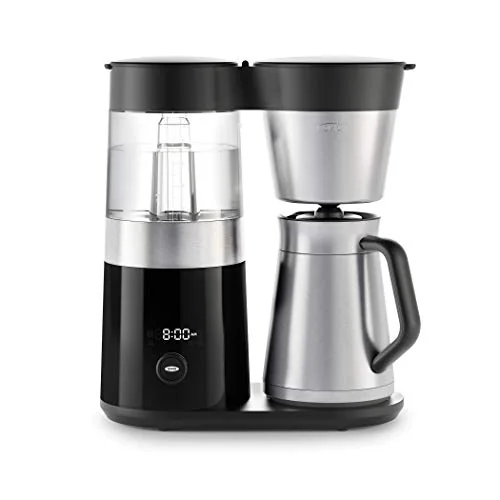
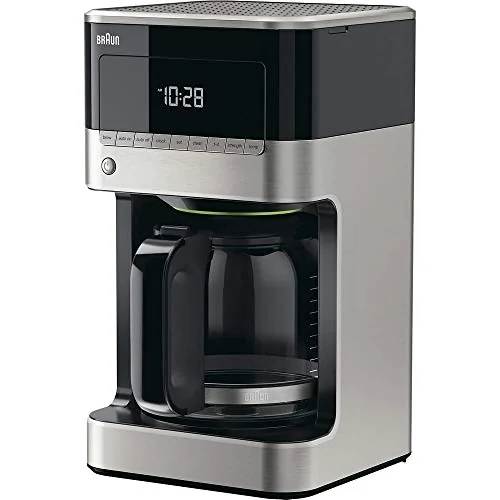
Braun BrewSense 12-Cup, the large pot with the button problem
The Braun BrewSense 12-Cup is the large-pot choice: 96 ounces, a 24-hour timer, regular and bold brew settings and a one-to-four-cup setting for small batches. Its trouble is the panel. The Spruce Eats counts nine buttons and calls them “a bit confusing”, which on a machine you program every night means finding the delay setting among nine buttons, every night for a month.
Serious Eats adds a second mark against it: bitterness and long brew times, “taking almost 14 minutes longer to finish a pot”. Its explanation is that the longer a brewer takes, the more bitterness it pulls from the coffee. A start time is when the brew begins, not when the pot is ready, and on a slow brewer that gap is wider than the clock suggests.
Ninja CE251, the cheap one and its low brew temperature
The Ninja CE251 is the cheap one, a fraction of what the OXO or the Breville costs. Its Delay Brew button walks you through the timer, the 60-ounce reservoir is removable and easy to fill, and the glass carafe sits on a hot plate, so the plate question from earlier returns. Serious Eats says it made pretty good coffee, but its brew temperature reached only 195°F (91°C), “on the low side of acceptable”, and “the coffee tasted a little bitter.” That is the whole trade: a working schedule and a pot that lands at the bottom edge of the window.
For the reader who wants to stay on the cheap side, drip coffee makers sorted by carafe heat sorts the budget machines by how hot the carafe stays. The wider question, how hot a machine’s water gets before it ever meets the grounds, is what how to pick a drip coffee maker by water temperature is built around.
A Plug Timer or an App for a Machine With No Clock
Not every kitchen needs a new machine. Some already own a good brewer with no timer, and the question is whether a plug-in timer or an app can give it a schedule. The answer depends on the machine, and one morning at home settles it.
Opinions split on outlet timers
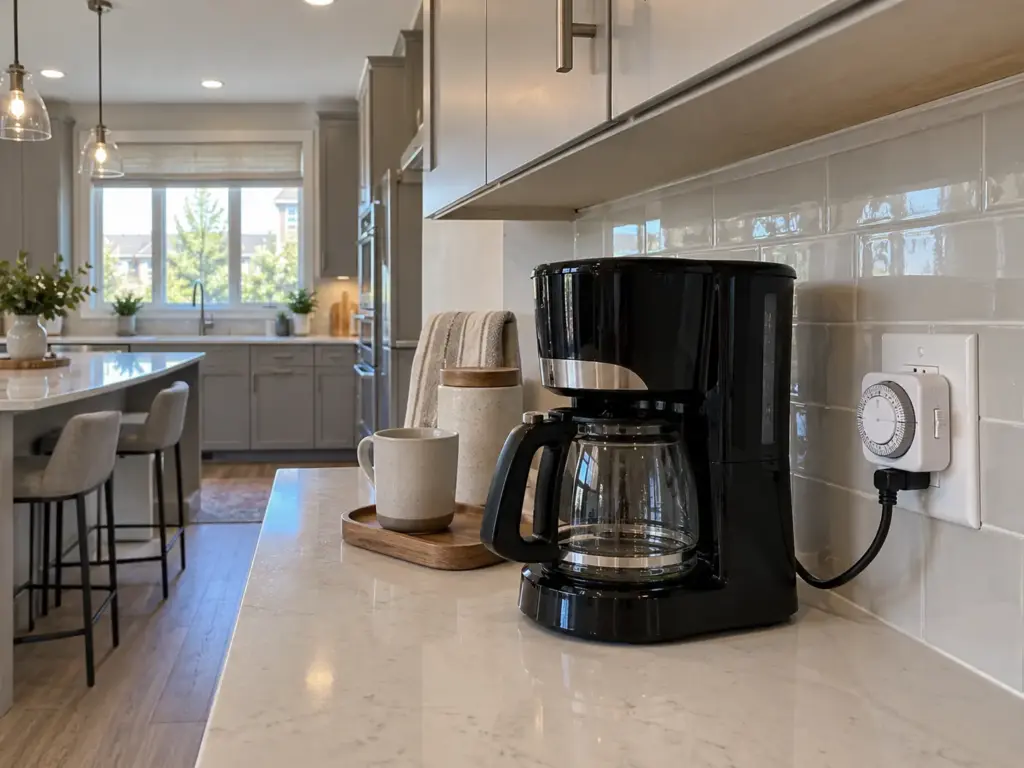
A digital outlet timer on a drip machine can run for over a year, with the water and coffee loaded the night before, at a small drop in quality. Another says an outlet timer “will only work with analog devices with mechanical switches”, after trying a vacation light timer on a drip brewer. The thread tested neither, so treat both as reports and not rules.
The mechanism is simple. A plug timer, or a smart plug run from a phone app, only cuts and restores power, so it can start a machine that begins brewing when power returns, and it cannot press a button for one that needs a press.
Test it on a morning you are home
Settle it on a day you are in the kitchen, with a pot you are there to watch:
- Fill the reservoir and the basket as you would the night before.
- Switch the machine on at its own switch and leave that switch on.
- Plug the machine into the outlet timer and set the timer to start five minutes from now.
- Stand in the kitchen and watch the pot and the clock at that minute.
The click you hear is the timer’s relay closing. If the machine starts brewing, the plug is a schedule for it. If the timer clicks and nothing happens, the machine needs a press to start and the plug will never be a schedule for it. A machine with no program memory also restarts clean after a power cut, which is why you run the test before trusting a work morning to it.
App and voice control
Some drip machines skip the plug and take their schedule from a phone, through app control or a voice assistant. The Spruce Eats lists one that can be programmed through an app or by Alexa or Google Assistant, while Serious Eats notes that most programmables stay with a plain digital clock, which is easier to use and needs no phone. Before you buy an app machine, ask what it does when the Wi-Fi drops overnight: whether the start time is stored in the machine or waits on the phone is a question for that model’s manual, and it decides whether the schedule survives a router restart.
Tomorrow Morning: Take the Grounds Out of the Open Basket
The timer starts on time, so a bad scheduled pot is read by its direction: flat or papery means the grounds waited, cooked or bitter means the pot sat, and sour and bitter together means the machine. The free changes come in order: the grounds out of the open basket, the start later and the batch smaller, the clock checked on the first Sunday of November. A machine earns its place by its carafe and its buttons, and every pick above carries its flaw.
A month from now, pour one mug the minute the pot finishes and another an hour later, and compare them. Then read the display on the Monday after the clocks change.
For tomorrow, make one change. Tonight, keep the grounds out of the open basket: grind into a sealed container or keep the beans whole, and in the morning fill the basket and press start. The first mug should taste sweeter and clearer, with the flat edge gone. If it turns sharp instead, the grounds are no longer the suspect, and the machine’s heat is the next one to check.
Frequently Asked Questions
01What is a programmable coffee maker?
A programmable coffee maker is a drip machine with a clock and a timer that starts the brew at a time you set. Set the clock first, then the start. Most hold a schedule up to 24 hours ahead.
02How far ahead can you set a programmable coffee maker?
Most programmable coffee makers take a start time up to 24 hours ahead, and some limit it to 12 hours. Check the window in your model’s manual before you rely on it for the next morning.
03Do any Keurigs have a timer?
Some single-serve models have an auto-on or schedule setting, and many do not. Look for a clock and a program setting in the manual or on the display before you buy.
04Can you grind the beans the night before and leave them in the coffee maker?
You can, and the cost is a duller cup. Grounds in an open basket are exposed to air, which dulls flavor over hours, so grinding at bedtime and keeping the lid closed is the free fix.
05Does an outlet timer work with any coffee maker?
It can work on a machine that you switch on by hand and leave on, and opinions differ on digital against mechanical timers. Test it once with a pot you are home to watch.



How did your cup turn out?
No comments yet. Tell us what you changed — and whether the needle moved.