
We may earn a commission when you buy through links on this page. It never changes what we recommend. How we pick
On this page7 parts
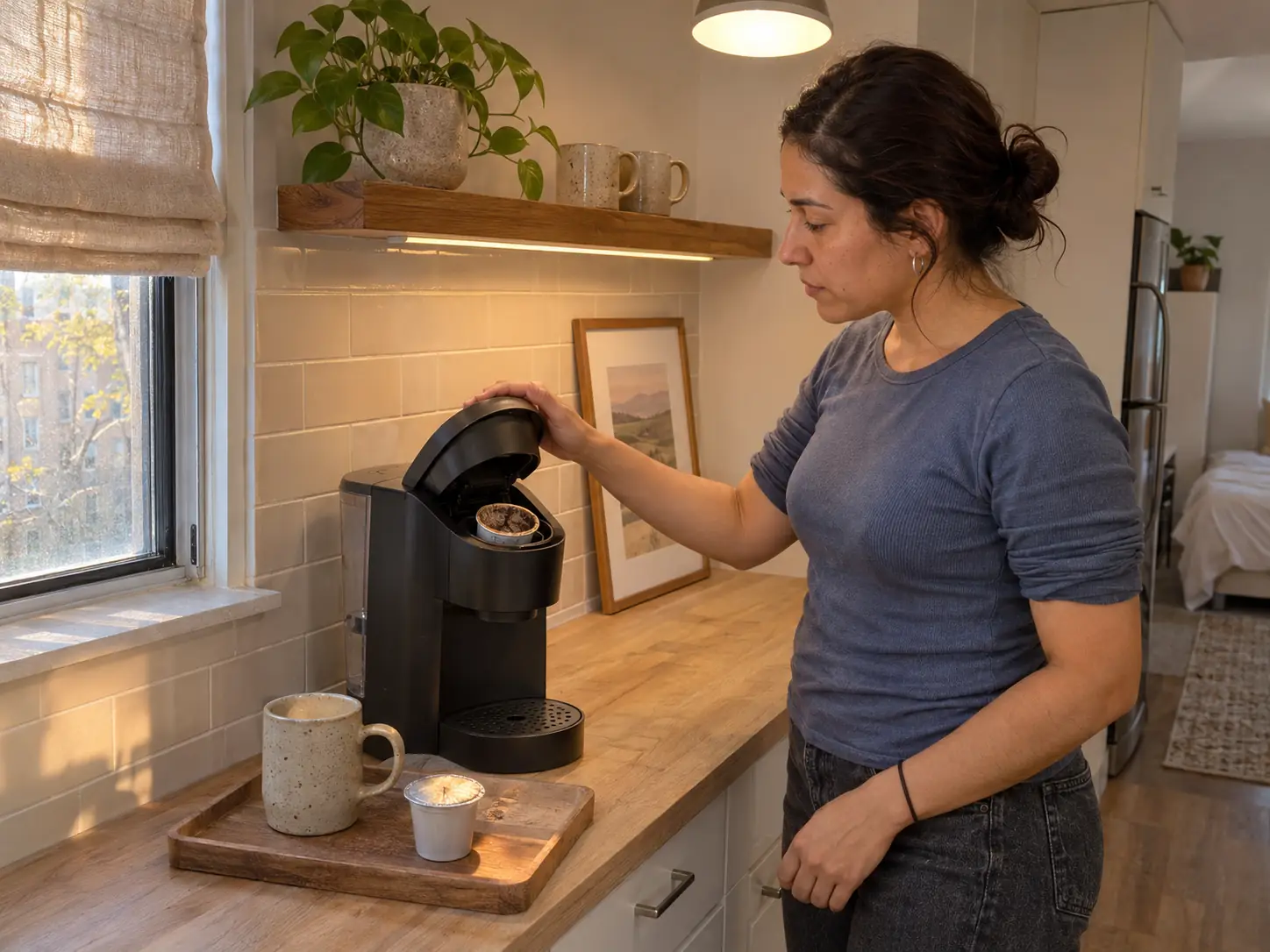
The first mug is empty, the used pod is still sitting in the holder, and the button is right there. Press it again to stretch the box and the second mug comes out the color of weak tea, thin up front and a little bitter at the end. So can you reuse coffee pods? You can run one twice, but most of what a pod holds leaves in the first part of the first run, which makes the second pass mostly hot water.
Below: why that cup runs thin, a two-cup test that settles it in your own machine, what a pod you fill yourself changes, what the machine and the shell have to agree on, and what the shell looks like after a few weeks of rinsing.
Quick Answer
A sealed pod gives one good cup, because the first run takes most of what it holds, and a second run through it comes out thin and watery. Reuse works only in a pod you fill with fresh grounds and seal yourself. Two matching cups will show you the difference in your own machine.
Why the Second Run Runs Thin
The second cup is whatever the first run left behind, and a pod leaves less than it looks like. A run through a sealed pod is a fixed amount of coffee meeting a fixed amount of water, and the grounds do most of their giving early. Start with the study that put numbers on it.
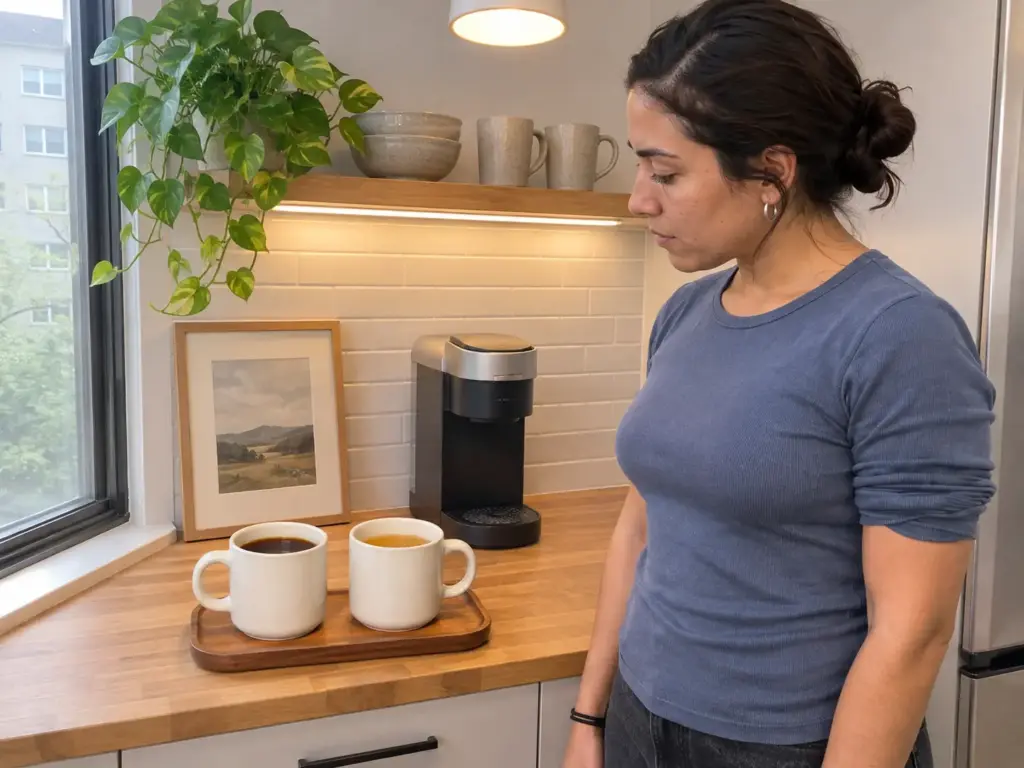
Most of the pod leaves in the first part of the run
A 2016 study of single-serve brewing in Food Research International timed a single-serve brewer and found that “80% of the soluble solids were extracted within the first 113 mL, while further brewing diluted the brew and introduced more bitter and astringent compounds.” That first 113 mL is about 3.8 fluid ounces, less than half of an 8-ounce mug. Everything after it is the tail: weaker, and tilted toward bitter.
Hold that against the pod shell in your holder. The first run already took the soluble solids, so a second pass begins in the tail. The acid comes out first and a second pass mostly adds bitterness, and the pale color follows from it: the water is crossing grounds that already gave their color to the first mug.
Treat 113 mL as that brewer’s number, because a machine with a different needle, a different lid or a different flow will sit somewhere near it, not on it. One and done is what a sealed pod means in practice.
A second run adds water, not coffee
Strength in a pod cup is set before the water starts, by how much coffee is in the shell and how fine it is ground. In a 2020 study of 43 capsules in Scientific Reports, the authors put it this way: “the most efficient way to increase total dissolved solids in the brew is to use more coffee for extraction.” A finer grind pulls in the same direction. A second run through the same shell adds neither, so the cup can only get thinner.
That is the bargain of a pod machine: a single-serve machine sets the dose for you, and the dose is spent after one run.
The 2016 study also found that a bigger brew volume raised extraction yield. So a larger cup size on the size button gives you a different cup from the first one, and the second run through the same grounds is a third thing again. Pressing the big button on a spent pod does not bring the coffee back.
What the study did not measure
Both studies ran a single pass through fresh grounds. Neither ran a second pass through a spent pod, so the closest measured thing is the tail of one run, and that is what the 80 percent figure describes. The second cup in your machine sits just past the edge of what they tested.
The numbers also come from specific gear: one single-serve brewer in 2016, and in 2020 a Krups Inissia that took all 43 capsules and was stopped by hand at 40 grams in the cup (about 1.4 ounces). Your machine, your water and your pod will not match either of them exactly. The only place to confirm the thin second cup is your own mug, which is what the next section is for.
The Side-by-Side Test at Your Own Counter
The studies cannot taste your machine, so two cups do the job. The order below changes one variable at a time, free steps first, and you taste between them. It is an order worked out from the two findings above, so treat it as reasoning and let your own cups overrule it.
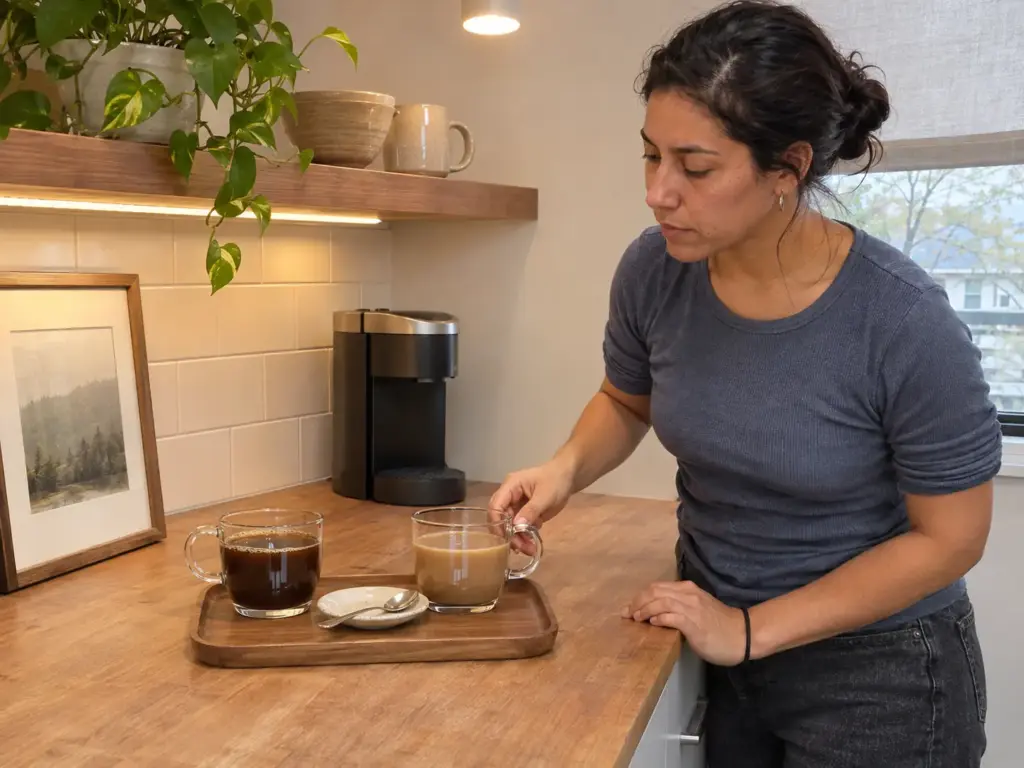
Two matching cups, one pod
Run the pod once into a clear cup at the machine’s smallest size. Without touching the pod, run it a second time into another cup of the same size. Taste the first, then the second, with the same sip size and in that order, and look at the color. A rinse of plain water between sips keeps the first cup from tinting the second.
A flat, watery second cup with a tea-brown color is under-extracted, too little coffee came out of the grounds into the water, and it is your answer for this pod in this machine. A second cup that is only a little paler is often a trick of the setup: a bigger mug, a long wait between sips, the first cup’s taste still sitting on the tongue. Match the cups and the sips, or the test lies.
Press the same small size for both runs. A bigger brew volume raised extraction yield in the 2016 study, so a larger button on the second run changes the volume and the cups stop being comparable.
Split one fresh pod instead
If the second cup is thin, and it usually is, try the workaround that keeps the full dose. Brew one fresh pod once (a double or a lungo on a Nespresso, the smallest size on a Keurig) and pour that single cup into two small mugs, which gives you two cups from one pod without a second run. The grounds are fresh, so the dose is whole and only the volume is halved.
That tastes like a short cup. A second pass tastes like a weak one, and the two are easy to tell apart once they sit next to each other.
The same logic points at a larger pod when one is made for your machine. More coffee in the shell is the lever the 2020 study names first, so the bigger pod spends effort where the extraction is.
When the first cup is weak too
Sometimes the first cup is already thin, and then the pod was never the problem. In the 2016 study, decreasing particle size raised extraction yield by about 63 percent. The grind is the lever, and a drip-grade grind in a pod comes out watery even on the first run.
The grind that decides a weak pod cup covers the setting. Go finer there before any new gear, and taste the cup before you move anything else.
A thin first cup also comes with an order of checks, and the order of fixes for a weak single cup starts with the basket. The grind comes right after that, and only when the first cup asks for it.
What a Refill Changes
The only pod that gives a second good cup is one that starts from fresh grounds, so the question moves from the factory pod to the shell you fill. A refill fixes the dose and hands you the grind and the seal. And it comes with chores worth knowing before the habit starts.
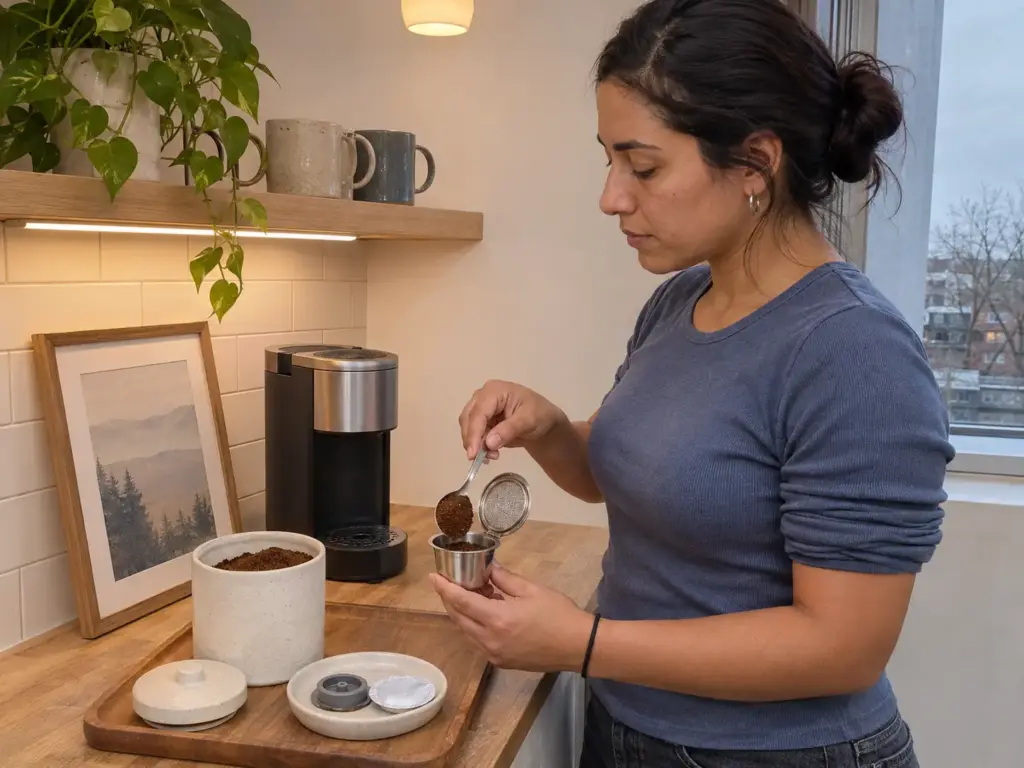
A refill starts from fresh grounds
The routine is short: open the spent pod, empty it, rinse it, let it dry, fill it with fresh grounds and seal it with a foil sticker or a silicone cap. The fill line, the grams and the needle type are covered in how to fill a reusable pod in a Keurig by the fill line. The routine matters here because it resets the dose, and a refillable pod that starts from fresh grounds is the one that can match the first cup of a factory pod.
For a Keurig, the reusable K-Cup to test your own grounds in a machine you already have is the Keurig My K-Cup Reusable Coffee Filter: a stainless steel mesh basket in a plastic holder, with a lid and MAX, cup and mug fill-line marks. It takes any ground coffee you choose. The plastic lid hinge is the weak point, and it is the part that snaps after a few uses, so expect to look at it early.
The grind decides whether it tastes like the first cup
The refill gives the dose back, and the grind is the other half. In the 2020 study, capsules with a higher share of fines (particles below 100 µm) at the same median grind size had longer extraction times. A refill with a different grind mix flows differently, so the cup changes from one fill to the next, and by eye there is no way to repeat it. Weigh one good fill, mark the scoop to match, and keep the grind the same.
Free first: a finer grind and a fresh scoop before any new shell. And keep the fill level at the line. A pod filled “to the top” packs tighter than the same coffee loosely heaped, and a tight pod is the one that backs up and leaks.
Rinse the shell right after the cup, while the grounds are still wet. Once they dry onto the mesh, the holes are the hardest part to clear, and a half-clogged shell makes the next cup uneven.
The chores that come back every week
Ten pods take about five minutes to empty, wash, dry and fill, and the work repeats weekly: emptying, washing, drying, reloading, sealing and reordering the foil stickers. For some households that is a fair trade for ten fresh cups. For others it is the reason the shells end up in a drawer.
On the Nespresso side, the CAPMESSO Reusable Capsules for Nespresso OriginalLine kit covers the Original line (Pixie, Inissia, Le Cube, Maestria, U and others) with 6 stainless steel pods, 100 foil lids, a scoop and a wooden tray. It is built for the Original line and is the wrong shape for Vertuo machines. Its espresso and crema come out uneven from fill to fill, with weak results possible, so the dose and the grind carry more weight here than the shell.
The grams that go in a Nespresso Original pod are laid out on their own page. Whether any of this adds up is a separate count, and whether a reusable shell pays for its chores is where that arithmetic lives.
What the Machine and the Shell Have to Agree On
A sealed pod is pierced on its first run, so a second run goes through a lid that is already open. A shell you fill has to fit the holder it goes in, and fit is the first filter before any purchase. Start with what can be seen, then match shell to holder.
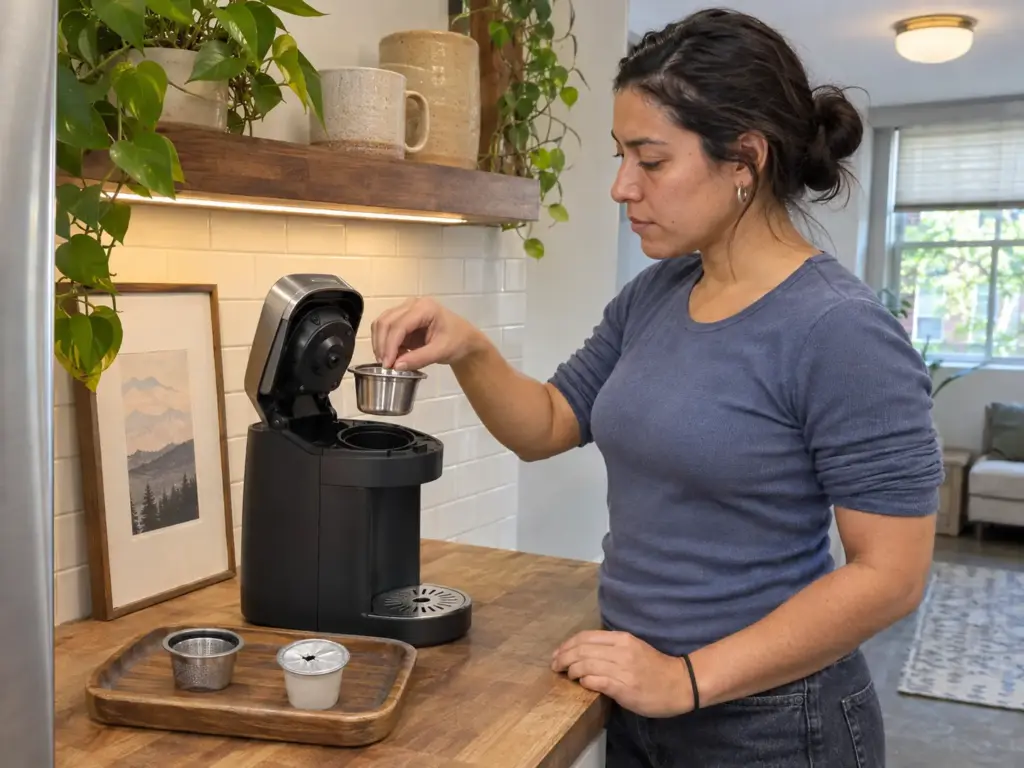
What the first run does to a sealed pod
Turn a used pod shell over in your palm. The foil lid has perforations where the machine’s needle punctured it, and the grounds underneath have already given most of their coffee to the first cup. A second run pushes water through that open lid into those grounds, and the flow is whatever the holes and the packed bed allow.
How flow and pressure change on a second pass depends on the machine and the pod, so the cup is the measurement. That is what the two-cup test above does, and it needs no claim about a fault in the machine.
Match the shell to the holder
Fit is the first filter. Keurig holders come in more than one kind: 5-hole machines (the Supreme line, K-Slim, K-Duo Gen 2) and 1-hole models (K-Mini, K-Express, K-Elite), and a shell made for one is the wrong shell for the other. Which reusable pod suits which Keurig needle carries the full rules by needle type.
For 5-hole machines, the CAPMESSO 4 Reusable K Cups pack has four stainless steel pods with a MultiStream lid and a silicone ring. Water can pour out in every direction when the ring does not seat or the holder does not match, which is the failure to watch on the first brew.
For 1.0 and 2.0 machines, the RETHONE Refillable K Cups pack of 3 is a one-piece SUS304 stainless mesh shell with a rubber top seal ring. It also covers the K-Classic, K-Elite, K-Latte, K-Cafe, K-Select and K-Compact, and it does not fit the K-Supreme. The rubber rings can come loose, so check that one early too. The 5-hole shell looks like the better-engineered of the two, and in a 1.0 machine it is simply the wrong one: fit beats design.
Where a reused pod leaks
The same shell can brew in one machine and spray in another, because the holes in the holder lid sit differently. The cup tells you at the first brew, well before month two. A bad seal, a wrong holder or a ring that has come off all produce the same thing: water leaving the pod where it should have crossed the grounds.
Before the first real fill, brew plain water through the empty, lidded shell and watch where it goes. A spray shows up there without costing a single scoop of coffee.
Nespresso Original and Vertuo shells are different shapes, so an Original shell in a Vertuo machine is the wrong tool. A household with both brands has one more option that skips shells entirely: decanting a pod’s grounds into the other brand’s shell moves the grounds, and the pod stays where it is.
Month Two: Rims, Seals and a Dry Shell
The second cup is easy to judge in week one. What decides whether the habit lasts is what the shell and the seal look like after weeks of rinsing. This section is the short list of what to look at.
Rinse and dry before the next fill
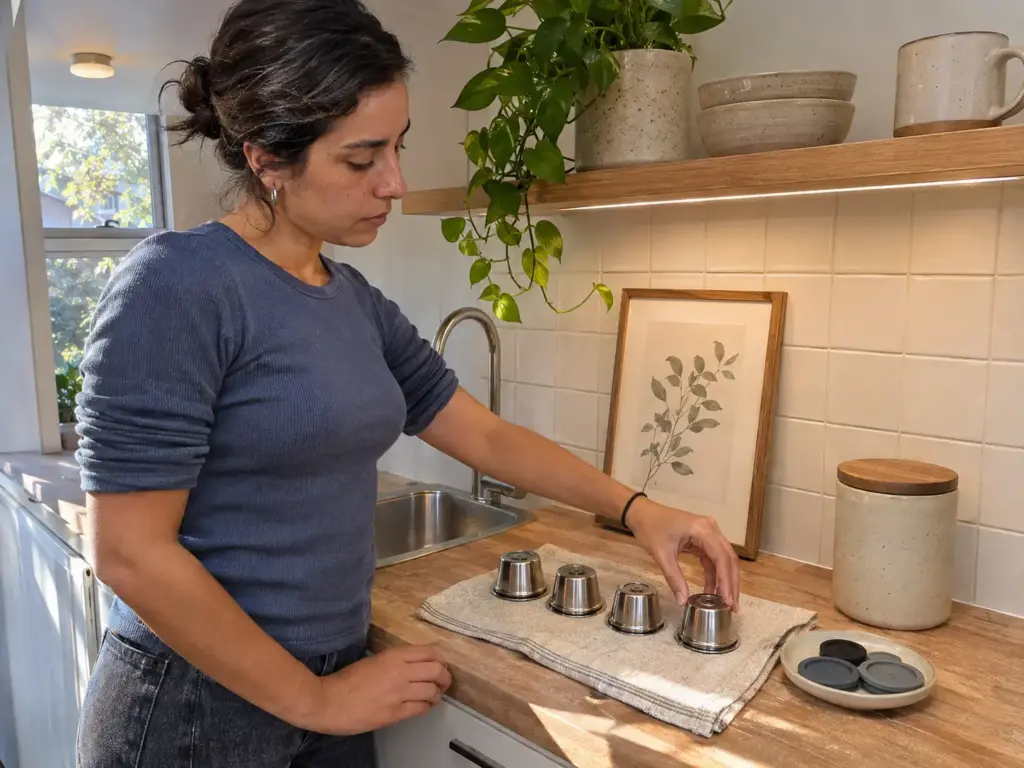
Rinse out the grounds, let the shell dry completely, then refill. A seal grips a dry rim and slips on a damp one, and that, more than any hygiene concern, is why the dry step matters in the cup: a damp rim is the one that lifts in the machine. Standing the shells upside down on a towel by the sink at the end of the evening is the whole system.
Hold the rinsed shell up to a window. If light does not show through every mesh hole, the water will favor the clear ones and skip the rest, and the cup comes out thin from the first run.
The parts that give out first
Two failures are worth checking first. The plastic lid hinge on the Keurig filter snaps after a few uses, and the rubber seal rings on the RETHONE pack can come loose. These are the parts to check each week.
A fill count does not tell you when a refillable pod is finished; the hinge and the ring do. What to check on a plastic lid seal walks through the seal side in more detail.
Run One Pod Twice Tomorrow, Then Pick Your Shell or a Drip Machine
A sealed pod gives one cup, and the second run is mostly hot water: the first run takes the soluble part and the dose never comes back. A refill is the only reuse that starts from fresh grounds, and it asks for the right grind, a seal that fits the holder and a few minutes of rinsing and drying. Fit comes before any purchase, and the free fixes (a finer grind, a fresh scoop) come before the shell.
After a few weeks of daily filling, press the lid hinge and run a fingertip around the seal ring before each fill. A hinge that gives and a ring that lifts mean the shell is ending. A cup that goes thin with fresh grounds in a good shell points at the grind.
If you want to keep the pod machine, a reusable shell for your own holder is the move. If you would rather skip the chores, a drip machine that makes one mug trades pods for ground coffee, and a machine that takes pods and grounds sits between the two. The spent pod itself has one other exit: recycling, and local rules decide what goes in the bin.
Tomorrow, run one pod twice into two matching cups at the smallest size, taste them in order and let the second cup decide. If it is thin and flat, the pod is spent. If the first cup was weak too, grind finer by one step and taste again.
Frequently Asked Questions
01Can I use my coffee pod twice?
You can run it twice, but the second cup comes out thin because the first run takes most of what the pod holds. A pod you fill and seal yourself is the one made to be used again.
02How many times can I use a Keurig coffee pod?
A factory K-Cup gives one good cup, while a reusable shell you fill yourself can be used again until its lid hinge or seal ring gives out. Watch those two parts instead of counting fills.
03Can I make two small drinks from one pod?
Yes, one fresh pod brewed once and poured into two small cups keeps the full dose. It is a split of one run, and it is a different thing from a second run through spent grounds.
04Can I put used pod grounds back into a drip machine?
Used pod grounds have already given most of their flavor to the first cup, so a drip pass makes the same thin cup. Fresh grounds are the fix, and a drip machine with ground coffee is the alternative.


How did your cup turn out?
No comments yet. Tell us what you changed — and whether the needle moved.