
We may earn a commission when you buy through links on this page. It never changes what we recommend. How we pick
On this page8 parts
- What a Single Origin Subscription Actually Sends
- Three Checks Before You Sign Up
- Atlas, Bean Box and the Rest, Flaw First
- What Every New Bag Costs You at the Grinder
- Who Should Skip It, and the Free Fix First
- What Month Two Looks Like
- Pick the Interval From Grams a Day, Then Check the Third Bag
- Frequently Asked Questions
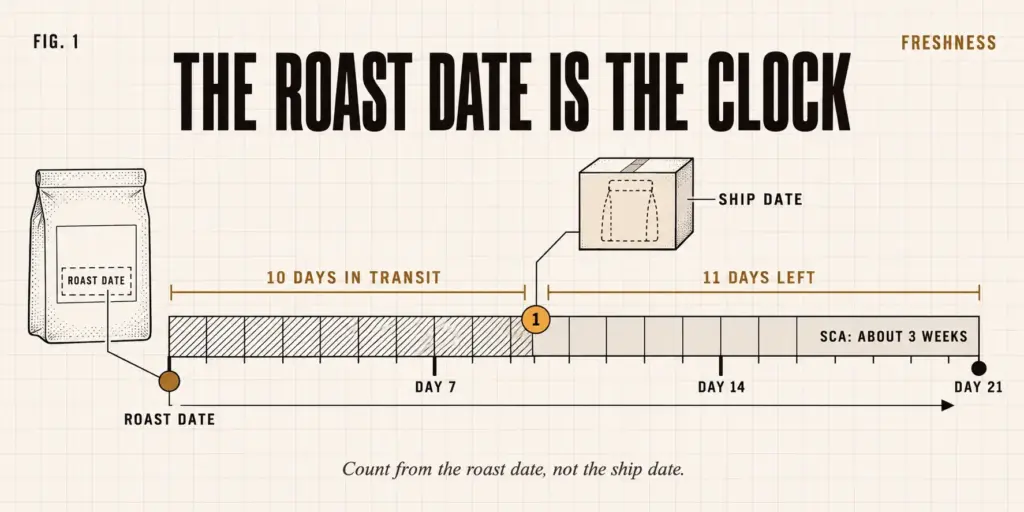
The third bag of the plan lands on the counter, the grinder is still sitting where last month’s coffee left it, and the first cup from the best single origin coffee subscription you could find comes out sharp enough to make you check the water. The bag gives you a country, a flavor note and one word for the roast, and the freshness clock on it runs from the roast date rather than the day the box shipped: the Specialty Coffee Association reads whole bean as fresh for about three weeks after roasting, so some of those days are gone before the bag reaches you. This guide covers what a plan really sends (and where single origin versus a blend stops being the question), the three checks that decide it, the services with their flaws written down, what every new bag costs at the grinder, who should skip the whole idea, and what shows up in month two.
Quick Answer
A single-origin subscription is worth it only if you want a different bag each time and will re-dial the grinder for each one. Three checks decide it: days from roast to your door, bag size against grams a day, and pause terms. Pick one roaster’s rotation for fresh and consistent, a multi-roaster service for variety.
What a Single Origin Subscription Actually Sends
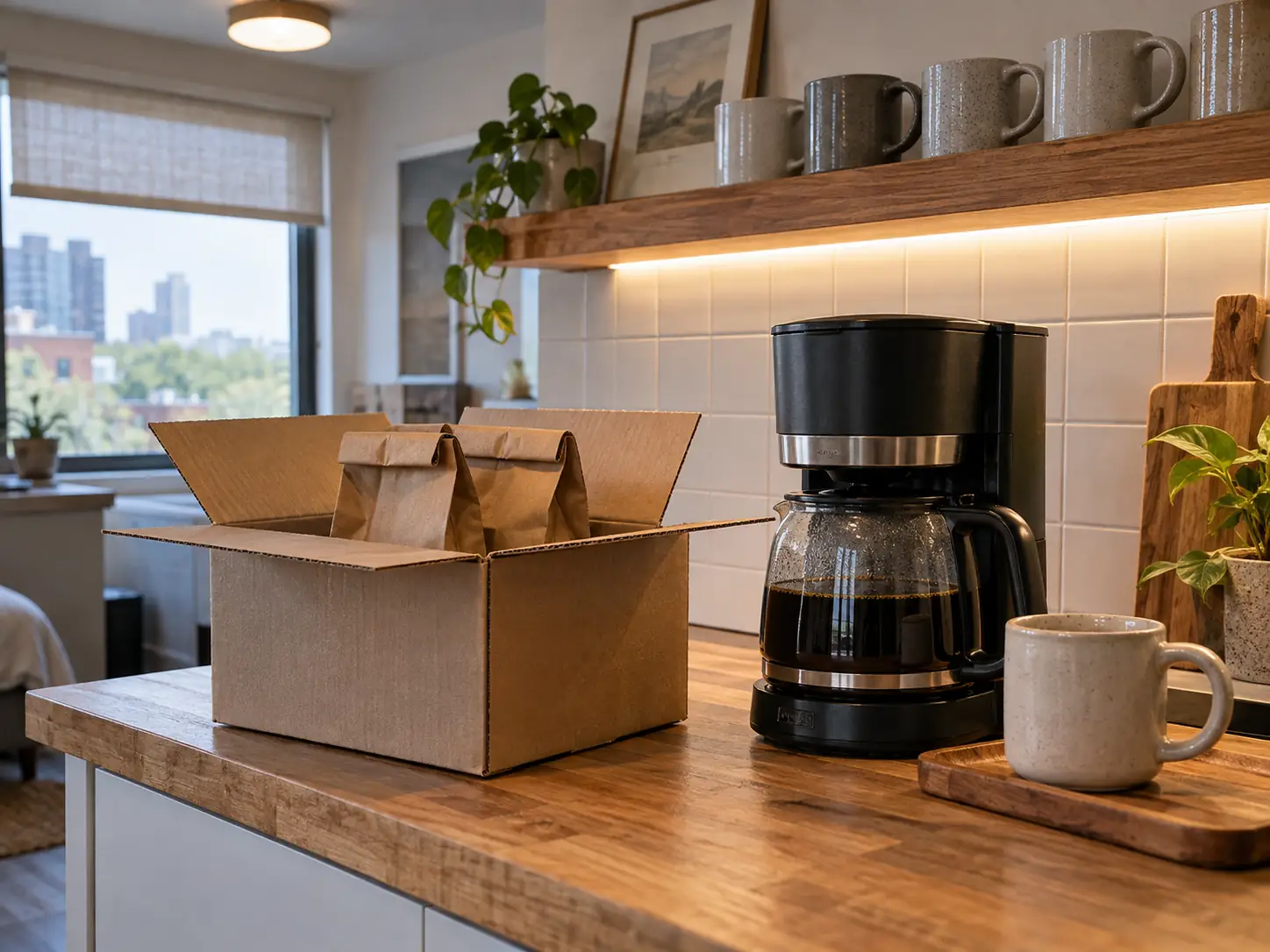
Before any service gets judged, it helps to know what arrives in the box: coffee from one farm, one cooperative or one country, chosen by somebody else, on a schedule you set once and then forget, which is the old coffee-of-the-month club with a taste quiz bolted on. The words “single origin” on that box promise where the beans grew. They say nothing yet about how the cup will taste.
Roaster-direct rotation or a multi-roaster box
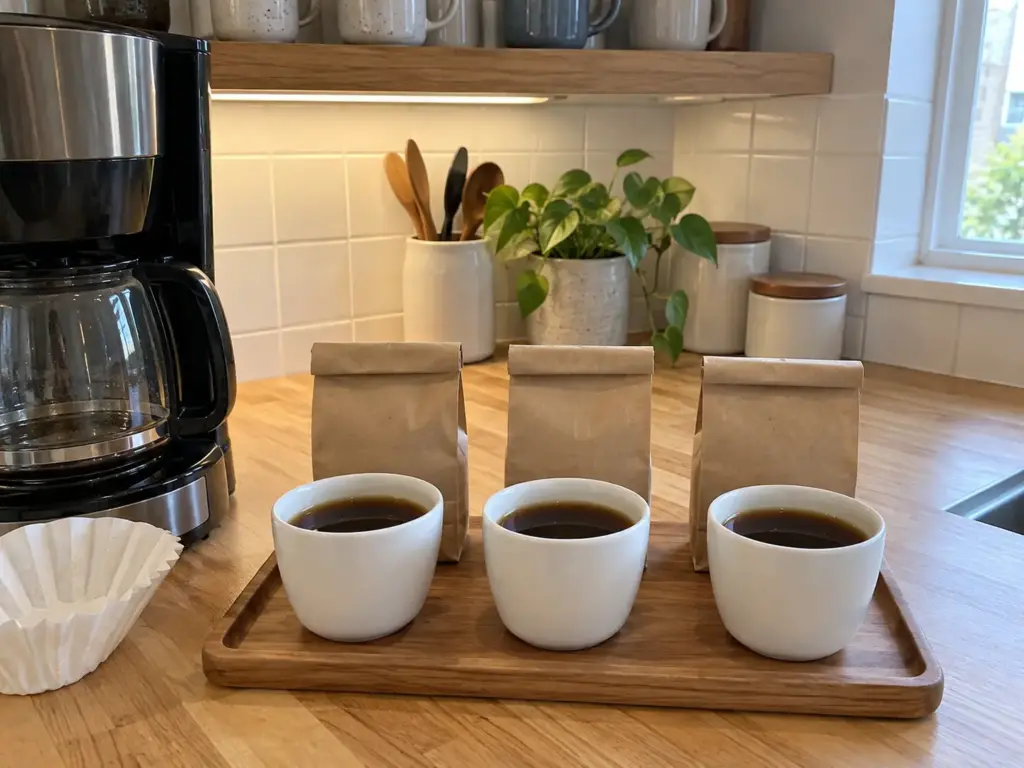
Two shapes of service hide behind the same label. In the first, one roaster rotates through its own single origins and the roaster’s choice decides what comes next. Atlas Coffee Club works this way: according to Serious Eats’ test, the coffee arrives from a specific country that changes throughout the subscription. Blue Bottle’s single-origin assortment is the same shape, and it is sold direct only; the Amazon shelf carries its blends.
In the second shape, a multi-roaster box, the service is a router. Trade passes your order to a small roaster, which roasts the bags and ships them straight to you, so the next bag can come from a different roaster with a different idea of what medium means. Mistobox sits in the same camp, and Serious Eats noted that its taste quiz asks whether you lean toward single origin or a blend, which is the choice this whole article turns on. Serious Eats describes the model as coffee roasted to order and shipped straight from the roaster, which is why the roast date can sit close to the order date.
The shape matters because of what you are buying. A roaster-direct rotation gives you variety of origin with one roasting hand behind it, which makes the cups easier to compare. A multi-roaster box gives you variety of hands too, and then the origin is only one of three things changing at once.
A country on a postcard is not a flavor
Look at the front of the bag: the country of origin in large type, tasting notes under it, and the roast reduced to one word near the bottom, even though the roast is the line that moves the cup most. The Atlas sampler on Amazon goes further and ships a postcard and a tasting card for every country, which is charming and tells you where the beans grew, not what the water will pull out of them.
Some subscribers say a year on Atlas tastes the same every month, even when the postcards promise new countries. One theory is that beans roasted in large batches, exactly the same way every time, pull every origin toward the same cup. It is a theory, not a measurement. That is a community explanation and it is unproven, but it points at the right variable. Serious Eats makes the related point that there is “no agreed-upon industry standard of roast level,” so what one roaster calls medium may land darker or lighter than you expect.
So a country name is a place on a map, and the cup is shaped by the roast and the process more than by geography. If you want the vocabulary for reading a bag, what the words on the bag actually promise has it, and the same logic explains why the roast changes the cup more than the country does.
Whole bean or ground in the box
Check this line before you sign up, because it is the easiest to miss on a plan page. The Specialty Coffee Association’s freshness column explains that the CO₂ whole bean loses over weeks is lost in minutes once the coffee is ground, and that ground coffee might be considered fresh for about an hour. A plan that ships pre-ground has already spent that hour before the box leaves the roaster.
That is why whole bean is the default worth insisting on, and why whole bean over pre-ground is the grind advice that costs the least. Some plans, and the Atlas sampler itself, offer both whole bean and ground. Choose whole bean, and keep the grinder for the counter.
If the plan lets you pick a roast level, set that before you let it pick a country. Trade’s quiz offers five roast levels in Serious Eats’ count, and an Atlas reviewer on Trustpilot confirms you can choose a preferred roast there but not narrow by region or process. The roast is the dial that moves the cup, so it is the one worth owning.
Three Checks Before You Sign Up
A plan can be single origin, beautifully described and still arrive wrong, and three checks that cost nothing settle it before the first box ships: how old the bag is when it reaches you, whether the bag size matches how fast you drink, and what it takes to pause. A plan page reads like a lease, which is to say fast and looking for the price. These three lines are the ones worth slowing down for instead.
Days from the roast date to your door
Count from the roast date, never from the ship date, and treat roast-to-ship time as the first line of any plan page worth reading: fresh roasted coffee is a claim until the date is printed on the bag. The SCA’s freshness column describes CO₂ leaving whole bean quickly for the first 20 days and slowly after that, and on that degassing measure it reads whole bean as fresh within about three weeks of roasting. The three weeks are a window with a start, and the start is the roast, not the box.
The arithmetic is short. A bag that spends a week in transit has used a third of that 21-day window. Transit adds up quickly: a few days from roaster to your door already eats into that window. For espresso, a short rest can help anyway, so the freshest day is not always the best-tasting one.
So the check is what you do the day the box lands: look for the roast date on the bag, which is what what the bag tells you before you buy covers in more detail. The bags carry no printed roast date. If yours has none, ask support before the next order or skip it; for the signs that a bag has already slipped, how to tell if beans are stale is the sensory version of the same check, and how long beans keep after opening, counted from the roast date is the number version.
Bag size against grams a day
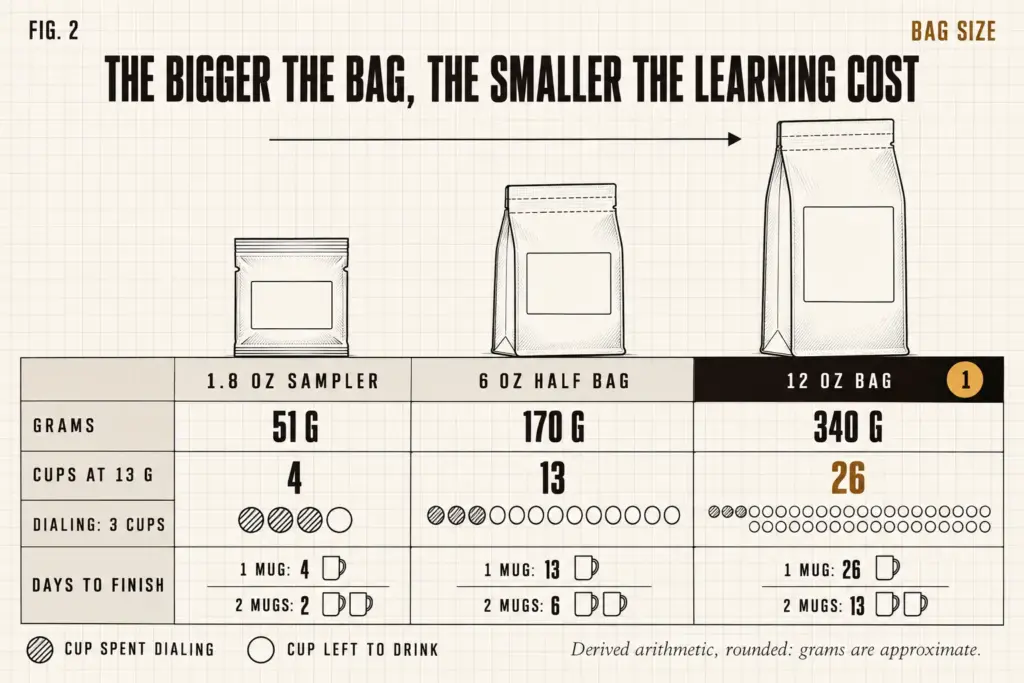
A 12 oz bag is about 340 g. At a 13 g dose, the grams per cup this blog uses for a single mug, that is about 26 cups, and how many cups are in a 12 oz bag works through the same division.
Cups per bag is the number that matters here, and it makes the next two lines easy to read. One mug a day finishes it in about 26 days. Two mugs a day finish it in about 13. Both numbers are derived arithmetic, and they decide the interval better than any default on the sign-up page.
The National Coffee Association’s storage guide says to “Try to buy smaller batches more frequently,” meaning enough for one or two weeks. For a one-mug household that means the 26 days of a 12 oz bag run past the SCA’s three weeks, so either the bag or the interval is wrong. Serious Eats’ test lists the delivery frequency each service allows: Trade ships every 7, 10, 14, 21 or 28 days, Mistobox lets you set anything from 1 to 60 days, Blue Bottle runs 1 to 4 weeks, and Bean Box moves between every two weeks and monthly. Pick the interval from grams a day, not from the first option on the list.
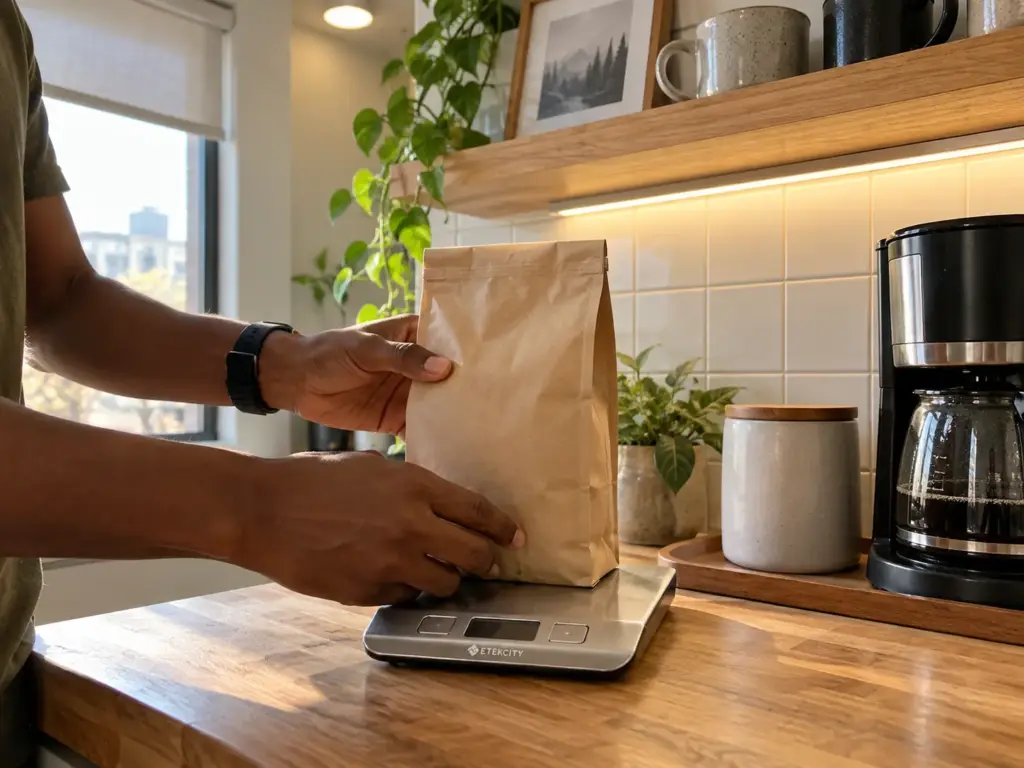
The cheapest place to run the check is the first bag. A scale settles whether the bag holds what the label says, and it holds the dose steady when you re-dial later. The Etekcity Food Kitchen Scale is the budget one: 1 g steps, a tare button and an 11 lb capacity, which is plenty for a 340 g bag and a 13 g dose and too coarse to trim a single cup by tenths of a gram. Tenths are what the other kind of scale is for.
The Hario Drip Scale Timer reads in 0.1 g increments, has a built-in timer and shuts itself off after 5 minutes, which is more precision than a bag-weight check needs. Either one changes more cups than a new machine would. After that, decide when to grind by bag size, because a bag you will finish in two weeks and one you will finish in four are not handled the same way.
Skip, pause and swap terms
Serious Eats ran a pause-or-cancel test after three weeks, and its verdict was that almost every service made the log-in, the frequency change and the pause fairly easy, though some had better options. Trade lets you change the coffee, the shipping time and the frequency once an order is placed. Mistobox’s swaps were easy in the same test. Blue Bottle is the strict one: “There are no substitutions or swaps.”
A plan you cannot pause is a bag a month that you may not finish, and an unfinished bag is the one that ages while the next one arrives. Before you enter a card number, find where the pause lives, and whether it needs an email.
Write the roast date and the day the box landed on the front of each bag with a marker, then set the bag on the scale. By the third bag you have a delivery time that belongs to you, a weight you checked and a comparison to make, not a hope.
Atlas, Bean Box and the Rest, Flaw First
With the checks in hand, read the services the way a plan page will not: one sentence on what each does well and the next on what is wrong with it, taken from the tests that measured them and from the people who used them. None of them is linked here, because none of them is sold through Amazon; only the samplers are.
Atlas Coffee Club — a new country, a familiar cup
Atlas ships a different country each cycle and offers a 6 oz “half bag,” which Serious Eats called a good fit for the sole coffee drinker in a house, as well as 12 oz bags. Serious Eats found the coffee less premium-tasting than some of the others.
Some Trustpilot reviews note that the bags carry no printed roast date, while praising the support team as helpful and responsive. That is one review, and it is stated here as one.
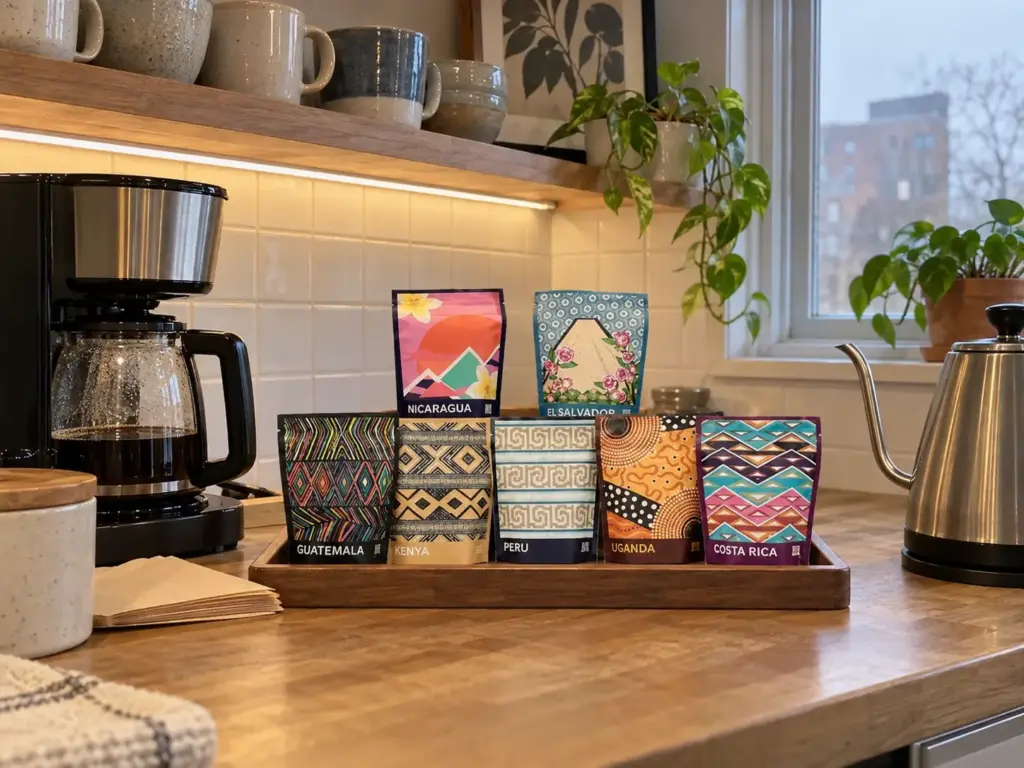
The Amazon sampler is the one way to taste what a rotation does without signing anything, and it doubles as a measure of what re-dialing eight times costs. Each of the eight bags is 1.8 oz, about 51 g, which is about four cups at a 13 g dose.
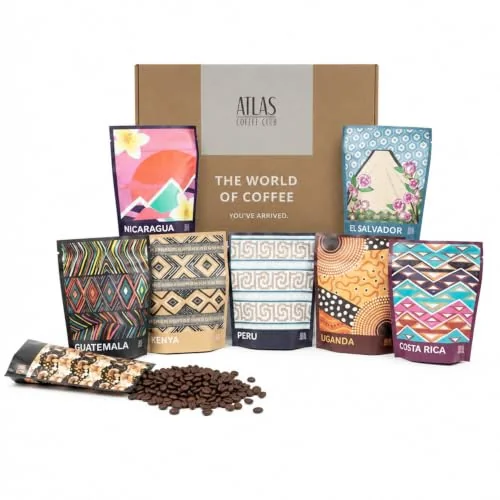
Eight coffees means eight sets of cups spent on the grinder, which is the cost the next section prices, and a box like this will not tell you which of the eight to buy again. For that, which single origin bags to buy first picks a first bag with a drip machine in mind.
The table below compares the five services on the three checks, with the flaw each one is reported to have, and leaves a cell as “not stated in the test” where the test did not say.
| Service | Delivery interval | Bag size | Pause or swap | The flaw people report |
|---|---|---|---|---|
| Atlas Coffee Club | Not stated in the test | 6 oz half bag or 12 oz | Not stated in the test | Coffee can taste alike from month to month; one review reports no printed roast date; Serious Eats found it less premium-tasting than some others |
| Bean Box | Every two weeks to monthly | Not stated in the test | Not stated in the test | Very limited questionnaire (Serious Eats); one review reports 11 oz where 12 oz was paid for |
| Trade | 7, 10, 14, 21 or 28 days | 11 oz, larger available | Coffee, timing and frequency can be changed after ordering | Browse page gives only vague taste descriptions (Serious Eats); smaller subscription bags |
| Mistobox | Any interval from 1 to 60 days | 12 oz | Swapping beans was easy | Shipping is charged per bag, which makes it the costlier plan in Serious Eats’ count |
| Blue Bottle | 1, 2, 3 or 4 weeks | 12 oz | No substitutions or swaps | No medium or dark roast plan; single-origin assortment is sold direct only |
Bean Box — a short quiz and an 11-ounce bag
Serious Eats found that Bean Box had a “very limited questionnaire” and a website that felt dated, so the plan has less to go on when it chooses your coffee. It moves between every two weeks and monthly, which keeps a one-mug household inside the window only if you pick the interval deliberately. Some buyers report getting less coffee than the package states, so it is worth weighing your first bag, though those reports are few.
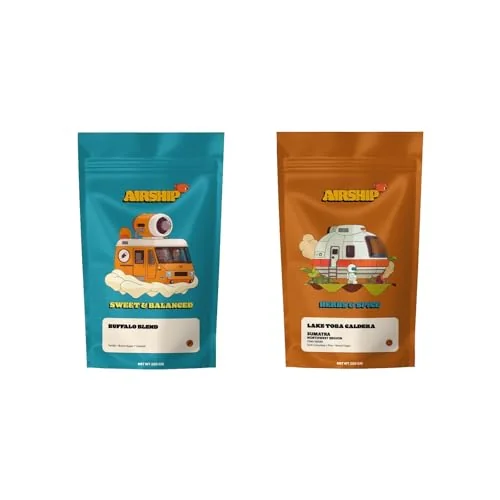
The compact card below is the Amazon sampler, and the two flaws above belong to the Bean Box service, not to it.
Trade, Mistobox and Blue Bottle — the terms that bite
Trade is the broadest of the three: Serious Eats counted more than 450 coffees from over 55 roasters, with an 11 oz subscription bag (larger sizes exist) and an interval you can set at 7, 10, 14, 21 or 28 days. Its flaw, from the same test, is the browse page, which gives only vague descriptions of what each bean tastes like, so you click through to each coffee for the real notes. Some people skip the small subscription bags and buy a 2 lb bag instead, and others prefer local or independent roasters to Trade, Bean Box and Atlas.
Mistobox lets you set any interval from 1 to 60 days, the most flexible in the test, and its swaps were easy. Its shipping is charged per bag, which makes it the costlier plan in Serious Eats’ count. Blue Bottle runs 1 to 4 weeks in 12 oz bags but offers no medium or dark roast plan, allows no swaps, and keeps its single-origin assortment on its own site.
The flaw no plan page prints usually shows on the third bag and not the first: the first box is the plan’s best foot forward, and the third is the plan.
What Every New Bag Costs You at the Grinder
The table priced the plans in everything except cups, and cups are what variety spends. Every new origin and roast changes where the grinder should sit, so a plan that rotates often spends your first cups from each bag learning how to dial in that coffee.
One grind step, then taste
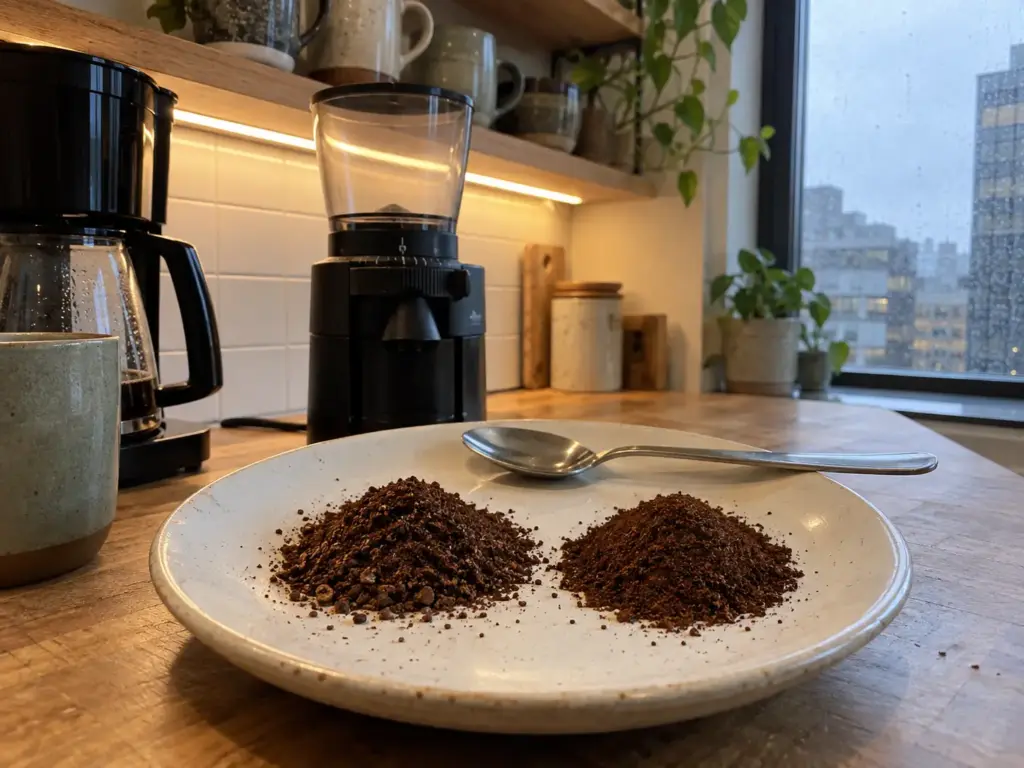
A sour cup from a new bag feels like a verdict on the coffee, but sour is a direction. It means the water left before it finished, so the grind was too coarse for this bean: go one grind step finer, and write the grind setting down so the next bag starts from it. Bitter points the other way, the water stayed too long, so go one step coarser, or half a step back if you overshot. How grind size changes sour to bitter is the longer version, and the rule is the same each time: one change, then taste.
That is exactly the work a rotation hands you each cycle. Swapping bags often means dialing in again, which is a pain, so a larger bag bought once a month and a few local bags is one workaround. For the setting itself, look at the number on your own grinder’s dial, because a step on one grinder is not a step on another.
Weigh the same dose of 13 g and use the same amount of water for every bag, and change only the grinder. When the dose and the water stay put, a sour or bitter cup can only be pointing at the grind, and you will know which way it points.
Why the size of the bag decides how many cups you learn it on
The bag size sets how much of the coffee you have to spend finding the setting. A 12 oz bag is about 26 cups, so two or three cups of dialing is roughly a tenth of it. A 6 oz half bag is about 13 cups, so the same dialing is about a fifth. An Atlas sampler bag of 1.8 oz is about four cups, so two or three cups of dialing is half of it or more.
The roast changes the move. A light roast usually wants a finer setting than a dark one, and which way to move when the roast changes gives the direction per roast without repeating it here. If the plan swaps between roasts bag to bag, expect the dial to move each time.
It is about 907 g, which at a 13 g dose is about 70 cups, so a bag a month is a little over two cups a day. It cuts the dialing cost almost to nothing and only suits a household that drinks that much.
The first cup after a change still comes from the old setting
A grinder keeps grounds inside, so the first dose after a change still comes out at the old setting. The second cup is the first real test of the new one, and a reader who judges the new grind on the first cup will turn the dial twice for a problem that was one step.
One free fix comes before any blame for the box. A bright coffee, a Kenya for example, in a drip machine that never gets hot enough under-extracts and reads as sour no matter which plan sent it. Free and likeliest is a finer setting, not a different plan, and the grind for a drip coffee maker says where to start.
Who Should Skip It, and the Free Fix First
For some kitchens the answer is no, and it is worth saying which ones. A plan is a decision to spend cups on variety, so it suits the reader who wants variety and fails three others: the one who wants the same cup every day, the one who finishes a bag slower than it ages, and the one whose cup goes sharp because of the grinder, not the box.
When the same cup every day is the goal
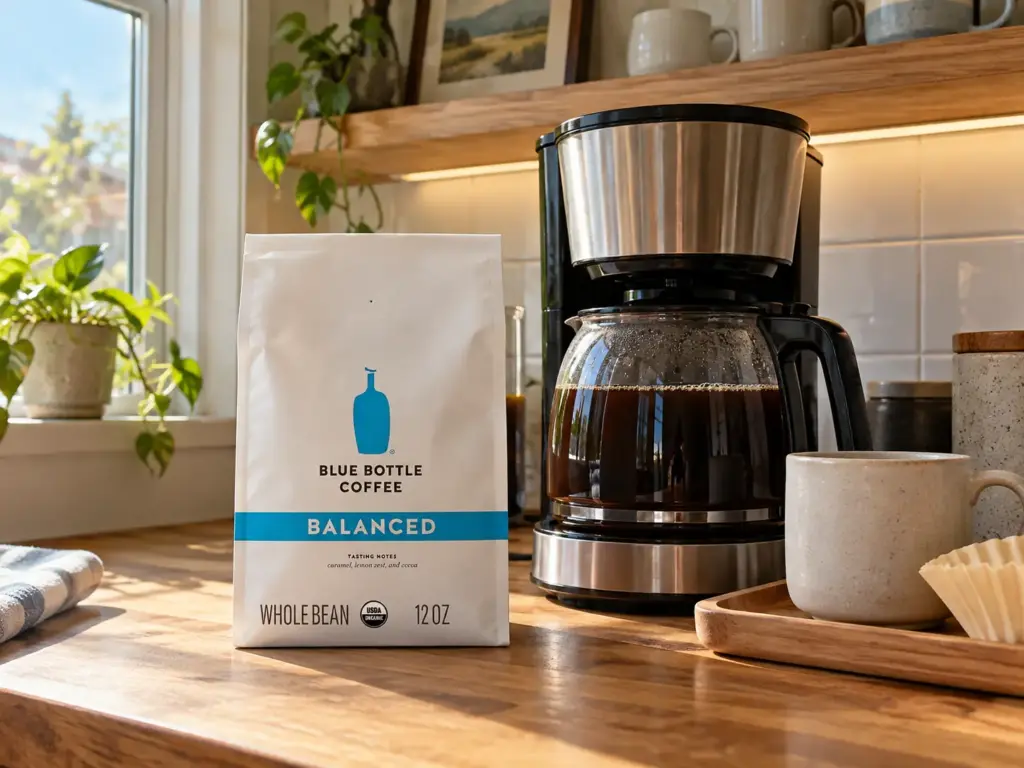
Someone who wants the same cup on a Tuesday and again on a Thursday does not want variety, and rotation is the opposite of consistency. What works is a single bag you rebuy, or a roaster-direct plan with one style, and the reference for that on Amazon is the Blue Bottle Whole Bean Organic Coffee, Balanced, Medium Roast, 12 ounce. It is a blend, not a single origin, so it does not answer a single-origin question: it answers the other one, one roaster and one roast style, the same cup each time.
The flaws that Serious Eats found in Blue Bottle’s subscription (no swaps, no medium or dark roast plan) belong to the service and not to this Amazon bag.
When a bag lasts longer than it stays fresh
One cup a day finishes a 12 oz bag in about 26 days, which is past the SCA’s three weeks, and two mugs a day finish it in about 13. If you are the first reader, lower the interval or shrink the bag. A local roaster with the roast date printed on the bag often beats any box.
There is a quieter version of this. The bag that sits at the back of the shelf until week four is the one that makes a plan look bad, and the plan did not age it. If you take a bigger bag, freezing only what you will not finish keeps the rest from drifting while you work through the first part.
Before you blame the box — the free fix
If the cup is sharp, grind one step finer, then taste. If it is still sharp, check the water and the machine before the roast, because a brewer that never gets hot enough under-extracts any bag, and a bright coffee reads as sour in it. This is the order of the cheap fixes, and a new plan sits at the end of it, not the front.
The same order applies when you brew espresso with your box. If that is you, single origin on an espresso machine covers how roast level decides the dialing there, and the free fix is still the grind.
What Month Two Looks Like
A plan is at its most careful in the first box. Month two is where the sameness, the slow box and the stale last bag show up, along with the one habit that carries a bag past week two.
When every bag tastes the same
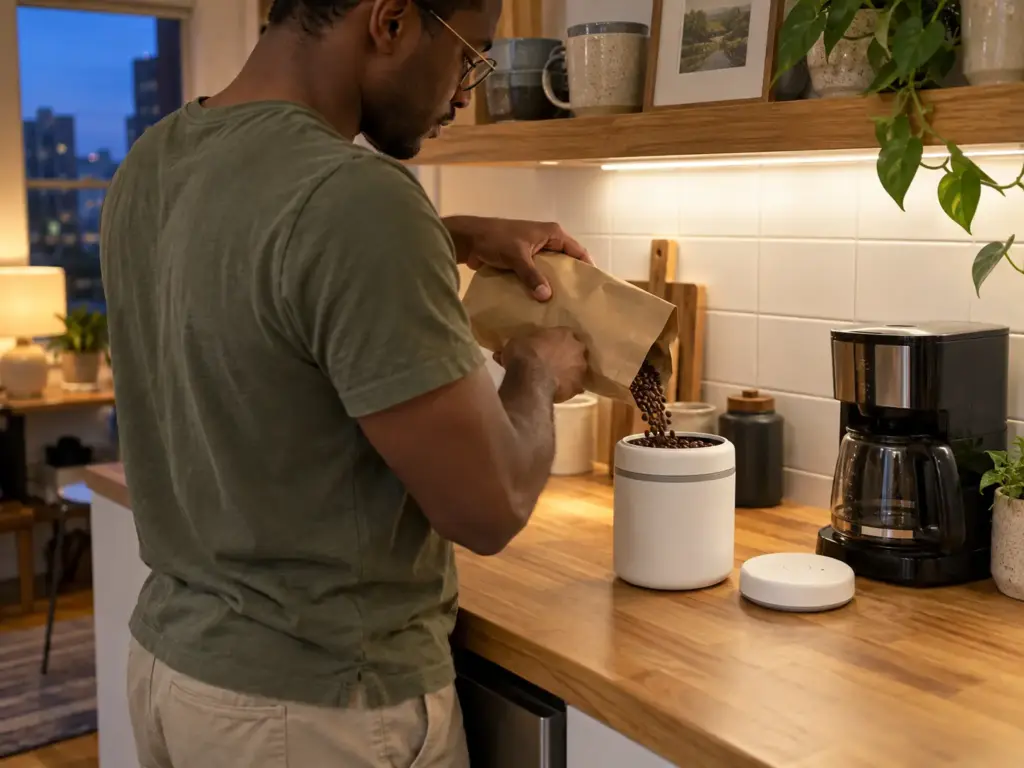
The Atlas case is the clearest example of it: new countries on the postcards and, for many subscribers, the same coffee every month in the mug. The theory is that large batches roasted identically flatten the origins. It stays a theory, but it is easy to check in your own cup. Read the roast level on the bag, not the postcard, and notice whether three bags from three countries came out at the same roast.
If they did, the variety you are buying lives in the postcard. A plan that lets you set the roast and the process, or a roaster that prints both, gives you something to compare. Trade’s quiz lets you choose from five roast levels, and Atlas’s own reviewer found no way to narrow by process.
A short bag and a slow box
The Bean Box reviewer who got 11 oz for 12 also reports a bag fresh-roasted on April 2nd with the date printed on it, and a cup that “tastes like old good coffee I could have bought from Whole foods.” It is a single review, and it makes a useful point anyway: a roast date on paper is not freshness in the cup. The Atlas reviewer’s ten days from order to door is the slow-box version of the same story.
Neither is a pattern. Both are the reason to run the check: weigh the first bag, write down the day it landed and the roast date, and compare the third bag against the first.
Keeping a bag past the second week
Once a bag is open, the National Coffee Association puts roasted beans at 1 to 3 weeks of freshness at room temperature when they are stored airtight. If you want to keep coffee beans fresh past the second week, the free fix comes first: a bag with a one-way valve, pressed flat to push out the air and clipped shut.
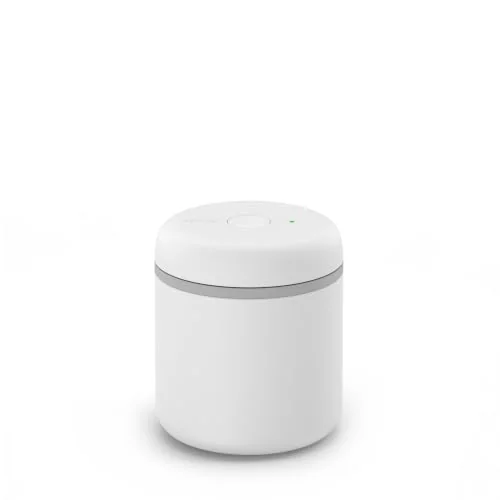
An airtight canister is the next step, and which container holds beans best compares the options. One quiet trap is the canister that still has last month’s beans in it, topped up with a fresh bag: the old beans make the new ones taste stale. Empty it and wash it before the bag goes in.
Serious Eats names the Fellow Atmos for plans that ship every month, and the pick suits the reader whose bag outlasts the second week.
Pick the Interval From Grams a Day, Then Check the Third Bag
Three things carry the whole decision. Count the days from the roast date, not the ship date, because the three weeks of freshness begin at the roaster. Pick the bag size and the interval from grams a day, and skip a plan that rotates faster than you can dial it in. And when a bag comes out sharp, the free fix comes before blaming the box: one grind step finer, then taste.
The check for later is the third bag: read the roast date, set the bag on the scale the day it lands, and see whether the weight and the date match the first two.
Tomorrow morning, weigh what is left in the current bag, divide it by 13 to count the cups, and set the delivery interval from that number. Then change the grinder by one step and taste. If the cup moves toward balanced, you have learned the plan’s rhythm for free, and the next decision is the bag once it is open, which is storage’s job: keep coffee beans fresh past the second week.
Frequently Asked Questions
01Who has the best coffee subscription?
No plan is best for everyone: a roaster-direct plan suits a fresh, consistent cup, while a multi-roaster box suits variety. Decide by roast date, bag size and pause terms, then taste the first three bags before you commit to a longer interval.
02Which single-origin coffee is considered the best?
No origin ranks as the best, because roast level and process change the cup more than the country does. Start with the guide to which single origin bags to buy first, then pick the roast that suits your brewer.
03What is the 15-15-15 coffee rule?
It circulates online as a community rule of thumb about resting and using roasted beans, and neither the SCA nor the NCA freshness guidance cited here uses that name. Count days from the roast date and anchor on the SCA’s three weeks for whole bean.
04Is a coffee subscription worth it?
It is worth it when you want variety and finish each bag within about three weeks of the roast date. If you want the same cup daily or drink slowly, rebuying a single bag is the better fit.
05Should a subscription ship whole bean or ground?
Whole bean is the better choice, because the SCA says ground coffee loses in minutes the CO₂ that whole bean loses over weeks. Grind at the counter, right before you brew.

How did your cup turn out?
No comments yet. Tell us what you changed — and whether the needle moved.